
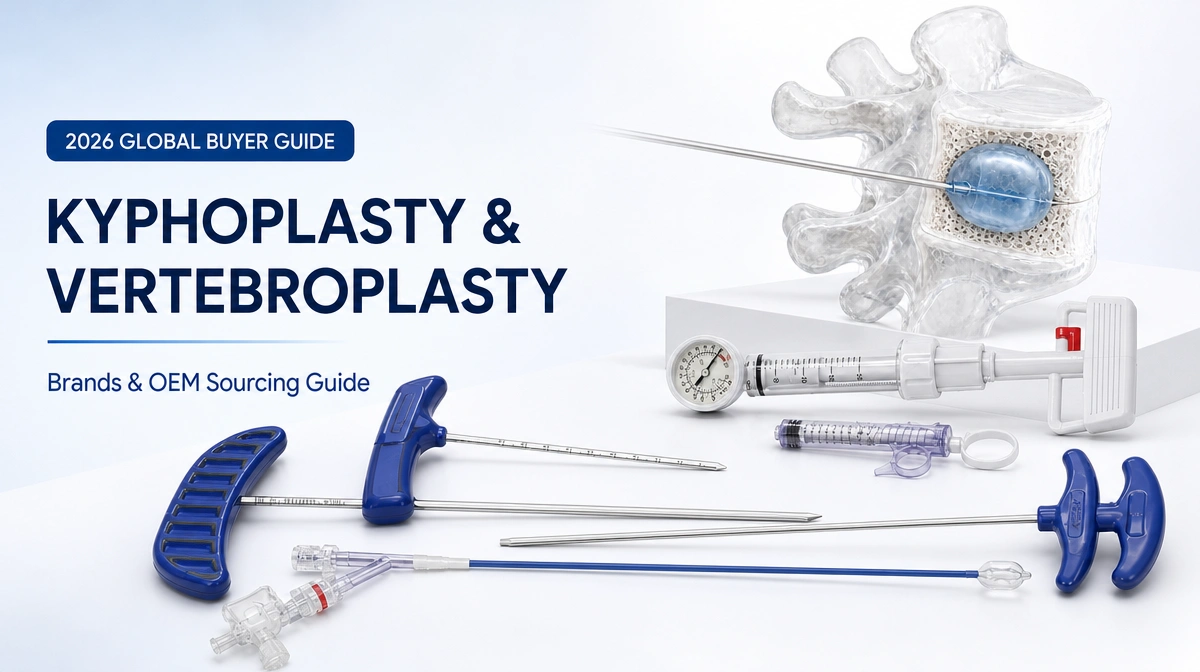
Choosing a kyphoplasty or vertebroplasty supplier means evaluating a connected procedure system: access instruments, cavity-creation devices where applicable, cement preparation, delivery components, sterile packaging and the documents needed to sell each configuration in the destination market. A recognizable brand name cannot resolve a missing compatibility statement or an incomplete kit.
This guide compares eight manufacturers with identifiable vertebral augmentation products in current official sources. It then explains how distributors can evaluate specifications, compare complete procedure costs and prepare an OEM inquiry. XC Medico appears in a separate supplier section, outside the eight-brand comparison.
Quick Answer
Eight brands to evaluate for kyphoplasty and vertebroplasty procurement in 2026 are Medtronic, Stryker, Merit Medical, DePuy Synthes, Globus Medical, IZI Medical, Tecres and Joline. Their portfolios cover different parts of vertebral augmentation, including balloon cavity creation, steerable access, bone cement preparation and cement delivery. They should not be treated as eight interchangeable balloon systems. Begin with the intended procedure and destination market, then compare the exact catheter, access cannula, cement, delivery device and sterile pack configuration. Verify product-specific regulatory documents and compatibility before comparing quotations. XC Medico is discussed separately as a potential source of PKP/PVP kits and OEM services; its offered configuration and documentation require the same buyer review.
In This Guide
- 1. Vertebral augmentation systems and distributor portfolio planning
- 2. Technical evaluation criteria
- 3. Eight brands and their verified portfolios
- 4. Brand comparison matrix
- 5. Procedure-stage purchasing checklist
- 6. XC Medico kit and OEM sourcing
- 7. Commercial procurement and document checklist
- 8. Frequently asked questions
- Sources, methodology and update notes
Editorial Disclosure and Research Method
XC Medico publishes this guide and offers products in the category. The eight-brand list is an editorial procurement shortlist, not a ranking by revenue, market share, clinical outcomes or independent product testing. Numbering provides navigation. No paid-placement assessment or comparative clinical trial was conducted for this article.
Selection required an identifiable product family in official manufacturer materials, relevance to balloon kyphoplasty or vertebroplasty procurement, and enough public detail to explain its role. We reviewed company product pages, public catalogs and selected regulatory records. A product page confirms a public portfolio listing; it does not establish current stock, distributor rights or authorization in every country. Regulatory database records are tied to their named devices and dates.
Current portfolio evidence takes precedence over historic brand familiarity. Globus Medical and Tecres are evaluated separately. Merit’s platform is Arcadia. IZI’s current spine page supports an Osteo-site and Blazer-C discussion; historical Kiva materials do not establish present availability. Joline’s current spine portfolio and its March 2026 MDR announcement support inclusion.
1. Overview: Vertebral Compression Fracture Solutions
1.1 Clinical Context: Where Vertebral Augmentation Fits
Vertebral compression fractures can create substantial pain and loss of function, but the presence of a fracture alone does not determine the appropriate treatment. The patient’s symptoms, fracture characteristics, stability and other findings influence clinical decisions. A distributor should therefore avoid describing a vertebral augmentation kit as a universal solution for osteoporosis, traumatic fractures or back pain.
For osteoporotic fractures, NICE recommends vertebroplasty and balloon kyphoplasty as options within a defined patient group: severe ongoing pain after a recent unhealed fracture despite optimal pain management, with pain confirmed at the fracture level through examination and imaging. This is a selection framework, not a general instruction to intervene in every fracture. NICE TA279 recommendations.
The procurement implication is practical. Hospital demand depends on the locally treated case mix, approved indications, clinical service and reimbursement arrangements. Build forecasts from the customer’s expected procedures and actual purchasing history, rather than transferring a broad osteoporosis prevalence estimate directly into kit sales.
Separate cement augmentation demand from instrumented stabilization demand. Some facilities purchase both categories, but they need distinct product specifications, training and regulatory documentation. Any use in traumatic, malignant or other pathological fractures must be assessed against the relevant device labeling and clinical judgment.
1.2 Kyphoplasty vs. Vertebroplasty: What Changes in the Purchase Order?
Percutaneous vertebroplasty, often abbreviated PVP, involves image-guided delivery of bone cement into a vertebral body. Balloon kyphoplasty, often abbreviated PKP, adds an inflatable device to create a cavity before cement placement. These descriptions explain the broad equipment difference; they do not prescribe the procedure or guarantee height restoration, pain relief or freedom from cement leakage. ACR/RSNA overview of vertebroplasty and kyphoplasty.
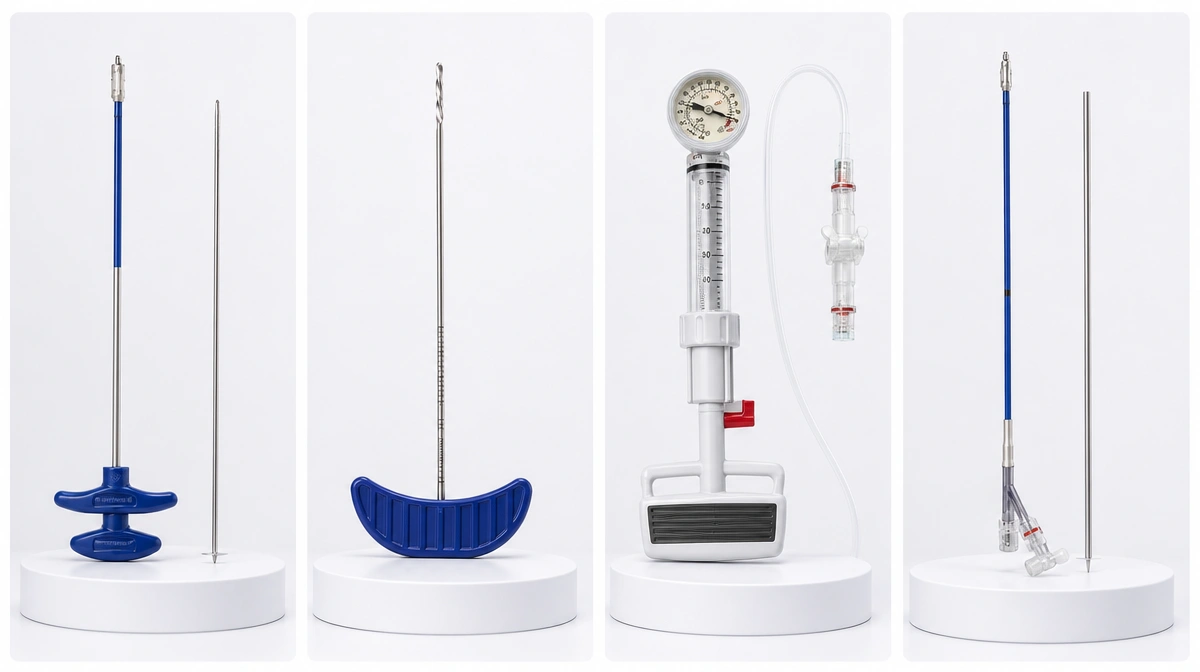
For procurement, the important distinction is the additional cavity-creation subsystem. A balloon order needs a compatible access channel, the correct balloon catheter configuration and its specified inflation equipment. A PVP order may omit these elements while still requiring a complete cement mixing and delivery chain. Mechanical or implant-based augmentation platforms need a separate configuration review and should not be labeled balloon systems simply because they treat similar fractures.
| Purchasing question | Vertebroplasty configuration | Balloon kyphoplasty configuration |
|---|---|---|
| Access components | Verify needle, cannula, stylet and optional biopsy components | Verify access components plus balloon passage compatibility |
| Cavity creation | Not a defining component of conventional PVP | Balloon catheter and specified inflation subsystem |
| Cement preparation | Named cement and compatible mixing components | Named cement and compatible mixing components |
| Cement delivery | Validated injector, connector and cannula combination | Validated delivery configuration after cavity creation |
| Commercial comparison | Price the complete configured procedure set | Include balloon count and inflation equipment, not only the catheter |
A quotation labeled “vertebroplasty kit” may cover access instruments only, or it may include mixing and delivery components. Likewise, “kyphoplasty system” does not tell the buyer whether cement is included. Require a bill of materials with quantities, model numbers and exclusions before comparing offers.
1.3 The Core Components of a Complete System
Think of the procedure pack as several connected modules. Access includes the puncture needle, stylet, working cannula and any specified dilator or drill. Cavity creation may include a balloon catheter or a platform-specific mechanical instrument. Balloon inflation requires the specified fluid pathway, connector and pressure-monitoring device. Cement preparation and delivery includes the named cement, mixer, injector and delivery cannula or tubing.
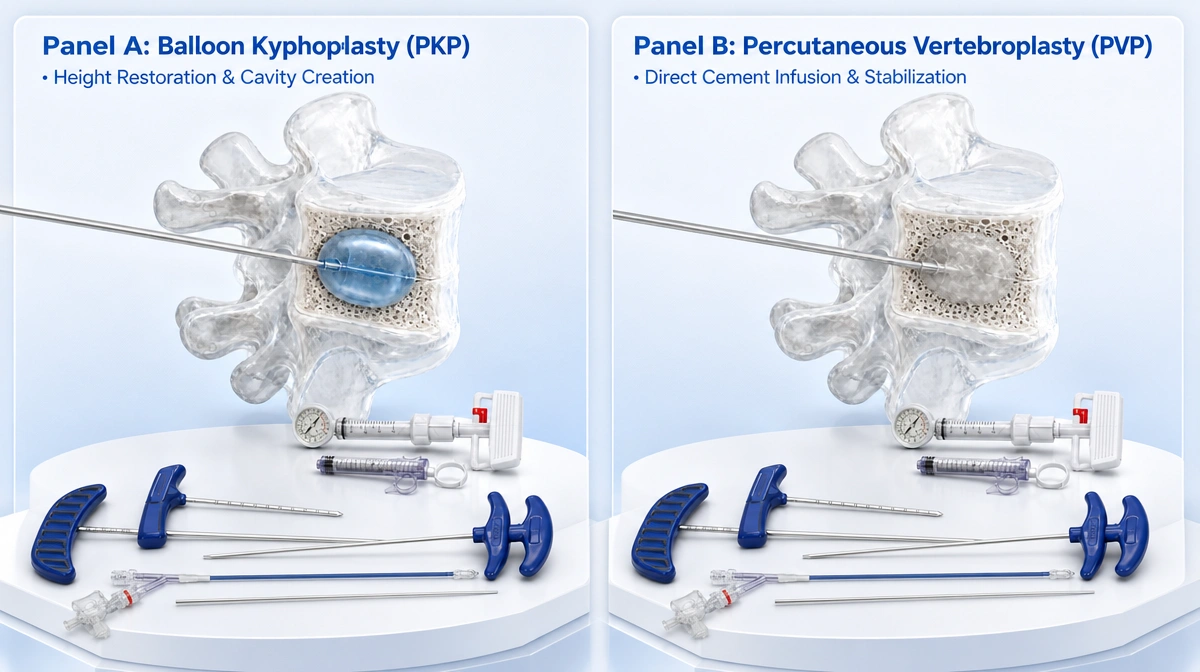
The balloon inflation device and the cement injector perform different functions. A pressure gauge attached to the inflation circuit does not establish the pressure delivered through the cement pathway. Shared terms such as “pump,” “syringe” or “high pressure” should never substitute for an identified component and intended use.
| Component | Minimum purchasing description | Common omission to resolve |
|---|---|---|
| Puncture needle and stylet | Gauge, usable length, tip option and model | Whether a biopsy component is included |
| Working cannula | Inner diameter, working length and connector | Compatibility with the proposed balloon or instrument |
| Balloon catheter | Configuration, dimensions, rated limits and marker arrangement | Which catheter sizes the pack actually contains |
| Inflation device | Model, gauge range, accuracy information and release mechanism | Whether it is supplied with each catheter or separately |
| Cement | Exact product, pack size and market-specific labeling | Whether the quote excludes cement |
| Mixer and injector | Named compatible cement and component codes | Tubing, adapters and residual volume in the delivery chain |
| Packaging | Sterile status, pack configuration and labeled shelf life | Whether all components share one sterile barrier or arrive separately |
Even where a supplier describes an all-in-one kit, the buyer should request a photographed packing layout and a signed component list. These create a reviewable basis for hospital evaluation, receiving inspection and reorder control.
1.4 Where PKP/PVP Fits in a Distributor’s Spine Portfolio
For distributors already selling spinal fixation products, vertebral augmentation can be evaluated as an adjacent procedure-based category. The strategic question is whether existing hospital relationships, clinical support and regulatory resources can support it. Repeated consumable demand is possible where customers perform these procedures regularly; it should be demonstrated through local demand rather than assumed.
When building a complete spine implant portfolio, keep a separate purchasing map for fixation implants, fusion devices and vertebral augmentation consumables. Hospitals may buy them through related departments, but the products solve different clinical problems and follow different replenishment patterns.
Our guide to adding MIS spine product lines provides a broader commercial planning framework. The Spine Implant System Portfolio can help buyers identify adjacent categories without treating them as substitutes for a PKP/PVP pack.
Start with a defined launch assortment: the configurations requested by named customers, a documented compatibility map and a replenishment plan. Expanding immediately into every balloon length, cannula gauge and cement variant can increase expiry exposure before the distributor has established demand.
2. Technical Evaluation Criteria for Sourcing Systems
2.1 Balloon Pressure Ratings, Integrity and Deflation Reliability
A larger advertised burst-pressure number does not, by itself, establish a better balloon catheter. Buyers need to distinguish the manufacturer’s maximum inflation pressure, rated burst pressure where specified, maximum volume and the conditions of the supporting test. These terms should not be merged into a single “safe pressure” claim.
Request the exact specification for each catheter model. Ask how the balloon was constrained during testing, what inflation medium was used, whether the tested samples were sterilized and aged, and what acceptance criteria applied. A laboratory burst result is not a clinical instruction to increase pressure when a balloon encounters resistance.
Deflation and withdrawal also belong in the evaluation. Request the manufacturer’s verification information for deflation, balloon folding or profile recovery, catheter integrity and passage through the specified access channel. Where evidence is confidential, agree on a technical summary or controlled review rather than accepting a brochure adjective.
Procurement teams can compare documentation completeness and validated limits. They cannot derive a universal pressure setting for sclerotic bone or other fracture types from a comparison table. The clinician must follow the specific device IFU and patient assessment.
2.2 Radiopacity and Visualization
Ask the supplier to identify which features are radiopaque: catheter markers, the balloon’s contrast-filled outline, access instruments or the cement itself. These are separate design features. A visible catheter marker does not establish the visibility of cement or the entire balloon boundary.
Do not assume that every marker is tantalum or platinum. If composition matters to a tender, request the actual material specification. For a functional evaluation, request labeled images or validated demonstration materials showing the relevant marker arrangement, imaging conditions and limitations.
Include marker position and the meaning of any spacing dimensions in the specification sheet. A catalog’s “marker distance” may not mean balloon diameter, inflated length or usable catheter length. Resolving these definitions before a trial avoids buying products that appear equivalent on a spreadsheet but are not specified in the same way.
2.3 Cement Viscosity and Delivery Pressure Control
PMMA describes a material family, not universal interchangeability. A cement delivery system must be evaluated with the named cement formulation and the manufacturer’s permitted preparation and delivery conditions. “High viscosity” on two brochures does not establish identical behavior, working time or compatibility.
The injector, tubing, connectors and cannula form a connected delivery pathway. Ask for the approved or validated component combination, the relevant pressure limitations, connector retention information and the manufacturer’s evidence supporting the claimed viscosity range. Do not infer that a narrow cannula works with every cement simply because a syringe can connect to it.
Temperature, preparation conditions and elapsed time influence the handling window described by a cement’s IFU. Buyers should therefore request the instructions for the intended market and ensure training materials reference that exact product. A generic demonstration using another cement is insufficient to validate a proposed purchasing combination.
Cement-augmented fixation is also a distinct category. The example of MIS cement-augmented pedicle screw fixation illustrates a fixation-based approach; it should not be read as evidence that balloon augmentation and screw fixation are interchangeable or routinely combined. Any combined use needs product-specific labeling and clinical assessment.
2.4 Cannula Tips, Handles and Depth Markings
For access instruments, specify gauge, actual inner diameter where relevant, usable length, stylet fit and available tip configuration. Beveled and diamond tips should be identified as catalog options rather than presented as a universal performance hierarchy. Selection belongs to the treating team within the device’s intended use.
Handle shape, grip security and marking legibility are useful topics for structured user evaluation. Ask evaluators to record observations against the exact model and sample lot. “Comfortable” or “easy to use” becomes more useful when translated into defined feedback about visibility, identification and component handling.
Check that depth graduations are explained in the technical drawing and IFU. Verify the reference point, units and readability after any permitted processing. For single-use products, inspection and demonstration must not imply authorization to reprocess them.
2.5 Single, Bilateral and Curved or Steerable Configurations
Separate the access approach from the number of balloons in a package. A one-balloon pack does not automatically define a unipedicular procedure, and a two-balloon pack does not establish suitability for every bilateral case. Curved access, a steerable osteotome and a steerable balloon are also different product features.
Ask the supplier to map each offered configuration to the corresponding instructions, access components and training materials. If the quotation includes a curved instrument, identify whether a dedicated introducer, sheath or handle is required. If two balloons are included, confirm the inflation-device quantity and any platform-specific operating arrangement.
Compare configurations through a complete purchasing list, not catheter unit price. Extra adapters, proprietary cement accessories and mandatory single-use tools can change the cost of the configured procedure even when the headline balloon price is lower.
3. Top 8 Kyphoplasty and Vertebroplasty System Brands in 2026
The shortlist below covers complementary product categories. Some companies offer broad balloon platforms; others contribute a particularly identifiable cement or delivery portfolio. For the wider supplier landscape, see our overview of top global spine implant manufacturers. The following entries focus specifically on vertebral augmentation.
3.1 Medtronic — Kyphon Balloon Kyphoplasty and Vertebroplasty
Verified portfolio. Medtronic’s official vertebral augmentation pages identify the Kyphon balloon kyphoplasty platform and the Kyphon V Premium vertebroplasty platform. The balloon portfolio includes bone-access options and cement-delivery components; V Premium is presented as a high-viscosity vertebroplasty platform. These are distinct configurations within the broader Kyphon offering.
Procurement relevance. Kyphon provides a useful reference for buyers evaluating a coordinated platform rather than a standalone balloon. The purchasing exercise should identify the particular balloon, access instruments, cement and delivery components proposed for the hospital. A brand-wide request for a “Kyphon kit” is not sufficiently precise for a comparable quotation.
What buyers should verify. Obtain the current local catalog and select exact product codes. Confirm balloon dimensions, permitted inflation limits, access compatibility, cement options and which components are packaged together. Ask whether a proposed configuration has changed since a hospital’s existing training or evaluation, and establish how product changes will be communicated.
Brand and manufacturing context. Medtronic announced a partnership with Merit Medical to offer the Kyphon KyphoFlex unipedicular balloon catheter. This illustrates why brand, commercial distribution and manufacturing relationships need separate documentation. It does not establish that all products from the two companies are interchangeable.
Commercial questions. Ask about local account eligibility, consignment or stocking arrangements where available, clinical education, replenishment and supply of the exact consumables already used by the customer. Evaluate the complete procedure configuration rather than treating brand recognition as a substitute for a supply agreement.
Official sources reviewed: Kyphon balloon platform; Kyphon V Premium; Medtronic–Merit partnership announcement.
3.2 Stryker — AVAflex and Vertebral Augmentation Cement Options
Verified portfolio. Stryker’s AVAflex balloon system page describes curved access components and balloon options. Its cement portfolio separately lists SpinePlex and VertaPlex HV. VertaPlex HV is the explicitly identified high-viscosity cement; the presence of SpinePlex in the same portfolio should not be used to relabel it as the same formulation.
Procurement relevance. AVAflex is relevant when a buyer needs to evaluate a curved-access balloon configuration. Treat the introducer, curved needle or associated access components, balloon and cement-delivery chain as a platform-specific bill of materials. Do not infer a compatible delivery pathway from the balloon name alone.
What buyers should verify. Request the market-specific catalog for available balloon sizes and their matching components. Compare the quoted cement product with the hospital’s required handling profile and obtain the relevant IFU. Confirm whether the offered kit includes inflation equipment, access devices, cement and delivery consumables or requires additional product codes.
Regulatory evidence. FDA record K162062 identifies AVAmax and AVAflex device names. That record supports a product-specific regulatory reference, not a statement that every Stryker vertebral augmentation configuration is cleared under the same submission. Match the current device name and supplied model to the appropriate documentation.
Commercial questions. Ask for separately priced configurations where the customer is comparing straight and curved access options. Include the cost and availability of all required accessories, training materials and replenishment items. Confirm that evaluation samples represent the intended commercial configuration rather than a demonstration assembly with different components.
Official sources reviewed: AVAflex balloon system; cement and delivery portfolio; FDA K162062.
3.3 Merit Medical — Arcadia, PowerCURVE and StabiliT
Verified portfolio. Merit Medical lists Arcadia balloon catheters, PowerCURVE navigating osteotome technology and StabiliT vertebral augmentation offerings. The spelling is Arcadia. StabiliT and StabiliT MX should be identified by their exact system names and documentation rather than merged into a generic radiofrequency ablation description.
Procurement relevance. Merit is useful for comparing how access, targeted channel preparation, balloon cavity creation and cement delivery are organized across product families. A steerable osteotome and a balloon catheter serve different functions. Buyers should identify which components belong to the configuration being quoted and which are alternative approaches.
What buyers should verify. Request an itemized configuration for the intended procedure, including the access channel, any navigating instrument, balloon and cement-delivery components. Identify whether special equipment is required for the particular StabiliT version. Do not transfer a feature from an older system brochure to a current MX or Arcadia quotation without confirmation.
Clinical labeling boundary. Merit also markets technologies in interventional oncology, but a vertebral augmentation system should not be described as a tumor-ablation system solely because the broader company portfolio contains ablation products. An ablation claim requires its own device, intended use and supporting labeling.
Commercial questions. For distributors, a modular portfolio can create more than one purchasing configuration. Ask the supplier to simplify the launch assortment into clearly named packs, with component codes, exclusions and training requirements. This helps avoid overstocking similar-looking instruments that are not intended for the same system.
Official sources reviewed: Merit spine portfolio; Arcadia balloon catheter; StabiliT MX brochure.
3.4 DePuy Synthes — CONFIDENCE Spinal Cement System
Verified portfolio. The J&J MedTech site lists the CONFIDENCE Spinal Cement System. FDA record K201831 identifies CONFIDENCE and VERTEBROPLASTIC Radiopaque Bone Cement, with a 2020 clearance concerning the named products. The associated labeling describes CONFIDENCE high-viscosity cement and its specified uses.
Procurement relevance. CONFIDENCE belongs in this comparison as a documented cement-system offering. Its inclusion is not a claim that the product page establishes a complete, current DePuy-branded balloon platform. Buyers should distinguish cement preparation and delivery from the separate instruments needed for access or cavity creation.
What buyers should verify. Obtain the current cement IFU, the exact delivery-system configuration and the local commercial entity’s supply documentation. If the hospital requests use with a fixation system, verify the named combination and indication rather than extending a cement label to every fenestrated screw.
Regulatory evidence. The FDA record is useful because it provides specific device names and indication boundaries. It does not demonstrate blanket compatibility with unrelated access cannulas, balloon systems or spinal fixation products. Match the proposed order to the exact labeling and any later relevant changes.
Commercial questions. Ask whether the quotation includes cement only or a complete preparation-and-delivery assembly. Check the number of separately supplied sterile components, their shelf lives and the support available for the current system. A buyer replacing an existing cement should also evaluate any change to associated components and training before treating the purchase as a simple material substitution.
Official sources reviewed: CONFIDENCE product page; FDA K201831 clearance and summary.
3.5 Globus Medical — AFFIRM and FORTRESS
Verified portfolio. Globus Medical’s vertebral body augmentation page identifies the AFFIRM VCF System, including access and cavity-creation options, and FORTRESS bone cement. It distinguishes FORTRESS Plus high-viscosity cement from FORTRESS. The company describes AFFIRM for both vertebroplasty and kyphoplasty.
Procurement relevance. AFFIRM provides a basis for evaluating an integrated access-to-delivery portfolio. Its adjustable cavity-creation instrument and bone-tamp options should be identified individually in the purchasing specification. The general phrase “cavity creation” does not establish that every configuration contains the same type of balloon or mechanical tool.
What buyers should verify. Ask for the exact AFFIRM instrument list and the matching cement preparation and delivery components. Specify whether the quotation is based on FORTRESS or FORTRESS Plus. The two names should not be collapsed into one generic viscosity or handling specification.
Corporate identity. Globus Medical and Tecres are separate suppliers in this guide. A combined “Globus/Tecres” entry would obscure the actual product names, contracting parties and documents needed by a distributor. Regulatory and compatibility evidence must remain attached to the company and device to which it belongs.
Commercial questions. Ask how multiple cavity-creation options affect pack composition and stocking. Where a customer already buys other spine products from the supplier, evaluate possible service coordination without assuming that the vertebral augmentation products share the same availability, contract or authorization. Keep the augmentation product list distinct from fixation and interbody-fusion inventory.
Official source reviewed: Globus vertebral body augmentation portfolio.
3.6 IZI Medical — Osteo-site and Blazer-C
Verified portfolio. IZI Medical’s current spine page presents Osteo-site vertebral balloon and access products, cement-related components and Blazer-C. Its vertebroplasty page lists needles, injectors, mixers and cement. The public injector description refers to low- and medium-viscosity cement; buyers should not extend that statement to every high-viscosity formulation.
Procurement relevance. The current Osteo-site listings provide a more useful starting point for an RFQ than a historic brand reference alone. Map the offered access, balloon and cement-delivery components to the current catalog, then identify whether the chosen configuration requires additional components outside the quoted pack.
Brand and ownership context. Halma identifies IZI Medical within its group. IZI also published an earlier acquisition announcement for Kiva and related Benvenue products. That history explains legacy references, but it does not establish that every legacy Kiva configuration remains commercially available in the buyer’s market today.
What buyers should verify. Obtain current product codes and an availability statement for the intended country. If a tender names Kiva, request explicit confirmation of the current product, regulatory documents and supply route. Do not substitute another augmentation platform without a documented customer and regulatory review.
Commercial questions. Ask whether balloon, access and cement components can be supplied in the required quantities and delivery schedule. Confirm model-specific compatibility and whether marketing materials, demonstration products and saleable packs use the same component names. Historic catalogs should be clearly separated from the active order list.
Official sources reviewed: IZI spine solutions; IZI vertebroplasty products; Halma company profile; IZI’s historical Kiva acquisition announcement.
3.7 Tecres — Mendec Cement and Delivery Systems
Verified portfolio. Tecres lists Mendec Spine Kit and Mendec Aqua within its vertebral augmentation offering. The Spine Kit page identifies a low-viscosity cement kit with mixing and delivery components. Mendec Aqua is described as a hydraulic delivery system for high-viscosity cement. The wider Mendec range contains differentiated viscosity options.
Procurement relevance. Tecres is particularly relevant to cement and delivery-system evaluation. Its presence in this list does not imply that every Mendec product includes a balloon catheter or the entire access subsystem. A complete cement-preparation kit and a complete kyphoplasty procedure pack are different purchasing scopes.
What buyers should verify. Request the exact cement formulation, delivery model and included accessories. Confirm whether needles and other access items are separate. Where hydraulic delivery is proposed, obtain the permitted component combination and the instructions that define its operating limits and preparation requirements.
Corporate identity. Tecres identifies its relationship with Demetra in its corporate materials. It is not presented here as a Globus Medical subsidiary or a combined brand. Purchase orders, declarations and registration records should identify the actual responsible entities for the offered devices.
Commercial questions. Compare the full cement-and-delivery package with other quotations at the same scope. A lower cement price may not translate into a lower configured procedure cost once mixers, tubing, injectors and access items are added. Conversely, a quoted integrated preparation set should not be charged again for components already included. An itemized comparison resolves both errors.
Official sources reviewed: Mendec Spine Kit; Mendec Aqua; Tecres corporate information.
3.8 Joline — Kyphoplasty and Quattroplasty Portfolio
Verified portfolio. Joline’s current spine page lists kyphoplasty-related balloon, bone-access and cement-application products, including its Stop’n GO double-balloon concept for Quattroplasty. Its download area provides spine brochures and instructions. These materials establish a specific current portfolio rather than a generic spine-manufacturer association.
Procurement relevance. Joline is useful when evaluating alternative balloon configurations and associated cement-handling components. A double-balloon concept should be assessed as its own system. It should not be interpreted as a recommendation that every customer needs more balloons or a direct equivalent to two independently supplied conventional catheters.
Regulatory evidence. In March 2026, Joline announced MDR certification of its spine portfolio. This is a current manufacturer announcement. Buyers still need the applicable certificate, declaration of conformity, device scope and labeling for the specific offered models; the announcement alone is not a substitute for that dossier.
What buyers should verify. Request the current spine catalog for the destination market, component compatibility and the specific catheter configuration proposed for evaluation. Confirm the applicable cement-application system and whether the quote includes all necessary preparation, inflation and delivery components.
Commercial questions. Ask about local distribution arrangements, product training, pack composition and reorder quantities. When comparing a differentiated balloon configuration with another platform, use equivalent purchasing boundaries and a clinician-led evaluation plan. Do not claim superior clinical performance from configuration differences without appropriate comparative evidence.
Official sources reviewed: Joline spine portfolio; current downloads; March 2026 MDR announcement.
4. Brand Comparison Matrix
This matrix summarizes the official product references above. “Verify by market” means this review does not establish authorization for the buyer’s exact SKU and country. It does not mean the product lacks authorization. Public list prices and like-for-like distributor quotations were not established, so the final column identifies cost drivers rather than invented price tiers.
| Brand | Verified platform examples | Mechanism or purchasing role | Cement viscosity information | Regulatory evidence boundary | Main cost-comparison items |
|---|---|---|---|---|---|
| Medtronic | Kyphon balloon platform; V Premium | Balloon cavity creation; separate vertebroplasty platform | V Premium described for high-viscosity delivery; verify exact cement | Verify by market and named configuration | Balloon, access, cement and delivery components |
| Stryker | AVAflex; SpinePlex; VertaPlex HV | Curved-access balloon system; cement and delivery portfolio | VertaPlex HV explicitly high viscosity; distinguish SpinePlex | FDA K162062 names AVAmax/AVAflex; verify current SKU and market | Curved access components, balloon and selected cement system |
| Merit Medical | Arcadia; PowerCURVE; StabiliT/MX | Balloon, navigating channel preparation and system-specific augmentation options | Verify the named cement and delivery system | Verify by market; do not transfer labeling across product families | Selected configuration, dedicated tools and required equipment |
| DePuy Synthes | CONFIDENCE | Cement preparation and delivery offering | CONFIDENCE high-viscosity cement identified | FDA K201831 supports named products and labeling; not all combinations | Cement pack, preparation/delivery set and separately needed access items |
| Globus Medical | AFFIRM; FORTRESS; FORTRESS Plus | Access, cavity creation and cement-delivery portfolio | FORTRESS Plus identified as high viscosity | Verify by market and exact system | Cavity-creation option and cement-specific components |
| IZI Medical | Osteo-site; Blazer-C | Balloon/access portfolio and vertebroplasty consumables | Public injector description references low/medium viscosity; verify combination | Verify by market; historic Kiva documents do not establish current availability | Current model availability, access, balloon and cement components |
| Tecres | Mendec Spine Kit; Mendec Aqua | Cement mixing and delivery; hydraulic option | Spine Kit low viscosity; Aqua high-viscosity delivery | Verify by market and specific product | Cement, mixer, injector, tubing and separate access items |
| Joline | Kyphoplasty; Stop’n GO/Quattroplasty | Balloon configurations, access and cement application | Verify named cement and application system | March 2026 MDR announcement; obtain model-specific supporting documents | Catheter configuration and included inflation/delivery components |
Use the table to shortlist suppliers by system scope. A distributor seeking a balloon platform needs more evidence than a cement-only buyer. A customer already equipped with a validated delivery system may have different purchasing requirements from a facility starting a new service.
For a fair commercial comparison, request the same destination, currency, delivery terms, forecast quantity and minimum remaining shelf life. Record whether training, samples, registration support, freight and taxes are included. Keep demonstrated costs separate from assumptions until written quotations are available.
5. Procedure-Stage Purchasing and Instrumentation Checklist
This section organizes purchasing around the clinical workflow. It is a component-readiness checklist, not surgical instruction. It does not specify access trajectories, inflation settings, cement volumes or injection timing. Qualified clinical teams must use the applicable instructions and their approved protocols.
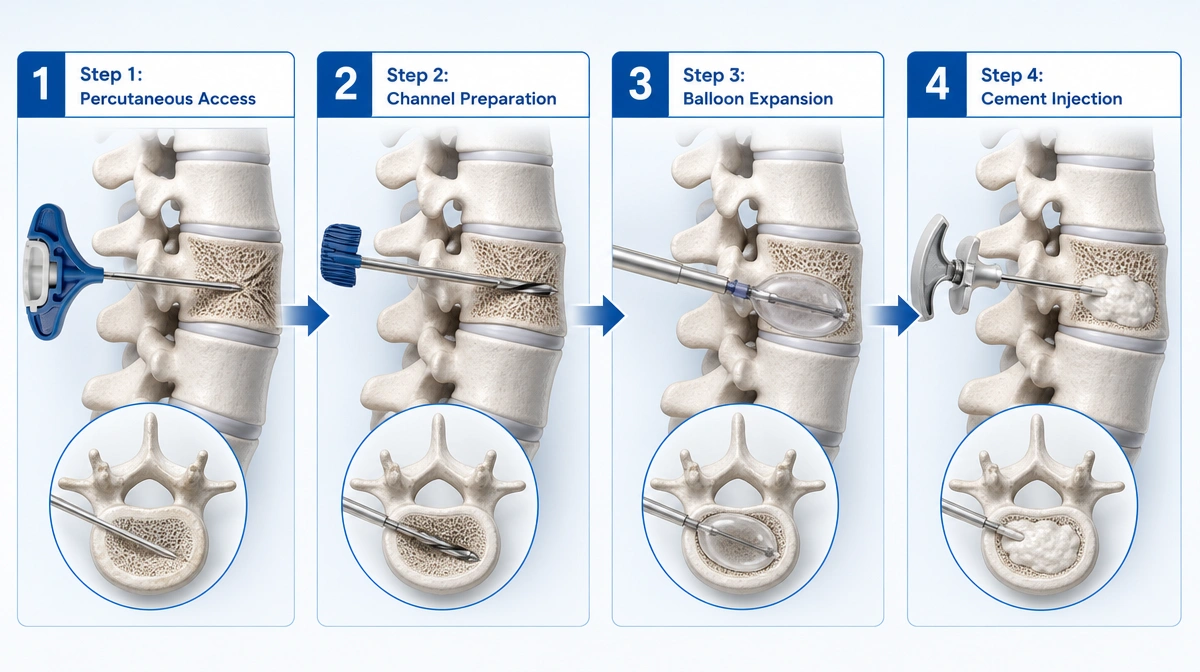
5.1 Access and Any Planned Biopsy
Confirm that the procedure pack contains the specified access needle, stylet, working cannula and any required supporting instruments. If biopsy is planned, verify whether the appropriate component is included or separately ordered. Do not assume every access needle is labeled for every sampling task.
The purchasing record should identify gauge, length, tip option, sterile status and quantity. Pack labels must make similar variants distinguishable during receiving and preparation. An evaluation should also establish whether the printed component list matches the physical contents and the supplier’s technical file.
For distributor logistics, the relevant question is readiness: can the hospital identify and obtain all components before the case? A low-cost pack that repeatedly requires an unplanned accessory purchase is difficult to compare fairly with a more complete configuration.
5.2 Channel Preparation and Cavity Creation
Where the selected technique uses cavity creation, verify that the specified balloon or mechanical instrument fits the intended access system. Record catheter dimensions, compatible working-channel dimensions and any dedicated introducer or preparation tool. A visual resemblance between parts is not a compatibility statement.
For balloon configurations, list the inflation device, connectors and any required separately supplied items. Keep maximum pressure and volume information linked to the exact catheter IFU. Purchasing documentation should make it possible to trace a component change back to the compatibility assessment.
Ask the supplier to identify which devices are single use and which, if any, have validated reprocessing instructions. Do not place a disposable device in a reusable-instrument procurement category simply because it is supplied outside a consolidated sterile pack.
5.3 Cement Preparation, Delivery and Monitoring Readiness
Confirm the selected cement’s identity, packaging and expiry, followed by the mixer, injector, connectors, tubing and delivery cannula. If the system is sold as a kit, verify the full assembly rather than checking the cement and injector in isolation.
The label “high viscosity” does not establish a universal low-pressure procedure. Procurement documents should record the manufacturer’s permitted combination and limitations. Clinical monitoring and decisions about delivery remain within the relevant IFU and clinical protocol.
For inventory purposes, identify whether a cement pack and a device pack have separate lot numbers or expiry dates. Define how both are recorded and whether one can be replenished independently without creating an unvalidated combination. This helps avoid stock that appears complete in the warehouse but cannot be assembled into the intended procedure configuration.
5.4 Completion, Disposal and Traceability
Verify that any system-specific removal or completion components are available, while leaving their clinical use to the relevant instructions. Identify which routine closure or dressing supplies are outside the product pack so the customer does not mistake a device kit for a complete operating-room consumables package.
After evaluation, capture the product codes and lot identifiers used, the component configuration and any product complaints. Establish how damaged packs, unused components and expired stock are handled under the applicable policies. Single-use labeling must remain clear even if training materials discuss reusable instruments elsewhere in the portfolio.
Distributors should agree on complaint escalation, product traceability and field-action communication before launch. These arrangements are part of a reliable supply system and should be reviewed alongside price and delivery commitments.
6. XC Medico Kyphoplasty, Vertebroplasty and OEM Sourcing
XC Medico is presented here as the publisher and a potential sourcing partner, separate from the eight-brand shortlist. The public product page provides a starting point for an RFQ; a final offer must identify the exact configuration, responsible manufacturer, supporting documents and destination-market eligibility.
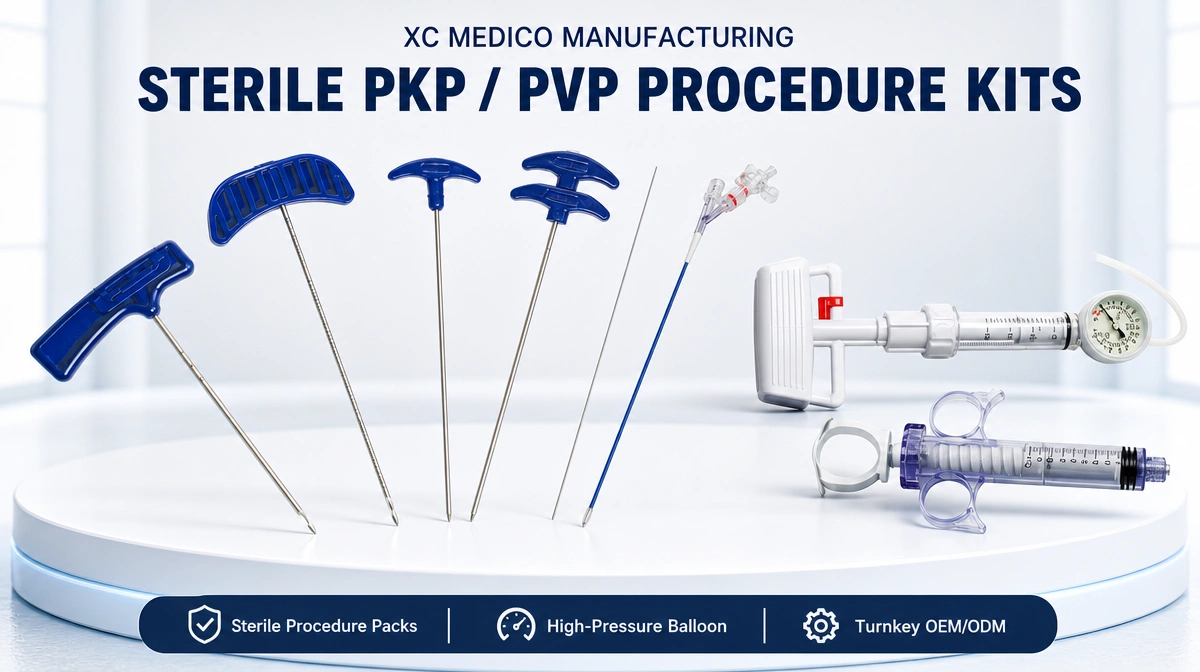
6.1 Define the Complete PKP/PVP Pack Before Requesting a Quote
XC Medico’s published Kyphoplasty and Vertebroplasty Procedure Kits page lists access-related instruments, balloon catheters, inflation equipment and cement-filling components. Buyers can use that page to initiate a configuration review rather than assuming that every pictured component is supplied in every pack.
Ask for separate PKP and PVP bills of materials. A PVP inquiry may not require a balloon subsystem; a PKP inquiry needs the proposed catheter and its matched inflation and access components. In both cases, explicitly state whether bone cement, biopsy items, preparation accessories and any reusable instruments are expected to be included.
| RFQ field | Information to provide or request |
|---|---|
| Destination | Country, importer and applicable registration requirements |
| Procedure scope | PKP or PVP; customer-requested system configuration |
| Access items | Gauge, working length, tip and required quantities |
| Balloon items | Model, dimensions, quantity and matched inflation equipment |
| Cement scope | Exact proposed cement; included, excluded or customer supplied |
| Delivery assembly | Injector, connectors, tubing and cannulas with compatibility evidence |
| Packaging | Individually packed components or defined consolidated pack |
| Commercial quantities | Evaluation quantity, opening order and forecast reorder volume |
| Evidence | IFU, labels, product-specific regulatory documents and verification summaries |
This approach makes quotations comparable and gives the customer a configuration that can be reviewed before a purchasing decision. It also separates the advertised portfolio from the specific product that will actually be supplied.
6.2 Verify Balloon Specifications and Inflation Equipment
The public XC Medico product table includes different catheter entries and dimensional fields. It also reports a constrained burst-pressure value for a listed model. That value should be treated as a published specification claim to verify, not a universal operating pressure or a recommendation for all listed catheters.
Request a controlled technical data sheet that defines each field, including balloon dimensions, marker spacing, usable catheter length, channel compatibility, rated limits and test conditions. Where a web table uses merged or incomplete cells, obtain an explicit model-by-model table instead of assuming that one displayed value applies across every row.
For the inflation device, request the model, gauge units, accuracy information, connector details and pressure-release description. Confirm which balloon configuration it supports. If the buyer requires a particular rating or test standard, include that requirement in the RFQ and ask for the corresponding verification evidence.
A useful sample evaluation compares the documentation with the supplied pack: model numbers, labels, component fit and the specified demonstration setup. Product performance claims should be supported by the relevant reports, and clinical use should follow local requirements and the approved instructions.
6.3 Access Instruments, Cement Delivery and Packaging Boundaries
Specify the access instrument rather than requesting “standard needles.” The purchasing sheet should identify the intended gauge, length, tip option, material specification and any required markings. Ask for drawings or controlled specifications where dimensions affect compatibility.
For cement delivery, identify whether the proposed mechanism is screw-driven, hydraulic or another design. Do not attribute a mechanism to an entire supplier portfolio without a model-specific description. Require a compatibility statement for the named cement and the complete delivery assembly.
Packaging needs the same precision. The product page states EO sterilization, but the buyer should obtain the relevant validation and release information for the actual supplied pack. Confirm single-use labeling, the sterile barrier, shipping configuration and expiration details. A reusable instrument container is not the sterile barrier for a disposable procedure kit.
If the hospital also needs reusable instrument storage, evaluate that as a separate item. Combining disposable consumables and reusable instruments in a commercial proposal does not make their sterilization or reprocessing requirements identical.
6.4 Private Labeling and OEM/ODM: Define the Change and Its Responsibilities
XC Medico describes orthopedic and spinal contract manufacturing services through its OEM/ODM offering. Buyers should specify whether they need a standard product under an agreed commercial arrangement, customized packaging, private labeling or a device design change. These requests carry different technical and regulatory implications.
A logo change is not equivalent to changing a balloon dimension, catheter material, cannula gauge or cement connector. Design changes may require additional verification, packaging work, sterilization assessment and regulatory review. The project plan should identify responsibilities, required evidence and the conditions for release.
For private-label discussions, request the proposed legal-manufacturer arrangement, labeling responsibilities, registration support, complaint handling and change-notification terms. Use our guide to vetting an OEM orthopedic implant manufacturer as a broader supplier-review framework, then add the device-specific requirements for the PKP/PVP pack.
MOQ, tooling charges, validation costs, lead times and documentation access should be quoted for the actual project. A website’s standard-product order quantity does not establish the minimum quantity for a customized sterile kit. Similarly, a stated quality certification or cleanroom capability should be checked against its current scope and the manufacturing activities relevant to the proposed device.
7. Commercial Procurement Checklist for Spine Distributors
7.1 Regulatory Dossier and Supplier Responsibilities
Begin with identity: the legal manufacturer on the label, the contracting supplier, the registration holder where applicable and the model codes being purchased. These may be different entities. The documentation should explain their roles consistently.
ISO 13485 certification concerns a quality management system; it is not, by itself, permission to market a particular device. FDA establishment registration and device listing are also not product approval or clearance. A 510(k) is a device clearance where that pathway applies, not an “FDA-certified manufacturer” status. FDA explanation of registration and certification claims.
For EU supply, review the applicable declaration of conformity, classification and conformity-assessment documentation, including notified-body certificate scope where required. Establish the regulatory basis for the actual product rather than relying on a CE logo in a brochure. European Commission resources explain declarations of conformity and the notified bodies and certificates module.
For a consolidated system or procedure pack, also determine whether MDR Article 22 applies and obtain the corresponding statement where required. Documentation for individual components does not automatically resolve the obligations of the party assembling or sterilizing the pack. Identify that party and the regulatory basis for the final configuration.
This is also part of evaluating spine implant suppliers to protect margins: unusable stock, documentation gaps and unplanned substitutions can erase an apparent purchase-price advantage.
| Document or record | Buyer’s verification question |
|---|---|
| Legal-manufacturer identity | Does it match the label, IFU and relevant regulatory records? |
| Quality-system certificate | Is it current, authentic and applicable to the relevant site and activities? |
| Market-access documents | Do they cover the product, configuration and intended destination? |
| Catalog and SKU list | Can every quoted component be identified unambiguously? |
| Material and dimensional specifications | Are critical features defined for the exact model? |
| Compatibility evidence | Is the proposed balloon/access/cement/delivery combination supported? |
| Performance verification | Are relevant balloon, catheter and delivery-system claims substantiated? |
| Sterilization information | Does it apply to the supplied product and pack configuration? |
| Packaging and shelf-life evidence | Does it support the labeled expiry and distribution conditions? |
| IFU and labels | Are the language, intended use, warnings and identifiers appropriate? |
| Traceability and complaint process | Can lots be traced and field actions communicated promptly? |
| OEM and change-control agreement | Who controls specifications, labeling, registration and design changes? |
7.2 Inventory Turnover and Remaining Shelf Life
Do not insert a generic three-year or five-year shelf-life assumption into the purchasing contract. Use the labeled expiry supported for the actual product and packaging. A kit may contain separately packaged components with different dates, so the buyer needs a rule for the usable complete configuration.
Agree on minimum remaining shelf life at receipt, storage and transport conditions, expiry reporting and the handling of damaged packages. Ask whether partial shipments will have mixed lots or dates. Evaluate opening order size against likely use before expiry, not only against the unit-price discount.
A simple inventory record should include SKU, configuration, quantity, lot, expiry, destination eligibility and customer allocation. Keep different balloon sizes and access gauges distinct even when packaging looks similar. Reordering by a generic kit name increases the chance of receiving a technically different configuration.
7.3 Training Support and Evaluation Products
Ask what training is available for the exact product and local users. Useful support may include current IFUs, component-identification materials, validated demonstration setups and product-specific education. Training availability should be confirmed with the supplier rather than inferred from a global website.
Clearly distinguish demonstration-only samples from products eligible for clinical use. Define the evaluation’s purpose: documentation review, pack-content verification, handling feedback or another agreed activity. Any clinical evaluation requires appropriate local authorization and institutional processes.
Collect structured feedback and record the configuration tested. If a sample uses a different catheter, connector or cement than the commercial quote, resolve that difference before approving the order. A successful demonstration does not validate an untested substitution.
7.4 Requesting Sample Packs and OEM Pricing
Prepare a single RFQ with the destination country, intended customer setting, component requirements, forecast quantities and documentation list. Ask for a configuration drawing or packing list, an itemized quotation and a clear statement of what is excluded.
For XC Medico inquiries, buyers can request a sterile kyphoplasty sample kit, subject to configuration availability, documentation review and destination-market requirements. State whether the request is for nonclinical evaluation or another permitted purpose. Sample availability, sterile status, pricing and delivery terms must be confirmed in the written offer.
For OEM projects, attach a separate change list. Identify which requirements are essential, which are preferences and which can be met by an existing validated configuration. This gives both parties a concrete basis for estimating development work and commercial feasibility.
8. Frequently Asked Questions
What is the primary difference between PKP and PVP in clinical reimbursement?
There is no universal reimbursement difference. Coverage and payment depend on the country, payer, care setting, procedure classification and eligibility requirements. Distributors should verify the applicable local rules with the hospital or payer and should not estimate reimbursement from the kit price or procedure name alone.
What balloon burst pressure is considered safe for sclerotic bone fractures?
There is no universal safe burst-pressure value for sclerotic bone. A burst-test result is not a clinical inflation target. The clinician must follow the exact catheter’s instructions, including its pressure and volume limits, and assess the patient and fracture. Buyers should request model-specific ratings and supporting test information.
Can standard high-viscosity PMMA cement be used with all delivery cannulas?
No. Compatibility depends on the named cement, injector, connectors, tubing and cannula, as well as the manufacturer’s specified preparation and delivery conditions. A shared PMMA description or a physically fitting connector does not establish compatibility. Request a documented combination for the exact products being purchased.
What is the typical shelf life of sterile disposable kyphoplasty kits?
Shelf life is product- and packaging-specific. Use the labeled expiry and supporting evidence for the supplied configuration rather than assuming a standard number of years. If components have different expiry dates, confirm the usable life of the complete pack and agree on minimum remaining shelf life at delivery.
How can distributors customize balloon sizes and needle gauges through OEM?
Submit the intended market, required dimensions, compatibility requirements and expected quantities to the manufacturer. Changes to balloon size or needle gauge may require design verification, packaging and sterilization assessment, and regulatory review. Agree on responsibilities, evidence, development costs and release criteria before treating a customized product as order-ready.
Does a complete vertebroplasty or kyphoplasty kit always include bone cement?
No. The word “kit” does not define a standard bill of materials. Some offers include access and delivery devices while cement is supplied separately. Request a component list with model numbers, quantities, sterile status and exclusions, and verify the exact cement intended for the system.
How should a distributor compare a manufacturer with a trading supplier?
Identify the legal manufacturer and trace every offered product to its documentation, regardless of who issues the quotation. A trading supplier may provide useful logistics or market support, while a manufacturer may control design and production. Evaluate documented responsibilities, authorization, change control, traceability and after-sales support rather than relying on the business label alone.
Sources and Update Notes
Review date: October 15, 2026. Product and regulatory references are linked beside the claims they support. Manufacturer sources establish public portfolio descriptions; they do not replace current quotations, controlled IFUs or independently checked certificates. Selected older regulatory records are identified as such and are not represented as new 2026 clearances.
- Clinical context: NICE TA279 and the ACR/RSNA patient-information resource, used for broad procedure distinctions and patient-selection context.
- Brand portfolios: official Medtronic, Stryker, Merit Medical, J&J MedTech, Globus Medical, IZI Medical, Tecres and Joline pages linked in the eight profiles.
- Specific regulatory references: FDA K162062 and K201831; Joline’s March 2026 announcement is identified as a manufacturer statement, not an independent certificate audit.
- Corporate relationships: official Medtronic–Merit announcement, Halma’s IZI profile and Tecres corporate materials. These do not establish product interchangeability.
- XC Medico sourcing: the live PKP/PVP product page, OEM/ODM services page and relevant distributor guides linked in the article.
Refresh this guide when products are renamed, ownership or supply arrangements change, an IFU is revised, or relevant regulatory status changes. A historic brochure should not remain the sole basis for a present-availability claim. No comparative market-share, clinical superiority or universal pricing claim is made here.
Editorial Accuracy Note
This is a commercial procurement guide for professional buyers. It does not select treatment for an individual patient or provide operative instructions. Product suitability, clinical use and market access require review against the current documentation for the exact device and country. Examples of specifications are not instructions to use those settings.
Build a Documented PKP/PVP Sourcing Plan
Send XC Medico your destination country, required kit components, preferred catheter and access specifications, cement requirements and estimated order quantities. Request a configuration-specific quotation, sample availability and the relevant documentation package before finalizing the purchase.

