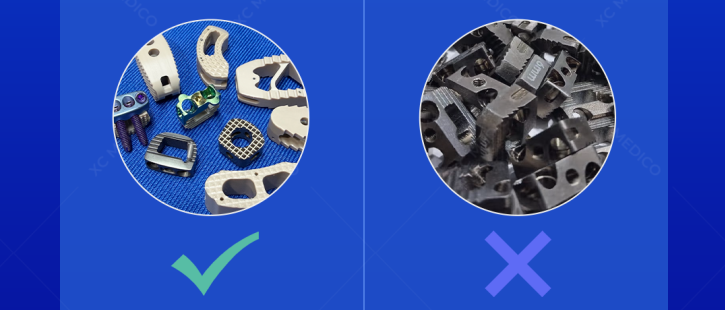
![Spine implant supplier evaluation: academic prestige vs factory manufacturing strength]()
Key takeaways
Academic prestige can make a spine line look low-risk—while quietly making it commercially unworkable for distributors through pricing power, tight terms, and low margin.
In most tenders, the first “real” gate isn’t your supplier’s publication list. It’s whether your bid package proves compliance readiness, traceability, and the ability to deliver consistently.
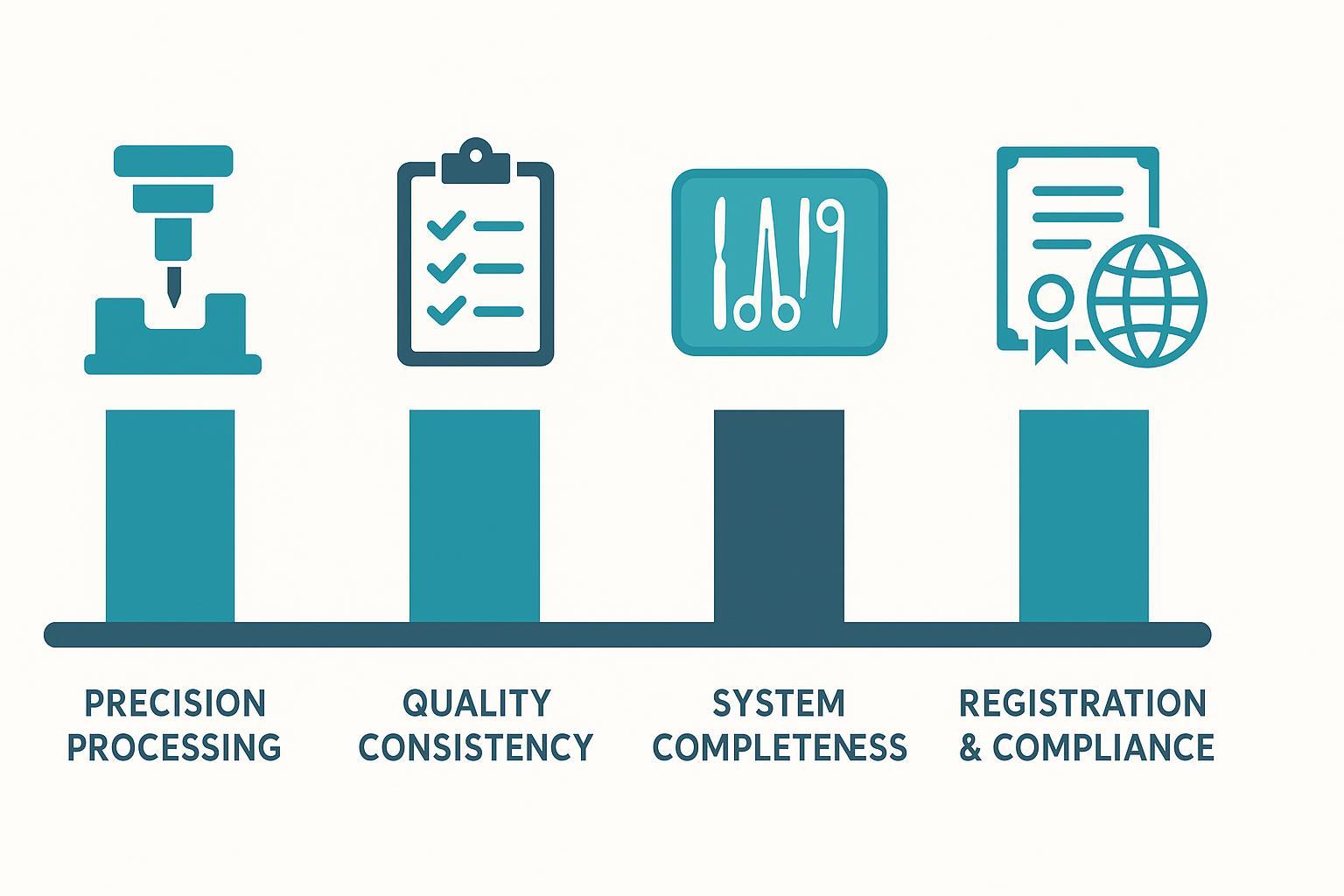
If you want a spine portfolio that wins bids and protects margin, vet factories on four dimensions: precision processing, quality consistency, system completeness, and registration/compliance experience.
The fastest way to avoid bad supplier relationships is to ask for evidence you can audit: traceability examples, change-control posture, inspection methods, validated cleaning/sterilization pathways, and instrument/tray logistics.
You’ve probably seen this movie.
You take on a “top-tier” spine brand because it has the clinical papers, the KOL slide decks, and the kind of name recognition that feels like an instant credibility upgrade. Then you try to run the business:
You can’t price competitively in tender-heavy regions.
Your margin gets squeezed until it’s basically a handling fee.
Your contract starts to look like a set of penalties disguised as “partnership.”
And the frustrating part is: on paper, you did the responsible thing. You chose “evidence.”
Here’s the uncomfortable truth distributors learn the hard way:
For distribution economics, academic prestige is rarely the decisive variable. Factory manufacturing strength is.
Not because papers don’t matter—but because they’re often a second-order filter. The first-order filters are the boring ones: documentation, consistency, completeness, and the ability to execute at scale without surprises.
The hidden mechanism: why “great papers” don’t turn into distributor profit
![Editorial illustration showing a distributor choosing between prestige and factory strength]()
Big brands aren’t overcharging because they have PDFs.
They’re overcharging because the market lets them. The papers are part of the story that protects pricing power—especially with hospital committees that want to feel defensible.
For distributors, that pricing power shows up as a predictable pattern:
Premium list prices become the baseline in every negotiation.
Your “discount” is positioned as a concession, not a sustainable commercial structure.
Tender math punishes you: the more price-sensitive the market, the more that premium blocks you from competitive bids.
Risk gets pushed downstream: consignment terms, inventory liability, rigid minimums, and performance clauses that leave you holding the bag when adoption is slower than promised.
Meanwhile, your cost base isn’t just the implant.
It’s the system:
If your supplier can’t execute those pieces with factory-level repeatability, distributors pay for it—usually in the most expensive way possible: failed tenders, stockouts, and “urgent” logistics.
Tenders don’t buy prestige—they buy proof (spinal implant tender requirements)
In spine tenders, a strong brand may help create comfort. But comfort doesn’t win bids if your submission can’t clear the gates.
Look at how real hospital RFPs are structured: they typically demand complete proposal responses, pricing exhibits, and a broad product scope—and they evaluate vendors on responsiveness and cost, among other factors.
If you want a grounded example of how spine implant tenders are framed, skim primary documents like Cook County Health’s spinal implants RFP or ECMC’s spine implants RFP. Even if the exact scoring varies, the pattern is consistent: you’re being judged on the completeness and credibility of your bid package—not on brand mythology.
That’s the trap:
If your evaluation starts with academic papers, you’re optimizing for reassurance.
If your evaluation starts with factory strength + compliance readiness, you’re optimizing for tender survival and margin.
The four dimensions behind spinal implant tender requirements
![Infographic-style illustration of a four-pillar supplier evaluation framework]()
If you’re building (or rebuilding) a spine portfolio, here’s the evaluation frame that prevents expensive mistakes.
1) Precision processing capability
Spine implants are manufacturing-intensive. Small variations become big operational problems when you’re trying to standardize surgeon preference cards, instrument compatibility, and tray replenishment.
Precision processing capability isn’t “they have CNC.” It’s:
multi-axis machining for complex geometries
stable processes that hold tolerances across lots
metrology capacity that matches the part complexity
evidence that the factory can repeat results under real production load
What to ask for (evidence, not promises):
Which machining processes are in-house vs. outsourced?
What inspection tools are used for complex geometries (e.g., CMM for dimensional verification)?
Can they show a representative inspection record tied to a lot number?
Key Takeaway: Precision is a commercial issue. Inconsistency is what turns “good samples” into warranty cost, tender risk, and surgeon churn.
2) Quality consistency
Distributors don’t get punished for one bad batch. They get punished for unpredictability.
Quality consistency in implant manufacturing means the supplier has a system that reduces variability and catches issues early:
in-process monitoring (not just final inspection)
defined sampling plans and traceable records
a change-control mindset (so your “same SKU” doesn’t quietly become a different product)
disciplined CAPA behavior (corrective and preventive action), because issues happen—what matters is how they’re handled
A simple way to think about this:
3) System completeness
Spine is rarely a “single implant” business.
Hospitals and surgeons evaluate systems: implants, instruments, trays, IFUs, packaging, labeling, and replenishment workflow. If any of that is missing, your sales team is stuck selling around operational friction.
System completeness includes:
coherent implant families (so you’re not stitching together incompatibilities)
instrument/tray readiness for the real OR workflow
documentation completeness (IFU, labeling, traceability expectations)
the ability to scale across procedure types without reinventing your logistics every time
If you want a concrete reference for how broad a spine offering can be, review a spine-system scope page like XC Medico Spine System, which lists multiple spine instrument sets and implant families. The point isn’t “choose this exact catalog.” The point is: a spine line that wins tenders is a system, not a SKU.
4) Registration and compliance experience (ISO 13485 certified manufacturer readiness)
In tender and multi-country distribution, compliance experience is leverage (the good kind).
A manufacturer that’s genuinely ready for global distribution can support:
regulatory document packages
stable labeling/UDI readiness where required
traceability expectations
audit posture (clear certificates, scopes, and renewal cadence)
Start with the baseline: ISO 13485.
ISO 13485:2016 is the medical-device quality management system standard defined by ISO—see ISO’s ISO 13485:2016 standard. For distributors, it matters because it reduces the friction of qualification, audit discussions, and ongoing documentation requests.
But don’t stop at the certificate.
Ask for scope and evidence that matches the product family you’re buying. A perfectly valid certificate that doesn’t cover implant manufacturing or doesn’t map to the relevant site and processes is a red flag.
Spine implant supplier evaluation: stop “reading papers,” start requesting auditable proof
Here’s a due-diligence sequence that maps to how tenders and real operations work.
Step 1: Use papers as a secondary screen
Clinical evidence can help when:
you’re dealing with a genuinely novel design
hospital committees require certain study types for comfort
you need surgeon adoption support in a competitive account
But papers should not be your first gate—because papers don’t answer the questions tenders punish you for:
Can you deliver the same quality next quarter?
Can you support registrations without months of back-and-forth?
Can you replenish trays and instruments without chaos?
Step 2: Run a factory-strength scorecard first
A good factory will welcome evaluation that’s specific.
Instead of asking “Are you high quality?” ask for artifacts:
a traceability example for one lot number
inspection approach for complex geometries
change-control process (how are changes communicated and approved?)
how complaints are investigated and closed (CAPA posture)
what “system completeness” looks like for the procedures you target
If you want a distributor-friendly framework to structure this, adapt a criteria-first approach like XC Medico’s Top 7 Evaluation Criteria for Choosing Orthopedic Suppliers in 2026—then tailor it to spine-specific realities.
Step 3: Validate supply-chain execution (because margins die in logistics)
Ask the operational questions before your first tender submission:
What are standard lead times vs. surge lead times?
What’s the replenishment process for instruments and trays?
What is their warehousing and inventory-control posture?
This is where “factory strength” becomes visible.
For example, a manufacturing-focused overview like XC Medico’s Manufacturing Powerhouse describes specific process stages (machining, surface finishing, assembly, cleaning) and lists operational claims like “99.9% Inventory Accuracy,” alongside certifications such as ISO 13485 and CE marking.
The point is not to accept claims blindly. It’s to prioritize suppliers who speak in auditable, operational language instead of only marketing language.
The strongest counterargument: “But clinical evidence does matter”
It does.
The mistake is treating clinical papers as a proxy for everything else.
Academic publications can support:
hospital committee confidence
surgeon preference discussions
specific indications and technique considerations
But for distributors, clinical evidence is not a substitute for:
registration readiness
consistent manufacturing
complete systems
predictable supply
A clean mental model is this:
If you’re building an orthopedic OEM/ODM manufacturer shortlist, this distinction matters—because the wrong first filter locks you into the wrong economics.
If you only buy adoption comfort, you’ll eventually pay for business risk.
Next steps: turn this reframe into a supplier shortlist
If this article feels uncomfortably accurate, that’s a good sign—you’re seeing the trap clearly.
Here’s a low-friction next step: build a one-page “factory strength” checklist and apply it to every spine supplier you’re considering.
A useful starting point is a documentation-first vetting framework like XC Medico’s practical guide to vetting orthopedic suppliers in the U.S., then adapt it to your target markets and tender realities.
Instead of paying a premium for academic prestige, fast-growing distributors are partnering with orthopedic suppliers who prioritize precision processing and proven compliance experience—ensuring you win tenders on quality while protecting your margins.
FAQ
1) Do “published clinical papers” help me win spine tenders?
They can help, but rarely as your first gate.
In most tender-heavy markets, publications support comfort (committee confidence, surgeon conversations). What clears the bid package is proof of compliance readiness, traceability, and consistent supply execution. Treat papers as a secondary screen—then validate factory strength with auditable artifacts.
2) What’s the fastest way to spot a spine supplier that will squeeze distributor margin?
Look for commercial structures that push risk downstream.
Common warning signs include premium list prices that make tender math impossible, rigid minimums, inventory liability, and penalty-heavy “partnership” clauses. If the supplier’s pricing power leaves you with a handling-fee margin, the line is commercially fragile—even if the brand looks prestigious.
3) What documents or evidence should I request before committing to a spine line?
Ask for evidence you can audit, not promises you can’t verify.
Start with a traceability example tied to a real lot number, representative inspection records for complex geometries, and a clear change-control approach (how changes are reviewed, approved, and communicated). Then validate quality-system behavior via CAPA posture and complaint closure examples, plus instrument/tray logistics that match your target procedures.
4) How do I evaluate “system completeness” in a way that actually affects tenders and adoption?
Evaluate the system like an OR workflow, not a catalog.
You’re not just buying implants—you’re buying trays, instruments, replenishment discipline, labeling/UDI readiness, IFUs, and the ability to scale across procedure types without constant workarounds. A complete, coherent system reduces friction for surgeons and helps your team submit cleaner bids with fewer operational surprises.