You want the best circular external fixator for fixing limbs. These devices help with limb reconstruction and fixing deformities. Recent studies show Ilizarov circular external fixators work very well. They give strong support and help bones heal. These circular and ring fixators press on bones evenly. This helps bones heal and keeps patients safe. XC Medico’s Ilizarov Circular External Fixators are CE/ISO certified. They are known as reliable devices for fixing bones. Their ring shape helps healing in tough cases. Hexapod systems also help bones heal well. But Ilizarov fixators are still trusted for safety and healing.
Key Takeaways
Circular external fixators, such as the Ilizarov, help bones heal well and are safe to use. - These devices can be used for many problems, like fixing bones or straightening limbs. - When picking a fixator, think about how steady it is, how easy it is to use, and if it works well for patients. - New designs and materials in fixators make patients feel better and help them heal with fewer problems. - Good technical support and training are very important for using external fixators the right way and helping patients get better.
Circular External Fixator Overview
![Circular External Fixator Overview]()
What Are Circular and Ring Fixators
Many hospitals use circular external fixators. Doctors use these devices for bone injuries and deformities. Circular and ring fixators have rings and wires to hold bones. The ring shape gives strong support. It helps bones heal better. There are two main types in orthopedic surgery. Ilizarov external fixators use adjustable rings and wires. Hexapod external fixators have rings and six struts. They help with complex corrections. Both types keep bones stable and help healing.
Tip: Circular and ring fixators let doctors move bones during treatment. This helps fix deformities and make limbs longer.
Here is a table showing the main types of circular and ring fixators:
Type of Fixator | Description |
Taylor Spatial Frame (TSF) | Two rings and six struts. Fixes many bone problems. |
Ilizarov external fixator | First circular fixator. Adjustable with a wrench. Used for kids and hard cases. |
Clinical Applications in Limb Reconstruction
Doctors use circular external fixators for many limb surgeries. These devices help bones heal in tough cases. They are used for diabetic lower extremity reconstruction, planned limb surgery, and ankle arthrodesis. You also see them for bone transport and fixing deformities. The device keeps bones stable and helps healing in bone defects and non-union. External fixation devices help when internal fixation is not safe.
Here is a table showing common clinical indications:
Clinical Indication | Description |
Diabetic lower extremity reconstruction | Treats bone problems, deformities, and keeps joints still. |
Elective lower extremity surgery | Used for making limbs longer, fixing deformities, and non-union. |
Intra-articular calcaneal fractures | Lowers problems like infection and flap issues. |
Ankle arthrodesis | Helps people with weak bones or old infections. |
Compatibility with internal fixation | Gives support in infected areas without using inside devices. |
Circular external fixators are good for fixing deformities and moving bones.
Studies show they help bones heal well and work better.
You get strong support and safety while healing.
Circular and ring fixators are great for hard cases.
You can trust circular external fixation devices to help patients get better and move again. Healing gets better with strong support and careful adjustments.
Device Comparison Criteria
When you look at circular external fixators, check important things. These things help you pick the best device for healing and safety. You want a device that helps bones heal well. It should be easy to adjust. It should give good results you can trust.
Note: Comparing devices helps you find the right fixator. You can see which one helps healing and keeps patients safe.
Here are the main things to think about:
Stability and how well it holds bones
How easy it is to use and change
Results from real surgeries and studies
Choices and new ideas in products
Safety checks and certifications
Where you can buy it around the world
Help and training for customers
Cost and what you get for your money
Working with other companies
Stability and Mechanical Performance
You want your fixator to hold bones steady and strong. Stability helps bones heal better. Devices with strong stability keep bones from moving too much. This helps healing and stops problems.
Here is a table that compares how well different fixators hold bones:
Fixator Type | Mechanical Stability | Load-Bearing Capacity | Notes |
Mitkovic EF | Moderate | Moderate | Modified unilateral EF with limited stress distribution. |
Delta EF | High | High | Superior stress distribution due to three-dimensional arrangement. |
Unilateral EF | Highest | Lowest Displacement | Higher contact area with bones, minimizing stress and enhancing stability. |
Ilizarov EF | Moderate | Moderate | Uses wires leading to higher stress compared to pins. |
Hybrid EF | Moderate | Moderate | Combination of features from other types, but less effective overall. |
Delta EF works better for tibia, calcaneus, and first metatarsal than Mitkovic EF.
Unilateral EF moves bones the least and keeps them stiff. This helps healing.
The lowest stress at the pin-bone spot is in the unilateral type. This makes it safer and keeps pins from getting loose.
Pick circular external fixators that hold bones steady. Ilizarov circular external fixators use rings to help bones heal in hard cases.
Ease of Use and Adjustment
It is important that fixators are easy for doctors and patients. You want a device that is simple to put together and change. This saves time and helps avoid mistakes. Some fixators do not need tools, so they are faster and safer.
Here is a table that shows how hexapod fixators compare for use and healing:
Metric | Taylor Spatial Frame (TSF) | Orthex System | p-value |
Mean Lengthening Achieved | 54 mm | 51 mm | 0.41 |
Healing Index (days/cm) | 41 | 43 | 0.70 |
Pin Site Infection Rate (%) | 40% | 18% | <0.001 |
Regenerate Density (3 months) | Higher density | More homogenous | 0.029 |
Strut Exchanges Frequency | More frequent | Less frequent | <0.0001 |
New materials and machines make fixators easier to use.
You can change hexapod fixators with easy steps.
Some fixators need fewer strut changes, so you do less work.
Fewer pin infections mean safer healing.
Pick fixators that are easy to adjust. This helps you control healing and results.
Clinical Outcomes and Evidence
Clinical outcomes show how well fixators work for patients. You want devices that have good proof and results. Good outcomes mean bones heal faster and patients are happier.
Studies and real data help you trust the device.
Devices with CE or FDA checks are safe to use.
Pick circular fixators with strong proof and testing.
Tip: Devices with many choices and new ideas often work better. You get more options for different bone problems.
When you compare fixators, look at healing, safety, and how well they work. You want a device that helps bones heal, is easy to adjust, and gives good results for every patient.
Circular External Fixator Models Compared
Ilizarov vs. Hexapod External Fixators
It is important to know how these devices help bones heal. Ilizarov circular external fixators and hexapod external fixators are two main choices. Both use rings to hold bones, but each has special features. Ilizarov fixators give strong support for up-and-down and bending forces. This helps bones heal when they need to stay still. Hexapod fixators use six struts for careful changes. These systems are stiffer when twisting bones. This helps with hard bone problems. You can use good hexapod fixators for fixing bone shapes and breaks.
Here is a table that shows how stiff each device is:
Fixator Type | Rigidity Characteristics |
Ilizarov | Higher rigidity in axial and bending loading |
Hexapod | More rigid in torsional loading |
Cardan Joints | Significant 'toe-in' laxity under various loads |
Ball-and-Socket | Minimal laxity, greater rigidity under axial load |
Tip: Pick the device that fits your patient’s needs. Ilizarov fixators are good for steady support and healing. Hexapod systems are better for hard bone fixes and making bones longer.
Specialized Fixators for Ankle and Lower Limb
Some bone problems need special fixators for ankles and lower legs. These devices help heal tough cases like diabetic foot and ankle fusion. Doctors use circular frames to fix hard breaks and bone shapes in these areas. Studies show these special devices work well. El-Gafary found all 20 patients healed, and they wore shoes after about 26 weeks. Zarutsky et al. saw 80.5% of patients had strong healing or stable bones, but 51.2% had big problems. Wukich et al. found more problems in diabetic patients.
Here is a table with study results:
Study | Findings | Complications |
El-Gafary | 100% fusion rate, average shoe wear 26.5 weeks | N/A |
Zarutsky et al. | 80.5% solid fusion or stable pseudarthrosis | 51.2% major complications, 7.3% amputations |
Wukich et al. | Increased risk of complications in diabetic patients | N/A |
Note: Special circular fixators help heal tough bone problems. Think about patient risks and what you want to happen before picking a device.
Feature Table: Device Comparison
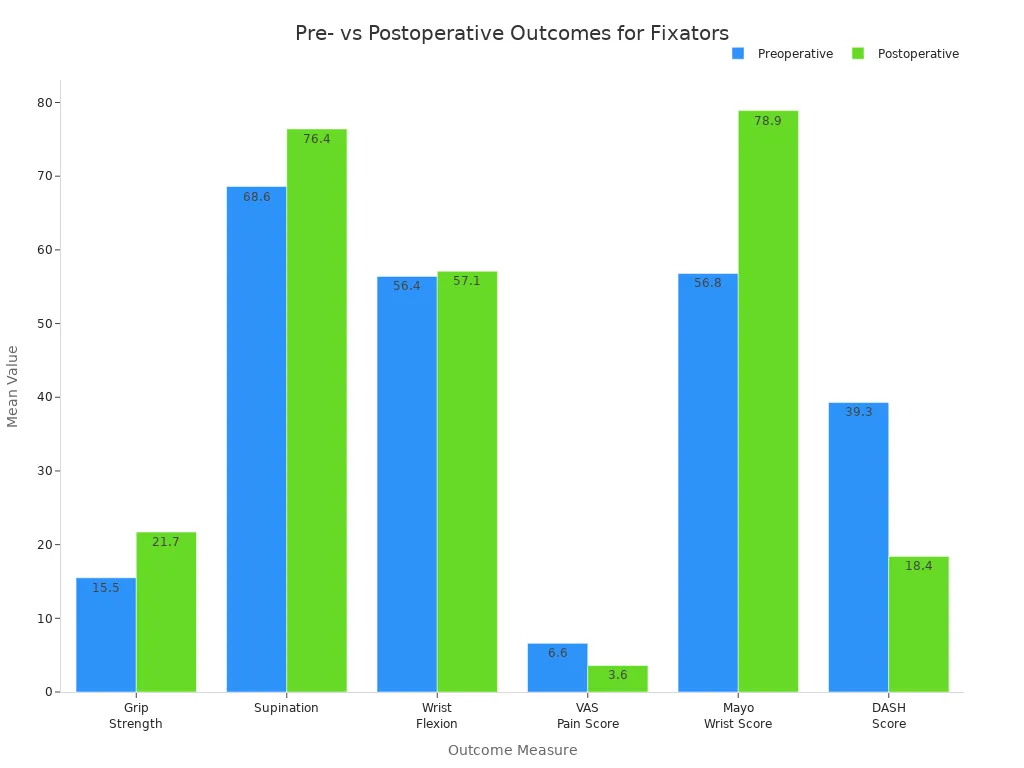
You want to know how fixators help healing and movement. The table below shows changes in grip strength, wrist movement, pain, and scores before and after using circular fixators.
Outcome Item | Preoperative Mean (SD) | Postoperative Mean (SD) | p-value |
Grip Strength (kg/F) | 15.5 (4.2) | 21.7 (4.7) | <0.001 |
Supination (degrees) | 68.6 (9.5) | 76.4 (8.4) | 0.029 |
Wrist Flexion (degrees) | 56.4 (11.3) | 57.1 (18.6) | <0.001 |
VAS Pain Score | 6.6 (1.3) | 3.6 (1) | <0.001 |
Mayo Wrist Score | 56.8 (21.1) | 78.9 (9) | 0.004 |
DASH Score | 39.3 (20.9) | 18.4 (11.6) | 0.003 |
You see better healing, less pain, and more movement after using circular fixators. These results show fixators help patients heal faster and move better.
Callout: When picking a circular fixator, look for strong healing, safety, and good results. Devices with rings and easy changes help fix hard breaks and make bones longer.
You can trust circular fixators for healing broken bones, making bones longer, and fixing bone shapes. These devices let doctors treat many bone problems and help patients get back to normal life.
Hardware and Software Innovations
Frame Design and Material Advances
Circular external fixators have changed a lot. New devices use better materials and smart designs. The Extremity Reconstruction Frame has rings that fit the body well. These rings make it easier to put in wires and pins. SpeedWire technology helps you connect wires to the ring quickly. This makes things safer and faster. New walking accessories help patients stay steady. They also help patients move while healing.
Here is a table that lists design features and their benefits:
Design Features | Advantages |
Ring structure | Supports bones all around and stops them from moving. |
Multiple fixation points | Spreads force out and lowers pressure on bones and tissues. |
Adjustability | Changes for different breaks and bone problems. |
Lightweight and durable | Gives strong support but is not heavy for patients. |
Easy to install and remove | Makes surgery quicker and less painful. |
Wide range of applications | Works for many kinds of breaks, even hard ones. |
Promoting healing | Helps bones heal faster and lowers risk of not healing. |
Reduce complications | Fewer problems like infections. |
Convenient for postoperative care | Makes it easier to care for yourself after surgery. |
External fixation devices help make limbs longer and heal bones. These features make fixators safer and more comfy for patients.
Adjustment Mechanisms and Software Integration
New fixators have better ways to adjust and smart software. 3D printed fixators match bone pins and help fix breaks without x-rays. This makes things more exact and lowers radiation. Adjustable stiffness with Voronoi shapes lets you change the device as bones heal. Computer simulations show how the device will work before surgery. You can make small changes for better bone alignment.
You can change how stiff the fixator is after surgery.
Many contact points give more support and keep bones steady.
Computer simulations help you make the device fit each break.
Tool-less fixator systems let you make changes quickly. Hexapod frames use software to help with hard bone problems and making bones longer. These new ideas help bones heal better and keep patients safe. Patients feel more comfortable and get better results with these advanced devices.
Clinical Evidence and User Experience
![Clinical Evidence and User Experience]()
Published Outcomes for Circular External Fixation
You want to know if circular external fixation helps people heal. Many studies check how patients do after using these devices for broken bones. Researchers looked at 15 studies about patient-reported outcomes. These studies show patients often heal better and move more easily. But the review found current ways to measure results do not show how patients really feel after using circular frames like the ilizarov circular external fixator. Experts say new tools are needed to measure healing and safety for these patients. Circular external fixation helps bones heal and lets people get back to normal life.
Patients using circular external fixators often heal better and move more.
Current ways to measure results do not always show how patients truly feel.
New ways to measure healing and safety are needed for these devices.
Surgeon and Patient Feedback
You want to hear what surgeons and patients think before picking a device. Surgeons say there are many hexapod systems, which can be confusing. They suggest learning one system well for the best healing. Companies compete to make better hardware and software. This helps patients heal and stay safe. Patients also talk about their experiences with circular external fixators. Most say their health gets better and they feel happier after treatment. Many would pick the same device again.
Observation | Description |
Confusion in Choice | Surgeons find many hexapod systems confusing at first. |
Positive Competition | Better hardware and software improve healing and patient outcomes. |
Importance of Mastery | Surgeons get better results when they master one system. |
70.5% of patients say their health improves after using external fixators.
Patients have better movement and feel happier after healing.
96.8% of patients using the ilizarov circular external fixator are satisfied.
91.7% would choose the same treatment again.
Tip: You can trust circular external fixation devices to help bones heal, keep patients safe, and give good results for both patients and surgeons.
Practical Considerations for External Fixators
Training and Learning Curve
You need good skills to use external fixators. The ilizarov circular external fixator needs careful training. Many surgeons think learning is hard at first. You must know the basics before you begin. If you skip training, you might have more problems. Practice with different circular external fixator frames helps you learn. This makes healing better for patients. Young surgeons often need extra help to get good at these techniques. Hospitals and companies give workshops and guides to help you learn faster.
You need to spend time to get good at using external fixation devices.
Knowing the basics helps you heal bones better and keeps patients safe.
Trying different fixators helps you make fewer mistakes.
Tip: Pick a device that has easy instructions and training help. This makes healing easier for you and your patients.
Technical Support and After-Sales Service
You want good technical support when you use external fixator systems. Top companies offer custom designs and special branding. You can talk to engineering teams for help. Fast prototyping and in-house tools help you get the right device. Quick technical support helps you fix problems fast. You get help with installation and after-sales service to keep fixators working well. Most products have at least a two-year warranty. You can trust high-quality orthopedic products that meet world standards.
You get many kinds of external fixation devices and implants.
After-sales support helps you keep healing safe.
Ordering is easy with good procurement and delivery services.
Note: Good technical support and after-sales service let you focus on healing. You do not need to worry about device problems.
Procurement and Value
You should think about procurement and value when picking circular external fixation. Look for products that heal bones well and keep patients safe at a fair price. Top suppliers have many fixators for different bone problems. Check if the device has CE/ISO standards. Good procurement services help you get the right device fast. Value means quality, support, and good results over time. You save time and money when you pick a trusted supplier for orthopedic trauma care.
Factor | What to Look For | Why It Matters |
Certification | CE/ISO standards | Makes sure it is safe |
Product Range | Many types of fixators | Helps with more problems |
Support | Training and after-sales service | Makes healing better |
Warranty | At least two years | Protects your purchase |
Procurement | Fast and reliable delivery | Saves time |
Callout: When you pick a circular external fixator frame, think about healing, safety, and support. These things help you get better results for your patients.
XC Medico Circular External Fixator Advantages
Superior Stability and Versatility
You want a device that holds bones steady. XC Medico’s circular external fixator frame is very stable. The ring shape keeps bones in place. It helps healing in hard cases. You can use these fixators for limb reconstruction and bone transport. They also work for fixing deformities. CE/ISO certification means the device is safe and high quality. You can trust these fixators for pelvic, ankle, femur, tibia, and knee problems. There are special models for ankles and lower legs. You can pick the right fixator for each patient.
Tip: Pick a circular external fixator frame that works for many bone problems. This helps you get reliable healing.
Innovative Features and User-Friendly Design
You want a device that is easy to use. XC Medico’s ilizarov circular external fixator uses new materials and smart systems. You can put the frame together fast. This saves time and lowers mistakes. The frame is light, so patients can move and heal better. Many fixation points give strong support and less pressure on tissues. The simple system means less training is needed. You can spend more time helping patients.
Feature | Benefit |
Adjustable rings | Helps line up bones exactly |
Lightweight materials | Makes patients more comfortable |
Quick assembly | Surgery goes faster |
Multiple models | Works for many needs |
Clinical Support and Global Reach
You need good support when using external fixators. XC Medico gives training, technical help, and after-sales service. You get guides and workshops to learn how to use the device. The company ships fast and offers custom orders for big buyers. You can count on global support and many product choices. Large buyers get easy ordering and trusted quality. CE/ISO certification means you can trust the safety and healing.
Note: XC Medico helps you reach your healing goals. You get better care for your patients with their support.
You can see circular external fixators help lower blood loss. Patients spend less time in the hospital. There are fewer infections with these devices than other ways. The table below shows these results:
Outcome Measure | Circular Fixator Group | Open Reduction and Internal Fixation Group |
Intraoperative Blood Loss (mL) | 213 | 544 |
Hospital Stay (days) | 9.9 | 23.4 |
Deep Infections | 0 | 7 (18%) |
Trauma centers should pick devices that are safe and easy to use. Good training and saving money are important too. XC Medico’s fixators help bones heal well. They also help patients move better. The total success rate is 95.2%. You can learn more or order by clicking below:
Pick XC Medico to give your patients the best care.
FAQ
What is a Circular External Fixator?
A circular external fixator holds broken bones together. The frame goes around your limb and helps healing. Doctors use it for hard fractures and fixing limbs. It keeps bones steady and lets doctors make small changes.
How does the ilizarov circular external fixator help bone healing?
The ilizarov circular external fixator presses evenly on the bone. You can adjust the frame to line up bones better. This helps bones heal faster and lets you move more after surgery.
Can you use a circular external fixator frame for different bones?
You can use a circular external fixator frame for many bones. Doctors pick these frames for the pelvis, ankle, femur, tibia, and knee. It works for lots of bone problems and deformities.
What support do you receive when choosing circular external fixation?
You get training and technical help when you choose circular external fixation. The supplier gives guides and workshops. You get quick shipping and custom orders. This support helps you use the device safely and well.
Why should large buyers consider CE/ISO certified circular external fixators?
Large buyers should pick CE/ISO certified circular external fixators for safety and quality. These certifications mean the device meets strict rules. You get good products, worldwide help, and trusted results for trauma care.