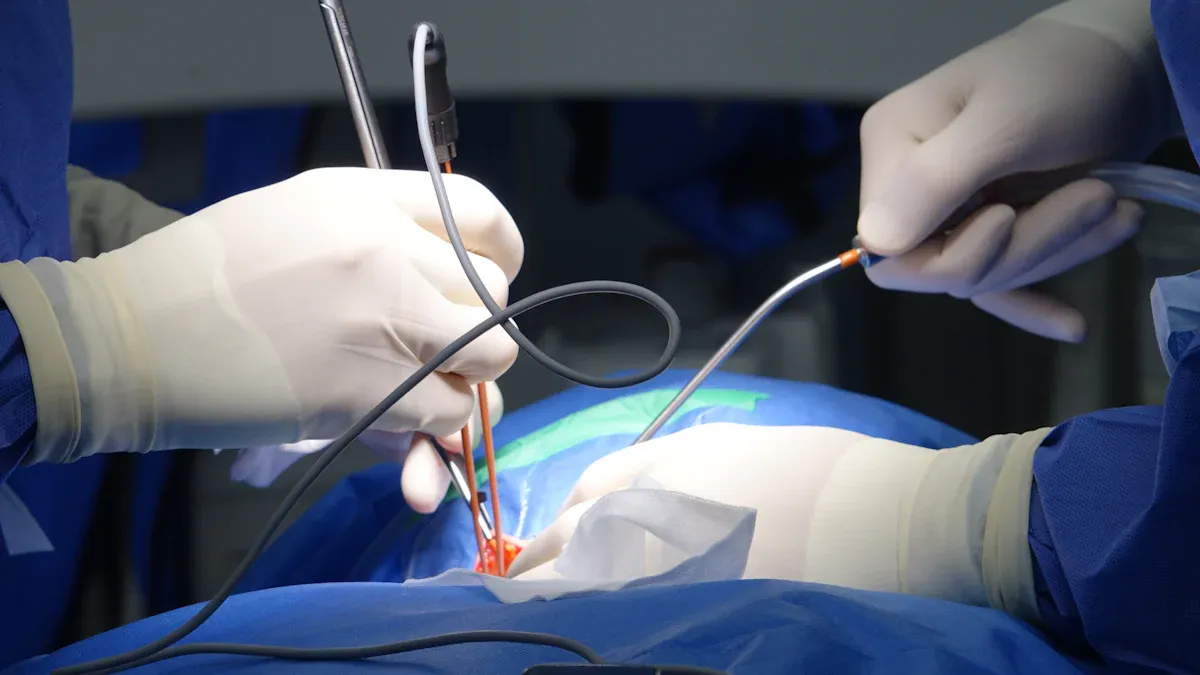
![A Comprehensive Guide to Arthroscopic Blades in Orthopedic Procedures]()
You use arthroscopic blades in arthroscopy to do careful surgery inside joints. These special tools help you hurt less tissue. This means patients heal faster and have fewer problems. Surgeons see quicker healing and fewer infections with good blades. Many doctors now use minimally invasive surgery. This shows why strong tools matter. XC Medico works on new ideas and quality. They give you tools that make surgery safer and easier every time.
Key Takeaways
Arthroscopic blades help lower tissue damage during surgery. This helps patients heal faster and have fewer problems.
Picking the right blade type, like straight, curved, hooked, or specialty, helps doctors work safely and carefully in different surgeries.
Custom arthroscopic shaver blades from XC Medico use new technology. They have built-in suction and two cutting windows. This makes surgery work better and faster.
Using arthroscopic blades in less invasive surgeries lowers pain and shortens recovery time. This makes surgeries safer and work better.
Buying XC Medico blades in large amounts saves money and helps the environment. It also gives good quality and strong support to healthcare workers.
Types of Arthroscopic Blades
![Types of Arthroscopic Blades]()
You use many kinds of arthroscopic blades in surgery. Each blade looks different and does a special job. You pick the blade based on what you need to do. The right blade helps you work safely and carefully. Here is a table that shows the main types of arthroscopic blades and how they are used:
Category | Description | Typical Applications |
Arthroscopic Shavers | Motorized tools that cut and clean soft tissue and bone. | Cleaning cartilage, trimming menisci, removing tissue, taking out bony growths. |
Arthroscopic Scissors | Small tools for cutting soft tissue very precisely. | Cutting soft tissue without hurting nearby parts. |
Arthroscopic Punches | Tools with sharp jaws for removing tissue. | Cutting meniscal pieces, taking out synovial tissue, cleaning labral tears. |
Straight Blades
You use straight blades to make neat and direct cuts. These blades help you take out tissue and trim the meniscus. You also use them to smooth cartilage and release ligaments. Straight blades come in many sizes. You pick the size for the area you need to reach. The edge can be straight, angled, or serrated. These blades give you better control and keep patients safe.
Curved Blades
Curved blades help you reach around corners inside the joint. You use them when straight blades cannot get to the spot. The curve lets you follow the joint’s shape. You get more control when working near delicate parts. Curved blades are good for trimming tissue and shaping cartilage.
Hooked Blades
You use hooked blades to grab and cut hard-to-reach tissue. The hook lets you pull tissue before you cut it. You use these blades for meniscus and ligament work. Hooked blades give you more control and protect healthy tissue. They help you stay safe during tricky surgeries.
Specialty Blades
Specialty blades are made for special surgical jobs. You use them for things like shaping bone or removing tough tissue. Some have two cutting edges or built-in suction. These features help you work faster and keep the area clean. You pick specialty blades when you need extra skill and speed.
Tip: Picking the right arthroscopic shaver blades for each surgery helps you do your best work and keeps patients safe.
Arthroscopy Surgical Applications
![Arthroscopy Surgical Applications]()
Arthroscopy helps doctors fix joint problems with small cuts. Patients feel less pain after surgery. Doctors use arthroscopic blades and arthroscopic shaver blades inside joints. These tools remove damaged tissue and fix ligaments. They also reshape cartilage or bone. Patients heal faster and have fewer risks. Doctors get better control during knee arthroscopy and other joint surgeries.
Tissue Removal
Doctors often need to take out damaged or loose tissue. Arthroscopic shaver blades help them do this very carefully. These blades clean cartilage and remove scar tissue. They also take out bone spurs. This process is called debridement. Doctors protect healthy tissue while working. They make the joint smoother and help it move better.
Here is a table that shows common procedures for tissue removal with arthroscopic blades:
Procedure | Description |
Rotator cuff tears | Doctors fix torn rotator cuff tendons by attaching them to bone. |
Shoulder impingement syndrome | Doctors remove tissue or bone spurs to relieve pressure on the rotator cuff. |
Osteoarthritis | Doctors take out extra cartilage or smooth bone spurs in the joint. |
Biceps tendon disease | Doctors release or attach the biceps tendon using arthroscopy. |
Other conditions | Doctors remove scar tissue or loose cartilage to help the joint work better. |
Doctors use arthroscopic shaver blades for all these cases. They get better results by removing only the bad tissue. They keep the rest of the joint safe.
Meniscus and Ligament Procedures
Knee arthroscopy is common for meniscus and ligament problems. Doctors use arthroscopic shaver blades for meniscectomy. This means they remove or trim a torn meniscus. This helps the knee work better. They also use these blades to clean cartilage and smooth rough spots. This is important for osteoarthritis.
Meniscectomy is one of the most common uses for arthroscopic blades in knee surgery. Doctors make precise cuts and protect healthy tissue. Patients return to normal activities faster. There is less risk of problems after surgery.
Cartilage and Bone Reshaping
Sometimes doctors need to reshape cartilage or bone. This helps the joint work better. Arthroscopic shaver blades give doctors the control they need. In knee arthroscopy, doctors smooth rough cartilage or remove bone spurs. They also use these blades in microfracture procedures. This helps new cartilage grow.
Here is a table that shows how doctors use arthroscopy for cartilage and bone reshaping:
Aspect | Details |
Surgical Position | The patient lies on their back with the knee bent at 90°. |
Procedure | Doctors check the cartilage problem with arthroscopy. Then they use blades to reshape the area. |
Microfracture Technique | Doctors make small holes in the bone to help new cartilage grow. |
Scaffold Details | Doctors may use a special membrane to help healing. |
Outcomes | Patients often feel less pain and move better after these procedures. |
In one case, a doctor uses a no. 11 scalpel blade to reshape a discoid medial meniscus. The patient moves their knee fully in one week. They feel no pain and go back to sports after surgery. This shows how arthroscopic blades help doctors get great results in cartilage reshaping.
Note: Arthroscopy helps doctors treat joint problems with small cuts and less pain. Patients recover faster. Doctors use arthroscopic shaver blades for meniscectomy, cartilage repair, and bone reshaping. This gives more safety and precision for patients.
Arthroscopic Shaver Blades Design & Materials
Cutting Technology
You want good results in arthroscopy. Custom arthroscopic shaver blades from XC Medico use new cutting technology. These blades help you be more precise and careful. Some new blades have suction and two cutting windows. This keeps the area clean and removes debris fast. You can work quicker and keep patients safer.
Here is a table that shows how these features help:
Feature | Benefit |
Integrated suction | Keeps your view clear and reduces debris |
Dual cutting windows | Lets you cut and remove tissue at the same time |
Optimized suction channel | Prevents clogging and keeps the joint clean |
New custom arthroscopic shaver blades have diamond-coated edges. This makes them last longer. Some blades also shake less and are easier to control. Some systems use robots for even better accuracy. Better fiber optic and LED lights help you see more clearly during surgery.
Material Quality
You need blades that are strong and last long. Custom arthroscopic shaver blades from XC Medico use tough metals for the shaft and tip. This makes them strong and hard to break. The grip uses special plastic, so it feels better in your hand. The inside blades are even stronger. This means they work well in hard surgeries. The blades do not rust, so you can use them longer.
Here are the main materials used in custom arthroscopic shaver blades:
Metal shafts and tips for strength
Composite plastic grips for comfort
High-strength inner blades for reliability
Corrosion-resistant surfaces for longer use
XC Medico checks every blade to make sure it is safe. The company follows rules for quality and safety. They work on new ideas and keep their supply chain strong.
Ergonomic Features
Doctors work for many hours in surgery. Custom arthroscopic shaver blades from XC Medico have features to help you stay comfortable. The handpieces are light and easy to hold. The grips fit your hand and help you not get tired. The surface does not slip, so you hold it tight. Buttons let you change what the blade does quickly. You can cut forward or backward with the blade.
Here is a table showing ergonomic features and their benefits:
Feature | Description |
Lightweight handpiece | Easy to use for long surgeries |
Ergonomic contours | Fits your hand and reduces tiredness |
Anti-slip surface treatment | Keeps your grip steady |
Manual control button | Lets you change functions quickly |
Bidirectional blade interface | Supports both forward and reverse cutting |
Durable construction | Handles high temperatures and pressure during cleaning |
Custom arthroscopic shaver blades work fast to remove tissue. Less shaking means your hand does not get tired. You can be more precise. XC Medico makes sure the blades work with most surgical systems. You get spare parts fast and can join training programs. The company gives you clinical data and helps you use the blades with your equipment.
Tip: Picking custom arthroscopic shaver blades from XC Medico gives you safety, comfort, and precision. You get tools you can trust for great results in arthroscopy.
Benefits of Arthroscopic Blades
Precision & Control
Doctors want the best results in surgery. Arthroscopic blades help them be very precise. They can make tiny cuts and reach small spaces. Custom arthroscopic shaver blades let doctors work with great accuracy. They only remove damaged tissue and keep healthy parts safe. The table below shows how arthroscopic shaver blades are different from regular tools:
Feature | Arthroscopic Shavers | Traditional Surgical Tools |
Incision Size | Small incisions, minimally invasive | Larger incisions, more invasive |
Trauma Level | Less trauma and scarring | More trauma and scarring |
Recovery Time | Faster recovery | Longer recovery |
Precision in Treatment | High precision for micro-traumas | Lower precision for micro-traumas |
Cutting Power | Different cutting tips for varying efficiency | Standard cutting tools |
Removal of Debris | Effective suction and flushing capabilities | Limited debris removal |
Adaptability | Various cutting tips for specific needs | Less adaptability in cutting techniques |
Minimally Invasive Advantages
Arthroscopy has many good points. Arthroscopic blades let doctors use small cuts. Patients feel less pain and heal faster. Custom arthroscopic shaver blades help lower bleeding and infection risk. Studies show these blades make surgery safer and recovery quicker.
Study Title | Findings |
The Role of Arthroscopy As Minimal Invasive for Shoulder Trauma | Shows shoulder arthroscopy has fewer problems and faster healing than open surgery. |
The hidden blood loss and its factors in patients undergoing minimally invasive knee arthroscopy | Proves knee arthroscopy causes less damage and less bleeding. |
The role of in-office needle arthroscopy in orthopedic practice | Finds needle arthroscopy helps patients and is less invasive. |
Improved Outcomes
Doctors want patients to get better quickly. Arthroscopic blades and custom arthroscopic shaver blades help with this. There are fewer problems and better results. Studies show patients heal faster and spend less money when doctors use these blades. Special shaver blades for shoulder arthroscopy make hard surgeries easier. Many hospitals use these blades to help patients do better.
Improvement Metric | Description |
Recovery Times | Studies show patients heal faster |
Procedural Costs | Using reusable blades saves about 15% in costs |
Surgical Efficiency | More precision means fewer problems |
Value for Bulk Buyers
Buying custom arthroscopic shaver blades in bulk from XC Medico saves money. You get good prices, strong quality, and helpful support. Reusable blades help save money over time and are better for the environment. XC Medico gives strong warranties and quick help. Hospitals and clinics can trust these products.
Key Point | Description |
Cost Reduction | Reusable arthroscopy blades help hospitals save money. |
Sustainability | Reusable blades are better for the environment. |
Technological Advancements | New ideas make blades work better and easier to use. |
Market Growth | More joint problems mean more need for good blades. |
Good prices
Strong quality
Fast help and warranties
Tip: Picking custom arthroscopic shaver blades from XC Medico gives you safety, precision, and great value for your hospital or clinic.
You need good arthroscopic blades to keep surgery safe and work well. When picking blades, check if they fit your handpiece. Make sure they stay sharp for a long time. Look for strong materials like stainless steel. Pick a design that matches your surgery. Think about how to lower infection risks.
XC Medico uses smart designs and tough materials to help you do better in surgery. The table below shows how these things help you succeed:
Key Factors | Description |
High-Quality Blades | Help you be more exact and get better results |
Ergonomic Design | Make it easier and more comfortable to use |
International Quality | Have CE and ISO 13485 certificates |
You can count on XC Medico for tools you can trust. If you buy a lot, you get good quality, world certificates, and expert help. Pick XC Medico to give your patients the best care.
FAQ
What makes XC Medico arthroscopic blades different?
These blades use strong materials and new cutting technology. XC Medico checks each blade for quality. This helps doctors get safer surgeries and better results.
Can you use XC Medico blades with most surgical systems?
Yes, these blades work with many surgical handpieces. You can set them up quickly in your operating room. They fit easily with popular systems.
How do you order arthroscopic blades in bulk?
You talk to XC Medico’s sales team to order blades. They help you pick the right ones and give special prices for big orders. You get fast shipping and good support.
Are XC Medico blades safe for repeated use?
These blades are made from tough, rust-proof materials. You can clean and sterilize them many times. They work well for lots of surgeries.
What support does XC Medico offer to international buyers?
You get expert help and training for their products. XC Medico answers your questions fast and gives strong warranties. They ship quickly to buyers around the world.