
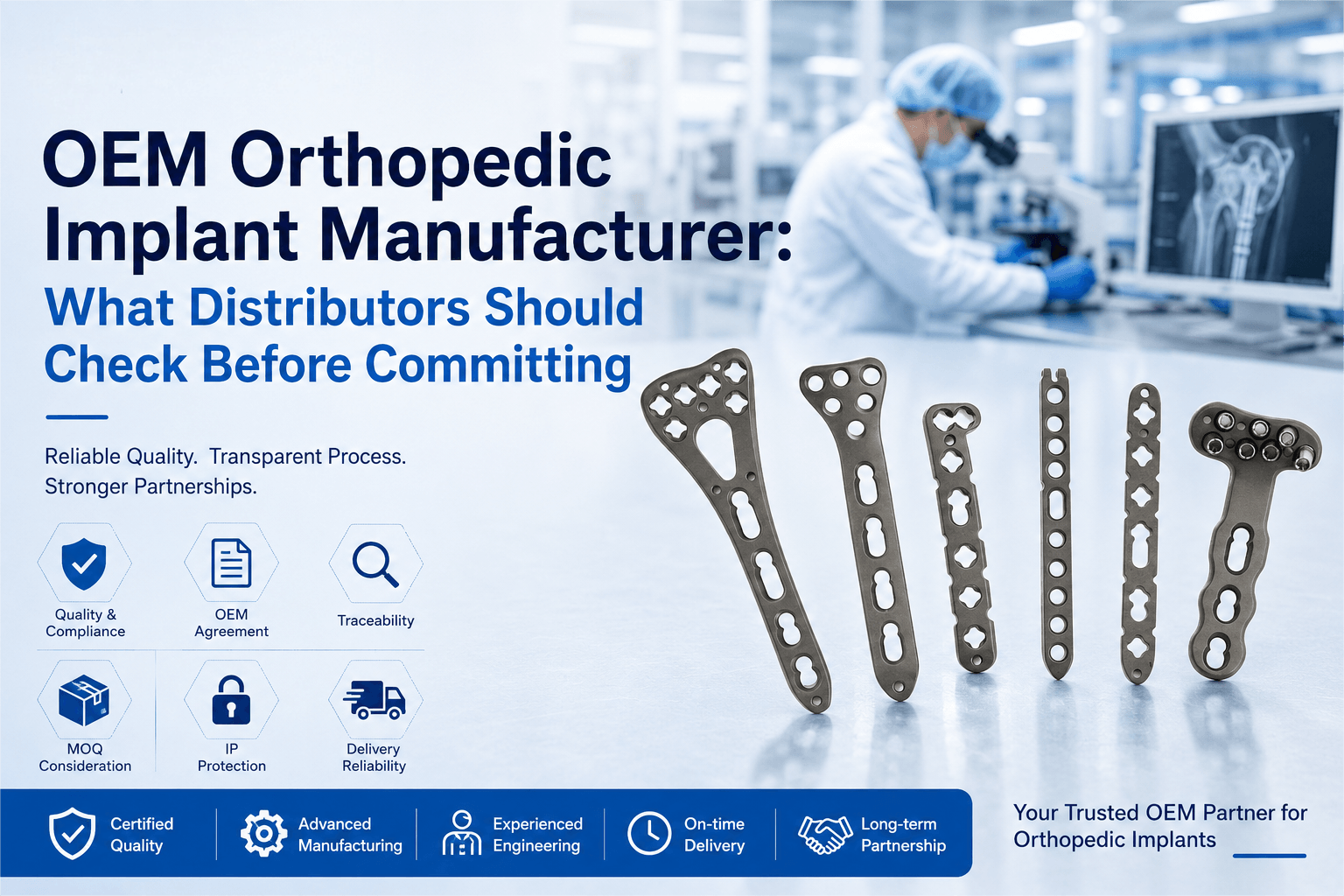
Choosing an OEM orthopedic implant manufacturer usually starts with a simple question: can this supplier make the product at the right price?
That question matters, but it is rarely the question that decides whether the partnership works. In orthopedic implants, the problems usually appear later — during registration, hospital evaluation, repeat ordering, or after a distributor has already printed the catalog and trained the sales team.
A lower unit price can disappear quickly if the certificate scope is unclear, the technical file is incomplete, or a shipment misses the tender window. This is why experienced distributors tend to look beyond the quotation sheet. They ask how the manufacturer handles documentation, traceability, customization, inventory, and responsibility when something does not go exactly as planned.
The points below are the areas worth checking before a contract is signed. They are not theoretical. They are the parts of an OEM relationship that usually become expensive when they are left vague.
1. Start with the certificate scope, not the certificate logo
Most manufacturers can show a certificate. Fewer can immediately explain what that certificate covers.
For a distributor, this distinction is important. An ISO 13485 certificate on the website does not automatically mean every implant category, every production site, and every export market is covered. A supplier may have valid documentation for trauma plates but a weaker documentation package for spine systems. Another may have strong CE documentation, but limited experience supporting registration in markets that require additional local files.
Before comparing prices, ask for the full certificate scope and the related annexes. The review should confirm whether the manufacturer can support the exact product family you plan to register, not just whether the company has a general quality certificate.
For most international orthopedic distributors, the documentation review normally starts with:
- ISO 13485 — check the product categories and manufacturing activities listed in the scope
- CE Mark — confirm whether the product family is included and whether the documentation supports your EU or related market strategy
- FDA 510(k) — relevant when the US market is part of the plan
- MDSAP — useful for distributors working with Canada, Brazil, Australia, Japan, or other markets where MDSAP can influence registration
This is also a good moment to test the supplier's regulatory communication. A capable OEM partner should be comfortable discussing scope, technical files, labeling, and market registration requirements in specific terms. If every answer stays general, that is a warning sign.
For a broader overview of quality-system expectations, see XC Medico's ISO 13485 certified orthopedic manufacturer capability page.
2. Clarify what “OEM” really means in this project
The word OEM is used very loosely in the orthopedic supply market.
Sometimes it means true product development: the distributor brings a requirement, a design idea, or a clinical preference, and the manufacturer helps turn it into a manufacturable implant system. In other cases, it simply means logo marking on an existing catalog product. That second model can still be useful, but it is closer to private labeling than full OEM manufacturing.
The commercial difference is obvious. The regulatory and legal difference is even more important.
If the project involves real customization, the manufacturer should be able to explain how engineering review, sample production, design verification, labeling, and documentation will be handled. If the project is mainly private label, the supplier should be clear about what can and cannot be changed without affecting the existing validation package.
| Project Stage | Questions Worth Asking |
|---|---|
| Design Review | Can the manufacturer modify an existing system, or are they only offering a catalog product with brand marking? |
| Prototype / Sample | How long does sampling take, and what tolerances can realistically be maintained in production? |
| Documentation | Which files can be provided for registration, and which files remain controlled by the manufacturer? |
| Scale-up | Can the factory handle repeat orders if the line is adopted by more hospitals? |
| After-sales Support | How are batch records, complaints, adverse event information, and CAPA-related communication handled? |
There is nothing wrong with starting from a validated design and building a private-label program around it. For many distributors, that is the fastest and lowest-risk route. The problem is when both sides call the project “OEM” but have different expectations about ownership, customization, documentation, and responsibility.
3. Traceability is where cheap supply often becomes expensive
In daily negotiations, traceability may sound like a quality department topic. In real distribution work, it is a sales and risk topic as well.
Hospitals and regulatory bodies may ask where the material came from, which batch it belonged to, whether the inspection records match the shipment, and whether the implant can be traced back through the production chain. If the manufacturer cannot answer those questions cleanly, the distributor is left trying to explain a product it did not manufacture.
For orthopedic implants, the material file should not be treated as a formality. Ask for examples of the actual documents the supplier provides with or after shipment. A serious manufacturer should be able to show how the material certificate, in-process inspection record, final inspection, and laser marking connect to one another.
Key items to review include:
- Raw material certificates — for example, titanium alloy documentation such as ASTM F136 / Ti-6Al-4V ELI or equivalent standards where applicable
- In-process inspection records — dimensional checks, surface finish checks, and lot-level inspection records
- Mechanical test reports — especially for load-bearing implants where fatigue or strength data may be required; ask whether fatigue testing can be performed according to ISO 12189 or equivalent methods
- Laser marking and batch traceability — each implant should be traceable to the related production batch
For higher-risk implant categories, testing capability is worth checking in more detail. XC Medico's quality system is supported by a CNAS-accredited laboratory, with equipment such as Instron fatigue testing machines, CMM inspection equipment, and 3D topology measurement tools. For distributors, this matters because test reports and inspection records are not only internal factory files; they often become part of the evidence used during product registration, hospital evaluation, and post-market quality review.
4. MOQ is not just a purchasing number
MOQ looks like a small commercial detail until a distributor tries to launch a new implant line.
A large MOQ may be acceptable for a mature product with stable hospital demand. It is much harder to justify when the distributor is still testing surgeon acceptance, building instrument sets, preparing registration, or entering a new region. In that stage, the wrong MOQ can tie up cash in slow-moving SKUs before the market has proved itself.
This is why MOQ should be discussed together with the launch plan, not separately. A manufacturer that understands distributor economics will usually be open to phased ordering: samples first, then a limited initial order, then volume pricing as adoption grows.
This is also where XC Medico's OEM/ODM model is intentionally different: customized orthopedic implant projects can be supported from 1 set MOQ. For distributors entering a new market, that removes a major barrier created by traditional suppliers who ask for large first orders before surgeon acceptance, registration progress, or hospital demand has been proven.
Before committing, clarify:
- MOQ per SKU for standard private-label products
- Whether customized OEM/ODM orders can start from 1 set, especially during market testing
- MOQ for customized implants, instruments, packaging, and labeling after the first validation stage
- Sample terms before the first production order
- Lead time for first order versus repeat orders
- Whether pricing can improve as annual volume becomes clearer
A supplier who only pushes for a large first order may be optimizing for factory output rather than your market entry. A better OEM partner helps the distributor reduce launch risk while still creating a path toward scale. In practical terms, 1-set starting orders give the distributor room to test product fit, confirm documentation, prepare local registration, and approach hospitals without locking cash into a full system too early.
For more supplier-selection considerations, you can also read XC Medico's guide on choosing the best orthopedic manufacturers for distributors.
5. Put IP terms in writing before the first drawing is sent
IP protection is often discussed too late.
At the early stage, both sides may feel the relationship is friendly and straightforward. The distributor wants a quick quotation. The manufacturer wants to show capability. Drawings, customer information, packaging ideas, and market plans start moving back and forth before the contract language is ready.
That is not a good habit.
Before sharing sensitive files, the basic rules should already be written down. This does not need to be complicated, but it does need to be explicit. The agreement should state who owns custom designs, how confidential information is handled, and whether the manufacturer is restricted from supplying identical configurations to competitors in the distributor's protected territory.
At minimum, discuss these points:
- NDA — signed before design files, customer information, or market plans are shared
- Design ownership — especially for products developed from the distributor's specifications
- Territory protection — where appropriate, clarify whether identical OEM configurations can be sold to direct competitors
- Audit and documentation rights — define what quality and production records can be reviewed
Most disputes do not begin because one side expected trouble. They begin because the important terms were assumed rather than written.
6. Delivery reliability matters most after the first order
The first shipment often receives the most attention. Samples are prepared carefully, communication is fast, and both sides want the project to move forward.
The better test is what happens after the distributor starts selling.
Can the manufacturer keep standard items in stock? Are repeat orders predictable? Can the supplier separate urgent hospital demand from normal replenishment? If an implant system requires instruments, are those instruments available when the implants are sold?
These details matter because distributors do not only sell products. They also sell confidence to surgeons, hospitals, and purchasing teams. A private-label program that looks profitable on paper can become difficult to defend if stockouts are frequent or lead times change without warning.
Before signing an OEM agreement, ask for:
- Typical lead time for standard catalog items
- Lead time for customized production runs
- Inventory coverage for the product families you plan to promote
- On-time delivery performance from recent distributor orders
- Production capacity and current utilization
The goal is not to find a supplier who promises everything. The goal is to find one whose commitments are specific enough to plan around.
As a reference point, XC Medico's orthopedic manufacturing capacity exceeds 200,000 sets per year. Together with high inventory coverage for standard catalog items and fast shipment planning for in-stock products, this gives distributors more room to handle repeat orders, tender demand, and urgent replenishment without rebuilding the supply plan from zero each time.
A practical pre-contract review
Before moving from quotation to contract, it helps to slow the process down and check the areas that usually create problems later:
- Certificate scope matches the product categories and target markets
- The OEM/ODM model is clearly defined before pricing is finalized
- Sample traceability documents are reviewed, not just promised
- MOQ supports a realistic distributor launch plan, including whether 1-set starting orders are available
- NDA, design ownership, and territory terms are written into the agreement
- Lead times and inventory coverage are specific enough for hospital supply planning
Working with the right OEM partner
A good OEM orthopedic implant manufacturer does more than produce implants. It helps the distributor reduce uncertainty before the products reach hospitals.
That means clear documentation, realistic production planning, stable quality control, and a commercial structure that fits the way distributors actually grow. In many cases, the best partner is not the one with the lowest first quotation. It is the one that makes registration, launch, replenishment, and long-term support easier to manage.
XC Medico supports OEM and ODM programs across spine, trauma, joint, and CMF categories, with product development, sample preparation, regulatory documentation support, and scaled production for distributor-led projects. For customized OEM/ODM orders, the program can start from 1 set MOQ, allowing distributors to test the line before committing to larger system-wide inventory.
Explore the spine implant manufacturer and trauma implants supplier product lines, or download product specifications and technical documents before starting your supplier review.
Planning an OEM or private-label orthopedic implant program? Share your product category, target market, and launch timeline with the XC Medico team.

