


PEEK Spinal Cages at a Glance
A PEEK cage is an interbody fusion implant made from polyetheretherketone. It occupies the prepared disc space, provides structural support and accommodates bone graft. Cervical and lumbar versions differ in shape, dimensions, insertion instruments and fixation requirements; they are not interchangeable.
For distributors and hospital buyers, the useful comparison is more specific than “PEEK versus metal.” Check the surgical approach, cage footprint, height, lordotic angle, surface treatment, imaging markers and instrument set. This guide brings those checks together with published XC Medico size examples.
Start with the product range
Browse cervical and lumbar PEEK cages or compare interbody fusion cage options. Use the specifications below to prepare a model-specific enquiry.
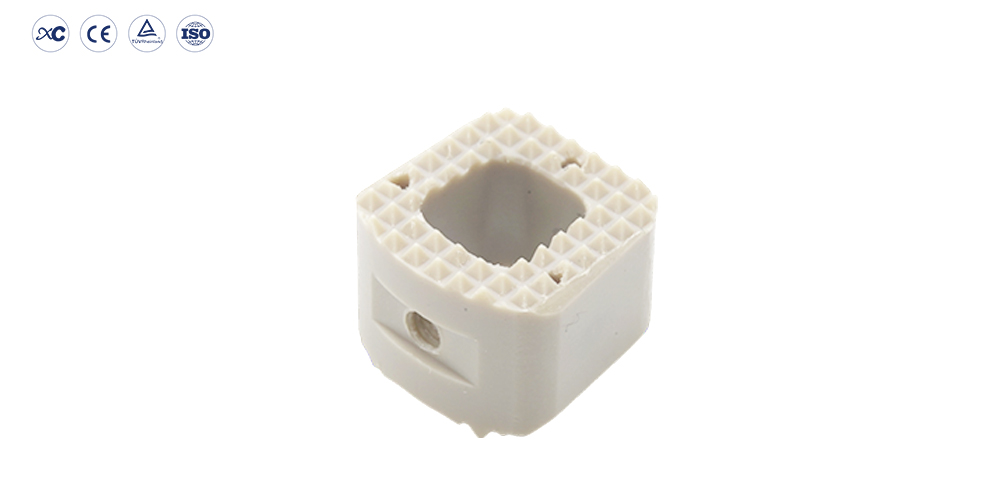
PEEK vs Titanium and Titanium Coated PEEK Cages
Unfilled PEEK is less stiff than solid titanium alloy and is radiolucent. These are useful material properties, but they do not establish that a finished cage produces better fusion or less subsidence. Cage geometry, surface design and the overall construct also matter. [1]
| Comparison | Unfilled PEEK | Titanium coated PEEK | Titanium including porous designs |
|---|---|---|---|
| Material structure | Polymer cage body. | PEEK core with a titanium surface layer. | Metal body; solid and porous architectures differ. |
| Mechanical behaviour | Lower material stiffness than solid titanium. | Behaviour depends on core geometry and coating design. | Porosity can reduce effective cage stiffness; bulk metal values do not describe every porous cage. |
| Bone interface | Unmodified PEEK has limited intrinsic bone bonding. | Coating aims to improve the bone-facing interface. | Surface texture and porosity can support bone attachment or ingrowth. |
| Imaging | Radiolucent body; markers help identify position. | Imaging appearance depends on coating and markers. | Metal can obscure adjacent structures; design and scanning technique affect visibility. |
| What to request | Material grade and traceability, marker diagram, device test reports. | Coating coverage, adhesion and wear evidence, plus core material records. | Porosity and surface specifications, device testing and representative imaging. |
Material and design references: [1–3]. These are selection considerations, not a ranking of clinical performance. HA-enhanced, carbon-fibre-reinforced and titanium-coated PEEK are distinct modifications and should not be described as ordinary unfilled PEEK. [2] [3]
Why “bone-like” does not mean flexible like a natural joint
A fusion cage is intended to support a fusion construct, not reproduce normal disc motion. Material stiffness and the stiffness of a complete implant are different quantities. Bone properties also vary with anatomical region, density and test direction. A single “bone modulus” number is therefore a poor purchasing specification. [1]
Can one material be called clinically superior
Comparative research concerns particular devices, procedures and follow-up intervals. A prospective controlled trial comparing 3D-printed titanium and PEEK cages illustrates why implant-interface findings and clinical outcomes should be evaluated separately. Its results should not be transferred to every cage sold under either material label. [4]
Cervical and Lumbar PEEK Cage Types
| Approach | Product configuration to review | Purchasing focus |
|---|---|---|
| ACDF — anterior cervical discectomy and fusion | Cervical interbody cage; separate plate fixation or an integrated fixation device, as specified. | Footprint, height, endplate contour, fixation method and matching trials. |
| TLIF — transforaminal lumbar interbody fusion | Lumbar cage designed for the transforaminal insertion route. | Straight or curved geometry, insertion interface and available heights. |
| PLIF — posterior lumbar interbody fusion | Lumbar cage system intended for a posterior approach. | Intended cage configuration, preparation tools and compatible fixation. |
| ALIF / OLIF — anterior or oblique lumbar interbody fusion | Approach-specific cage systems with different access and instrument requirements. | Footprint, lordosis, access instruments and supplementary fixation requirements. |
These labels describe different systems, not a universal cage that can be used through any approach. Review the ACDF implant and instrument solution, TLIF and MIS-TLIF systems and PLIF surgical solution when planning procedure-based inventory.
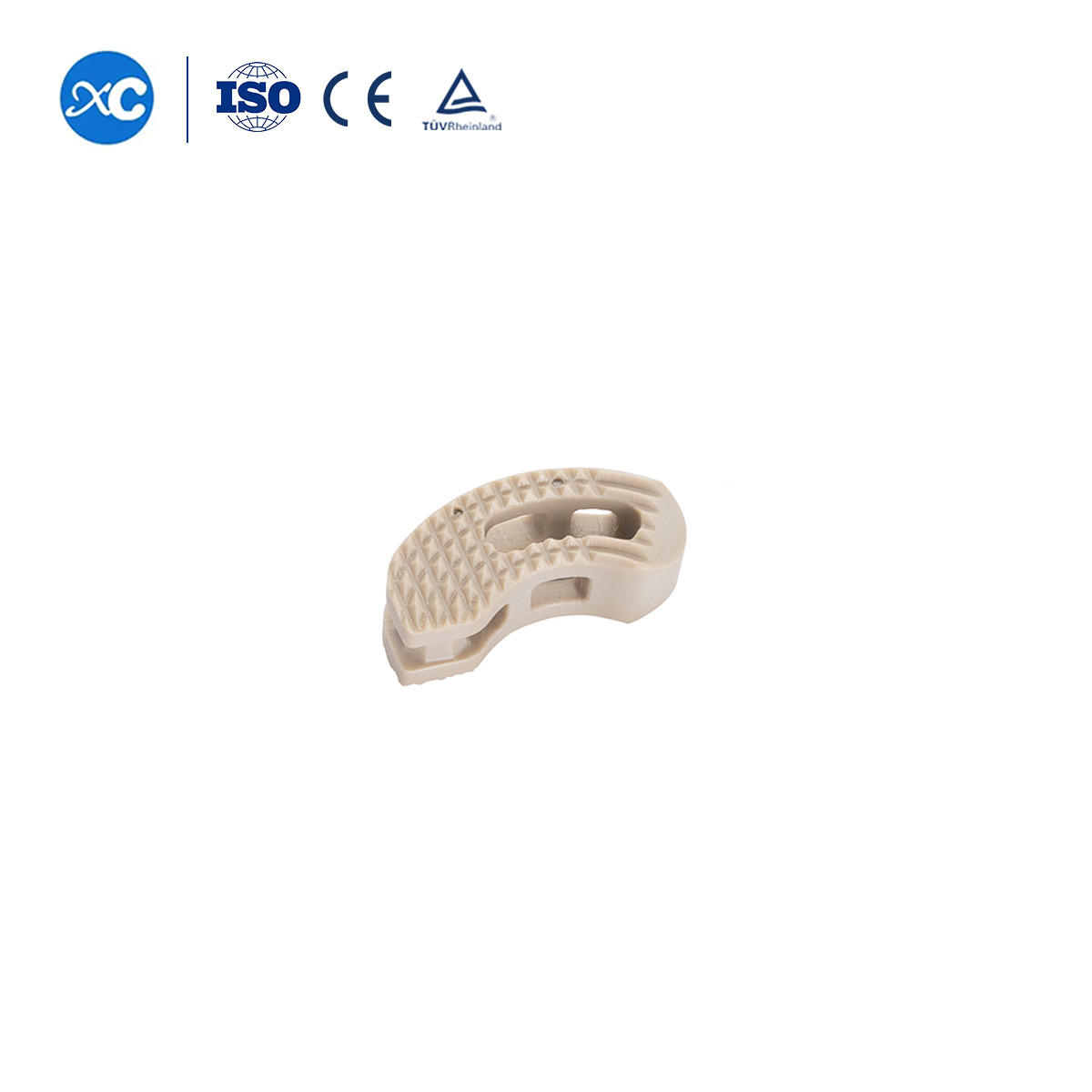
PEEK Cage Sizes and Published Product Specifications
The examples below reproduce selected specifications from XC Medico product pages reviewed on October 15, 2026. They are a starting point for catalogue matching, not a complete stock list or a clinical sizing recommendation. [5] [6]
| Product | Catalogue reference | Published specification | Confirm before ordering |
|---|---|---|---|
| Cervical PEEK cage | JQPEEK4 through JQPEEK10 | 4, 5, 6, 7, 8, 9 and 10 mm | Dimension definition, footprint, lordosis and instrument compatibility. |
| Cervical PEEK cage II | JQ2PEEK4 through JQ2PEEK8 | 4, 5, 6, 7 and 8 mm | Footprint and geometry differences from the standard cervical series. |
| TLIF PEEK cage | TLIF0D7X10 | 7 × 10 × 28 mm / 0° | Confirm dimension order against the technical drawing. |
| TLIF PEEK cage | TLIF5D10X10 | 10 × 10 × 28 mm / 5° | Confirm current material specification and corresponding trial. |
| TLIF PEEK cage | TLIF0D7X12 | 7 × 12 × 32 mm / 0° | Confirm footprint and insertion interface. |
| TLIF PEEK cage | TLIF5D12X12 | 12 × 12 × 32 mm / 5° | Confirm current availability and instrument set. |
View the cervical PEEK cage specifications and TLIF PEEK cage catalogue for the product families. Request the current controlled specification sheet before issuing a purchase order; catalogue text alone is not the final technical agreement.
A complete size list needs more than cage height
Ask for length, width, height definition, lordotic angle and the full catalogue reference for each variant. Include the corresponding trial reference and insertion-tool interface in the same list. This makes it easier to identify gaps in an opening instrument set and avoid ordering a cage that the supplied inserter cannot handle.
PEEK Cage Imaging on X Ray CT and MRI
Radiolucency means the polymer body is relatively transparent to X-rays. It can help show graft and adjacent bone, while radiopaque markers provide positional reference. It does not mean the entire implant construct is invisible or that scans are always free of artefacts. [7]

| Modality | Useful information | Important limitation |
|---|---|---|
| X-ray | Overall alignment and radiopaque marker position. | The PEEK body is poorly visible; one radiograph alone does not establish fusion. |
| CT | Assessment of bridging bone and the cage–endplate region. | Metal markers and surrounding hardware can still create artefacts. Interpretation depends on acquisition and reconstruction. |
| MRI | Assessment of neural and soft-tissue structures when clinically indicated. | Check device-specific MR labelling for the complete construct; a PEEK material label is not an MR safety determination. |
For published imaging examples, see the figures in the prospective titanium-versus-PEEK comparison. For CT assessment principles and illustrated cases, see CT Evaluation of Lumbar Interbody Fusion. These are external educational references, not XC Medico clinical results. [4] [7]

Imaging information to request from a supplier
Request the marker layout, an annotated example explaining cage orientation, and device-specific imaging instructions. If clinical images are supplied, ask for the model, procedure, follow-up interval and permission to use the anonymised images. Keep product photographs, educational illustrations and patient outcomes clearly separated in sales materials.
What to Check Before Buying PEEK Spinal Cages
| Purchasing item | Information to request | Decision it supports |
|---|---|---|
| Material and surface | Exact polymer grade, material certificate, batch traceability and any coating specification. | Distinguishes the actual product from a generic “PEEK” description. |
| Implant documentation | Current catalogue, drawings, intended use and instructions for use. | Connects each requested size to an identifiable device. |
| Mechanical evidence | Device-specific static and fatigue reports and relevant worst-case configurations. | Checks evidence for the supplied design rather than raw material alone. |
| Imaging | Marker map, representative imaging and applicable MR labelling. | Supports accurate technical information for customers. |
| Instruments | Tray list, trials, inserters, preparation tools and replacement-part references. | Defines the usable system and replenishment plan. |
| Packaging and processing | Sterile or non-sterile supply status, applicable processing instructions, shelf life and labels. | Prevents a mismatch between delivery configuration and hospital requirements. |
| Market documentation | Country-specific product coverage and documentation for the exact supplied models. | Helps the importer establish whether the intended sales route is supported. |
| Commercial scope | Size mix, quantity by reference, lead time, quotation validity and instrument charges. | Makes supplier quotations comparable. |
For price comparison, separate implants, instrument trays, replacement instruments, packaging and shipping in the quotation. A low cage unit price can still create a costly programme if the opening size mix is incomplete or instruments are difficult to replenish. Treat this as a purchasing framework; the actual requirements depend on the product and destination market.
Source PEEK Cage Systems from XC Medico
Prepare an enquiry around the procedure and required size mix. XC Medico lists cervical and lumbar PEEK cage products; request the current model specification, matching instruments and available documentation for your destination market.
Send these five details
Target country · Cervical or lumbar procedure · Required catalogue references or dimensions · Quantity by size · Instrument set requirements
Frequently Asked Questions About PEEK Cages
What is a PEEK cage used for?
It is an interbody fusion implant that provides structural support in the prepared disc space and accommodates bone graft. The intended procedure and any supplementary fixation requirements depend on the specific device.
Is a PEEK cage better than a titanium cage?
There is no universal winner. Compare the complete device, surface, footprint, imaging characteristics, procedure-specific evidence and instrument requirements. Material identity alone cannot predict the outcome.
Can a PEEK cage be seen on X-rays?
The polymer body is relatively radiolucent. Radiopaque markers can help show position, while associated screws or plates may also be visible. Marker placement should be explained in the device documentation.
What sizes are available?
Sizes vary by system. The published XC Medico examples above include cervical references listed at 4–10 mm and selected TLIF dimensions. Confirm the current drawing, dimension order, footprint and angle for every reference.
Are all PEEK cages suitable for MRI?
Do not infer MR status from the polymer alone. Follow the device-specific labelling for the cage and every component of the implanted construct.
What should a distributor request first?
Start with the current catalogue, a size-by-reference list, the instrument tray contents, product documentation for the target market and a quotation separating implant and instrument costs.
Sources and Product References
- Kurtz and Devine. PEEK Biomaterials in Trauma, Orthopedic, and Spinal Implants. 2007. Material properties and their limitations.
- Invibio. Implantable PEEK material families. Material modifications are not interchangeable.
- Patel et al. Three-Dimensional-Printed Titanium Versus Polyetheretherketone Cages for Lumbar Interbody Fusion. Neurospine, 2023. Comparative evidence review.
- Deng et al. Comparison between Three-Dimensional Printed Titanium and PEEK Cages for Cervical and Lumbar Interbody Fusion. Orthopaedic Surgery, 2023. Prospective controlled trial and imaging examples.
- XC Medico. Cervical PEEK cage product page. Published catalogue references and specifications.
- XC Medico. TLIF PEEK cage product page. Selected published catalogue dimensions.
- Williams et al. CT Evaluation of Lumbar Interbody Fusion. AJNR, 2005. Imaging principles and illustrated examples; not a current device clearance source.
Updated October 15, 2026. This article supports product research and procurement. General material evidence does not establish the performance or market authorisation of an individual XC Medico device. Clinical selection follows the applicable instructions for use and professional assessment.

