Top 7 Intramedullary Nail Brands and Manufacturers in 2026
Views: 0 Author: Site Editor Publish Time: 2026-10-13 Origin: Site
Comparing Intramedullary Nail Systems for Distributor Procurement
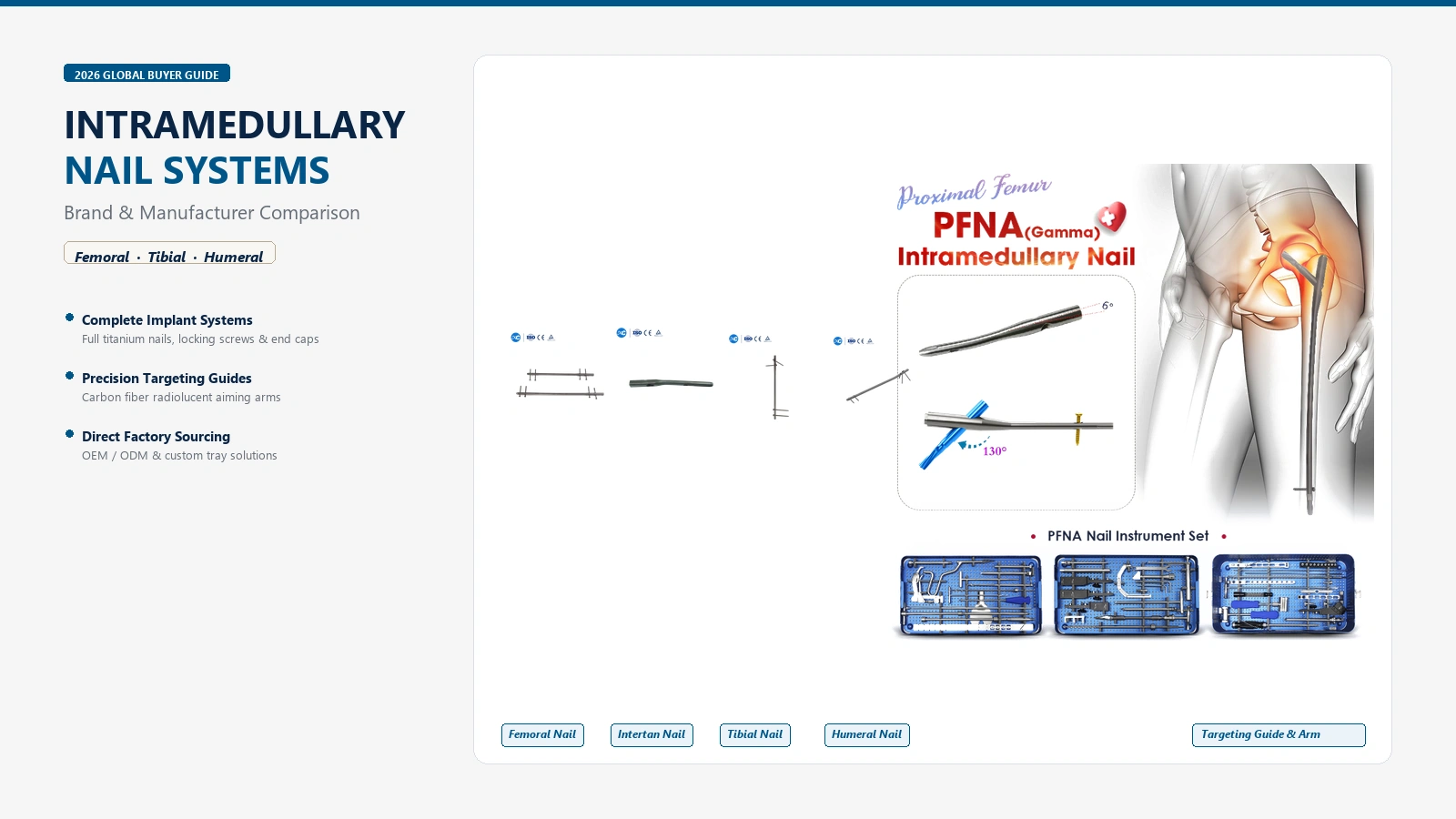
An intramedullary nail system combines a rod placed inside a bone’s medullary canal with locking components and dedicated instruments to stabilize selected fractures while supporting load transfer during healing. Its central position can provide load-sharing fixation, while suitable techniques can limit fracture-site exposure. However, nailing is not a universal solution for every fracture.
This guide compares seven documented international platforms across proximal femoral, femoral shaft, tibial and humeral applications. Selection reflects official product literature, identifiable system architecture and procurement relevance—not market-share rankings or a claim of clinical superiority. Regulatory evidence is considered at the device level, without implying blanket FDA clearance or CE coverage.
XC Medico publishes this comparison and presents its own sourcing offer separately. The aim is to help distributors compare complete intramedullary nailing systems rather than isolated implant prices.
Intramedullary nail platforms: implants, locking components and instruments.
Scope and disclosure: “Top 7” is an editorial shortlist, not a sales or outcomes ranking. The seven brands are Stryker, DePuy Synthes, Smith+Nephew, Zimmer Biomet, Orthofix, B. Braun Aesculap and Acumed. They do not offer identical anatomical coverage. For broader trauma categories, see our trauma implant manufacturer comparison.
Global Intramedullary Nail Platforms at a Glance
Compare the named system, not the corporate brand alone. The mechanisms below belong to specific product families; none should be assumed compatible with another manufacturer’s nail, screws or instruments.
Brand-to-system comparison based on the official sources linked below
Cephalomedullary: not applicable; humeral screw locking and optional fibular Tip-Loc fixation
Polarus instruments; Fibula/Forearm Nail 2 base set and radiolucent guides
Specialist coverage, laterality and complete base-set requirements
Listed applications summarize product positioning, not the complete indication statement. Confirm the current local IFU, registration and commercial availability for every selected model.
Top 7 Intramedullary Nail Brands and Flagship Systems
1. Stryker: Gamma4 and T2 Alpha
Brand and portfolio. Stryker’s trauma offering provides separate proximal femoral and long-bone platforms. Gamma4 is the hip-fracture reference here; T2 Alpha extends the comparison to femoral and tibial nailing rather than representing another version of the same implant.
System architecture. Gamma4 documentation identifies SOMA-informed geometry, a shortened proximal body, chamfered distal tip and length-dependent curvature for long nails. These are design features, not proof that a single nail fits every anatomy.
Locking and instruments. Gamma4 offers lag screw and RC Lag Screw options. T2 Alpha Tibia adds multiple locking configurations, dedicated suprapatellar instrumentation and a distal-targeting device. A shared basic instrument tray does not eliminate the need for system-specific modules.
Distributor checks. Match the exact nail generation, head element, end cap and locking screws. Identify which distal screws require guided versus freehand targeting. FDA record K222309 documents Gamma4 clearance; it should not be generalized to every Stryker configuration or market.
2. DePuy Synthes: TFNA and Long-Bone Nailing Families
Brand and portfolio. DePuy Synthes presents TFNA through J&J MedTech alongside broader nailing families. For purchasing, distinguish legacy Expert systems from the specific Advanced products currently offered in the destination market.
System architecture. TFNA is a proximal femoral nail platform with helical blade and lag screw configurations. It should not be described as a blade-only system. The head element, nail geometry and instrument package together define the product being compared.
Locking and instruments. Blade and screw options offer different implant-bone interfaces. Neither establishes a universal advantage in osteoporotic bone or eliminates fixation failure. Official ordering information identifies blade/screw insertion trays, making the instrument configuration part of the procurement decision.
Distributor checks. Request current local codes, locking options, extraction tools and explicit compatibility between shared modules. J&J announced an intended orthopaedics separation in 2025; buyers should verify the current contracting and labeling entities rather than infer completed ownership changes from that announcement.
Brand and portfolio. Smith+Nephew’s TRIGEN offering includes INTERTAN for intertrochanteric fixation and META-NAIL for tibial and retrograde femoral applications. These address different purchasing requirements despite their shared family branding.
System architecture. INTERTAN uses an integrated dual-screw design. The manufacturer describes a mechanism that converts rotation into active compression while controlling rotation of the head-neck fragment. This differs from simply adding an independent anti-rotation screw beside a lag screw.
Locking and instruments. INTERTAN’s paired cephalic components and dedicated instrumentation should be evaluated as a system. META-NAIL has its own compression and locking features, with official resources describing semi-extended instrumentation for tibial use. Benefits described for one platform should not be transferred to the other.
Distributor checks. Confirm Gold instrument revisions, screw combinations and the requested tibial approach. Compare tray contents, replacement drivers and individual screw replenishment. Clinical or biomechanical comparisons require review of the underlying study conditions, not just the brochure headline.
4. Zimmer Biomet: AFFIXUS and Natural Nail Platforms
Brand and portfolio. Zimmer Biomet’s current catalog includes AFFIXUS hip, femoral and tibial products alongside the AFFIXUS Natural Nail Humeral System. Buyers familiar with Zimmer Natural Nail, or ZNN, should confirm the exact current family name.
System architecture. AFFIXUS Hip Fracture Nail documentation describes a lag screw with an optional anti-rotation screw. Its published brochure lists a 1.8 m curvature specification; this belongs to the documented configuration and is not a universal Zimmer Biomet geometry.
Locking and instruments. The humeral system separately uses CoreLock, which locks metaphyseal screws at fixed angles through an integrated mechanism. It also has dedicated proximal-humeral and antegrade/retrograde targeting guides. That mechanism should not be attributed to AFFIXUS hip nails.
Distributor checks. Obtain a configuration-specific catalog covering curvature, laterality, screw options and extraction interfaces. Confirm whether an existing ZNN instrument inventory is supported with the proposed implants; similar branding does not establish compatibility or a direct replacement pathway.
Brand and portfolio. Orthofix provides internal fixation within its limb-reconstruction offering. Veronail is documented in official trochanteric-nail literature, while the current Centronail resources include a titanium supracondylar and retrograde system.
System architecture. Veronail’s defining comparison is between parallel sliding cephalic screws and convergent locked cephalic screws. Both configurations use two cephalic elements; describing the alternative as a crossed single screw would misrepresent the system.
Locking and instruments. The parallel configuration includes sliding screws with integral sleeves. The convergent configuration uses different components. Centronail literature separately describes multiple locking options and nail-connected distal targeting; these features belong to the relevant Centronail system.
Distributor checks. Veronail source literature is older, so obtain written confirmation of current local supply, supported sizes and replacement instruments. Check configuration-specific screw codes and distinguish fracture-fixation nails from Orthofix’s separate limb-lengthening products. A downloadable historical manual does not establish present-day market availability.
Brand and portfolio. B. Braun’s Aesculap trauma catalog distinguishes Targon PFT for proximal femoral fractures, F for femoral fixation, RF for retrograde femoral fixation and TX for tibial fractures. Regional catalogs also identify Targon PH for the proximal humerus.
System architecture. Targon PFT combines a telescoping TeleScrew with a separate antirotation pin. Its documented sliding mechanism should be compared with other cephalomedullary designs at the product level, not attributed to every Targon implant.
Locking and instruments. PFT literature describes dedicated targeting and torque-controlled instruments. Importantly, Targon FN is a femoral-neck plate-and-TeleScrew construct, not an intramedullary nail. It is excluded from the nail shortlist despite sharing the Targon name.
Distributor checks. Confirm regional registration, catalog revision, implant material and supported instrument sets. Do not assume that variable-angle or sliding features described for another product apply to TX, RF or PH. Request a separate component matrix for each anatomical platform.
Brand and portfolio. Acumed provides a specialist extremity perspective. Polarus 3 includes humeral plate and nail options; Fibula Nail 2 addresses a different lower-extremity application. Neither should be presented as a competing cephalomedullary hip system.
System architecture. Polarus 3 offers proximal and long humeral nails, with left/right-specific proximal designs and a PEEK insert supporting proximal screw friction. Plate features within the combined Polarus portfolio must not be mistaken for nail features.
Locking and instruments. Fibula Nail 2 documents threaded locking holes, optional Tip-Loc proximal fixation and carbon-fiber radiolucent targeting guides. The manufacturer specifies use with the Fibula and Forearm Nail 2 base set, an important distinction when evaluating a partial quotation.
Distributor checks. Confirm laterality, screw generation, base-set contents and optional modules. Assess Acumed for the anatomical coverage it actually offers rather than requiring every shortlisted company to supply femoral and tibial trauma nails. Separate the implant order from the full instrument investment.
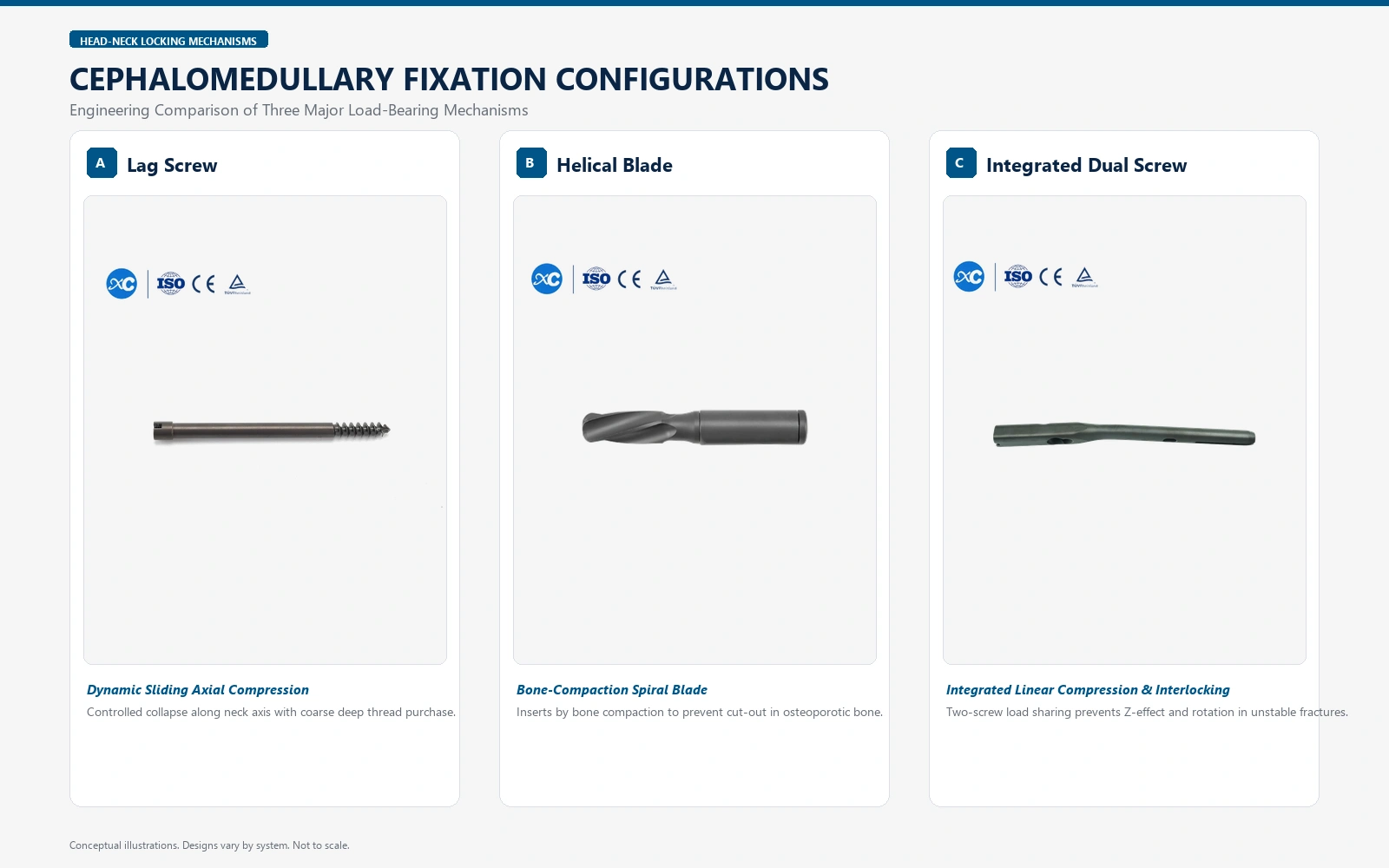
Single lag screw, helical blade and integrated dual-screw systems use different component architectures.
Anatomical Coverage: Femoral, Tibial, and Humeral Systems
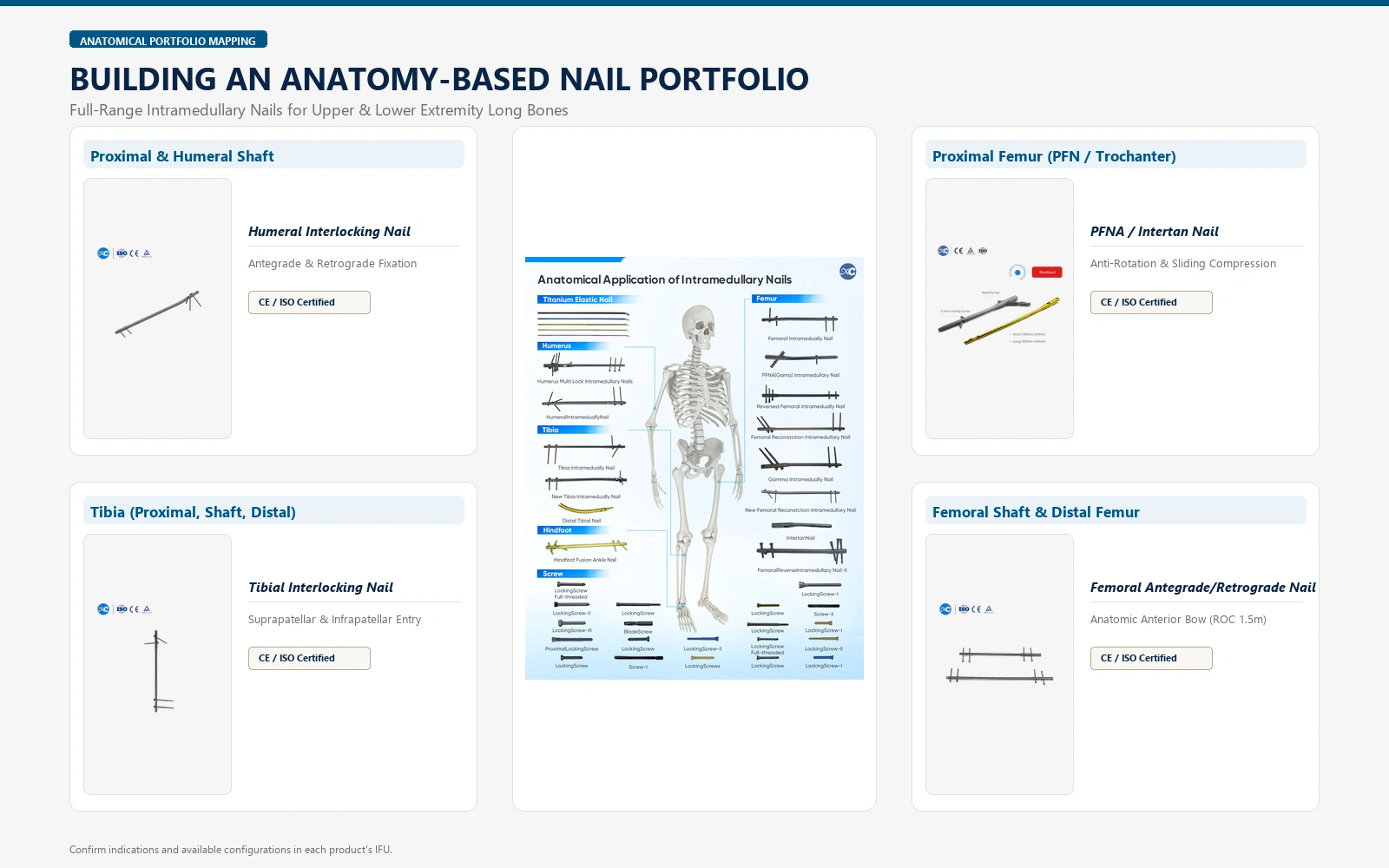
Proximal Femur and Cephalomedullary Nails
Gamma4, TFNA, INTERTAN, AFFIXUS Hip, Veronail and Targon PFT illustrate different head-neck fixation architectures. A helical blade, single lag screw, integrated dual-screw mechanism and separate antirotation element are not equivalent designs. Compare permitted sliding, rotational control and instrumentation. Osteoporosis alone does not identify one universally preferable system; reduction, implant position and the specific fracture remain important.
Femoral Shaft and Retrograde Systems
A femoral intramedullary nail may be designed for antegrade trochanteric or piriformis entry, or for retrograde insertion through the distal femur. Procurement must distinguish those designs, their curvature and locking patterns. T2 Alpha, AFFIXUS, META-NAIL and Targon RF provide relevant family-level comparisons, but approach and indication must match the exact model.
Tibial Systems
A tibial IM nail quotation should identify the intended instrumentation route. Suprapatellar or other semi-extended approaches require their specified sleeves and working channels; they are not simply standard trays used in a different position. T2 Alpha and META-NAIL resources illustrate this distinction. Detailed procedural discussion belongs in our tibial nail fixation technique guide.
Humeral Systems
For a proximal humeral nail, check laterality, proximal screw trajectories and the designated targeting guide. Polarus 3 and AFFIXUS Natural Nail Humeral illustrate distinct architectures. Rotator-cuff and nerve considerations require product-specific planning and technique; a targeting guide does not eliminate anatomical risk. Antegrade and retrograde availability must be verified rather than assumed across all humeral families.
Compare anatomical coverage before comparing individual implant specifications.
What Constitutes a Complete Intramedullary Nail System?
A complete system is a documented set of compatible implants and instruments for the intended application. “Complete tray” is not a standardized specification. Ask for an itemized bill of materials with quantities, product codes and processing status.
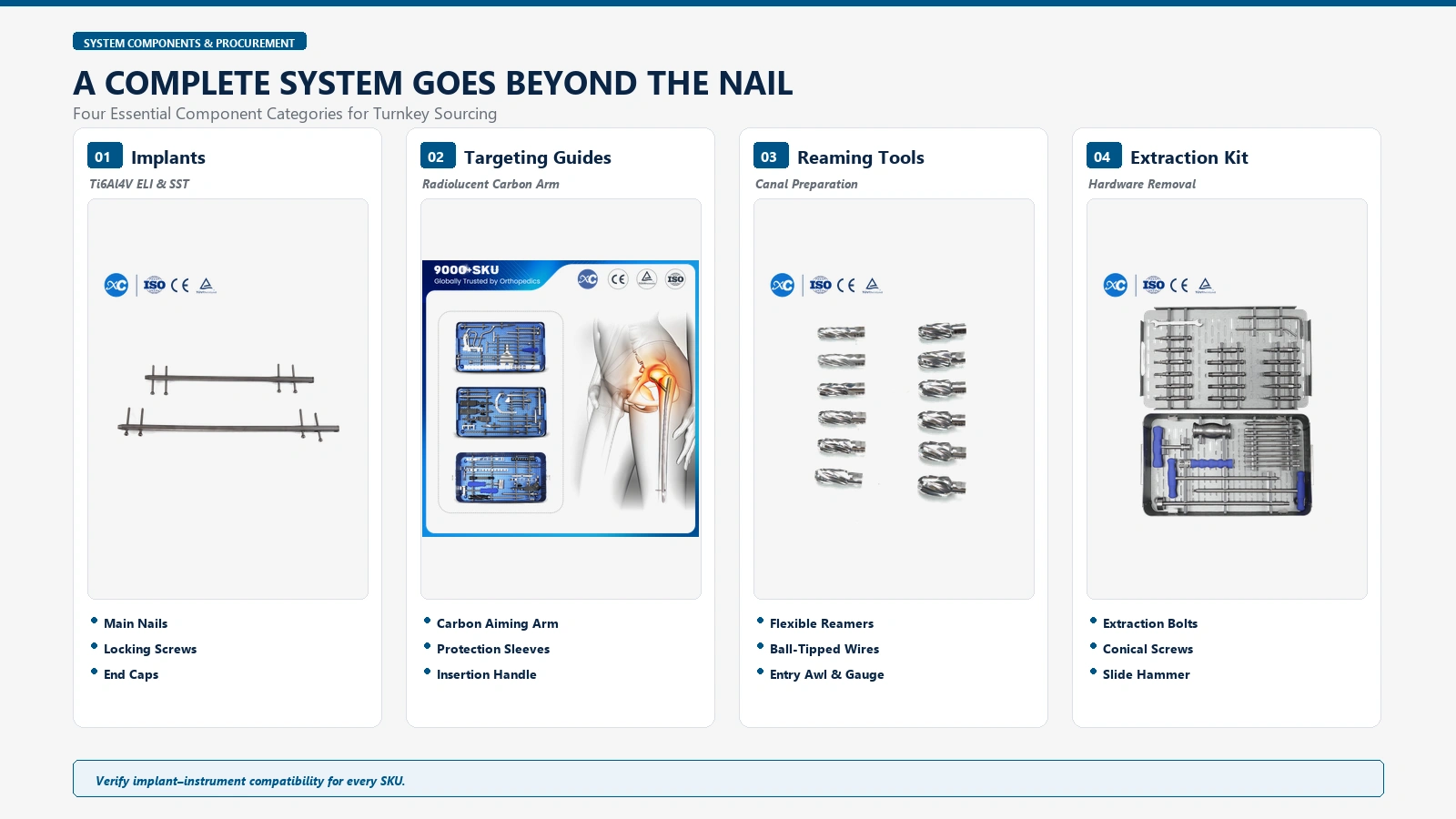
Implants: main nails in agreed diameters, lengths, curvature and laterality; compatible lag screws or helical blades where applicable; interlocking nail screws; set screws and end caps. Confirm material for each component rather than describing every modern nail as titanium.
Targeting and insertion: insertion handle, connecting bolt, targeting arm, drill sleeves, trocars and measuring tools. A radiolucent targeting guide may use carbon fiber in a documented system, but neither material nor radiolucency should be assumed. Separate proximal targeting from any optional distal device.
Reaming and preparation: the specified reaming set, guide wires, opening instruments and depth gauges. Verify flexible-shaft couplings, wire compatibility and whether particular items are reusable or single-use.
Extraction: compatible screwdrivers, nail extraction connections and appropriate removal tools. A “universal” extractor should not be treated as compatible without supporting documentation.
Include trays, cleaning instructions and sterilization requirements in the order review. A sterilization tray is not evidence that its contents arrive sterile. Confirm access to replacement drill bits, connecting bolts and sleeves: these operational details can determine whether a system remains usable after the first shipment.
Implant, insertion, preparation and extraction components should be specified together.
How Distributors Should Evaluate IM Nail Suppliers
Compare equivalent configurations before requesting orthopedic distributor pricing. A lower nail price may exclude targeting modules, extraction tools or necessary screw sizes. Use the following checks to turn a supplier presentation into a reviewable proposal.
Verification Dimension
Key Technical & Quality Criteria
What to Request
Anatomical fit
Length, diameter, curvature, entry design and laterality
SKU matrix, drawings and planning templates
Targeting and tolerances
Validated implant-guide matching, wear limits and supported distal-targeting method
Compatibility list, inspection criteria and functional validation summary
Materials and mechanical evidence
Exact alloy, applicable specification and tested construct
Material documentation and fatigue-test report scope
Market and sterile status
Legal manufacturer, authorization, labeling and processing requirements
Applicable registration, IFU, certificate scope and sterilization information
Continuity of supply
Individual screw replenishment, instrument service and change notification
Lead times, minimum orders, replacement and return terms
A radius-of-curvature value should be linked to the actual nail length and model. Do not assign anatomical suitability by ethnicity or compare isolated curvature numbers as a quality ranking. Likewise, instrument machining precision cannot by itself guarantee distal targeting after a nail deforms during insertion.
If Ti-6Al-4V ELI is specified, request evidence for that exact grade; “titanium alloy” is insufficient. Compare fatigue findings only with the test method, sample configuration and loading conditions. ISO 13485 concerns the quality system, not product marketing authorization. FDA 510(k) clearance and CE documentation must be matched to the selected device and market.
Sourcing Intramedullary Nail Systems from XC Medico
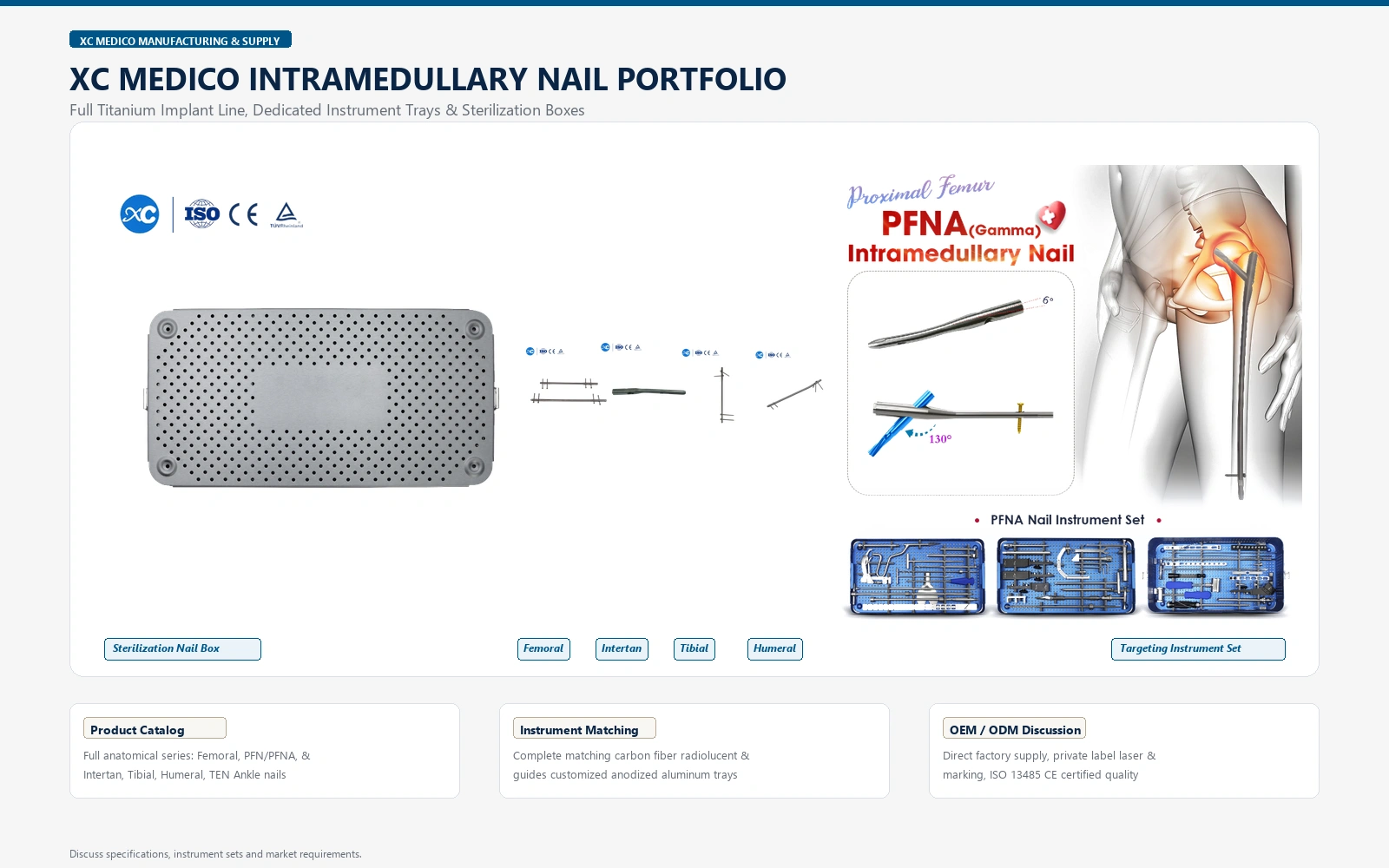
XC Medico’s published range includes femoral, proximal femoral, tibial and humeral nail products, titanium elastic nails and associated instruments. Begin with the intramedullary nail systems category and specify the anatomy, intended application and destination market. The broader orthopedic trauma implants range supports related portfolio discussions.
Request an IM nail catalog with exact diameters, lengths, laterality, material grades, head elements and locking-screw codes. For instruments, ask for a matched tray list covering insertion, targeting, preparation and removal. The femoral nail instrument set is a starting point; carbon-fiber guides, tray materials and custom reaming options require model-specific confirmation.
For orthopedic trauma implant OEM inquiries, define labeling, packaging, technical-document access and change-control responsibilities before agreeing a quotation. Request current ISO 13485 documentation and applicable product registration or CE documentation, together with available material and mechanical evidence. General website claims do not establish authorization for every proposed SKU.
Complete-system pricing should separately identify implants, reusable instruments, consumables and replenishment terms. XC Medico’s inclusion here is a disclosed commercial offer, separate from the seven-brand comparison.
Request a model-specific implant and instrument proposal for your target market.
Frequently Asked Questions
What is the primary difference between a cephalomedullary nail and a standard femoral nail?
A cephalomedullary nail includes fixation directed into the femoral neck and head for specified proximal femoral applications. A shaft-focused femoral nail primarily stabilizes the femoral canal through its locking configuration. Some reconstruction systems overlap these categories, so buyers should compare the exact indication, head elements and instrument requirements rather than rely on a generic name.
Why are helical blades used instead of traditional lag screws in some geriatric PFN systems?
Helical blades are designed to engage cancellous bone and provide rotational resistance through a different interface from a threaded lag screw. Their rationale is relevant to reduced bone quality, but they do not guarantee lower failure rates in every setting. Product selection still depends on fracture characteristics, reduction, implant position and the applicable system instructions.
What is the advantage of suprapatellar entry in tibial intramedullary nailing?
A suprapatellar approach allows nailing with the knee in a semi-extended position, which can assist alignment and imaging in selected cases. It requires a dedicated protective sleeve and compatible instrumentation because the access route involves the knee joint. This is a system and clinical-planning decision, not a universal advantage for every tibial fracture.
Can intramedullary nail instruments from different brands be mixed?
Do not assume interchangeability. Connecting threads, targeting offsets, drill diameters, sleeve tolerances and extraction interfaces may differ even when components look similar. Use the manufacturer’s documented compatible combination. Any proposed substitution requires explicit supporting validation and authorization; a physical fit on the back table is not sufficient evidence of compatibility.
What materials are standard for modern orthopedic intramedullary nails?
Titanium alloys and implant-grade stainless steels are established material categories, with specific compositions varying by system. “Titanium” does not automatically mean Ti-6Al-4V ELI. Request the precise material specification for the nail, screws and other implanted components, along with relevant documentation. Do not mix materials or components without the system’s compatibility guidance.
What specifications should be finalized when ordering a complete IM nail system from an OEM manufacturer?
Finalize the intended market, application, nail geometry, dimensions, material, laterality, locking components and instrument codes. Also agree sterile status, packaging, labeling, traceability and required documentation. The commercial agreement should define minimum quantities, replacement instruments, individual screw replenishment, change notification and responsibilities for registration support before production or private-label customization begins.
Sources and Review Notes
Manufacturer sources are linked within each profile. The review combines current product pages with clearly identified older technical documents; it does not constitute a facility audit, independent mechanical test or comprehensive regulatory assessment.
Last reviewed October 13, 2026. Confirm current local catalogs, IFUs and regulatory scope before ordering. Product names belong to their respective owners. This article provides procurement information, not surgical instruction or patient-specific treatment advice.
As a globally trusted Orthopedic Implants Manufacturer, XC Medico specializes in providing high quality medical solutions, including Trauma, Spine, Joint Reconstruction, and Sports Medicine implants. With over 19 years of expertise and ISO 13485 certification, we are dedicated to supplying precision engineered surgical instruments and implants to distributors, hospitals, and OEM/ODM partners worldwide.