


2026 REVISION ARTHROPLASTY SOURCING GUIDE
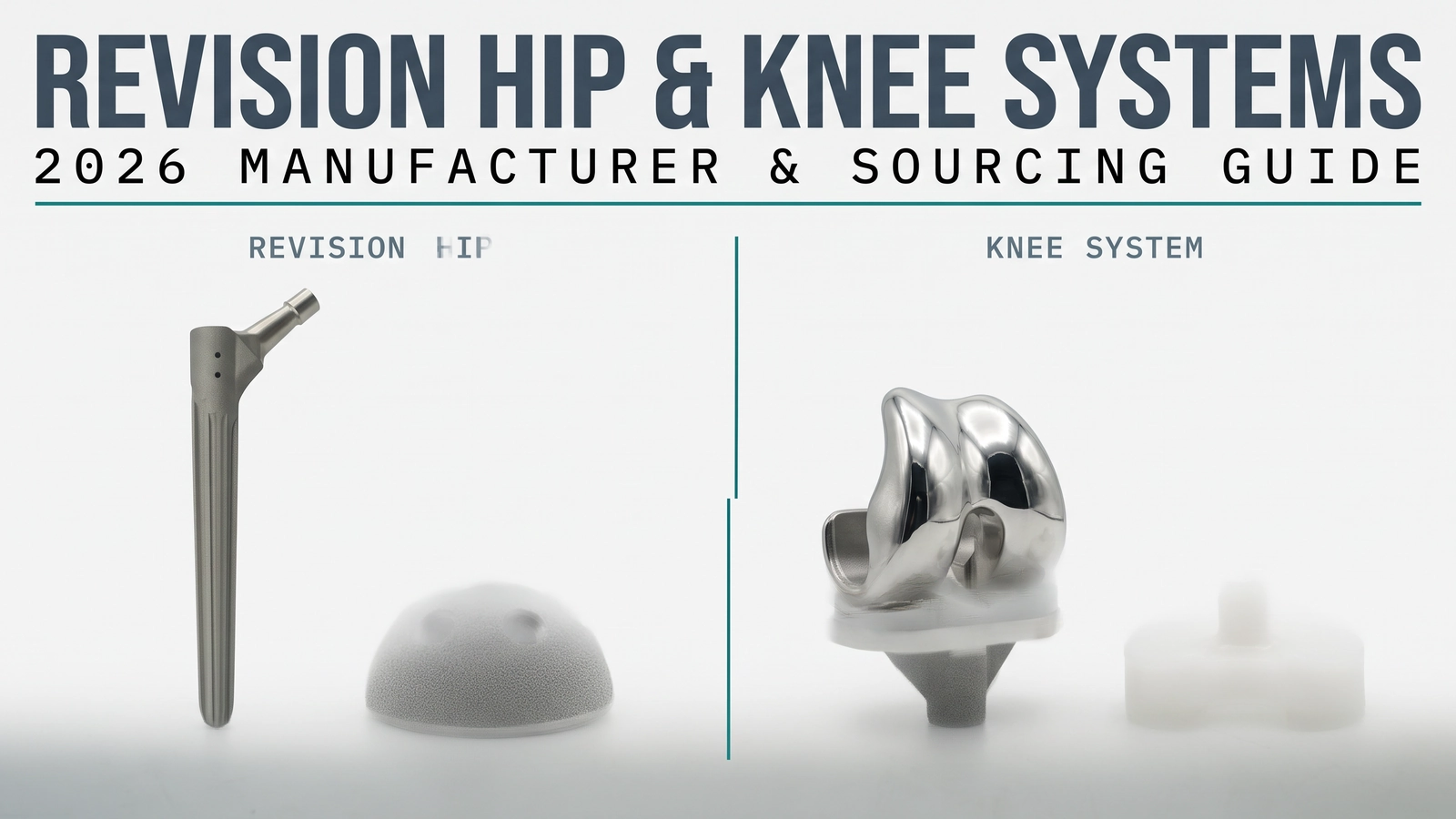
A revision hip or knee implant is only one part of a revision supply program. Distributors also need compatible stems, reconstruction components, instruments and a practical way to supply additional sizes when a hospital needs them.
This guide compares 10 revision hip and knee implant brands and manufacturers, including broad reconstruction companies, revision specialists and XC Medico. It explains what to check beyond the brand name when building a revision portfolio or reviewing a new supplier.
For a broader view of primary and revision replacement portfolios, see our guide to artificial joint manufacturers for hip and knee replacement.
How this list was selected
The selection is based on publicly documented revision products and relevance to distributor sourcing. Numbering organizes the guide; it is not a ranking by market share, implant survival or clinical superiority. XC Medico publishes this guide and is included as a supplier option. Documentation depth differs between companies, and listed products are not necessarily available in every country. Product sources checked September 2026.
Revision Implant Manufacturers at a Glance
Use the systems below as a starting point for requesting current catalogs and technical documents. Examples identify documented product families, not every component available from each company. Medacta is included here for its verified revision knee portfolio.
| Brand or manufacturer | Revision hip examples | Revision knee examples | Suggested sourcing focus |
|---|---|---|---|
| 1. Zimmer Biomet | Arcos | Persona Revision | Stem, bearing and bone-defect options |
| 2. Stryker | Restoration Modular | Triathlon Revision, Triathlon TS | Revision platform configuration |
| 3. DePuy Synthes | RECLAIM | ATTUNE Revision | Platform-specific implant and instrument coverage |
| 4. Smith+Nephew | REDAPT | LEGION RK | Dedicated hip and knee revision families |
| 5. Waldemar LINK | MP Reconstruction | Endo-Model, Endo-Model SL | Hinge knees and complex reconstruction |
| 6. B. Braun Aesculap | Prevision, Plasmafit Revision | Columbus Revision, EnduRo | Fixation choices and reconstruction components |
| 7. Medacta | Not assessed in this guide | GMK Revision, GMK Hinge | Revision knee and constraint options |
| 8. Enovis | EXPRT Revision Hip | EMPOWR Revision Knee | Instrument footprint and component inventory |
| 9. PETER BREHM | MRP-TITAN, MRS-TITAN | BPK-S Integration Revision | Specialist revision reconstruction |
| 10. XC Medico | Cemented and Cementless Revision Hip Systems | Revision Total Knee and Hinge Total Knee Systems | Direct supplier quotation and model-level verification |
Top 10 Revision Hip and Knee Implant Brands and Manufacturers
1. Zimmer Biomet
Zimmer Biomet provides dedicated revision systems for both joints. Arcos Modular Femoral Revision offers multiple proximal and distal configurations for femoral reconstruction. Persona Revision adds knee components, stem options and cones, with PS, CPS and CCK bearing choices documented in its portfolio.
Distributor checkpoint: Request a configuration map for the locally available system. Confirm which stems, bearings, cones and instruments belong in the opening inventory, and which can be supplied as case-specific additions.
Official product references: Arcos Modular Femoral Revision · Persona Revision
2. Stryker
Stryker's Restoration Modular platform addresses revision femoral reconstruction. Its Triathlon Revision offering includes Triathlon TS, while the company also documents GMRS for larger segmental reconstruction requirements.
Distributor checkpoint: Separate routine revision stock from segmental reconstruction stock. Ask which implant families, trays and backup components a hospital actually intends to use; a broad corporate portfolio does not mean every system belongs in the same initial purchase.
Official product references: Restoration Modular · Triathlon Revision
3. DePuy Synthes
DePuy Synthes documents the RECLAIM Modular Revision Hip System and ATTUNE Revision Knee System. These provide clearly identified revision product families for buyers comparing hip and knee reconstruction portfolios.
Distributor checkpoint: Specify the revision family in every inquiry. A quotation for an ATTUNE primary knee or another primary hip system does not establish revision coverage. Obtain the relevant surgical technique, compatible component list and instrument schedule for the exact revision platform.
Official product references: RECLAIM Modular Revision Hip · ATTUNE Revision Knee
4. Smith+Nephew
Smith+Nephew's revision portfolio includes the REDAPT Revision Femoral Stem and LEGION RK Revision Knee System. These are specific revision offerings rather than a general reference to the company's primary replacement range.
Distributor checkpoint: Compare hip and knee requirements separately. Ask for the available stem sizes and hip reconstruction options, then request a separate knee list covering revision components, augments, stems and instrumentation. Keep technology and material claims tied to the exact model being offered.
Official product references: REDAPT Revision Femoral Stem · LEGION RK
5. Waldemar LINK
LINK is especially relevant to a shortlist focused on complex revision and hinge reconstruction. Its MP Reconstruction System addresses femoral revision, while Endo-Model and Endo-Model SL provide rotational or hinge knee options. MEGASYSTEM-C extends its documented offering into tumor and major reconstruction applications.
Distributor checkpoint: Define whether the target accounts need revision knees, rotating hinges or larger reconstruction systems. Obtain a separate component and instrument plan for each. Hinge coverage and limb-salvage coverage should not be treated as identical capabilities.
Official product references: MP Reconstruction · Endo-Model · MEGASYSTEM-C
6. B. Braun Aesculap
Aesculap's Prevision platform includes cemented and cementless monobloc options as well as modular revision stems. Its hip reconstruction offering also includes Plasmafit Revision and acetabular reconstruction components. Documented knee options include Columbus Revision and the EnduRo hinged system.
Distributor checkpoint: Aesculap offers a useful reference for comparing fixation-specific inventories. Request separate schedules for cemented and cementless stems, acetabular components and knee systems instead of grouping all revision products into one undifferentiated catalog.
Official product references: Aesculap Hip Revision · Aesculap Knee Portfolio References
7. Medacta
Medacta is included for its GMK Revision and GMK Hinge knee offerings. The GMK revision portfolio documents modular implants and instruments, with options addressing constraint, stem extension, offset and augmentation.
Distributor checkpoint: Ask for a written compatibility map covering revision and hinge configurations. Confirm whether a change in constraint requires additional femoral components, bearings, stems or trays. Shared branding alone does not establish that every combination is permitted.
Official product references: GMK Revision System · GMK Hinge
8. Enovis
Enovis offers EXPRT Revision Hip, a modular femoral revision system, and EMPOWR Revision Knee. The knee offering documents cemented stems, VVC polyethylene, stackable augments and cone options.
Distributor checkpoint: Review the actual tray list and component quantities when assessing inventory efficiency. Ask the supplier to demonstrate a complete proposed configuration and identify the optional items omitted from the opening order. A compact set is valuable only if it supports the agreed case requirements.
Official product references: EXPRT Revision Hip · EMPOWR Revision Knee
9. PETER BREHM
PETER BREHM has a dedicated revision reconstruction portfolio. Its documented systems include the MRP-TITAN revision stem, MRS-TITAN revision cups and BPK-S Integration Revision Knee System. The company also provides product-specific technical and educational resources.
Distributor checkpoint: Evaluate how a specialist portfolio matches the revision work of your target hospitals. Ask about local technical support, access to additional sizes and instrument availability before deciding how much specialist inventory to hold.
Official product references: MRP-TITAN · Hip and Knee Portfolio · BPK-S Integration Revision Technique
10. XC Medico
XC Medico's published joint catalog includes cementless revision hip, cemented revision hip, revision total knee and hinge total knee systems. These four categories give distributors a starting point for a focused revision sourcing inquiry.
Distributor checkpoint: Request model-level specifications, implant and instrument lists, available sizes, fixation details and market-specific registration documentation. Category-page availability establishes a listed product offering; it does not establish clinical equivalence to another brand or confirm every possible reconstruction component.
For an initial evaluation, send the target country, required hip or knee system, preferred fixation and planned stocking quantities. Ask for an itemized quotation separating implants, reusable instruments and any additional components.
Revision vs Primary Arthroplasty and What Changes for Distributors
Primary arthroplasty replaces the native joint. Revision arthroplasty replaces some or all components of an existing joint replacement. Bone loss, instability, wear, loosening, infection or fracture can make revision reconstruction more complex. Specialized implants and instruments may be required. The AAOS explains these differences in its overviews of revision hip replacement and revision knee replacement.
For a distributor, the practical change is a move from quoting a standard implant combination to supporting a defined range of configurations.
- Inventory: Agree which sizes and accessories are held locally, supplied on loan or ordered for an individual case.
- Instruments: Confirm preparation, trial, assembly and extraction requirements with the hospital.
- Replenishment: Define how used stock is replaced and how urgent additional components are supplied.
- Commercial planning: Include instrument ownership or loan fees, freight, sterilization arrangements and slow-moving stock in the cost model.
A higher implant selling price does not automatically produce a higher distributor margin. Calculate the cost of supporting the portfolio before expanding it.
Knee Constraint Levels Explained from CR and PS to CCK and Hinge
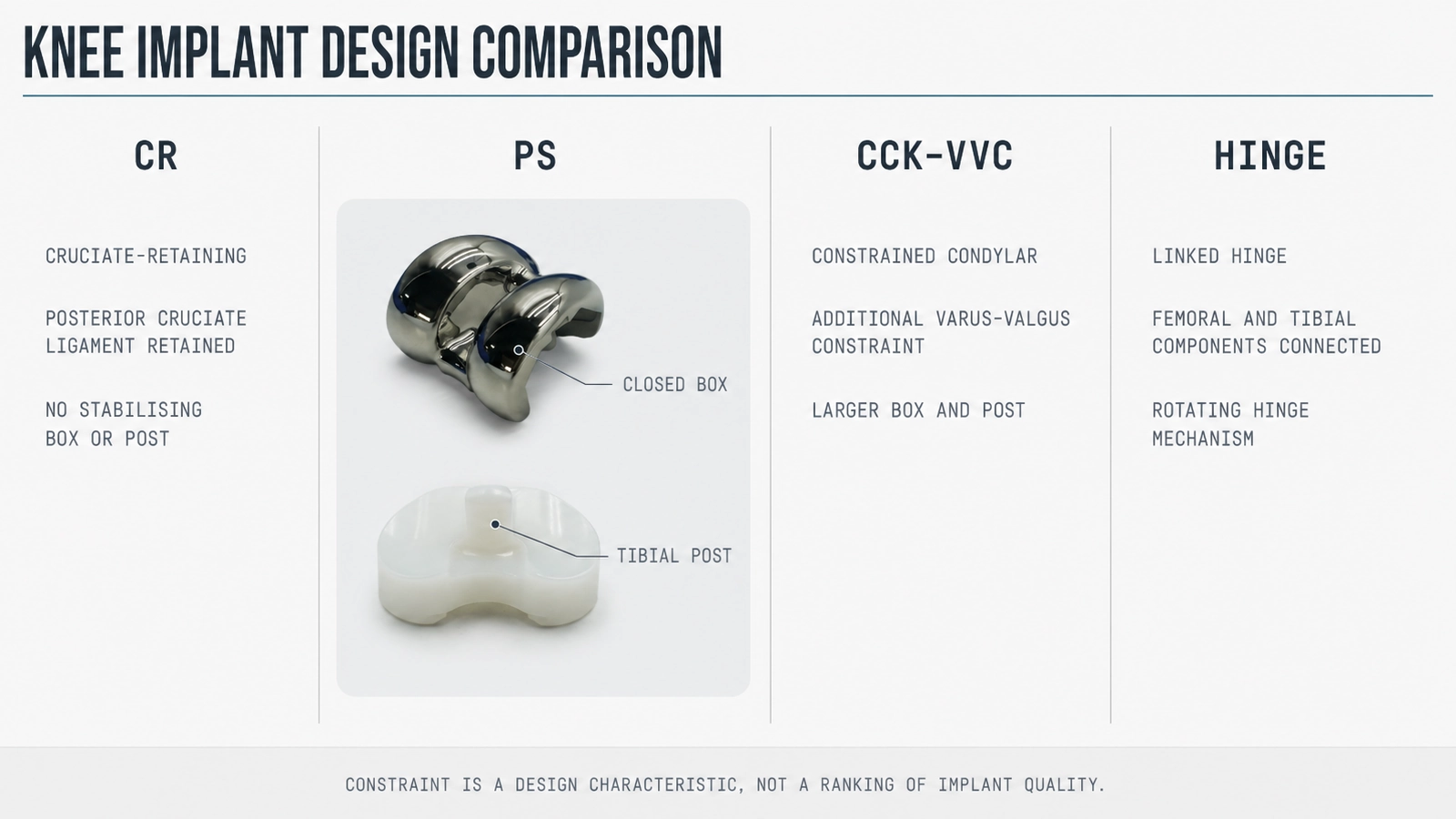
Knee constraint describes how much implant design limits movement to provide stability. CR and PS are useful starting terms, but a revision comparison should also include constrained condylar or varus-valgus constrained designs and linked hinge systems. These labels are not interchangeable. The AAOS knee implant overview explains the underlying CR and PS design distinction.
| Design | Basic distinction | What buyers should verify |
|---|---|---|
| CR Cruciate retaining | Retains the posterior cruciate ligament; commonly associated with primary knee designs. | A CR listing alone does not establish a dedicated revision portfolio. |
| PS Posterior stabilized | Typically uses a post-cam mechanism to substitute for posterior cruciate function; it is not a hinge. | Check revision indications and permitted stems, bearings and components. |
| CCK / VVC Constrained condylar / varus-valgus constrained | Provides additional coronal-plane constraint without a linked hinge; details vary by system. | Obtain the specific bearing, femoral component and fixation compatibility rules. |
| Hinge Linked knee design | Mechanically links femoral and tibial components. Rotating-hinge designs also permit axial rotation. | Confirm rotating versus fixed hinge, assembly parts, stems and dedicated instruments. |
Manufacturer terminology includes intermediate options, such as CPS in Persona Revision. The surgeon determines the required constraint from the clinical situation and the device's indications; a higher constraint label is not a universal quality upgrade. For documented examples, compare Persona Revision bearing options and LINK's hinge knee platform.
Keep hinge requirements separate in a supplier inquiry. Explore XC Medico's hinge total knee system and request the exact design and component specifications.
Cemented vs Cementless Revision Fixation
Revision hip fixation
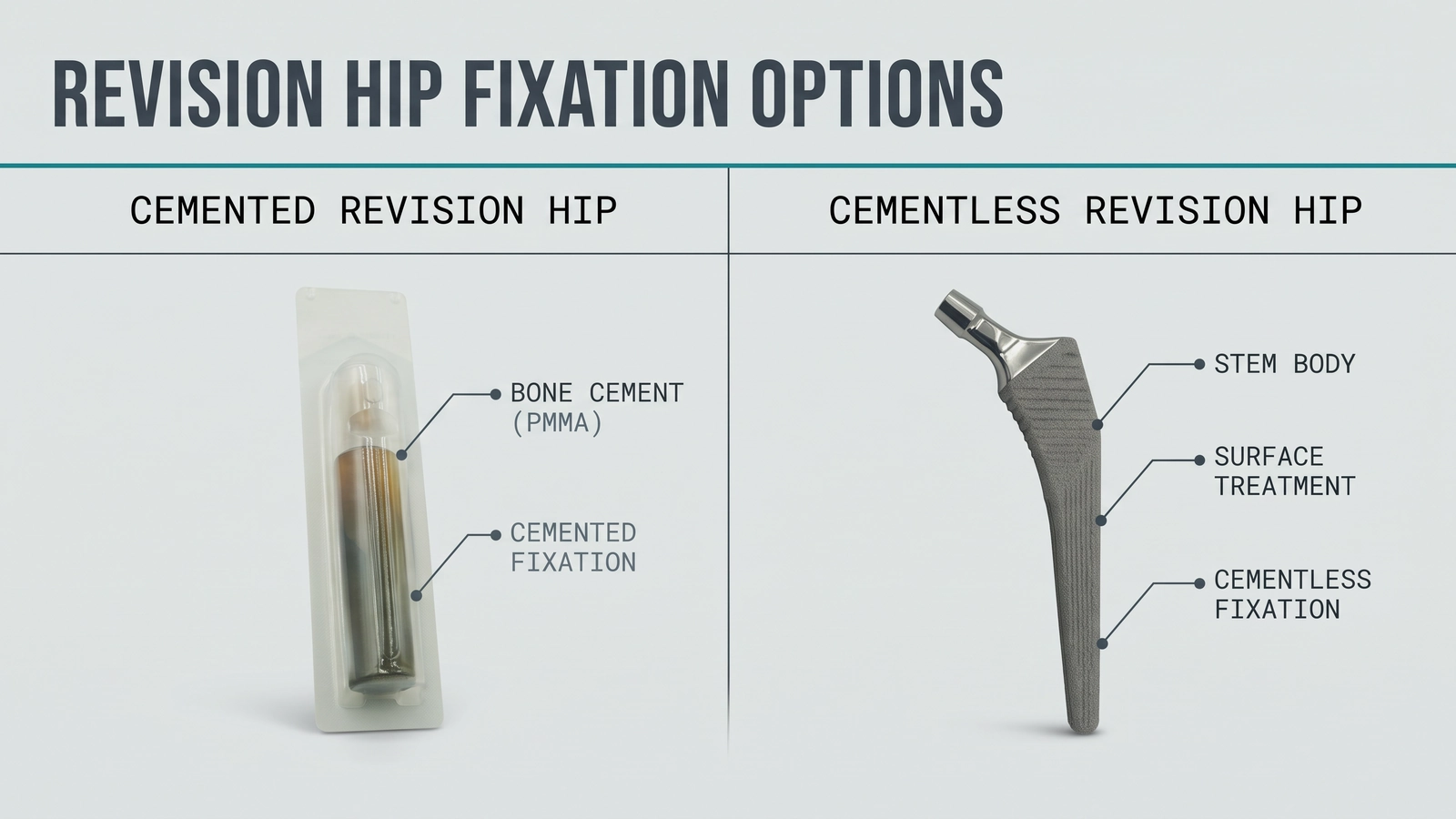
Cemented revision stems use bone cement for fixation. Cementless revision stems use a design intended to achieve mechanical fixation without cement, with biological fixation depending on the implant design and bone interface. Neither category alone determines suitability for an individual revision.
Aesculap's Prevision portfolio, for example, documents both cemented and cementless monobloc options. Buyers should therefore ask for the exact stem model and fixation method, not simply a “revision hip” price.
Review XC Medico's cemented revision hip system and cementless revision hip system separately. Request the size range, material, stem configuration and matched preparation instruments for each.
Revision knee fixation
The phrase “cementless revision knee” needs clarification. It may refer to a stem or porous reconstruction component rather than an entirely cementless construct. Revision systems can use different fixation approaches at different interfaces. A cone, stem and joint component should each have a documented fixation method.
For example, Enovis describes EMPOWR Revision Knee fixation using cemented stems and cones. Ask suppliers to identify the intended fixation for every quoted component and provide the relevant surgical technique. Do not infer whole-system fixation from one porous surface.
What a Complete Revision Portfolio Includes
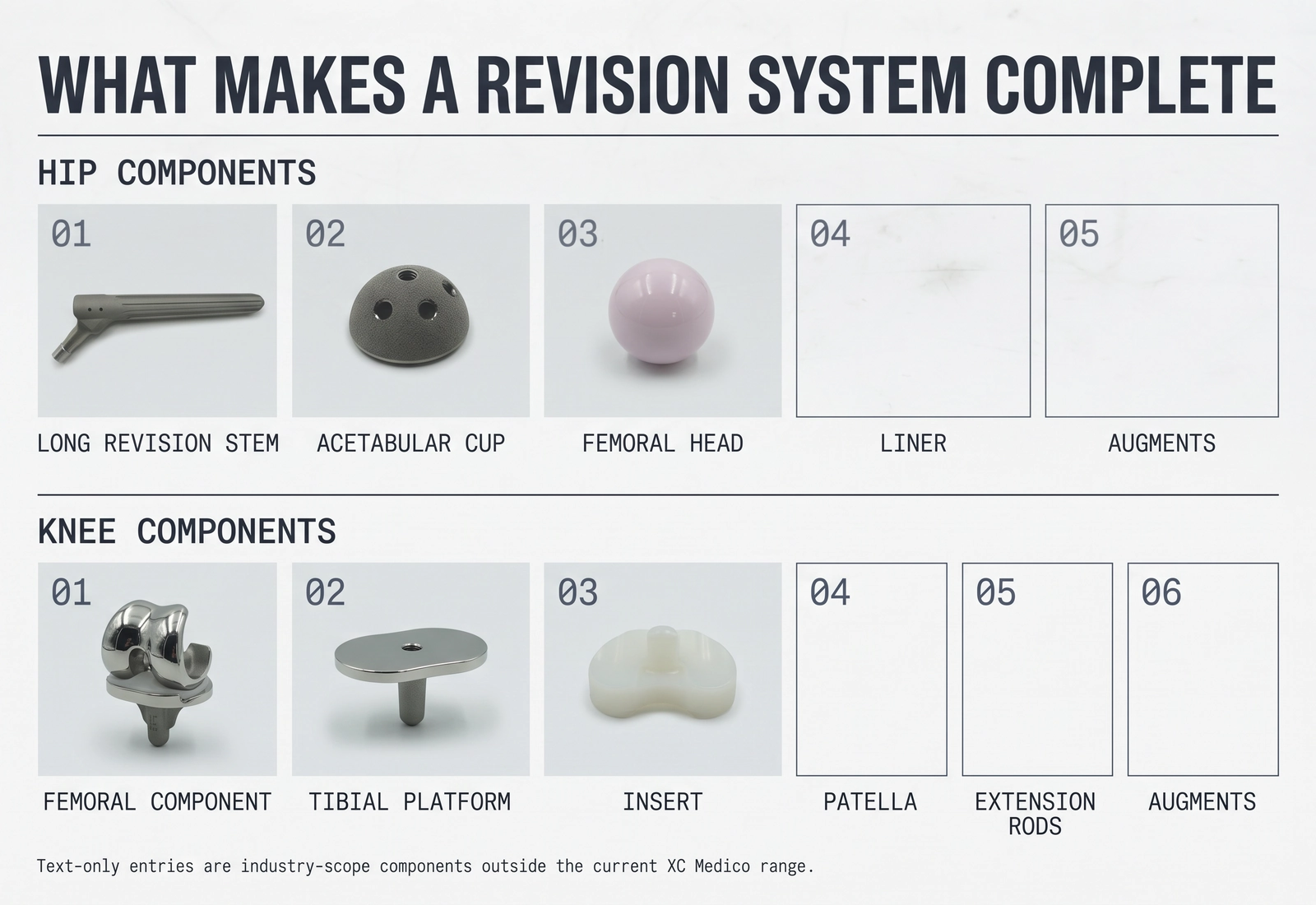
“Complete” should mean complete for your agreed clinical scope. A supplier may support selected revision configurations without offering every complex reconstruction option. Use the following list to identify available items and gaps; it is not a requirement to use every item in every procedure.
Hip revision scope
- Revision femoral stems, including the required lengths, diameters and cemented or cementless options.
- Modular bodies and assembly components where the chosen system uses modular construction.
- Revision acetabular shells, augments, reinforcement rings or cages where needed within the planned service scope.
- Documented compatible heads and liners, including any required stability-oriented options.
- Reamers, trials, insertion and assembly tools, plus separately agreed removal instruments.
Knee revision scope
- Revision femoral and tibial components with the required bearing and constraint choices.
- Stem extensions, offset options and their connecting parts where applicable.
- Femoral and tibial augments, plus compatible cones or sleeves if offered by the platform.
- A separately specified hinge option when included in the hospital's requirements.
- Matched trials, preparation instruments, assembly tools and tray inventories.
Use XC Medico's revision total knee system as the starting point for a knee inquiry, then request written confirmation of which items above are available for the proposed model. A longer stem alone does not answer the full portfolio question.
How to Verify a Revision Implant Supplier
Ask each shortlisted supplier to quote the same defined scope. This makes missing components visible and prevents a low implant-only price from being compared with a complete instrument-supported offer.
- Verify the exact product. Collect model names, catalog numbers, materials, sizes, intended fixation and instructions for use. Match these to the quoted items rather than relying on a company overview.
- Confirm the legal manufacturer and market documentation. Match the manufacturer on the label to the product documents and the supplier's role. Ask for evidence applicable to the exact devices and destination market. FDA establishment registration or device listing does not itself mean product approval or clearance, as the FDA explicitly explains.
- Check system-specific evidence. Request surgical techniques, relevant test documentation and available clinical or registry evidence for the proposed system. Evidence for another implant from the same company should not be presented as evidence for this model.
- Audit instruments and compatibility. Obtain the tray list, trial sizes, required assembly tools, reprocessing instructions and permitted component combinations. Do not assume that visually similar parts or matching nominal dimensions establish compatibility.
- Agree the supply arrangement. Put opening stock, lead times, additional-size access, replacement instruments, expiry handling and loan-set terms into the commercial offer.
- Compare the total program cost. Include implants, instruments, freight, replenishment and inventory exposure. Obtain the complaint, traceability and field-action contacts before placing the first order.
Frequently Asked Questions
Which revision hip and knee implant manufacturer is best for distributors?
The appropriate shortlist depends on the required systems, local product authorization, hospital preferences, instrument support and stocking model. Compare exact configurations and service commitments rather than choosing solely by company size or implant price.
Is every revision knee a hinged knee?
No. Revision portfolios can include non-hinged constrained options as well as hinge systems. The required design is a clinical decision. Buyers should document the requested constraint and compatible components before sourcing.
Can revision implants from different brands be combined?
Do not assume cross-brand compatibility. Obtain explicit documentation for the proposed combination, including the applicable instructions for use. A similar taper label, size or appearance is not sufficient verification.
Does a revision hip portfolio need acetabular components?
A femoral revision offering and a full hip reconstruction offering have different scopes. If your hospitals also require acetabular revision, check cups, liners, augmentation and reinforcement options separately instead of assuming they are included with the stem system.
What should I send to a revision implant supplier for a quotation?
Send the destination country, required system, fixation type, requested knee constraint where applicable, size range, instrument requirements and planned quantities. Ask for missing or unavailable items to be identified explicitly.
Build a Revision Portfolio Around Your Market
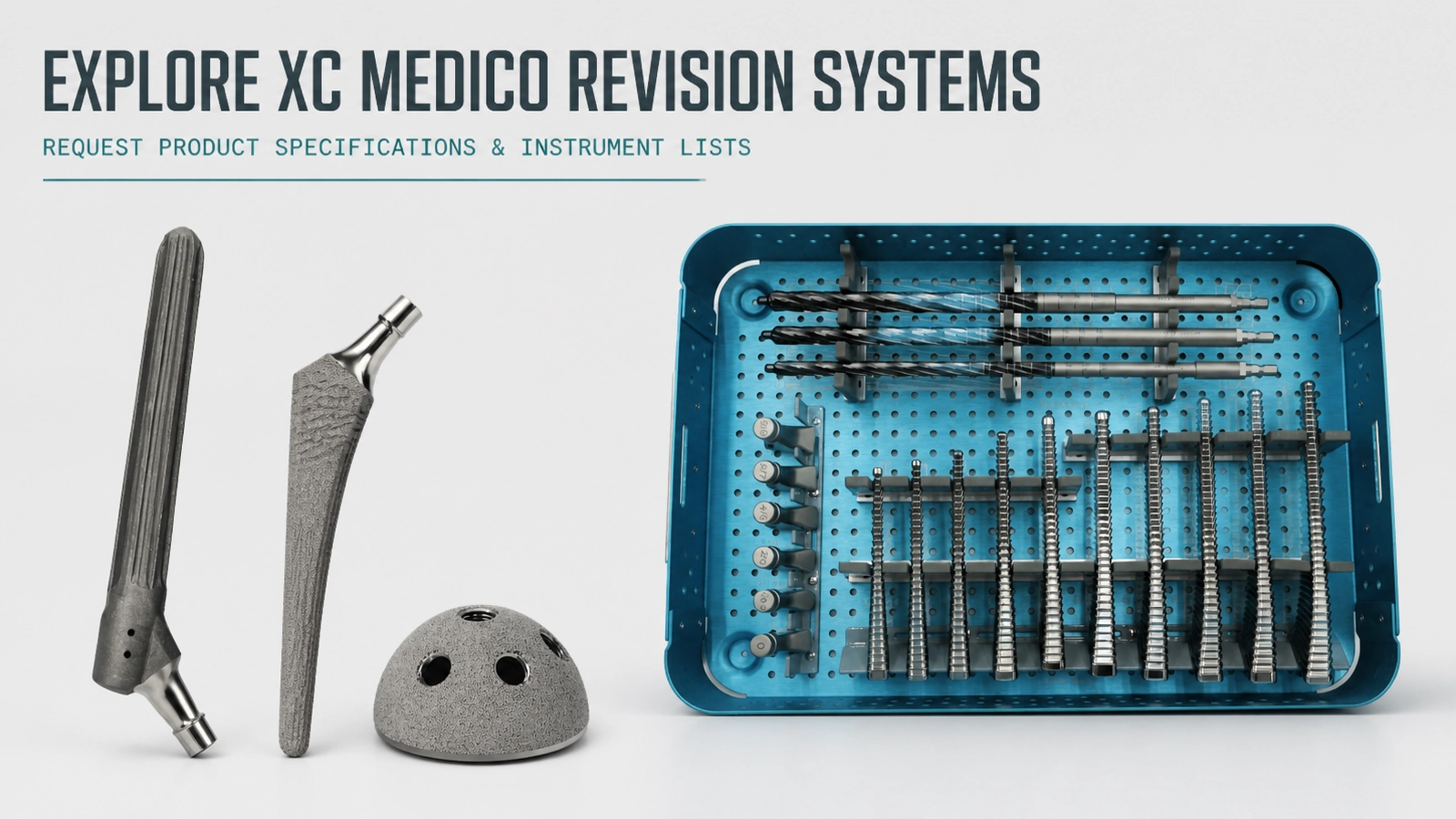
Planning to add revision hip or knee implants to your distribution portfolio? Send XC Medico your target market and required configurations. Request current product specifications, implant and instrument lists, applicable documentation and an itemized quotation.
Request Revision System DetailsThis guide is written for professional sourcing and portfolio evaluation. Clinical selection follows the treating surgeon's assessment and the applicable device instructions. Brand names belong to their respective owners. Product references are provided for verification and do not imply endorsement or commercial affiliation.

