


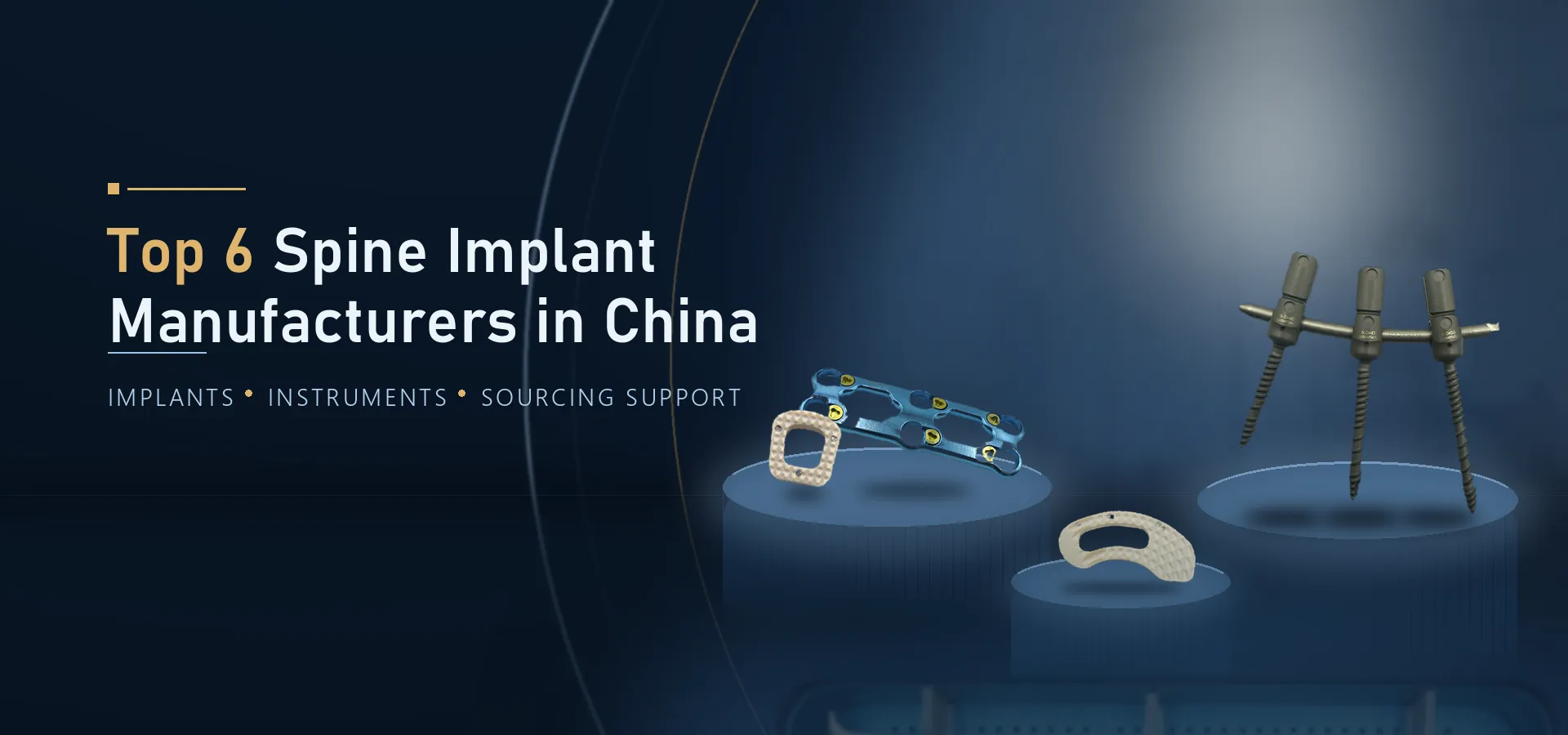
China offers a broad manufacturing base for posterior fixation, cervical systems, interbody fusion, minimally invasive fixation, and matched spine instruments. For international distributors, choosing a supplier requires more than comparing catalog size or unit price. The practical question is whether the selected systems, documentation, instruments, and supply arrangements fit your hospitals and target market.
This guide compares six spine implant manufacturers in China: WEGO Orthopaedic, Sanyou Medical, Double Medical Technology, Beijing Fule, Canwell Medical, and XC Medico. It focuses on product coverage, manufacturer identity, regulatory evidence, OEM options, and the operational support needed to build a distributor portfolio. For multinational brand benchmarking, see the separate global spine implant manufacturer comparison.
Quick Answer
The six manufacturers reviewed are WEGO Orthopaedic, Sanyou Medical, Double Medical Technology, Beijing Fule, Canwell Medical, and XC Medico. WEGO, Sanyou, and Double Medical have broad, established orthopedic or spine platforms with public company and product evidence. Beijing Fule presents a spine-focused implant and instrument range with recent device-specific FDA clearances. Canwell shows a wide catalog spanning cervical, thoracolumbar, cage, MIS, kyphoplasty, and instrument systems. XC Medico is included for its export-oriented open and MIS pedicle screw systems, cervical and lumbar fusion portfolio, matched instruments, and OEM/ODM support. Buyers should compare legal manufacturer identity, product-level approvals, system completeness, instrument compatibility, registration support, territory availability, quotation speed, and replenishment—not company size alone.
How We Researched This List
This review uses public information available at the September 2026 review date. Priority was given to official company websites, official product categories and catalogs, public-company disclosures, and device-level records in the U.S. FDA 510(k) database. A product family was marked Confirmed only when a relevant system or category could be identified in those sources. A company-wide statement was not treated as proof that every SKU is registered in every destination market.
The four comparison labels have narrow meanings. Confirmed means public primary evidence was found for the category. Partial means evidence covers part of the requested category or lacks enough detail to call the family complete. Verify by market means public availability or regulatory scope may vary by country, legal entity, or distributor territory. Not publicly confirmed means the reviewed sources did not establish the claim; it does not prove the capability is absent.
FDA 510(k) entries are described as device clearances, never as manufacturer certification. ISO 13485 is described only as quality management system certification. CE references, where relevant, must be checked against the exact product, certificate scope, legal manufacturer, notified body, applicable regulation, validity period, and destination-market requirements. Buyers should request current controlled documents directly from the legal manufacturer.
Editorial Disclosure
XC Medico publishes this page and is also included as the sixth company in the list. Its inclusion creates a commercial interest that readers should consider. The sequence is based on editorial relevance to the stated sourcing criteria; it is not a ranking by revenue, market share, product quality, surgeon preference, clinical performance, or patient outcomes. Company statements are separated from third-party regulatory records, and readers should independently audit every shortlisted supplier.
How We Selected These Spine Implant Manufacturers in China
Spine Implant Portfolio Coverage
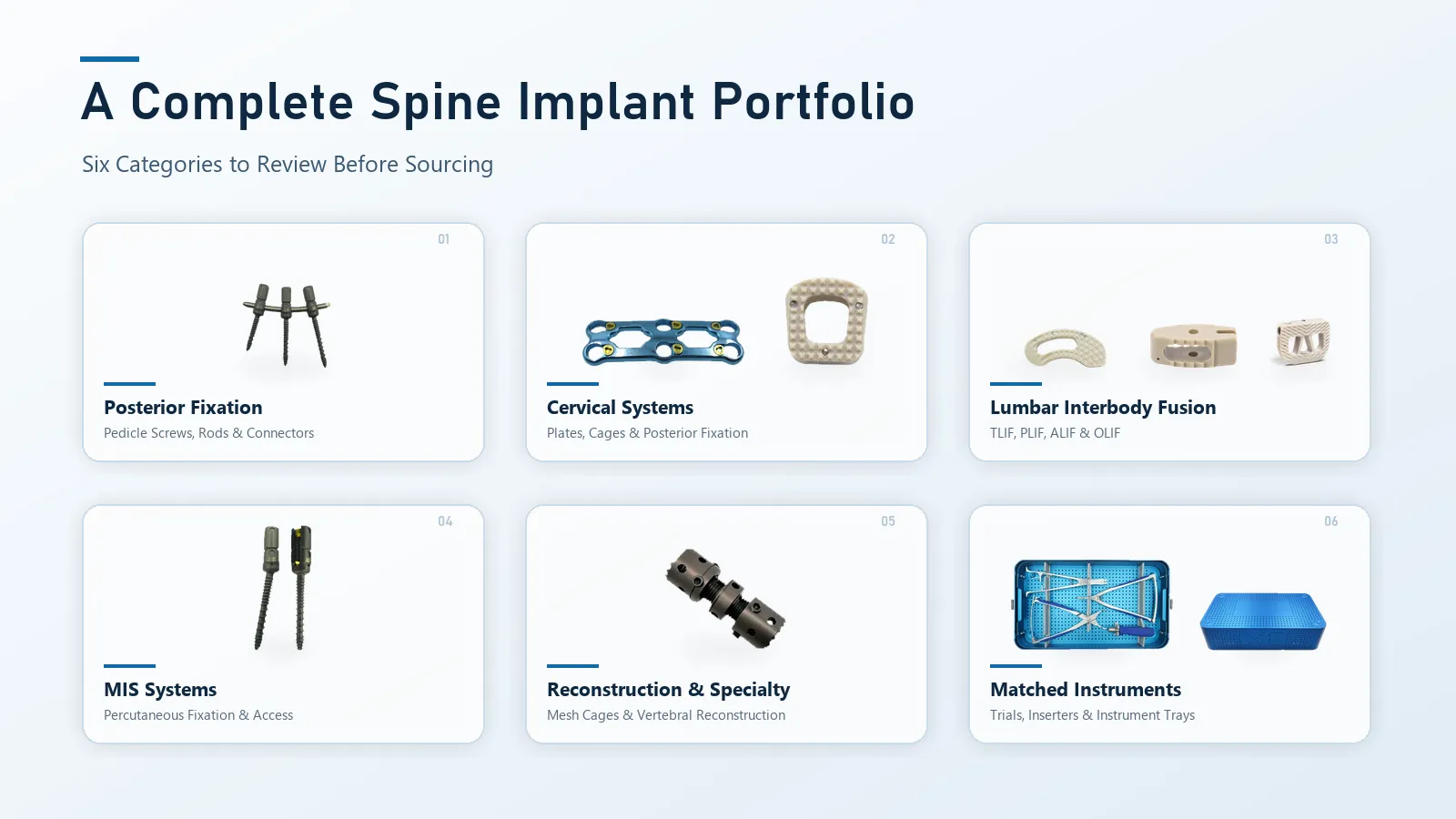
We looked beyond a single pedicle screw or cage. Strong candidates show a coherent portfolio across posterior fixation, cervical procedures, lumbar interbody fusion, reconstruction, specialty systems, and the instruments required to use them.
Pedicle Screw and Posterior Fixation Systems
A practical pedicle screw manufacturer in China should document screw types, rod diameters, connectors, reduction options, and the difference between open, deformity, cement-augmented, and percutaneous configurations. Compatibility must be system-specific.
Interbody Fusion Portfolio
We reviewed public evidence for cervical and lumbar cages, including TLIF, PLIF, ALIF, lateral or endoscopic approaches where shown. “Cage manufacturer” was not inferred from an unrelated spinal fixation registration.
Cervical and Lumbar Procedure Coverage
Manufacturers were evaluated on whether buyers could assemble procedure-level cervical and lumbar offerings rather than purchase isolated implants. Anterior cervical plates, posterior cervical fixation, cages, thoracolumbar fixation, and approach-specific instruments all matter.
Manufacturing and Instrument Capability
Implants and instruments form one surgical workflow. Public manufacturing descriptions, catalogs, instrument sets, quality information, or regulatory documentation were used to distinguish evidence from a purely promotional supplier claim.
Regulatory, Export and Distributor Support
We considered device-level regulatory evidence, public export or distributor orientation, and the availability of documentation, product matching, OEM support, and communication. Actual support remains a matter for buyer audit and market-specific confirmation.
China Spine Implant Manufacturer Comparison
The product columns record public category evidence. Supplier model and the detailed profiles explain the differences between companies; all-Confirmed rows do not mean the suppliers offer identical systems or support. “Confirmed” indicates public evidence of a relevant category, not universal market authorization or complete compatibility across all products.
| Manufacturer | Main Position | Pedicle Screw | Interbody Cage | Cervical | MIS | Instruments | Supplier Model |
|---|---|---|---|---|---|---|---|
| WEGO Orthopaedic | Established orthopedic group | Confirmed | Confirmed | Confirmed | Confirmed | Confirmed | Branded orthopedic supply; Premier platform and spine catalog |
| Sanyou Medical | Spine-focused listed manufacturer | Confirmed | Confirmed | Confirmed | Confirmed | Confirmed | Procedure-led branded systems; Zina, Lora and lumbar cage families |
| Double Medical Technology | Broad listed orthopedic manufacturer | Confirmed | Confirmed | Confirmed | Confirmed | Confirmed | Multi-category branded supply; Hobbit fixation and cage portfolio |
| Beijing Fule | Spine and trauma manufacturer | Confirmed | Confirmed | Confirmed | Confirmed | Confirmed | Branded and contract-oriented supply; COX, Usmart and MIS families |
| Canwell Medical | Broad orthopedic implant and instrument supplier | Confirmed | Confirmed | Confirmed | Confirmed | Confirmed | Branded supply and published OEM solutions; broad instrument catalog |
| XC Medico | Export-oriented consolidated sourcing partner | Confirmed | Confirmed | Confirmed | Confirmed | Confirmed | Distributor/OEM supply; implant, instrument and catalog coordination |
Reading rule: A “Confirmed” category still requires product-specific verification. Ask for the exact model list, intended use, legal manufacturer, certificate or clearance number, current certificate validity, instruments, and destination-market availability.
Top 6 Spine Implant Manufacturers in China
WEGO Orthopaedic
- Headquarters
- Weihai, Shandong, China
- Company Profile
- Shandong Weigao Orthopaedic Device Co., Ltd., publicly identified as WEGO Ortho, is an orthopedic business with spine, trauma, joint, sports medicine, and related instrument coverage.
Verified Spine Portfolio
WEGO’s official orthopedic pages and spine catalog present thoracolumbar posterior fixation, cervical solutions, interbody devices, MIS configurations, rods, connectors, hooks, and instrument cases. The Premier platform is publicly shown with polyaxial, monoaxial, reduction and other screw options, while official materials identify Premier MIS and related posterior fixation components.
Key Spine Systems
Publicly identifiable examples include the Premier posterior spinal fixation family, Premier MIS options, anterior cervical plate systems, cervical solutions, and interbody cage or spacer systems documented in the company’s spine catalog. The catalog is more useful than a homepage claim because it allows a buyer to trace implants to associated instruments and procedure groupings.
Manufacturing or Regulatory Evidence
The FDA database records device-specific clearances for WEGO entities, including Premier under K160320, the Milestone Spinal System under K133053, and an Anterior Cervical Plate System under K123578. Match these records to the offered product generation and model list before using them in a sourcing decision.
Distributor Relevance
WEGO may suit established distributors that want an orthopedic group with multiple categories and a documented spine catalog. The breadth can support portfolio consolidation, but it also makes entity mapping important: group brand, legal manufacturer, registration owner, exporting entity, and local representative may not be the same organization.
Best Fit
Consider for distributors able to manage a broad branded portfolio, evaluate territory terms, and perform device-by-device registration review rather than treating WEGO as a single universal approval umbrella.
What Buyers Should Verify
- The legal manufacturer and registration owner for each selected system.
- Whether open and MIS implants share validated components or require separate inventories.
- Current export availability, instrument configuration, sterilization status, and territory policy.
- Product-specific CE, FDA, or other market evidence rather than company-level summaries.
Sanyou Medical
- Headquarters
- Jiading District, Shanghai, China
- Company Profile
- Shanghai Sanyou Medical Co., Ltd. is a Shanghai Stock Exchange-listed orthopedic implant company with a spine focus and public product groupings organized around procedures and technologies.
Verified Spine Portfolio
Sanyou’s official spine pages cover ACDF, posterior occipitocervical-upper thoracic solutions, laminoplasty, ALIF, lateral and endoscopic lumbar fusion concepts, deformity, osteoporosis therapy, interbody fusion, thoracolumbar fixation, UBE, and minimally invasive surgery. This procedure-based organization helps buyers connect implant families with a planned hospital offering.
Key Spine Systems
Named systems visible in official sources include Zina MIS, Lora MIS fracture reduction and fixation, Hybrid MIS/open fixation, the Adena-Zina system, Katia cervical systems, Keystone and Halis lumbar cage systems, Lydia anterior lumbar fusion, and Zeus spinal fixation. Naming and market availability should be confirmed because product versions and commercial names can differ across jurisdictions.
Manufacturing or Regulatory Evidence
Sanyou’s official company profile identifies its research, manufacture, and sales focus and its SSE stock code 688085. FDA records provide device-level evidence: K212066 covers the Adena-Zina thoracolumbosacral pedicle screw system; K211689 covers the Keystone PEEK Cage System; K230872 covers several named lumbar cage systems; K163422 covers the Shanghai Sanyou PEEK Cage System; and K230961 identifies the Zeus Spinal System. Use the named systems as starting points for document requests and confirm which configurations are available for export.
Distributor Relevance
Sanyou is relevant to spine-specialist distributors interested in differentiated procedure systems and a portfolio that extends beyond basic commodity screws and cages. A sophisticated portfolio, however, can increase training, surgeon education, instrumentation, inventory, and registration requirements. Buyers should evaluate which systems are commercially available in their own market and which require dedicated technique support.
Best Fit
Consider for established spine channels with regulatory capacity, clinical education resources, and demand for multiple cervical, thoracolumbar, deformity, fusion, and MIS pathways.
What Buyers Should Verify
- The exact regional product name, generation, and commercial configuration.
- Whether the selected implants and instruments match the clearance or certificate version supplied.
- Territory availability, distributor requirements, training obligations, and replenishment lead times.
- Which systems can be registered independently and which depend on an integrated procedure platform.
Double Medical Technology
- Headquarters
- Xiamen, Fujian, China
- Company Profile
- Double Medical Technology Inc. is a Shenzhen-listed medical-device manufacturer founded in 2004. Its official corporate profile covers orthopedics and several adjacent surgical fields, while the spine portfolio sits within a broader multi-category business.
Verified Spine Portfolio
The official Chinese product center shows anterior cervical fixation, posterior cervical fixation, laminoplasty plates, interbody cages, open thoracolumbar posterior fixation, and minimally invasive thoracolumbar screw-rod systems. The export-facing site adds cage categories and the Hobbit platform for 5.5/6.0 posterior fixation, posterior cervical fixation, MIS, derotation, and 4.75 mm configurations.
Key Spine Systems
Public examples include the Hobbit Spine 5.5/6.0 System, Hobbit MIS, Hobbit Posterior Cervical 3.5/4.0, Hobbit Derotation, cervical interbody cages, DLIF and Endo LIF cages, anterior cervical solutions, and matched universal or platform-specific instruments. Buyers should use the latest controlled catalog because web categories may combine domestic and export offerings.
Manufacturing or Regulatory Evidence
Double Medical’s official corporate site identifies its Xiamen base, 2017 Shenzhen listing, and manufacturing-oriented business. The FDA database records multiple device clearances, including K151458 for the Double Medical Universal Spine System and K233078 for a Posterior Cervical Spine System. Request a mapping between these registered names and the current export catalog.
Distributor Relevance
Double Medical is relevant to orthopedic distributors that want spine alongside trauma, joint reconstruction, sports medicine, or other categories. This can simplify group-level sourcing, but a buyer still needs a spine-specific commercial plan: tray investment, surgeon conversion, implant matrix depth, consignment or replenishment expectations, and regulatory ownership should be settled before launch.
Best Fit
Consider for medium-to-large distributors seeking an established multi-category Chinese orthopedic manufacturer and capable of managing branded systems, territory policies, and procedure-specific inventories.
What Buyers Should Verify
- Whether the domestic and export catalogs contain the same product generations.
- Which entity manufactures, exports, and owns the target-market registration.
- The specific cage approaches, footprints, lordotic options, materials, and compatible inserters.
- Availability of training sets, replacement instruments, and spare tray components.
Beijing Fule
- Headquarters
- Pinggu District, Beijing, China
- Company Profile
- Beijing Fule Science & Technology Development Co., Ltd. states that it was founded in 1996 and focuses on spine, trauma, external fixation, implants, and instruments, with both branded and contract-manufacturing language on its official site.
Verified Spine Portfolio
Fule’s official product navigation identifies COX posterior screw-rod fixation, Usmart 5.5, Miko II and VSS minimally invasive systems, occipitocervical-thoracic posterior fixation, anterior cervical plates, zero-profile and other cervical cage options, and interbody fusion cages. Official instruction-manual pages also list spine catalog and technical manual resources.
Key Spine Systems
Relevant public systems include COX and COX II posterior fixation, Usmart 5.5, Miko II MIS, VSS MIS, cervical plate and cage systems, and lumbar interbody cages including posterior and anterior approach products. Catalog scope should be reconciled with the exact legal manufacturer and target-market device documentation.
Manufacturing or Regulatory Evidence
The official profile describes production, research, clean-packaging, biological, and mechanical laboratory facilities. More importantly, the FDA database records K252730 for the Fule Spinal Fixation System and K253151 for the Fule Interbody Fusion Cage System. In K252730, Beijing Fule is the applicant for the Fule Spinal Fixation System. A-Spine Asia appears in the primary predicate device section as the manufacturer of SmartLoc, the comparison device. That reference does not establish that A-Spine manufactures Fule’s system.
Distributor Relevance
Fule may appeal to buyers looking for a spine-and-trauma supplier with a broad web-visible catalog and contract-manufacturing orientation. The device records provide named systems for a registration team to investigate. Ask Fule to map the current commercial product codes to those files and identify the instruments, labeling, and documentation supplied with the selected configuration.
Best Fit
Consider for distributors or private-label teams prepared to conduct close entity, quality-agreement, and device-file due diligence while selecting from a broad spine catalog.
What Buyers Should Verify
- The applicant, specification developer, legal manufacturer, contract manufacturer, and exporter for each product.
- Whether the exact implant sizes and instruments are included in the cited clearance or other registration.
- Current ISO 13485 certificate scope and any product-specific CE evidence by regulation.
- Change-control responsibilities when branding, packaging, or design features are customized.
Canwell Medical
- Headquarters
- Jinhua, Zhejiang, China
- Company Profile
- Canwell Medical’s official company profile states a history beginning in 1994 and presents trauma, spine, sports medicine, hip and knee, instruments, and OEM solutions.
Verified Spine Portfolio
Canwell’s official Chinese site groups its spine offering into posterior cervical, anterior cervical, fusion cage, posterior thoracolumbar, anterior thoracolumbar, and vertebroplasty systems. Its international site lists cervical plates, pedicle screws, spine cages, PKP, and a substantial number of spine instrument sets. This dual presentation gives buyers a useful procedure map and an export-facing product index.
Key Spine Systems
Public examples include CanPCS posterior occipitocervical-thoracic fixation, CanACE anterior cervical plate, CanPEEK-C cervical cage, CanPEEK-P/V/L/T lumbar cages, CanART, CanFIX, CanESP, CanSIA and CanIVY thoracolumbar fixation, CanHELP minimally invasive fixation instruments, CanMIC access instruments, CanTLF instruments, CanMESH, and CanPKP.
Manufacturing or Regulatory Evidence
The official company profile describes orthopedic implant research and production and publishes counts for Chinese registrations or filings; those counts can change and do not establish overseas authorization. FDA K161151 identifies Canwell Medical Co., Ltd. and a pedicle screw spinal system. Ask for the current commercial system name and model list corresponding to that record.
Distributor Relevance
Canwell is relevant to distributors seeking both implants and a visibly extensive instrument catalog. Its official OEM Solution category also indicates an export-facing customization model. Buyers should distinguish simple branding or tray configuration from design changes that trigger verification, validation, risk-management, and registration updates.
Best Fit
Consider for buyers needing broad system coverage, many matched instrument sets, and a supplier open to OEM discussions, subject to careful product-file and market-access verification.
What Buyers Should Verify
- Which Canwell or affiliated entity is the legal manufacturer and certificate holder.
- Exact compatibility among cage families, inserters, trials, rasps, distractors, and fixation systems.
- Which products are available sterile, non-sterile, branded, or OEM in the destination market.
- Product-level regulatory status rather than the total count of company registrations.
XC Medico
- Headquarters
- Changzhou, Jiangsu, China
- Company Profile
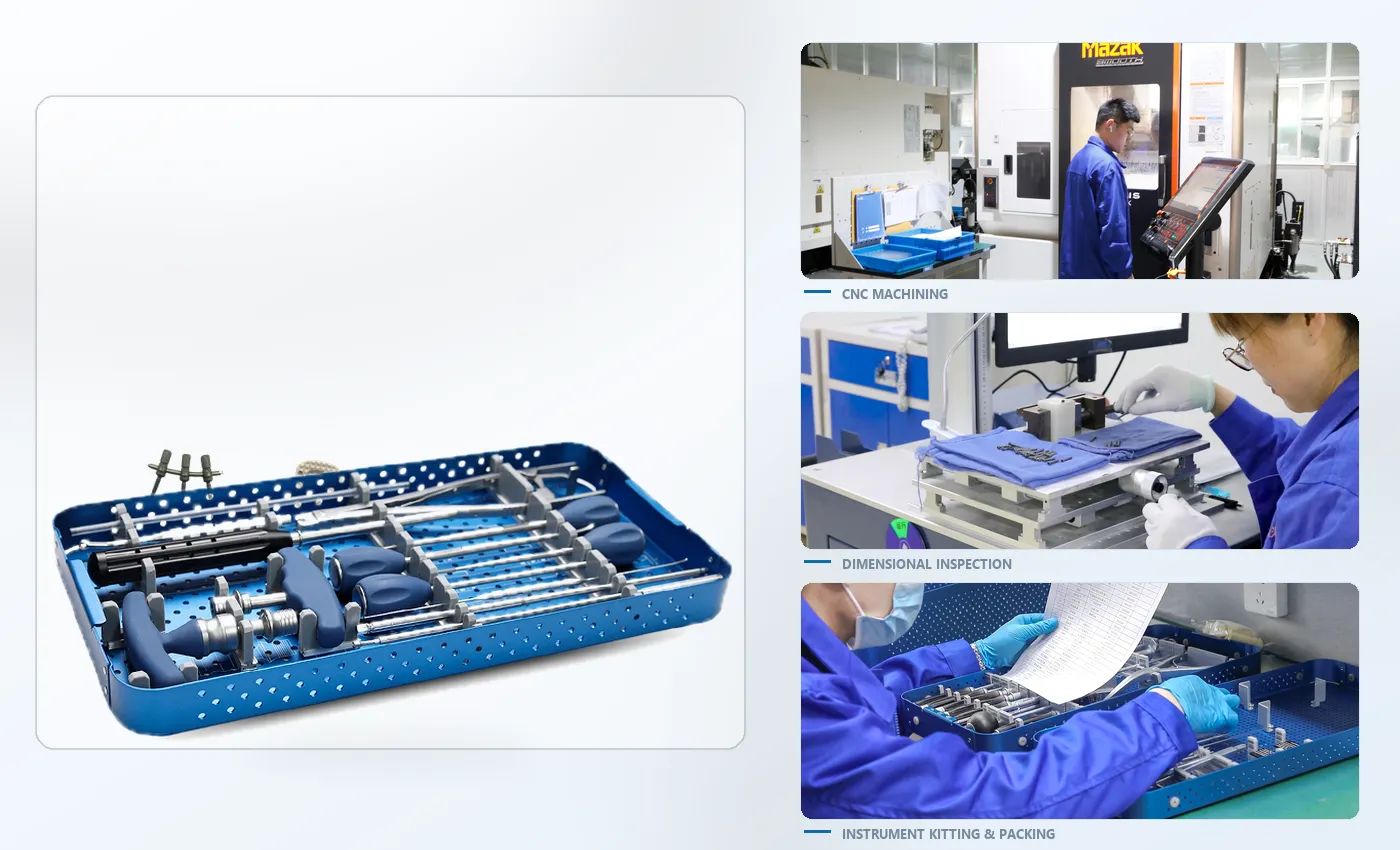
- XC Medico is an orthopedic implant and surgical instrument manufacturer serving international distributors, importers, hospitals, and OEM/ODM buyers across spine and other orthopedic categories.
Verified Spine Portfolio
XC Medico’s live product and category pages show open pedicle screw systems, MIS pedicle screw systems, anterior and posterior cervical fixation, cervical cages, and lumbar fusion systems related to TLIF, PLIF, ALIF, and OLIF. The site also presents matched spine instruments and procedure categories. Buyers can start with the spine implants and instruments overview and then evaluate the relevant family.
Key Spine Systems
Public examples include 5.5 mm and 6.0 mm open posterior fixation, the 5.5 MIS Spinal System II, the MisFix 5.5 minimally invasive system, anterior cervical plates, cervical PEEK cages, PLIF PEEK cages, and ALIF cage-and-plate configurations. Specific needs can be checked through the pedicle screw manufacturer evaluation page, 5.5 MIS Spinal System II, cervical PEEK cage, anterior cervical plate, PLIF PEEK cage, and ALIF cage and plate system.
Manufacturing or Regulatory Evidence
XC Medico publicly states ISO 13485 quality management system certification and provides product, factory, and quality-control information on its own site. Buyers should request the current certificate and scope, product-specific registration evidence, material records, inspection plans, applicable mechanical test reports, packaging or sterilization evidence, and batch traceability. Public website claims are a starting point, not a substitute for controlled documents.
Distributor Relevance
XC Medico’s commercial relevance is its distributor-oriented combination of implants, matched instruments, OEM/ODM, catalog support, registration-document coordination, product matching, responsive communication, and consolidated sourcing. These services can reduce the number of suppliers involved in a launch, but each selected system still needs independent technical and regulatory review.
Best Fit
Consider for international distributors, private-label buyers, and sourcing teams that value product matching, quotation speed, instrument pairing, and consolidated supply alongside a broad spine portfolio. Buyers seeking only a multinational branded commercialization model may prefer a different supplier type.
What Buyers Should Verify
- The exact specification matrix and implant-to-instrument compatibility for the intended procedures.
- Current market-specific regulatory documentation for each product family.
- OEM change scope, labeling responsibilities, validation needs, and ownership of registration files.
- Stock versus made-to-order lead times, replenishment rules, spare instruments, and complaint handling.
What Should a Complete Chinese Spine Implant Manufacturer Offer?
Posterior Pedicle Screw Systems
A complete posterior platform should define screw type, diameter and length matrix, thread form, head and reduction options, rods, connectors, crosslinks, hooks where applicable, and revision components. Open, deformity, cement-augmented, and MIS systems should not be assumed compatible merely because they share a rod diameter. Ask for an approved compatibility matrix and the current surgical technique.
Cervical Spine Implant Systems
Cervical coverage may include anterior plates, screws, zero-profile or stand-alone constructs, cervical cages, posterior cervical screw-rod fixation, occipitocervical components, and laminoplasty plates. A cervical implant manufacturer in China should explain which components form one registered system, which are independent devices, and which instruments support ACDF, posterior fixation, or reconstruction.
Lumbar Interbody Fusion Systems
A lumbar fusion implant manufacturer in China may offer TLIF, PLIF, ALIF, OLIF or other lateral cages, but approach labels alone are insufficient. Buyers need footprints, heights, lordotic angles, material specifications, markers, graft windows, insertion orientation, trials, rasps, distractors, and inserter compatibility. Regulatory scope must match the exact cage family and market.
Minimally Invasive Spine Systems
An MIS spine implant manufacturer in China should provide more than cannulated screws. The workflow can require guidewires, dilators, towers, reducers, percutaneous rod inserters, compression-distraction tools, removal instruments, and radiographic technique guidance. Replacement policy for long instruments and small components is commercially important because one damaged tool can immobilize a complete tray.
Vertebral Reconstruction and Specialty Systems
Depending on the distributor’s scope, specialty coverage may include titanium mesh, expandable cages, vertebroplasty or kyphoplasty systems, deformity components, corpectomy reconstruction, laminoplasty, osteoporosis-related options, and endoscopic access. Each specialty family adds distinct training, documentation, sterile supply, and risk-management demands; breadth should be matched to real local demand.
Matched Spine Surgical Instruments
A spine surgical instrument manufacturer in China should show that trials, taps, screwdrivers, torque instruments, rod tools, reducers, inserters, removal tools, and trays correspond to the implant revision being supplied. Buyers should inspect dimensional drawings or controlled compatibility records, spare-part codes, cleaning and sterilization instructions, calibration needs, maintenance, and the availability of single replacement tools.
For a more focused comparison of cervical and lumbar interbody systems, see our spinal cage manufacturers guide.
Chinese Spine Implant Manufacturers vs Global Spine Brands
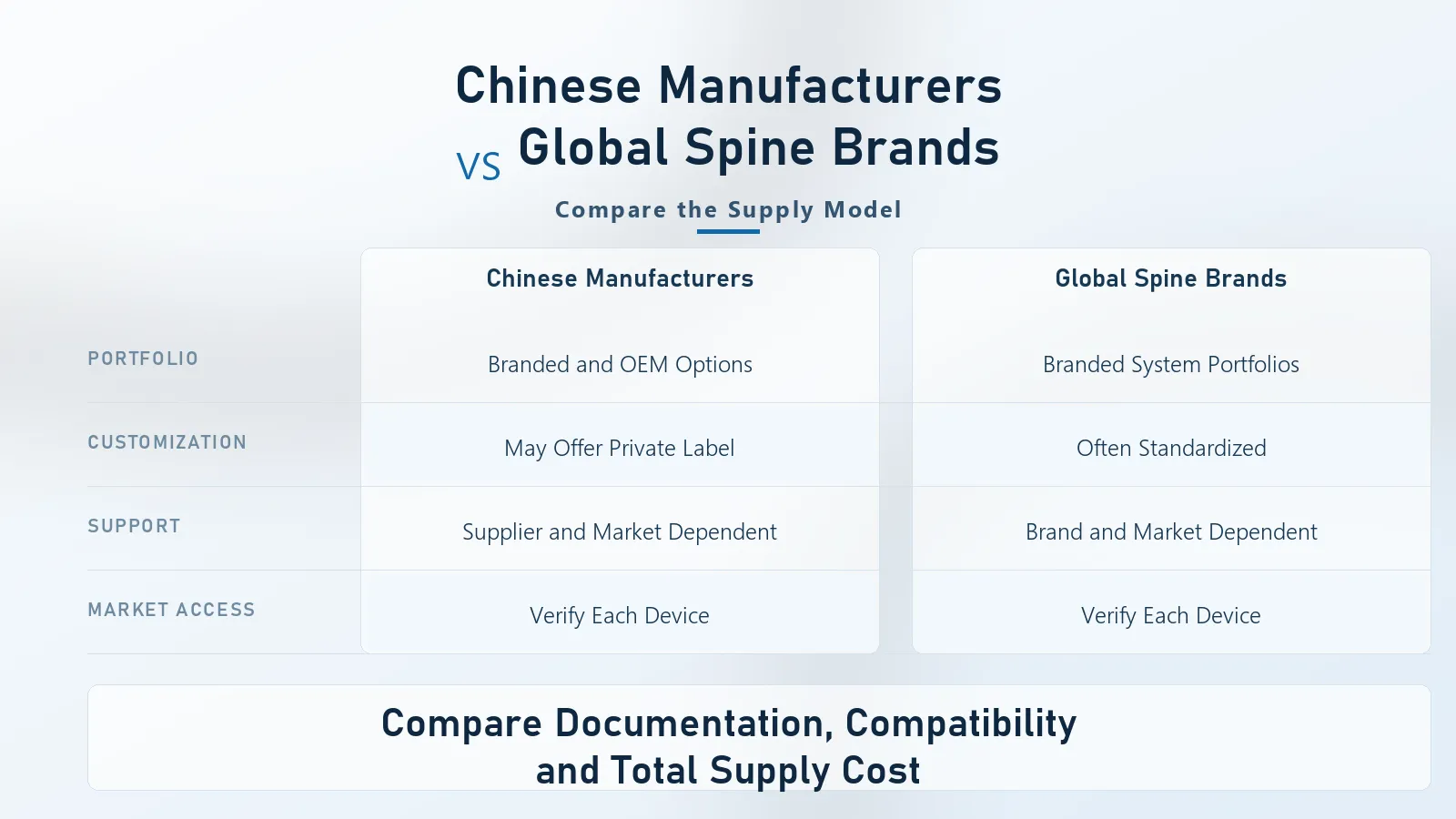
| Evaluation Area | Chinese Manufacturer Route | Global Brand Route | Buyer Due Diligence |
|---|---|---|---|
| Commercial model | May offer branded distribution, OEM, ODM, private label, or consolidated sourcing | Usually structured branded distribution with defined territory and commercial programs | Confirm brand ownership, territory, exclusivity, legal manufacturer, and quality-agreement roles |
| Portfolio selection | Can allow modular selection across open fixation, MIS, cages, cervical and instruments | Often organized as integrated proprietary platforms and procedure ecosystems | Compare actual procedure coverage and compatibility, not catalog page counts |
| Customization | Branding, packaging and configuration may be available; design changes require validation | Distributor-level product customization is often limited | Separate cosmetic changes from design changes and define regulatory responsibilities |
| Market evidence | Authorization can vary widely by product and country | May have broader multinational registrations, but not every device is approved everywhere | Request product-specific, current evidence for the target market in both cases |
| Training and enabling support | Ranges from basic manuals to distributor training and surgical technique support | Often supported by mature education and field infrastructure | Audit local training, case support, complaint handling, and instrument maintenance capacity |
| Price and inventory | May enable lower acquisition cost, flexible configurations, or consolidated orders | May carry higher brand, service, R&D, and field-support costs | Compare total landed cost, trays, consignment, replenishment, expiry, and slow-moving SKUs |
Geography does not determine quality, and company scale does not determine fit. A large global brand may be appropriate where mature clinical education, enabling technology, and established registrations are decisive. A Chinese spine implant supplier may be appropriate where product-level evidence is acceptable and the buyer values configuration flexibility, OEM support, instrument matching, or consolidated sourcing. The correct comparison is documented system against documented system.
For cross-category sourcing context, compare the orthopedic implant manufacturers in China covered in our broader guide. This spine hub adds the procedure and instrument detail needed for a dedicated spine shortlist.
How to Evaluate a Spine Implant Manufacturer in China
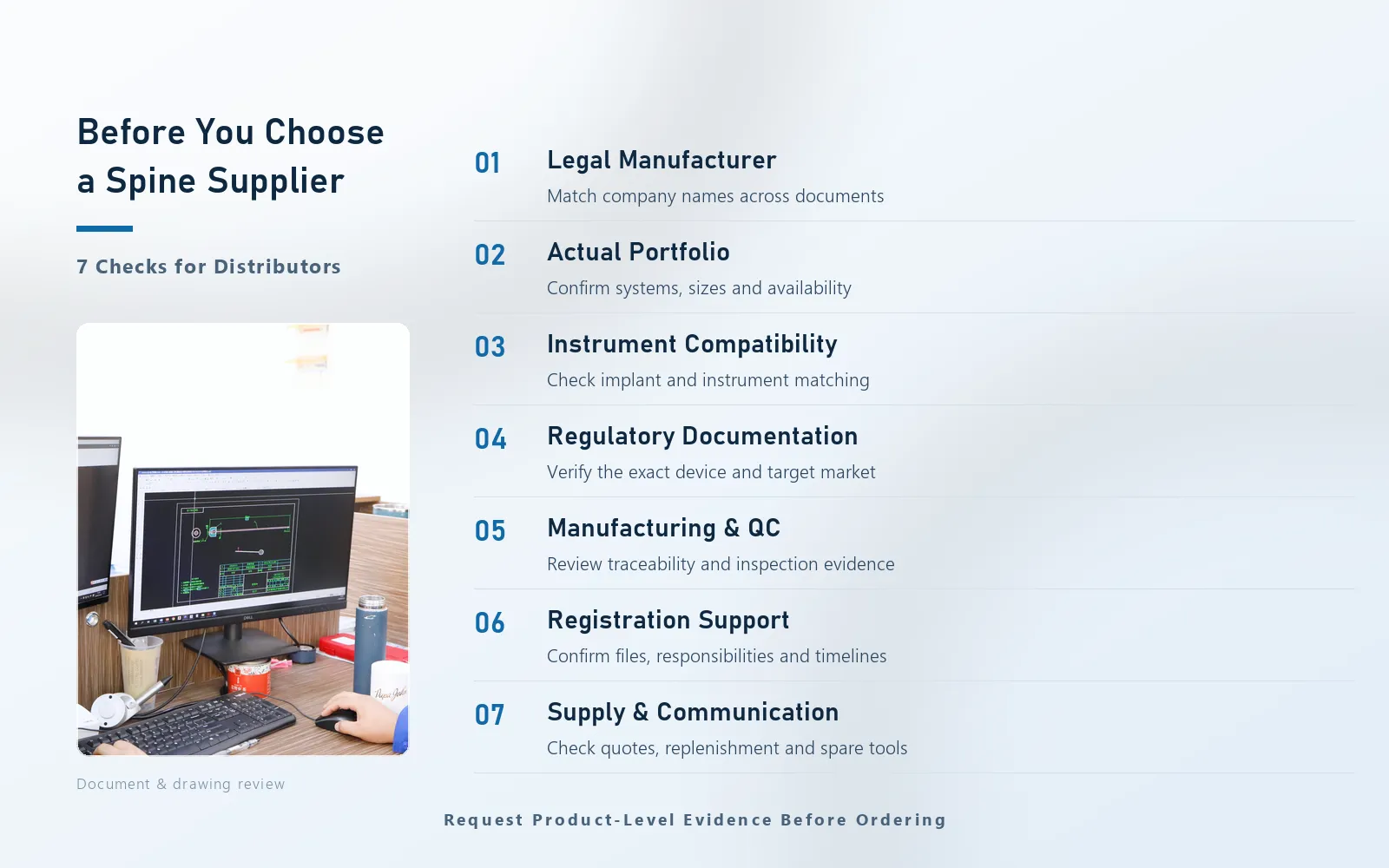
Verify the Legal Manufacturer
Start with the legal entity printed on labels, certificates, declarations, regulatory records, and quality documents. Map the roles of brand owner, specification developer, registration holder, contract manufacturer, sterilization provider, exporter, and local authorized representative. If names differ, request a written explanation and the agreements relevant to your registration and quality responsibilities.
Check the Actual Spine Portfolio
Request a controlled catalog and full model list, not a collection of marketing images. Build a procedure-by-procedure gap analysis covering open posterior fixation, MIS, anterior and posterior cervical, TLIF, PLIF, ALIF, OLIF or lateral fusion, reconstruction, and instruments. Confirm which products are active, orderable, registered, and supported in your market.
Confirm Implant and Instrument Compatibility
Review compatibility at the part-number and revision level. Confirm taps, screwdrivers, set-screw interfaces, torque limiters, rods, reducers, inserters, trials, and removal instruments. Conduct a physical sample or cadaver-lab evaluation where permitted and appropriate. Never assume two components are compatible because their nominal dimensions appear similar.
Verify Product-Specific Regulatory Documentation
For each system, request the applicable certificate or clearance, legal manufacturer, model list, intended use, classification, declaration, labeling, IFU, and validity information. ISO 13485 confirms a quality management system within its stated scope; it does not authorize a device for sale. FDA 510(k) is device clearance. CE evidence must be verified for the specific device and applicable EU regulatory framework.
Review Manufacturing and QC Evidence
Audit supplier controls for approved raw materials, machining, cleaning, passivation or surface treatment, inspection, packaging, sterilization where applicable, nonconforming product, calibration, traceability, CAPA, complaints, and change control. Ask for representative material certificates, dimensional reports, validated processes, and applicable mechanical testing. A polished factory video is not enough.
Evaluate Registration Support
Registration support should include accurate, controlled, product-specific files—not merely certificate forwarding. Clarify who prepares declarations, risk-management files, biocompatibility or performance evidence, labeling, IFUs, translations, samples, and responses to authority questions. Agree on document timelines, confidentiality, update obligations, and the process for design or supplier changes.
Assess Quote Speed, Replenishment and Communication
Commercial execution can determine whether a technically acceptable system succeeds. Test how quickly the supplier converts a surgeon request into a correct product matrix, quotation, tray configuration, document list, and delivery plan. Separate stock lead time from made-to-order lead time. Define order acknowledgement, shortage communication, replacement tools, complaint response, and escalation contacts before the first case.
What Should Distributors Ask Before Choosing a Chinese Spine Supplier?
| Question to Ask | Acceptable Evidence | Warning Sign |
|---|---|---|
| Who is the legal manufacturer for every system? | Consistent entity across labels, quality certificate scope, registration files, declarations, and agreements—or a documented explanation of each role | Only a brand name is provided, or legal entities change between documents without explanation |
| Which exact products are authorized in our market? | Current device-specific certificate, clearance or registration with model list and intended use | A company certificate is presented as proof that the whole catalog is approved |
| Can you provide a complete implant and instrument BOM? | Controlled part numbers, revisions, quantities, compatibility matrix, tray layout, and replacement-tool list | Quotation uses generic descriptions and omits trials, removers, torque tools, or accessories |
| Which products are stocked? | SKU-level stock policy, reorder points, recent fulfilment data, and separate custom-production lead times | “Fast delivery” is promised without defining inventory, cut-off time, or exclusions |
| What changes are included in OEM/private label? | Written scope for marking, packaging, labels, IFUs, tray configuration, design changes, validation, and regulatory impact | New implant geometry is described as a quick logo-level customization |
| How are complaints and recalls handled? | Quality agreement, complaint workflow, vigilance roles, traceability, investigation timeline, CAPA, and recall responsibilities | No named quality contact or no clear access to batch records |
| How do you control product changes? | Change-notification period, approval rules, regulatory impact assessment, and affected lot identification | Materials, subcontractors, drawings, packaging, or sterilization can change without buyer notice |
| What training and launch support is available? | Current surgical techniques, product training, tray checklists, instrument care guidance, and defined technical-support channels | Support ends after shipment or depends on undocumented verbal guidance |
Frequently Asked Questions
1. Who are the major spine implant manufacturers in China in 2026?
This guide reviews WEGO Orthopaedic, Sanyou Medical, Double Medical Technology, Beijing Fule, Canwell Medical, and XC Medico. They represent different models, including established orthopedic groups, spine-focused developers, broad listed manufacturers, contract-oriented suppliers, and export-focused OEM/ODM partners. The list is editorial and is not a revenue, market-share, quality, or clinical-outcomes ranking.
2. Which Chinese manufacturers specialize in spine implants?
Sanyou Medical has a particularly visible spine-focused procedure and technology portfolio. Beijing Fule also presents a strong spine-and-trauma focus. WEGO, Double Medical, and Canwell offer spine within broader orthopedic portfolios, while XC Medico supplies spine alongside other orthopedic systems with an international distributor and OEM/ODM model. Specialization should be judged at the product and support level.
3. What types of spine implants are manufactured in China?
Public catalogs from Chinese manufacturers include open and MIS pedicle screw systems, rods and connectors, anterior and posterior cervical fixation, cervical and lumbar interbody cages, TLIF, PLIF, ALIF and lateral-approach systems, laminoplasty plates, titanium mesh, vertebral reconstruction products, kyphoplasty systems, and matched surgical instruments. Availability and authorization vary by manufacturer and market.
4. Can Chinese spine manufacturers supply complete implant and instrument systems?
Yes, several manufacturers publicly present both implants and matched instruments. However, buyers must verify that the quoted tray is complete for the intended procedure and compatible with the exact implant revision. Request a controlled bill of materials, compatibility matrix, tray layout, spare-instrument list, cleaning instructions, and product-specific regulatory evidence.
5. Can Chinese spine implant manufacturers provide OEM or private-label services?
Some can. When evaluating a spine implant OEM manufacturer, distinguish the services offered from the responsibilities assigned in the contract. OEM scope may include marking, packaging, labeling, catalog configuration, documentation coordination, and sometimes design work. Branding changes and genuine design modifications are not equivalent. Any design, material, supplier, process, or intended-use change may require risk review, verification, validation, and regulatory updates. Define responsibilities in a quality and technical agreement.
6. How should distributors verify a spine implant manufacturer in China?
Verify the legal manufacturer, inspect the controlled product list, audit implant-instrument compatibility, review the ISO 13485 quality management system scope, check product-specific registrations, assess manufacturing and QC evidence, test registration support, and evaluate quotation, replenishment, complaint, and change-control processes. Use samples and on-site or remote audits where appropriate.
7. What documents should buyers request?
Request the current ISO 13485 certificate and scope; product-specific clearance, CE or registration evidence where applicable; model list; intended use; declaration; technical specifications; material certificates; risk and performance documentation as permitted; applicable mechanical and biocompatibility evidence; labeling and IFU; sterilization and packaging evidence; batch traceability; inspection reports; and change-control commitments.
8. What is the difference between a spine implant manufacturer and a trading company?
A legal manufacturer controls or assumes defined responsibility for device design and/or manufacture under the applicable regulatory framework and is identified in controlled device documentation. A trading company primarily sells products made by another entity. A trader can provide useful sourcing service, but buyers must know who controls design, production, quality records, registrations, complaints, changes, and recalls.
Sources and Update Notes
This page was last reviewed in September 2026. The company sections link to the principal official sources reviewed, including corporate profiles, official product pages or catalogs, public-company information, and FDA 510(k) records. Product pages were used to establish public portfolio visibility. FDA pages were used only for the named device clearance, applicant, decision, and other record-specific facts.
Public websites change, catalogs can combine several markets, and product names can be translated inconsistently. A page remaining online does not establish current production, stock, regulatory validity, or availability in a buyer’s country. Conversely, “Not publicly confirmed” would mean only that sufficient public evidence was not found during this review.
Sources serve different purposes: company catalogs establish publicly presented product families; corporate profiles identify business location and activities; regulatory records establish facts about named devices. The “Best Fit” assessments and procurement comparisons are editorial judgments based on that evidence, rather than independently measured supplier performance.
Editorial Accuracy Note
Public information and regulatory status can change after publication. Before purchase, registration, tender submission, or clinical use, buyers should obtain current product-level evidence directly from the legal manufacturer and confirm it with the relevant authority or qualified regulatory professional. Company size, listing status, website breadth, ISO 13485 certification, or one FDA 510(k) clearance does not prove that another product is suitable, authorized, compatible, or clinically preferable.
Build a Verifiable Spine Product Shortlist
Share your target procedures, implant families, instrument requirements, destination market, registration needs, branding scope, and expected order plan. XC Medico can help match catalog options, prepare a consolidated quotation, and identify the product-specific documents that require review.
Contact Your XC Medico Specialist Review the Spine Portfolio
