


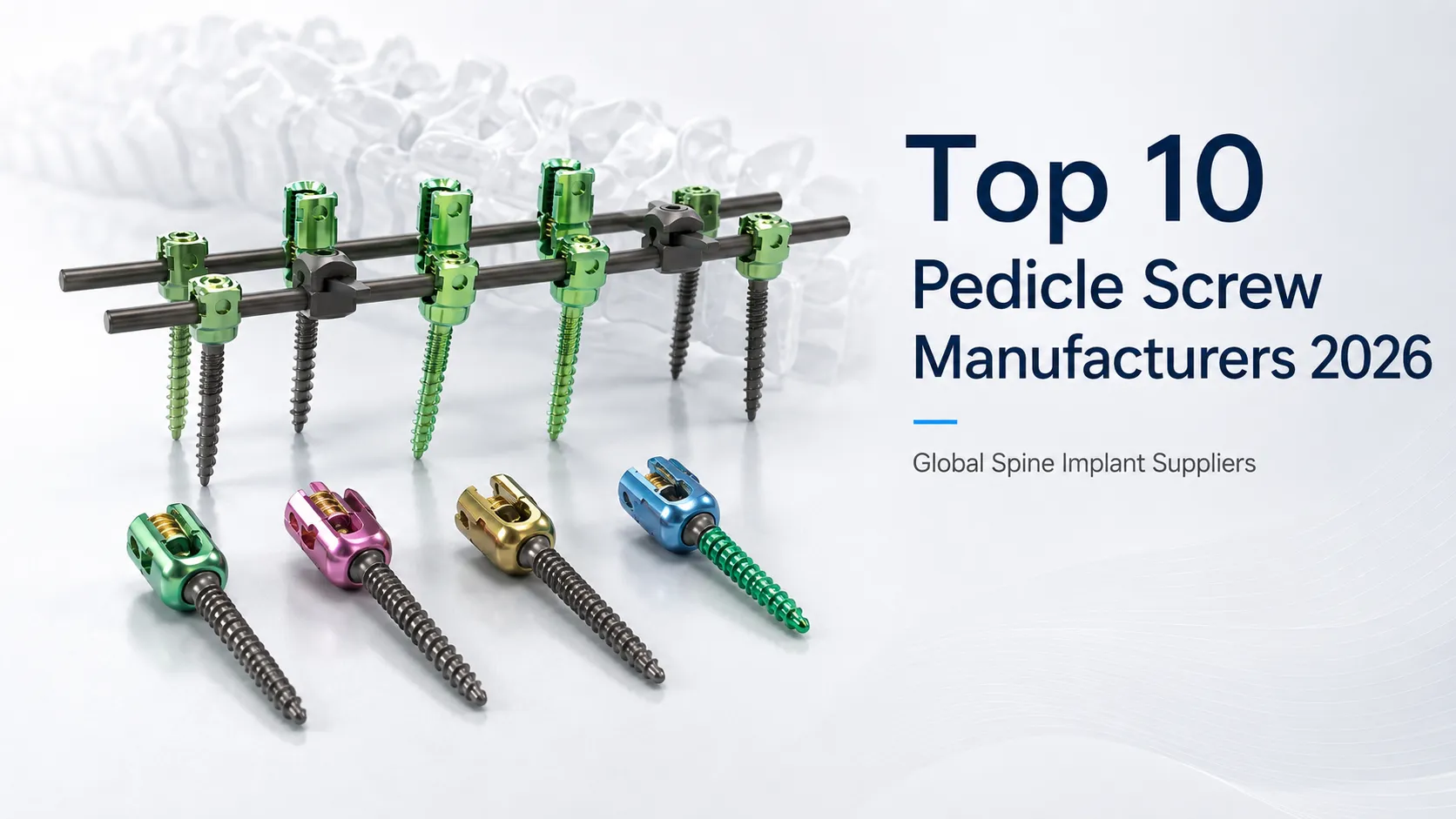
2026 Distributor Guide · Pedicle Screw Systems
Pedicle screw manufacturers supply the core hardware behind posterior spinal fixation — the screws, rods, and connectors that stabilize the thoracolumbar spine in degenerative, deformity, trauma, and revision cases. This category sits at the center of most spine distributors' catalogs, which is exactly why it deserves a more careful evaluation than "which brand is biggest."
What actually determines whether a pedicle screw supplier works for a distributor is system completeness — screw options, rod compatibility, minimally invasive capability, matched instruments, and regulatory documentation — not a single screw's design. A distributor isn't buying a screw. They're buying a posterior stabilization system that has to hold together, case after case, across whatever configuration a surgeon needs. This guide builds on our broader review of spine implant manufacturers, narrowing in specifically on pedicle screw systems.
In This Guide
How We Selected These Pedicle Screw Manufacturers
1. Pedicle Screw System Coverage
Whether the manufacturer offers polyaxial, monoaxial, reduction, cannulated, and MIS screw options, along with deformity and revision-specific hardware — or concentrates in a narrower slice of the category. This is the baseline test for whether a company is really a pedicle screw system manufacturer or just a screw vendor.
2. Open and Minimally Invasive Fixation Capability
This is one of the more important differentiators in this list. A manufacturer strong in open posterior fixation isn't automatically equipped for percutaneous placement — MIS capability requires screw extenders, percutaneous rod delivery, and dedicated reduction instruments as a validated workflow, not just a cannulated screw sold in isolation.
3. Rod, Connector, and Instrument Compatibility
A pedicle screw can't be evaluated apart from the posterior stabilization system it belongs to — 5.5mm and 6.0mm rod options, set screws, cross-links, connectors, reduction tools, and screwdrivers all have to be validated together.
4. Manufacturing and Quality Control
Titanium alloy specification, machining consistency on thread geometry and the screw-head interface specifically, dimensional inspection, and batch traceability — the manufacturing controls that help distinguish a consistently produced fixation system from one with greater batch-to-batch variability.
5. Distributor and Regulatory Support
Catalog completeness, instrument configuration options, product registration documentation, OEM/ODM and private-label support, and realistic replenishment lead times.
Quick Comparison of the Top 10 Pedicle Screw Manufacturers
This table provides a fast, procurement-focused comparison of the manufacturers discussed below. “Verify” and “market-dependent” indicate that current MIS availability, ownership, distribution, or regional access should be confirmed directly rather than assumed from a company's general spine portfolio.
| Manufacturer | Main Strength | Open System | MIS | Market Model |
|---|---|---|---|---|
| Medtronic | Broad thoracolumbar fixation with enabling-technology integration | CD Horizon Solera | Solera Voyager MIS | Global, direct-sales-led |
| Globus Medical | Comprehensive CREO fixation, deformity, and navigation ecosystem | CREO family | CREO MIS | Global, direct-sales-led |
| DePuy Synthes | Shared open and percutaneous thoracolumbar platform | EXPEDIUM | VIPER Systems | Global medtech; restructuring should be monitored |
| Stryker | Historically established Xia 3 and Serrato portfolio | Historical portfolio; verify current ownership | Market-dependent; verify with VB Spine | U.S. spinal implants transferred to VB Spine |
| Zimmer Biomet | Posterior fixation within a broad orthopedic portfolio | Vitality | PathFinder / PathFinder NXT | Global, direct-sales-led |
| Alphatec (ATEC) | Procedure-focused open, MIS, and hybrid workflow integration | Invictus | Invictus | Specialized, direct-sales-led |
| Ulrich Medical | Independent European spine specialization | Posterior thoracolumbar systems | Verify by system and market | Independent specialist; market-dependent |
| Weigao Orthopaedic | China-scale orthopedic manufacturing breadth | Pedicle screw / posterior fixation systems | Verify by current catalog | Broad portfolio; market-dependent |
| Sanyou Medical | Dedicated spine and trauma product specialization | Pedicle screw systems | Verify by system and market | Spine specialist; distributor access varies |
| XC Medico | Matched implant and instrument supply with OEM/ODM flexibility | 5.5mm and 6.0mm platforms | MisFix 5.5 system | Distributor- and OEM-oriented |
Global Pedicle Screw Manufacturers
1. Medtronic

Product portfolio: The CD Horizon Solera platform (4.75mm and 5.5/6.0mm rod options) with the Solera Voyager MIS system built on the same platform, supporting both percutaneous and Wiltse minimally invasive rod insertion approaches.
Manufacturing and regulatory: Backed by Medtronic's broader global manufacturing and regulatory infrastructure, with the Stealth AXiS surgical platform extending Medtronic's integration of fixation, navigation and enabling technology.
Distributor relevance: Broad thoracolumbar fixation and MIS integration, direct-sales-led.
2. Globus Medical

Product portfolio: One of the most comprehensive pedicle screw platforms in the industry — the CREO family spans CREO MIS (extended modular screw heads for percutaneous placement), CREO AMP (modular platform for intraoperative versatility), CREO NXT (non-threaded cobalt chrome deformity system), and CREO ONE (a robotic screw integrated with ExcelsiusGPS navigation).
Manufacturing and regulatory: Following its September 2023 merger with NuVasive, Globus now operates one of the largest dedicated spine and enabling-technology portfolios in the industry — confirm current product line details directly, since the combined catalog shifted after the merger.
Distributor relevance: A comprehensive pedicle screw and deformity platform, direct-sales-led.
3. DePuy Synthes

Product portfolio: The EXPEDIUM Spine System (open) and VIPER Systems (percutaneous/MIS), sharing a common posterior thoracolumbar fixation platform across both approaches.
Manufacturing and regulatory: Part of Johnson & Johnson MedTech. As of February 2026, J&J has been reported to be exploring a sale of its DePuy Synthes orthopedics unit valued at more than $20 billion, with a tax-free spin-off previously identified as a preferred separation route, while other transaction structures remain under consideration. DePuy Synthes also acquired Expanding Innovations in July 2026, adding non-screw expandable interbody cage technology to its spine portfolio.
Distributor relevance: Distributors with existing DePuy Synthes relationships should track this restructuring closely, as ownership and commercial terms could change depending on which separation path J&J pursues.
4. Stryker

Product portfolio: Historically, the Xia 3 Spinal System and Serrato Pedicle Screw were Stryker Spine's core thoracolumbar fixation products.
Current status: Stryker completed the sale of its U.S. spinal implants business to Viscogliosi Brothers (forming VB Spine, LLC) in April 2025, with related international spine business sales anticipated in additional markets. Pedicle screw systems previously sold under the Stryker Spine name should not be assumed to still be a current Stryker product — confirm ownership directly, as VB Spine has been expanding this business through 2026.
Distributor relevance: Stryker remains active in spine-adjacent areas including Interventional Spine, Neurotechnology and enabling technologies, while the U.S. spinal implant portfolio transferred to VB Spine.
5. Zimmer Biomet

Product portfolio: The Vitality Spinal Fixation System for open posterior fixation, alongside the PathFinder and PathFinder NXT minimally invasive pedicle screw systems.
Manufacturing and regulatory: Part of Zimmer Biomet's broader orthopedic ecosystem, headquartered in Warsaw, Indiana.
Distributor relevance: Posterior fixation as one category within a full orthopedic portfolio, direct-sales-led.
Specialized and Distributor-Relevant Spine Manufacturers
6. Alphatec (ATEC)

Product portfolio: Invictus, a spinal fixation platform designed for open, MIS, or hybrid approaches within a single system, featuring helical flange tulip technology to resist cross-threading, and integration with ATEC's SafeOP neural monitoring system.
Distributor relevance: A stronger, more procedurally focused presence in modern spine workflow integration than some larger diversified orthopedic companies — a strong fit for distributors building a thoracolumbar and MIS-focused catalog specifically.
7. Ulrich Medical

Product portfolio: Posterior spinal fixation, deformity correction, and thoracolumbar systems, alongside vertebral body replacement and cervical fusion products.
Manufacturing and regulatory: A family-owned German company founded in 1912, headquartered in Ulm, with more than 500 employees, subsidiaries in France and the US, and 2025 revenue of roughly €178 million.
Distributor relevance: An independent, owner-run European spine specialist, adding diversity to a catalog built primarily around US-based manufacturers.
8. Weigao Orthopaedic

Product portfolio: Pedicle screw and posterior fixation systems as part of a broader spine, trauma, and joint portfolio.
Manufacturing and regulatory: The orthopedic device subsidiary of Weigao Group (Hong Kong-listed since 2004), one of China's larger domestic orthopedic implant producers by manufacturing scale.
Distributor relevance: Represents China-scale spine manufacturing capacity — confirm current pedicle screw system specifics directly, since this is one category within a much broader catalog.
9. Sanyou Medical

Product portfolio: Spine and trauma implants, including pedicle screw systems, as a dedicated specialty rather than a small piece of a general orthopedic catalog.
Manufacturing and regulatory: Founded in 2005 in Shanghai, with an R&D lab established in 2010 by a team with prior multinational spine experience; frequently cited as one of China's larger independent spine implant manufacturers by product breadth and patent count.
Distributor relevance: A genuinely specialized spine manufacturer rather than a generalist orthopedic company with spine as a side category.
10. XC Medico

Headquarters: Changzhou, China
Product portfolio: A China-based spine implant manufacturer supplying open and minimally invasive pedicle screw systems, matched instruments, and OEM/ODM support for distributors — covering polyaxial and reduction screws across 5.5 and 6.0 rod platforms within the broader spine implant systems catalog.
Manufacturing capability: In-house CNC machining and quality inspection integrated into the same production process as its interbody cage and instrument lines.
Distributor relevance: Screw, rod, and instrument sets developed as matched systems rather than sourced separately, with flexible OEM/ODM configuration for distributors building or extending a private-label spine catalog.
Main Types of Pedicle Screw Systems
Polyaxial Pedicle Screws
The screw head can angulate relative to the shaft before the rod is locked in place, giving surgeons flexibility to capture the rod even when screw trajectories vary slightly between levels — the most commonly used screw type for standard thoracolumbar fixation.
Monoaxial Pedicle Screws
A rigid, fixed-angle head that doesn't articulate relative to the shaft. This fixed-head design may be selected at specific levels in deformity constructs where more direct control over vertebral position is desired, even when other levels use polyaxial screws.
Reduction Pedicle Screws
Feature an extended tab or tower that allows the rod to be reduced down to the screw head from a distance above the pedicle. These screws are commonly considered in constructs requiring rod reduction or vertebral realignment before final locking; final selection depends on anatomy, construct planning, and the approved surgical technique.
MIS and Percutaneous Pedicle Screws
Placed through small skin incisions using extended tab or cannulated screw designs, guided by fluoroscopy or navigation, with rods delivered percutaneously through the same working channels. A genuine minimally invasive pedicle screw system requires the screw extenders, percutaneous rod-passing instruments, and reduction tools as a validated set — not just a cannulated screw sold on its own.
Cannulated Pedicle Screws
Hollow-shaft screws that allow guidewire-based insertion, commonly used in percutaneous applications and sometimes paired with cement augmentation in osteoporotic bone.
What Makes a Complete Pedicle Screw System
| Component | Buyer Should Check |
|---|---|
| Pedicle screws | Diameter range, length range, head type (polyaxial/monoaxial/reduction) |
| Rods | Diameter (4.75mm, 5.5mm, 6.0mm), length, material |
| Locking caps | Compatibility with screw head design, breakaway torque consistency |
| Connectors | Offset, lateral, and cross-link options for multi-level or revision constructs |
| Reduction instruments | Matching interface with the specific screw tower design |
| Screwdrivers | Head compatibility, grip consistency under torque |
| Rod instruments | Benders, persuaders, reducers matched to rod material and diameter |
| Trays | Complete system organization, clear size identification |
Open vs. Minimally Invasive Pedicle Screw Systems
| Factor | Open System | MIS System |
|---|---|---|
| Screw insertion | Direct exposure | Percutaneous |
| Screw heads | Standard or reduction | Extended tab or cannulated |
| Rod delivery | Open placement | Percutaneous delivery through screw towers |
| Instrumentation | Conventional | Dedicated MIS extenders and reduction tools |
| Portfolio need | Core spine catalog | Advanced spine portfolio |
Distributors comparing open and percutaneous workflows should also review whether the supplier's open spinal stabilization system shares compatible rods, screws, and instruments with its MIS platform.
Pedicle screws are frequently placed alongside an interbody procedure — most commonly TLIF, and increasingly as posterior supplemental fixation for OLIF constructs — which is why screw and rod compatibility across both open and MIS approaches matters for a distributor's broader lumbar fusion catalog, not just the screw system in isolation.
Global Brands vs. OEM-Oriented Pedicle Screw Manufacturers
| Factor | Global Brands | OEM-Oriented Manufacturers |
|---|---|---|
| Brand recognition | High | Lower, built around distributor branding |
| Product breadth | Broad | Focused, configurable |
| OEM flexibility | Limited | Higher |
| Private label | Usually limited | Often available |
| MOQ flexibility | Less relevant at this scale | Important for new market entry |
| Distributor catalog matching | Standardized | More adaptable |
| Registration support | Mature, established | Supplier-dependent, varies significantly |
For distributors evaluating OEM orthopedic manufacturer options specifically for pedicle screw systems, the deciding factor is usually which side of this table matters more for the specific market being entered — established brand recognition, or the flexibility to build a private-label catalog from scratch.
How to Choose a Pedicle Screw Manufacturer
For a China-specific due-diligence framework covering system scope, manufacturing controls, instruments, documentation, and distributor support, see how to evaluate a pedicle screw manufacturer in China.
Check the Screw Portfolio
Confirm the manufacturer offers polyaxial, monoaxial, reduction, and MIS screw options — not just one type presented as if it covers every case.
Confirm Rod and Connector Compatibility
Don't evaluate screw SKUs in isolation. Confirm rod diameter options, cross-links, and offset connectors are validated to work with the specific screw system being sourced.
Review Instrument Set Completeness
This is where distributors most often get caught out. Confirm reduction instruments, screwdrivers, and rod-handling tools are included and validated as a set, not assumed to be generic.
Evaluate MIS Capability
If your target market includes percutaneous procedures, verify the complete MIS workflow — extenders, percutaneous rod delivery, and reduction tools — not just the existence of a cannulated screw.
Verify Manufacturing and Testing
Ask about titanium alloy specification, machining tolerance on the screw-head interface, mechanical testing data, and batch traceability.
Review Regulatory Documentation
ISO 13485 certifies the manufacturer's quality management system — it is not itself a product approval. Request the certificate scope annex confirming pedicle screw systems are covered, along with any applicable product registration or regional approval documentation for the specific market you're selling into.
Assess Distributor and OEM Support
Confirm packaging and labeling customization, catalog configuration options, registration document support, and realistic replenishment lead times.
Frequently Asked Questions
Article note: This list reflects publicly available information as of mid-2026 and is intended as an editorial industry overview, not investment or procurement advice. Company details, product lines, and ownership change; distributors should verify current information directly with each manufacturer before making sourcing decisions.
Building or expanding a pedicle screw portfolio? Compare open and MIS system configurations, matched instruments, and documentation requirements with XC Medico's spine team.

