Hip implant manufacturers support modern joint reconstruction with acetabular components, femoral stems, bearing surfaces, revision implants, and matched surgical instruments. For orthopedic distributors, hospital procurement teams, and importers, selecting a hip replacement supplier involves much more than comparing a well-known brand name or the price of a single implant.
A usable total hip replacement system must combine a complete implant range with reliable instruments, product-specific regulatory documentation, dependable replenishment, and long-term technical support. The manufacturer must also be able to support the requirements of primary total hip arthroplasty, revision procedures, different surgical approaches, and the needs of the intended market.
This 2026 guide compares seven established and specialized hip implant companies from a procurement perspective. It complements our broader reviews of joint implant manufacturers and knee implant manufacturers, helping buyers evaluate the hip and knee segments as related but distinct supplier categories.
Scope note: This is an editorial supplier comparison, not a clinical recommendation or a strict ranking by revenue, market share, or implant performance. Product availability, regulatory status, and distribution arrangements vary by country and should be verified directly with each manufacturer.
In This Guide
- How we selected the manufacturers
- Top 7 hip implant manufacturers
- Chinese manufacturers worth following
- Global brands vs. specialized manufacturers
- Common hip implant components and systems
- How to choose a hip implant manufacturer
- Frequently asked questions
How We Selected These Hip Implant Manufacturers
The companies were selected to represent important supplier types within the hip reconstruction market. The list includes large multinational brands, focused joint-reconstruction companies, and an internationally active manufacturer with Chinese roots. It is intended to help buyers build a shortlist rather than declare one company suitable for every market or procedure.
Publicly available corporate and product information was considered alongside the practical sourcing criteria below. Buyers comparing these companies with other orthopedic implant manufacturers should still complete product-level due diligence before registration or purchasing.
Hip Implant Portfolio Coverage
We considered whether a manufacturer supports primary total hip arthroplasty, acetabular and femoral options, alternative bearing combinations, and revision hip reconstruction. A broad catalog is useful only when its components form a coherent procedure system.
Implant Design and Technology
Evaluation included cemented and cementless fixation, acetabular shell options, femoral stem philosophies, dual-mobility concepts, porous surfaces, patient-matched planning, and technologies intended to support different surgical approaches.
Instrumentation and Surgical Support
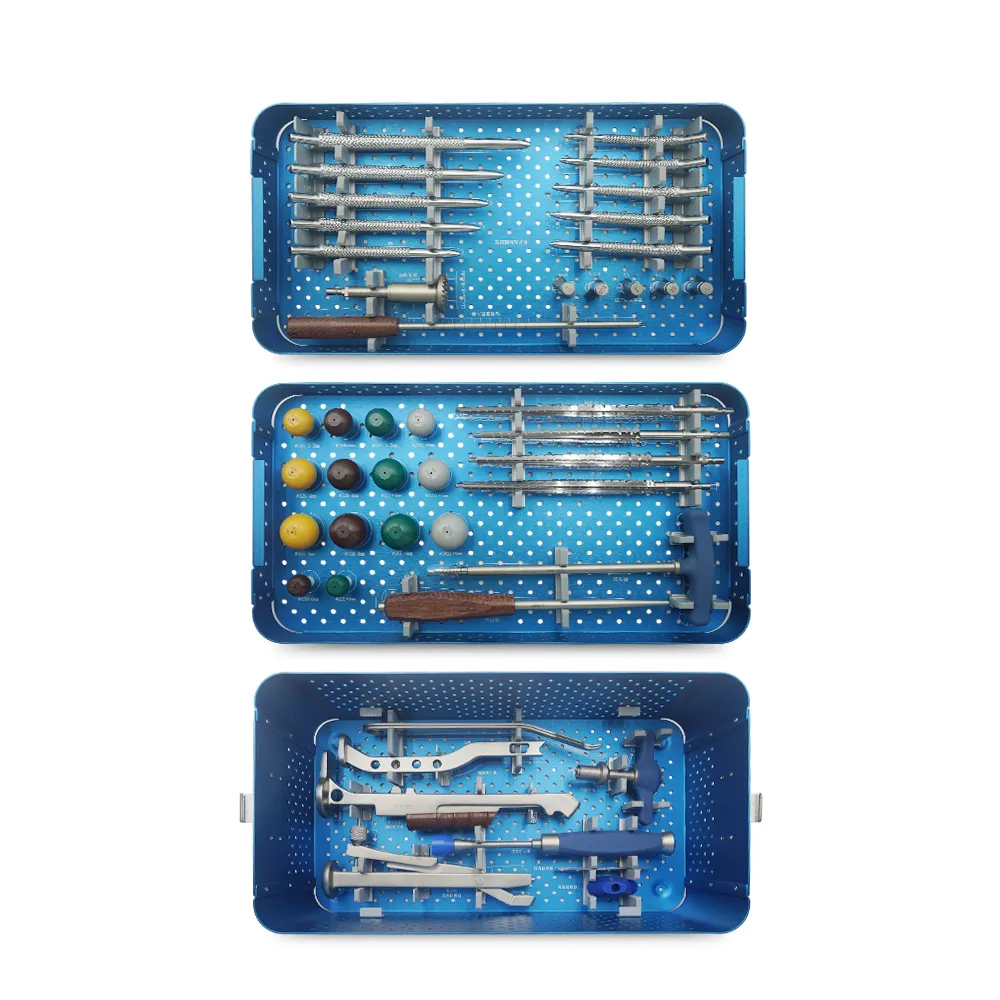
Hip implants depend on matched broaches, reamers, trials, cup impactors, extraction tools, instrument trays, and surgical technique guidance. Instrument quality and availability can materially affect the operational value of an implant program.
Manufacturing and Quality Capability
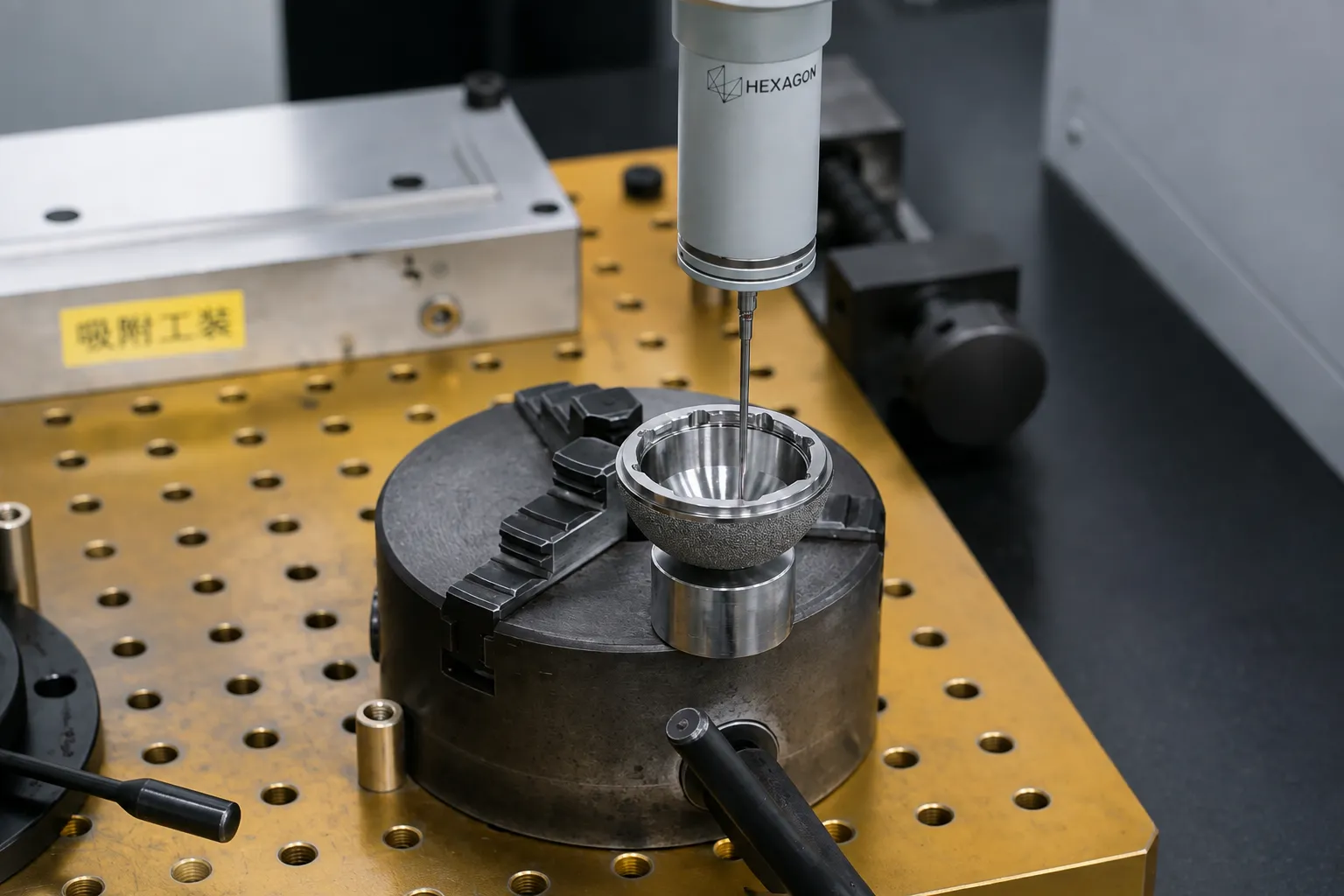
Buyers should review the legal manufacturer, production site, quality-management scope, raw-material control, inspection, traceability, and applicable product registrations. Company-level claims should never replace device-specific document verification.
Distributor and Market Support
We also considered training, instrument logistics, local channel structure, product documentation, technical support, and long-term supply. These factors are especially important for distributors introducing a new hip replacement system to surgeons and hospitals.
Top 7 Hip Implant Manufacturers in 2026

The sequence below is editorial. A higher number does not establish better clinical outcomes, and the best supplier depends on the required implant range, commercial model, local regulatory pathway, surgeon preferences, and instrument-support capability.
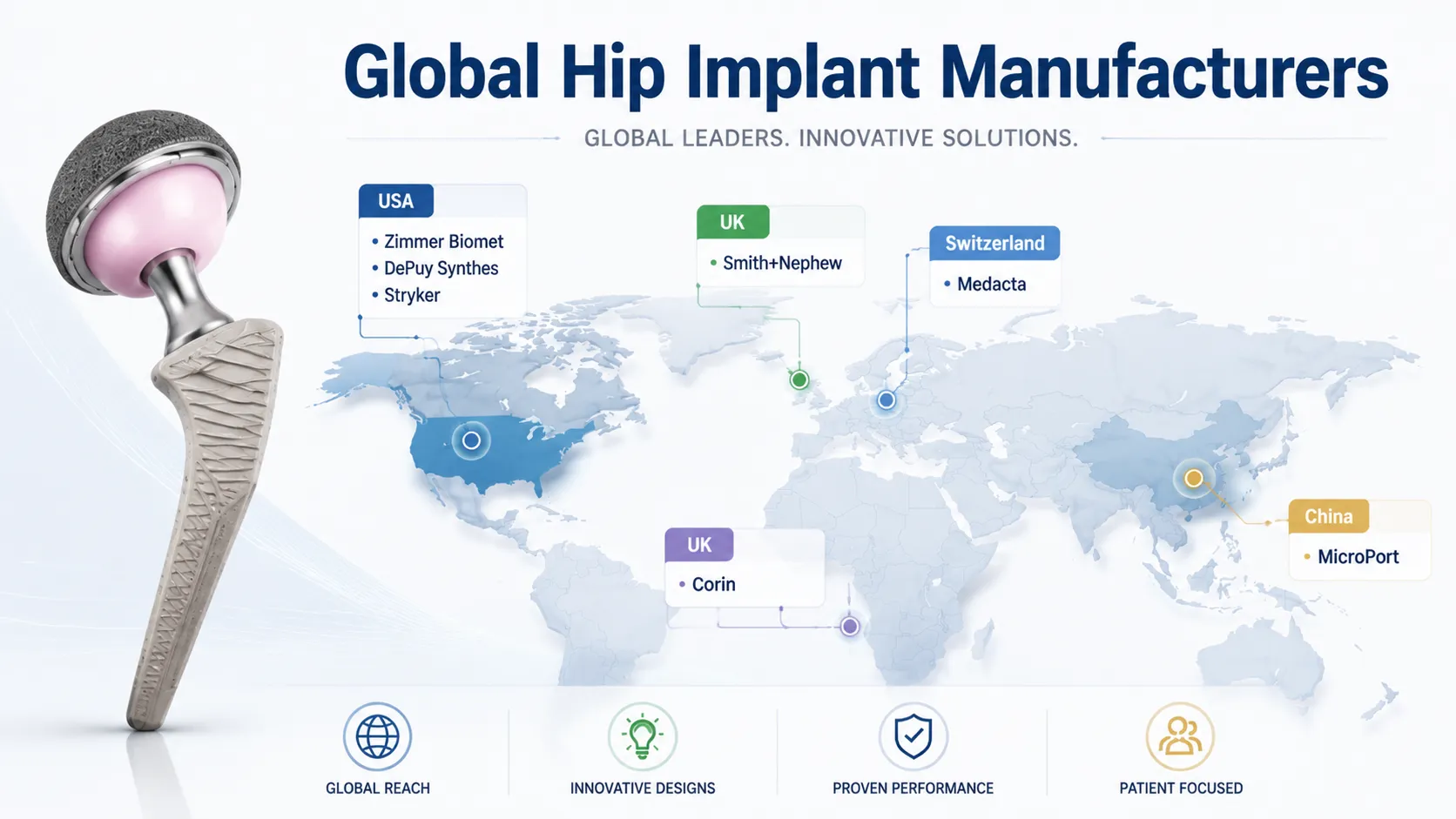
1. Zimmer Biomet
Profile: Global joint-reconstruction leader
Zimmer Biomet is one of the most established names in hip and knee reconstruction. Its hip portfolio addresses acetabular reconstruction, femoral fixation, bearing options, and revision procedures, supported by a large global commercial and education network.
The company’s verified hip product lines include the G7 Acetabular System and the Avenir Complete Hip System. Together they illustrate Zimmer Biomet’s ability to support both acetabular and femoral sides of total hip arthroplasty through an integrated branded portfolio.
Why buyers consider it: broad reconstruction experience, strong surgeon recognition, mature instruments, and support for primary and revision workflows.
Key consideration: established global-brand programs may offer less commercial flexibility than private-label or distributor-focused supply models. Confirm territory access, capital and instrument requirements, and local service arrangements.
2. DePuy Synthes
Profile: Full-line multinational orthopedics company
DePuy Synthes, the orthopedic business associated with Johnson & Johnson MedTech, maintains a substantial presence in joint reconstruction. Its hip portfolio includes long-established acetabular and femoral systems used within comprehensive total hip replacement programs.
Verified examples include the PINNACLE Hip Solutions portfolio and the ACTIS Total Hip System. These products reflect the company’s focus on integrated implant and instrument platforms for modern hip arthroplasty.
Why buyers consider it: extensive global infrastructure, broad clinical familiarity, strong education resources, and a mature implant-and-instrument ecosystem.
Key consideration: product access and distributor opportunities differ by country. Buyers should verify current corporate, channel, and portfolio arrangements rather than assuming global availability is uniform.
3. Stryker
Profile: Reconstruction and enabling-technology company
Stryker is a major orthopedic manufacturer with a strong position in joint replacement, instruments, operating-room technologies, and robotic-assisted workflows. Its hip business combines implant systems with procedure support and a large global commercial network.
The company’s established hip portfolio includes the Trident Acetabular System and the Accolade femoral stem family. These lines provide recognizable acetabular and femoral platforms without relying on an unnecessarily specific regional version designation.
Why buyers consider it: strong brand recognition, mature reconstruction portfolio, integrated instrumentation, and experience linking implants with enabling technologies.
Key consideration: the complete commercial value proposition may include equipment, training, service, and regional channel requirements in addition to implant pricing.
4. Smith+Nephew
Profile: International orthopaedics and sports-medicine company
Smith+Nephew operates across orthopaedics, sports medicine, and other medical technology fields. Within hip reconstruction, the company supports both primary arthroplasty and revision procedures through femoral, acetabular, and revision-focused solutions.
Verified product names include the POLARSTEM femoral stem and the REDAPT Revision Hip System. POLARSTEM is the correct product name; the unverified name “Polar3” should not be used.
Why buyers consider it: established international presence, experience in primary and revision reconstruction, and a broader orthopedic and sports-medicine support structure.
Key consideration: availability and distribution models may differ across business units and countries. Confirm the exact implant, instrument, and revision components available in the target market.
5. Medacta
Profile: Specialized joint-reconstruction and surgical-approach company
Medacta is a focused orthopedic company with hip, knee, spine, and sports-medicine activities. Its hip positioning is closely associated with the AMIS approach and with technologies intended to support planning, reproducibility, and patient-specific reconstruction.
Rather than relying on an unverified “MyHip” product name, this guide uses the more careful description of patient-matched femoral and acetabular technology. This preserves the relevant procurement concept without overstating a trademark or product identity that has not been confirmed.
Why buyers consider it: hip specialization, approach-focused education, personalized technology, and a more concentrated reconstruction identity than many diversified medtech groups.
Key consideration: approach-specific programs require surgeon training, suitable instruments, and consistent local support. Buyers should assess the complete implementation model, not only the implants.
6. Corin Group
Profile: Hip- and knee-focused reconstruction specialist
Corin Group concentrates on hip and knee reconstruction and differentiates itself through a focused implant portfolio, digital planning, and personalized orthopedic technologies. This narrower specialization makes the company relevant to established joint-reconstruction distributors.
Verified hip products include the Trinity acetabular system and the MiniHip stem. Both product families have been associated with ODEP 5A* ratings, although buyers should always check the current ODEP listing and the precise product configuration during due diligence.
Why buyers consider it: focused hip expertise, recognizable acetabular and bone-conserving femoral concepts, and an emphasis on personalized reconstruction.
Key consideration: a specialized portfolio may require a distributor with strong joint-reconstruction training, instrument logistics, and surgeon-development capability.
7. MicroPort Orthopedics
Profile: Chinese-founded, internationally active joint-reconstruction company
MicroPort Orthopedics focuses on hip and knee reconstruction and operates within the wider MicroPort medical-technology group. Its international history and dedicated joint portfolio distinguish it from Chinese manufacturers serving only the domestic market.
The company is relevant to buyers seeking an established Asian-origin alternative with international operations, procedure technologies, and a specialized reconstruction portfolio. However, its global structure means that the legal manufacturer, manufacturing country, product registration, and commercial entity can differ by system and region.
Why buyers consider it: dedicated joint-reconstruction focus, international commercial experience, and a position connecting Chinese medical-technology development with global orthopedic markets.
Key consideration: verify the exact legal manufacturer and regional product availability. MicroPort’s Chinese parentage should not be interpreted to mean that every hip implant is manufactured in mainland China.
Chinese Hip Implant Manufacturers Worth Following

China’s joint-reconstruction sector includes listed orthopedic groups, specialized hip and knee manufacturers, and internationally active companies. MicroPort Orthopedics appears in the main list because of its broader international position. AK Medical and Chunli Medical are included here as notable Chinese manufacturers rather than being used to fill additional places in the Top 7.
For a wider country-level review covering trauma, spine, joints, sports medicine, and OEM suppliers, see our guide to orthopedic implant manufacturers in China.
| Manufacturer | Hip-market position | Relevant strengths | Buyer consideration |
| MicroPort Orthopedics | Chinese-founded global joint company | Hip and knee specialization, international operations, procedure technologies | Confirm legal manufacturer, origin, registration, and regional entity by product |
| AK Medical | Listed Chinese reconstruction specialist | Primary and revision joints, 3D-printing applications, customized reconstruction | Review full instrument investment, revision depth, training, and target-market registrations |
| Chunli Medical | Listed Chinese artificial-joint manufacturer | Long-standing hip and knee focus with a broader orthopedic catalog | Confirm implant range, instruments, revision support, registration, and local clinical training |
These companies are not interchangeable. A distributor seeking a branded international joint program, an advanced reconstruction platform, or a focused Chinese catalog will face different requirements for registration, training, instruments, inventory, and surgeon adoption.
Global Brands vs. Specialized Hip Implant Manufacturers
Large global brands and specialized hip manufacturers usually support different commercial and operational models. The right choice depends on whether the buyer prioritizes brand recognition, focused technology, channel flexibility, or a complete local launch program.
| Evaluation factor | Large global brand | Specialized manufacturer |
| Brand recognition | Usually stronger among hospitals and surgeons | May require more local education and market development |
| Portfolio breadth | Often broad across primary, revision, instruments, and enabling technologies | Often narrower but more concentrated on selected concepts or approaches |
| Training ecosystem | Established global education and service infrastructure | Can be focused and responsive but may depend more on the local distributor |
| Commercial flexibility | Usually governed by mature regional channel policies | May offer more adaptable territory or launch arrangements |
| Instrument investment | Mature systems, sometimes linked to larger program commitments | May be more configurable, but completeness must be checked carefully |
| Best fit | Established branded hospital and surgeon networks | Focused reconstruction channels seeking differentiation or flexibility |
Common Hip Implant Components and Systems
A hip replacement is a procedure system, not a single product. Distributors evaluating a hip prosthesis manufacturer should understand how the core components fit together and which options are available for primary and revision cases.
Acetabular Components
The acetabular side may include a metal shell, liner, fixation screws, trial components, and insertion instruments. Depending on the system, buyers may encounter cemented cups, cementless shells, porous coatings, multi-hole revision shells, constrained options, or dual-mobility configurations. An acetabular cup manufacturer should provide clear compatibility tables for shells, liners, heads, screws, and instruments.
Femoral Stems
Femoral stems vary by fixation method, geometry, length, offset, coating, and surgical philosophy. Common categories include cemented stems, cementless stems, short stems, and revision stems. A femoral stem manufacturer should support the implant range with broaches, trials, neck options, extraction tools, and an understandable sizing strategy.
Bearing Surfaces
Bearing combinations may use ceramic or metal femoral heads with polyethylene or ceramic liners, subject to the design and approvals of the specific system. Buyers must verify compatibility, available diameters, offsets, taper specifications, material documentation, and the regulatory status of each approved combination.
Revision Hip Systems
Revision reconstruction can require long or modular femoral stems, acetabular augments, cages, revision shells, specialized liners, extraction instruments, and solutions for bone loss. A supplier that offers a strong primary system but limited revision support may still leave a distributor dependent on another brand for complex cases.
How to Choose a Hip Implant Manufacturer
The manufacturer list is only a starting point. Supplier qualification should be completed at the legal-entity, manufacturing-site, implant-family, and target-market levels.
Evaluate the Complete Hip System
Review acetabular shells, liners, screws, femoral stems, heads, trials, revision options, and instruments as one system. Confirm which sizes and combinations are actually registered and available, not merely shown in a global catalog.
Review Surgical Instrument Compatibility

Confirm that broaches, reamers, cup positioners, impactors, trials, torque tools, extraction instruments, and trays match the selected implants. Instrument-set cost, maintenance, cleaning instructions, replenishment, and case coverage should be evaluated alongside implant pricing. The same principle applies when comparing broader orthopedic surgical instrument manufacturers.
Verify Product-Specific Regulatory Documents
ISO 13485 certification, CE documentation, FDA clearance, and other market authorizations serve different purposes. Ask for documents matching the exact legal manufacturer, production site, device name, size range, and target market. Do not assume that one company certificate covers every implant in its catalog.
Assess Manufacturing and Traceability
Request material certificates, batch records, inspection examples, traceability records, labeling samples, and information about critical manufacturing processes. For coated or additively manufactured implants, confirm which processes are performed internally and which are subcontracted.
Plan Inventory and Instrument Logistics
Hip systems contain many sizes and compatible combinations. Buyers should model implant consignment, tray quantities, low-frequency sizes, revision inventory, replenishment lead times, and emergency replacement procedures before launch.
Confirm Training and Distributor Support
A new hip program requires surgical technique documents, product training, instrument training, case-planning support, complaint handling, and a clear escalation path. Determine which responsibilities belong to the manufacturer and which must be provided by the local distributor.
Practical document checklist
- Legal manufacturer and production-site details
- ISO 13485 certificate and relevant scope
- Device-specific registrations or conformity documents
- Implant and instrument compatibility matrix
- Material and batch-traceability examples
- Mechanical and dimensional inspection records
- Surgical technique and instrument instructions
- Cleaning and sterilization instructions for reusable instruments
- Complaint, vigilance, and change-notification procedures
- MOQ, stock, lead-time, discontinuation, and replacement policies
Frequently Asked Questions
What products do hip implant manufacturers provide?
Hip implant manufacturers may provide acetabular shells and liners, femoral stems, femoral heads, fixation screws, dual-mobility or constrained options, revision implants, trials, broaches, reamers, impactors, extraction tools, and procedure-specific instrument trays.
What is the difference between primary and revision hip systems?
Primary systems are designed for first-time total hip arthroplasty, while revision systems address failed implants, bone loss, instability, infection-related reconstruction, or other complex conditions. Revision systems often require longer stems, modular components, augments, cages, specialized shells, and additional extraction instruments.
How should distributors compare hip replacement suppliers?
Distributors should compare the complete implant range, instrument compatibility, regulatory scope, manufacturing controls, training, revision support, inventory requirements, lead-time reliability, complaint handling, and local territory arrangements. Unit price alone does not show the total cost of operating a hip program.
Are Chinese hip implant manufacturers suitable for international markets?
Some Chinese manufacturers have substantial joint-reconstruction capabilities and international experience. Suitability depends on the exact device, legal manufacturer, applicable registration, instrument completeness, documentation quality, training support, and the requirements of the target country. Country of origin should not replace product-level due diligence.
Does ISO 13485 mean every hip implant is approved for sale?
No. ISO 13485 relates to a quality-management system. It does not by itself authorize every product for sale in every country. Buyers must verify the applicable device-specific regulatory pathway, certificate or clearance, registered name, manufacturer, and market scope.
Should a distributor choose a global brand or a specialized manufacturer?
A global brand may provide stronger recognition, mature infrastructure, and a broad technology ecosystem. A specialized manufacturer may offer focused hip expertise, differentiated concepts, or greater commercial flexibility. The best choice depends on the distributor’s surgeon network, regulatory resources, instrument capacity, inventory model, and market strategy.
Build a Product-Level Hip Supplier Shortlist
No manufacturer name eliminates the need for product-level verification. Before selecting a hip replacement supplier, define the procedures, implant configurations, revision coverage, instruments, regulatory documents, and service model required in your market. Then compare each shortlisted company against the same written criteria.
Evaluating Hip Implant Suppliers?
Review product specifications and technical documents, or discuss your target-market and procedure-system requirements with our team.