


A spinal cage is an implant placed between adjacent vertebral bodies to provide structural support and accommodate bone graft during interbody fusion. Also called an interbody cage or spinal fusion cage, it belongs to a product category spanning cervical fusion and several lumbar surgical approaches. Its footprint, material, fixation requirements and insertion instruments depend on the particular system.
For spine distributors, orthopedic distributors, importers and hospital procurement teams, comparing spinal cage manufacturers requires more than recognizing a brand. A cervical cage for anterior cervical discectomy and fusion, or ACDF, has different requirements from a TLIF cage, PLIF cage, ALIF cage or lateral implant. A supplier may have extensive static cages but a narrower expandable portfolio, or a broad international catalog with only selected products available locally.
This guide connects named companies with documented products, then explains the material, design and purchasing differences that matter when building a portfolio. It also separates branded distribution from OEM and private-label projects. For company-level context across fixation, implants and instruments, see our broader spine implant manufacturer comparison. Here, the focus stays on the cage itself and the support needed to supply it responsibly.
Quick Answer: What Are the Leading Spinal Cage Brands in 2026?
The ten brands and manufacturers covered here are Medtronic, Globus Medical, DePuy Synthes, Highridge Medical, Alphatec/ATEC, Spineart, Orthofix, ulrich medical, Sanyou Medical and XC Medico. Their documented portfolios differ across cervical, TLIF, PLIF, ALIF, lateral, PEEK, titanium and expandable interbody systems. Highridge replaces the historical Zimmer Biomet spine entry because the relevant business passed through ZimVie and became Highridge Medical. This is an editorial comparison, not a ranking of clinical outcomes or market share. Distributors should shortlist individual cage systems by surgical approach, material, matched instruments, product-specific documentation and local availability. OEM buyers must additionally establish manufacturing responsibilities, labeling arrangements and change-control requirements before selecting a supplier.
How We Researched These Spinal Cage Brands and Manufacturers
This is an editorial product-category comparison rather than a ranking by revenue, market share, clinical outcomes or implant performance. The September 2026 review used manufacturer product pages, official catalogs, company announcements and selected FDA records. Older documents were retained where they identify a specific system; their age is not presented as evidence of a new launch.
Each profile follows an entity-to-product-to-evidence structure: identify the current business, name the relevant cage family and link the supporting source. Public catalog presence establishes a documented offering, but does not establish worldwide availability, an open distributorship or permission to relabel a product. We did not independently audit factories, test implants or verify every national registration.
Ownership changes receive particular attention. Highridge's official history documents the Zimmer Biomet–ZimVie–Highridge sequence. DePuy Synthes' July 2026 acquisition announcement identifies commercial X-PAC TLIF and LLIF systems while describing ALIF expansion as a future plan. These distinctions prevent outdated company names and development pipelines from being treated as current product equivalents.
How We Selected These Spinal Cage Brands
Interbody Cage Portfolio Breadth
We looked for identifiable cervical and lumbar interbody families, including complementary sizes and approach-specific designs. Breadth means relevant coverage for a buyer's case mix; it does not mean every supplier must offer every procedure or the largest possible catalog.
Material Options
The review distinguishes PEEK, titanium, porous titanium and composite or coated constructions where documented. A material label alone does not establish surface structure, manufacturing method or implant stiffness. Buyers need those details for each selected product rather than extrapolating across a brand.
Fixed vs Expandable Cage Technology
Static and expandable devices were assessed separately. Expansion may change height, lordosis or footprint, depending on the mechanism. An articulating inserter or direction-changing cage is not automatically an expandable implant. Expandable vertebral body replacement devices were excluded from the interbody expansion column.
Procedure Coverage
Coverage includes ACDF, TLIF, PLIF, ALIF and lateral approaches when supported by named products. Lateral coverage does not automatically establish OLIF compatibility. Approach, spinal level, insertion trajectory and supplemental fixation must be checked against the selected device's current instructions.
Instrument Compatibility
We considered whether cages belong to an identifiable instrument workflow: preparation tools, trials, inserters, graft-delivery instruments and, where relevant, expansion drivers. Similar implant dimensions do not establish compatibility between brands, product generations or instruments with different connection mechanisms.
Regulatory and Distributor Support
Useful supplier support includes traceable catalogs, product-specific documentation, market access information and ongoing instrument availability. For distributor and OEM projects, buyers should also establish territory rights, replenishment arrangements, technical support and the responsibilities of the legal manufacturer.
Spinal Cage Brand Comparison
Confirmed means a named product or primary record supports the category. Limited means public evidence establishes only partial coverage or lacks sufficient product detail. Verify by market flags a regional or configuration-dependent offering. Not publicly confirmed means the reviewed sources did not establish that capability; it does not prove absence.
| Brand / manufacturer | Cervical | TLIF / PLIF | ALIF | Lateral / OLIF | Expandable interbody |
|---|---|---|---|---|---|
| Medtronic | Confirmed | Confirmed | Confirmed | Confirmed | Confirmed |
| Globus Medical | Confirmed | Confirmed | Confirmed | Confirmed | Confirmed |
| DePuy Synthes | Confirmed | Confirmed | Confirmed | Confirmed | Confirmed |
| Highridge Medical | Confirmed | Confirmed | Confirmed | Confirmed | Confirmed |
| Alphatec / ATEC | Confirmed | Confirmed | Confirmed | Confirmed | Confirmed |
| Spineart | Confirmed | Confirmed | Confirmed | Confirmed | Confirmed |
| Orthofix | Confirmed | Confirmed | Confirmed | Confirmed | Confirmed |
| ulrich medical | Confirmed | Confirmed | Confirmed | Verify by market | Not publicly confirmed |
| Sanyou Medical | Confirmed | Confirmed | Confirmed | Confirmed | Not publicly confirmed |
| XC Medico | Confirmed | Confirmed | Confirmed | Limited | Confirmed |
| Brand / manufacturer | Material examples | Sourcing context |
|---|---|---|
| Medtronic | PEEK, coated PEEK, titanium | Branded procedural systems |
| Globus Medical | Porous titanium; mixed constructions by system | Branded spine portfolio |
| DePuy Synthes | PEEK, titanium-integrated PEEK, porous titanium | Established systems plus acquired X-PAC portfolio |
| Highridge Medical | PEEK, coated PEEK, porous titanium | Current business for relevant legacy Zimmer Biomet systems |
| Alphatec / ATEC | Porous titanium; construction varies by family | Approach-specific procedural platforms |
| Spineart | Ti-LIFE porous titanium; SCALA metallic expandable cages | Specialist interbody systems |
| Orthofix | PEEK, coated PEEK, titanium-based systems | Multiple interbody and instrument families |
| ulrich medical | PEEK, titanium; partner-manufactured porous titanium | Own systems plus identified partner products |
| Sanyou Medical | Documented PEEK cage families | Spine-focused manufacturer; export scope requires verification |
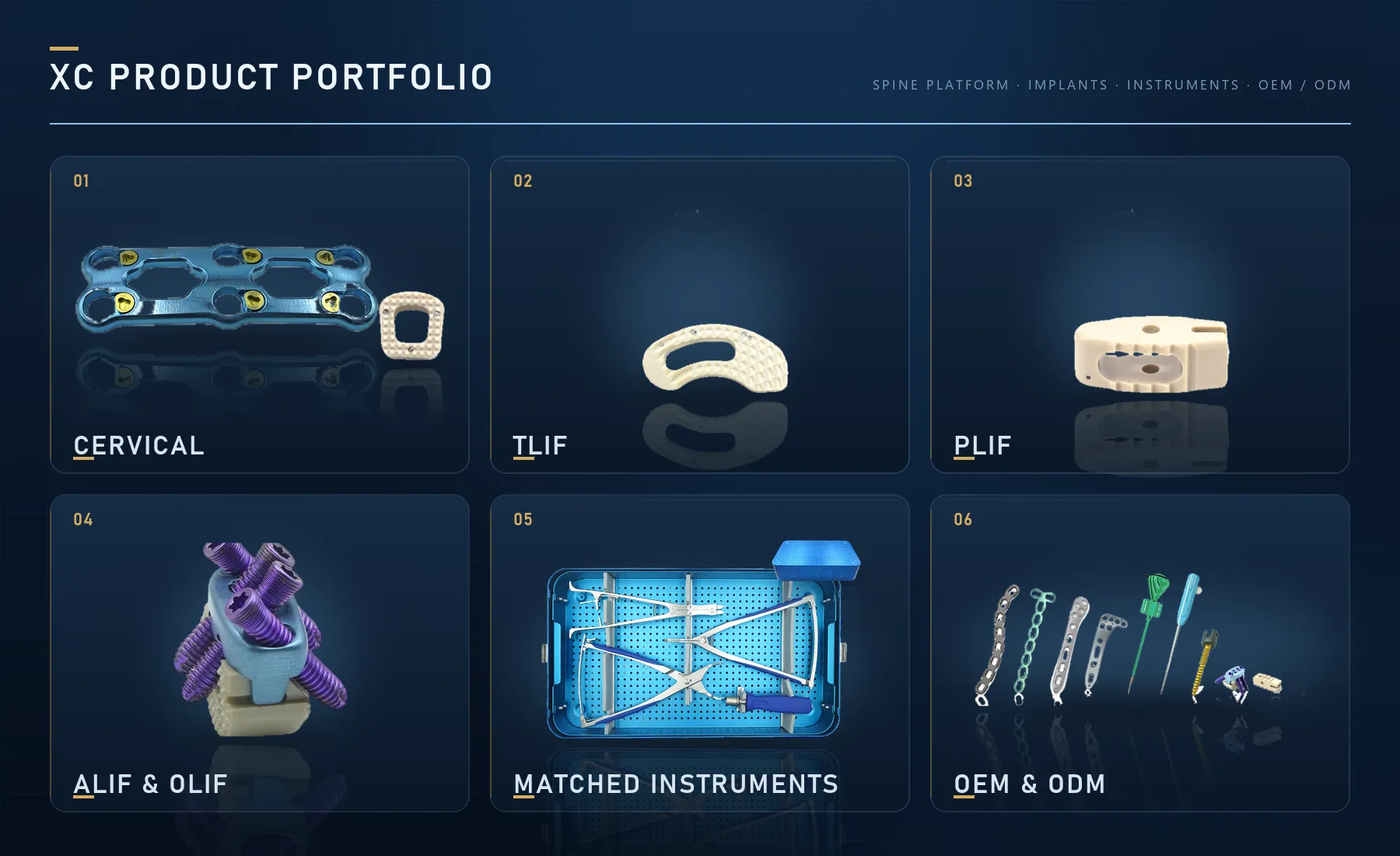
| XC Medico | PEEK and titanium alloy | Distributor supply and OEM/ODM discussions |
The combined lateral/OLIF column confirms at least one relevant lateral category, not universal interchangeability. For ulrich medical, STROMBOLI DLIF appears in a partner-manufactured catalog family. XC Medico names OLIF PEEK Cage-II in its ALIF product content, but detailed OLIF configuration evidence was limited in this review. Profile sources below support the table.
Top 10 Spinal Cage Brands and Manufacturers in 2026
The numbers organize the guide and are not performance positions. Distributor relevance describes a procurement consideration, not a promise of agency rights, pricing or private-label availability.
01Medtronic
- Headquarters / operating base
- Ireland; operational headquarters in Minneapolis, Minnesota, United States.
- Key spinal cage systems
- Anatomic PEEK cervical systems, Endoskeleton TC/TCS and TO/TT families, Anteralign LS/TL, Endoskeleton TAS and Catalyft PL/PL40.
- Procedure coverage
- Documented cervical, posterior lumbar, ALIF and selected OLIF applications. Medtronic specifically identifies Catalyft PL for TLIF, PLIF and MIDLF procedures.
- Material / design focus
- The portfolio includes PEEK-based cervical devices, titanium-coated constructions and titanium interbody systems. Surface branding and material composition should be checked for the individual model.
- Expandable technology
- Catalyft PL and PL40 provide a documented expandable titanium interbody offering; expansion characteristics are model-specific.
- Matched instrumentation
- Catalyft documentation describes dedicated insertion, expansion and graft-delivery workflows. Relevant navigation support depends on the complete configuration.
- Distributor relevance
- A reference portfolio for buyers comparing several approaches within established branded systems and procedural support arrangements.
- What buyers should verify
- Local catalog availability, current labeling, compatible fixation, instrument versions, training access and any applicable product notices. Do not infer graft compatibility from the cage category alone.
02Globus Medical
- Headquarters
- Audubon, Pennsylvania, United States.
- Key spinal cage systems
- HEDRON cervical and lumbar spacers, SABLE expandable posterior lumbar spacers, and Modulus XLIF lateral interbody implants.
- Procedure coverage
- Cervical, posterior lumbar, ALIF and lateral families appear in the current product directory and procedure pages.
- Material / design focus
- HEDRON and Modulus include porous titanium structures. SABLE uses 3D-printed titanium endplates; buyers should distinguish endplate material from the construction of the whole implant.
- Expandable technology
- SABLE provides a directly documented expandable posterior lumbar option. A family's expansion mechanism should not be assumed to apply to other Globus cages.
- Matched instrumentation
- The catalog identifies system-specific relationships, including HEDRON C-MIS compatibility with COALITION MIS instruments. Compatibility remains a named-system claim.
- Distributor relevance
- Useful for evaluating static and expandable cages alongside a broad spine product offering, including systems bearing different established family names.
- What buyers should verify
- The exact family, approved approach, required fixation and local instrument set. A shared corporate owner does not make all legacy systems mutually compatible.
03DePuy Synthes
- Headquarters / relevant business location
- United States; Raynham, Massachusetts, is the location identified in the reviewed spine acquisition announcement.
- Key spinal cage systems
- CONDUIT Interbody Platform, ACIS cervical spacers, CONCORDE lumbar systems and the acquired X-PAC expandable interbody portfolio.
- Procedure coverage
- CONDUIT lists cervical, curved, TLIF, lateral, ALIF and PLIF systems. ACIS adds a separately identified cervical offering.
- Material / design focus
- CONDUIT uses 3D-printed porous titanium. ACIS includes PEEK and PROTI 360 titanium-integrated options.
- Expandable technology
- The July 16, 2026 acquisition of Expanding Innovations added a commercial portfolio including X-PAC TLIF and LLIF cages. The announcement describes future ALIF expansion; it does not establish a commercially available X-PAC ALIF cage.
- Matched instrumentation
- Established systems have associated implant and instrument workflows. Integration plans for acquired technology should be distinguished from currently supplied instrument configurations.
- Distributor relevance
- Relevant to buyers comparing a broad static interbody platform with recently acquired expandable technology.
- What buyers should verify
- Current ordering entity, country availability, acquisition-transition support and product-specific training. Confirm X-PAC supply locally rather than assuming immediate global rollout.
04Highridge Medical
- Headquarters
- Westminster, Colorado, United States.
- Key spinal cage systems
- ROI-C cervical cages, ROI-A ALIF cages, TrellOss porous titanium families and FlareHawk expandable interbody systems.
- Procedure coverage
- Cervical, posterior lumbar, ALIF and lateral offerings are represented across these families, including TrellOss-L MPF for lateral applications.
- Material / design focus
- Examples include PEEK and titanium-coated PEEK cervical cages and porous titanium TrellOss devices. FlareHawk construction must be checked by version.
- Expandable technology
- Highridge announced acquisition of FlareHawk and Toro expandable fusion systems from Accelus in September 2025.
- Matched instrumentation
- ROI systems use VerteBRIDGE fixation technology and dedicated instruments; other families have their own implantation and expansion tools.
- Distributor relevance
- This is the appropriate current company entry for the relevant spine portfolio historically associated with Zimmer Biomet and subsequently ZimVie.
- What buyers should verify
- Current legal manufacturer and labeling, legacy catalog cross-references, instrument continuity and regional availability. Historical branding on documentation needs reconciliation with the product being ordered.
05Alphatec / ATEC
- Headquarters
- Carlsbad, California, United States.
- Key spinal cage systems
- IdentiTi cervical and lumbar interbody families, including IdentiTi-PS, and the Calibrate LTX lateral expandable system.
- Procedure coverage
- ATEC organizes its offering around cervical, ALIF, posterior lumbar and lateral approaches. The reviewed IdentiTi-PS page specifically identifies PLIF.
- Material / design focus
- IdentiTi-C and IdentiTi-PS use porous commercially pure titanium. Their documented subtractive manufacturing process illustrates why porous titanium should not automatically be described as 3D printed.
- Expandable technology
- Calibrate LTX provides lateral expansion for height and lordosis within ATEC's lateral platform.
- Matched instrumentation
- The system combines an expansion workflow, graft-delivery channel and related lateral fixation options. Buyers should obtain the full approach-specific set list.
- Distributor relevance
- Relevant where a purchasing decision involves the implant, access system and procedural support together.
- What buyers should verify
- Which static and expandable families are available locally, instrument requirements and the scope of training. A lateral offering does not automatically establish compatibility with every oblique approach.
06Spineart
- Headquarters
- Geneva, Switzerland.
- Key spinal cage systems
- TRYPTIK Ti and SCARLET AC-Ti cervical cages; SCARLET AL-T anterior lumbar cages; JULIET Ti posterior and lateral families; SCALA TL posterior expandable cages.
- Procedure coverage
- The Ti-LIFE portfolio identifies cervical, posterior lumbar, ALIF and lateral cages. JULIET Ti LL is the lateral family; the letters OL within a posterior product name should not be interpreted automatically as OLIF.
- Material / design focus
- Ti-LIFE is a porous titanium architecture produced through additive manufacturing.
- Expandable technology
- FDA record K261049 documents SCALA TL with a clearance letter dated August 20, 2026. AccessGUDID also identifies SCALA TL posterior expandable cage models.
- Matched instrumentation
- Request the specific static or expandable set and its current technique guide; SCALA instrumentation should not be inferred from JULIET compatibility.
- Distributor relevance
- A specialist portfolio for comparing porous titanium cage families and a documented expandable posterior system.
- What buyers should verify
- SCALA's current launch and distribution status in the destination country, local product naming and system-specific instruments. A US clearance is not a worldwide authorization.
07Orthofix
- Headquarters
- Lewisville, Texas, United States.
- Key spinal cage systems
- WaveForm C, WaveForm TO/TA, WaveForm A and L, FORZA PEEK/PTC, and FORZA XP.
- Procedure coverage
- Official pages identify cervical, ALIF, LLIF and posterior lumbar offerings. FORZA XP specifically covers PLIF and TLIF.
- Material / design focus
- WaveForm uses a 3D-printed gyroid structure. Other families include PEEK and coated constructions, making exact family identification important.
- Expandable technology
- FORZA XP is a documented expandable posterior lumbar spacer system with in-situ expansion and a graft-packing workflow.
- Matched instrumentation
- FORZA XP documentation describes an inserter used through insertion, expansion and subsequent graft packing. Orthofix also lists approach-specific disc-preparation and access instruments.
- Distributor relevance
- Useful for comparing several interbody material and design options within one supplier's broader spine offering.
- What buyers should verify
- Material composition by component, implant sterilization status, current IFU revision and which trays accompany each family. Separate product ranges may require distinct instrument investments.
08ulrich medical
- Headquarters
- Ulm, Germany.
- Key spinal cage systems
- cerv-X cervical cages, pezo PEEK lumbar cages and tezo titanium lumbar cages. Its catalog also includes the Bone InGrowth cage family manufactured by Tsunami Medical.
- Procedure coverage
- cerv-X covers cervical interbody fusion; pezo and tezo identify PLIF, TLIF and ALIF options. The partner family includes STROMBOLI DLIF.
- Material / design focus
- PEEK and titanium are separately documented, with porous titanium available through the identified partner-manufactured family.
- Expandable technology
- Expandable interbody coverage was not established from the reviewed sources. ADD, ADDplus and obelisc are vertebral body replacement systems and are not counted as expandable disc-space cages here.
- Matched instrumentation
- The pezo and tezo pages describe shared PLIF/TLIF instruments and approach-dependent ALIF insertion connections.
- Distributor relevance
- Relevant to buyers examining a specialist manufacturer's own interbody systems alongside clearly attributed partner offerings.
- What buyers should verify
- The legal manufacturer of each cage, country-specific portfolio and precise implant-instrument pairing, particularly when combining products from different catalog families.
09Sanyou Medical
- Headquarters
- Shanghai, China.
- Key spinal cage systems
- Caro cervical cages, Halis lumbar cages, Dica direction-changeable lumbar cages, Lydia anterior lumbar cages and the cataloged Keystone lumbar fusion system.
- Procedure coverage
- Current official categories identify cervical, lumbar interbody, ALIF and lateral solutions. FDA K163422 documents the Caro, Halis, Lydia and Dica PEEK cage families.
- Material / design focus
- The reviewed FDA summary identifies PEEK cages with tantalum markers. Newer materials or surface treatments require their own product-specific evidence.
- Expandable technology
- Not publicly confirmed in the reviewed interbody sources. Dica's direction-changing designation is not evidence of height expansion.
- Matched instrumentation
- The FDA summary identifies associated implantation instruments. Buyers should request the current tray list for the selected export configuration.
- Distributor relevance
- A Chinese spine-focused manufacturer with named cervical and lumbar cage families that can be investigated beyond generic supplier claims.
- What buyers should verify
- Current export models, English labeling, registration scope and distributor rights. The historical FDA record must be matched to the exact device offered today.
10XC Medico
- Headquarters
- Changzhou, China.
- Key spinal cage systems
- Cervical PEEK cages, TLIF and PLIF PEEK cages, Titanium TLIF Cage, ALIF cage configurations and the Expandable PVE Cage.
- Procedure coverage
- Public pages document cervical, TLIF/MIS-TLIF, PLIF and ALIF offerings. The ALIF product page also names OLIF PEEK Cage-II; detailed OLIF specifications and instruments should be requested directly.
- Material / design focus
- PEEK and titanium alloy products, with cage geometry and fixation configurations varying by family.
- Expandable technology
- The PVE product page describes a height-adjustable lumbar interbody cage. This confirms a public offering, not independently verified registration in every market.
- Matched instrumentation
- Procedure pages describe coordinated implant and instrument configurations for posterior and anterior lumbar fusion.
- Distributor relevance
- XC Medico is positioned as a distributor-focused supplier of cervical and lumbar interbody cages with matched instruments and OEM/ODM support.
- What buyers should verify
- Legal manufacturer, product-specific certificates, exact set contents, packaging status and agreed OEM scope. Request a model-level quotation rather than relying on general website certification statements.
Source notes: cervical PEEK cage · titanium TLIF cage · ALIF cage and related portfolio · PVE cage · OEM/ODM services
Main Types of Spinal Cages
The most useful classification combines anatomical region, surgical approach, material and mechanical design. These categories overlap: a titanium spinal cage can also be a TLIF cage and an expandable cage. Comparing suppliers becomes clearer when each requested SKU is described across all four dimensions.
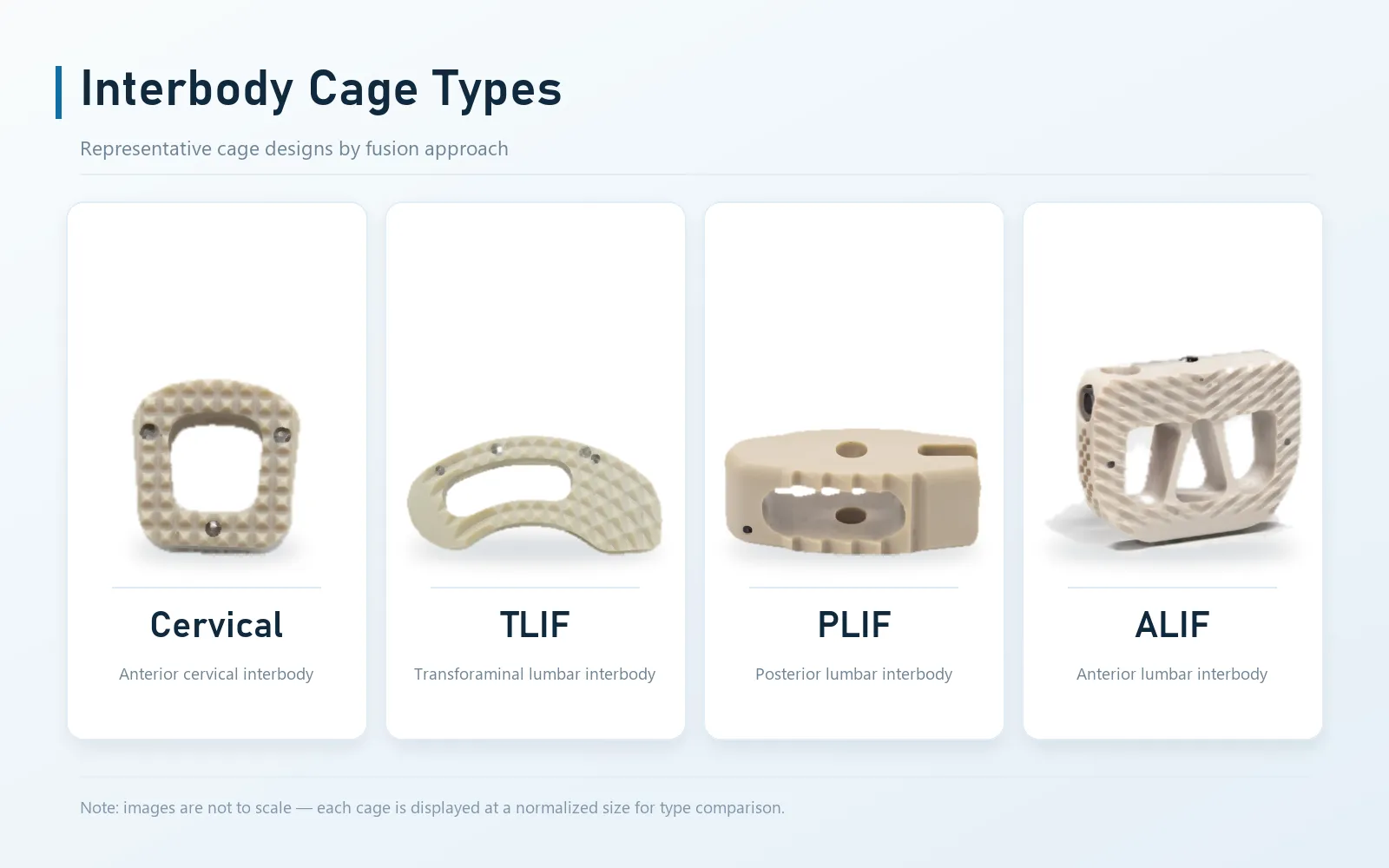
Cervical Cages
A cervical interbody cage is designed for the cervical disc space, commonly within an ACDF construct. Relevant distinctions include footprint, height, endplate shape and whether fixation is separate or integrated. A low-profile or integrated design must still be assessed against its particular fixation requirements; the appearance of screws does not establish universal standalone use.
TLIF Cages
A TLIF cage is configured for transforaminal lumbar access. Straight, curved and articulating options may use different inserter connections and positioning workflows. Distributors should identify the required access corridor, trial range and graft-delivery tools. XC Medico's TLIF and MIS-TLIF configurations illustrate how cages fit within a broader implant-and-instrument offering.
PLIF Cages
A PLIF cage supports posterior lumbar interbody fusion. Some systems provide implants for paired placement; specific use follows the product instructions. Although certain manufacturers support TLIF and PLIF with related instruments, this is a documented system feature, not an assumption. Review the complete PLIF implant and instrument configuration when planning inventory.
ALIF Cages
An ALIF cage is intended for anterior lumbar insertion. Procurement comparisons typically include footprint, lordotic options, graft space and integrated or supplemental fixation. Screw trajectories and access instruments may be central to the set. The ALIF system overview provides a procedure-level example without replacing model-specific instructions.
OLIF and Lateral Cages
An OLIF cage or lateral lumbar interbody cage must be matched to the intended access route and treated level. Direct lateral and oblique approaches can require different insertion connections, trajectories and access tools. A lateral cage listed in a catalog should not be relabeled as an OLIF cage unless its documentation supports that use.
Expandable Cages
An expandable spinal cage changes one or more dimensions after insertion. Depending on the design, this may involve height, lordosis or footprint. Expandability is a mechanical feature that cuts across approach categories. Buyers should distinguish disc-space interbody devices from cages intended to replace a vertebral body after corpectomy.
PEEK vs Titanium Spinal Cages
A PEEK spinal cage uses polyetheretherketone as its principal structural material; a titanium spinal cage uses titanium or titanium alloy in its structure. Coated PEEK and multi-material devices create additional categories. Comparing these materials is useful for specification and procurement, but material alone does not establish a better clinical outcome.
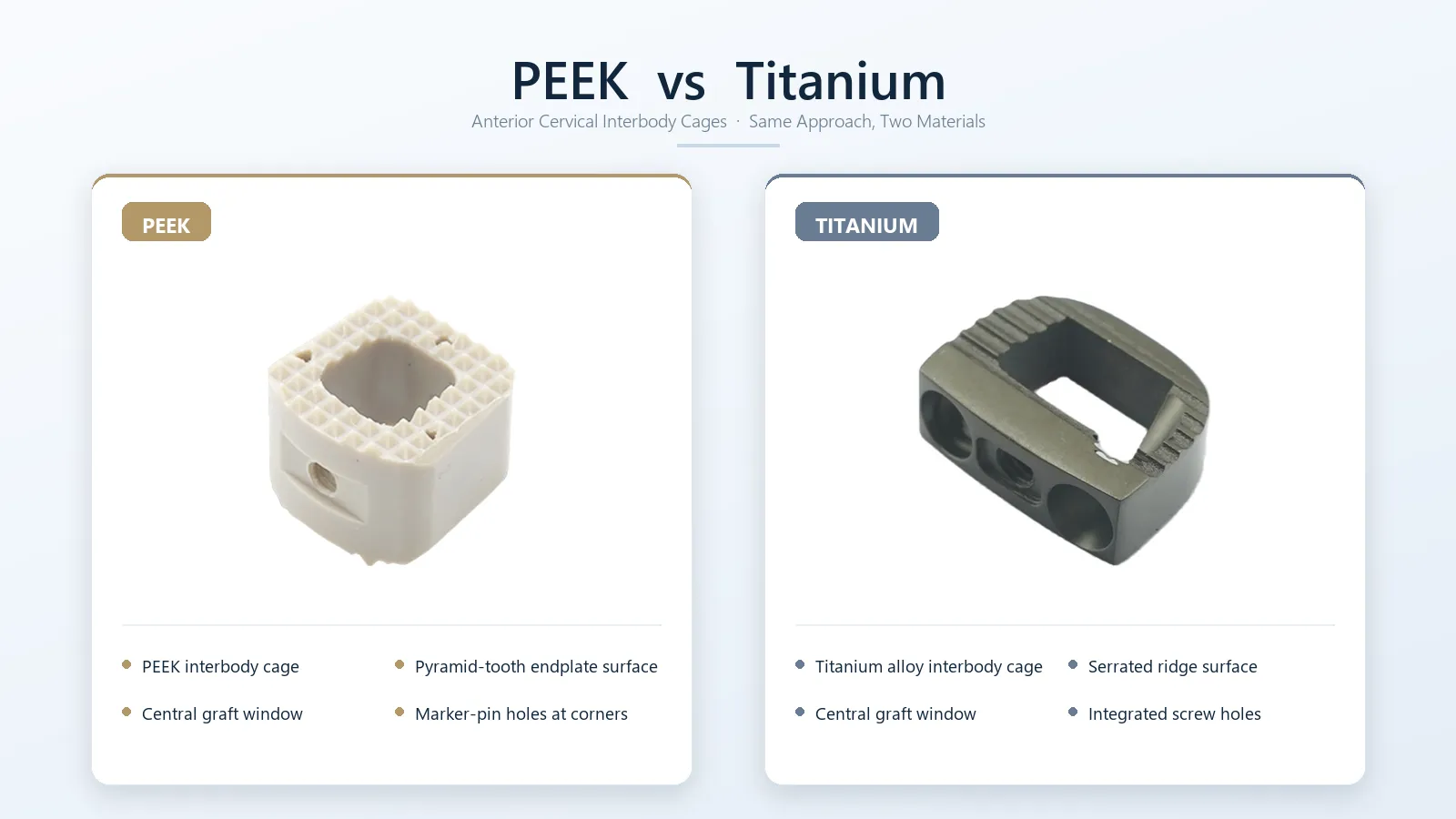
| Factor | PEEK-based cages | Titanium-based cages | Purchasing question |
|---|---|---|---|
| Construction | Polymer body; may incorporate markers or a coating. | Solid, porous or mixed-component construction. | What material and process apply to every component? |
| Imaging | Radiolucent body; markers help identify position. | Metal visibility and artifacts depend on design and imaging method. | What imaging information appears in the current labeling? |
| Surface | Uncoated, textured, coated or otherwise modified. | Machined, treated or porous surfaces, depending on the system. | Which surface specification and verification records are available? |
| Mechanical comparison | Finished-device behavior depends on geometry as well as polymer properties. | Porosity and architecture affect behavior beyond bulk metal properties. | Do test summaries cover the quoted design and sizes? |
| Supply control | Review polymer traceability, markers and coating controls where relevant. | Review alloy traceability, manufacturing route and surface-process controls. | How are changes to materials or processes communicated? |
Porous titanium is not synonymous with one manufacturing method. For example, Spineart describes additive Ti-LIFE manufacturing, while ATEC describes a subtractive process for the reviewed IdentiTi devices. Compare the finished implant and its evidence rather than treating a material label as a complete technical specification.
Static vs Expandable Spinal Cages
A static cage has a fixed implant geometry. An expandable cage incorporates a mechanism that changes specified dimensions after placement. Neither description establishes universal clinical superiority, and an expandable device does not necessarily expand in every direction.
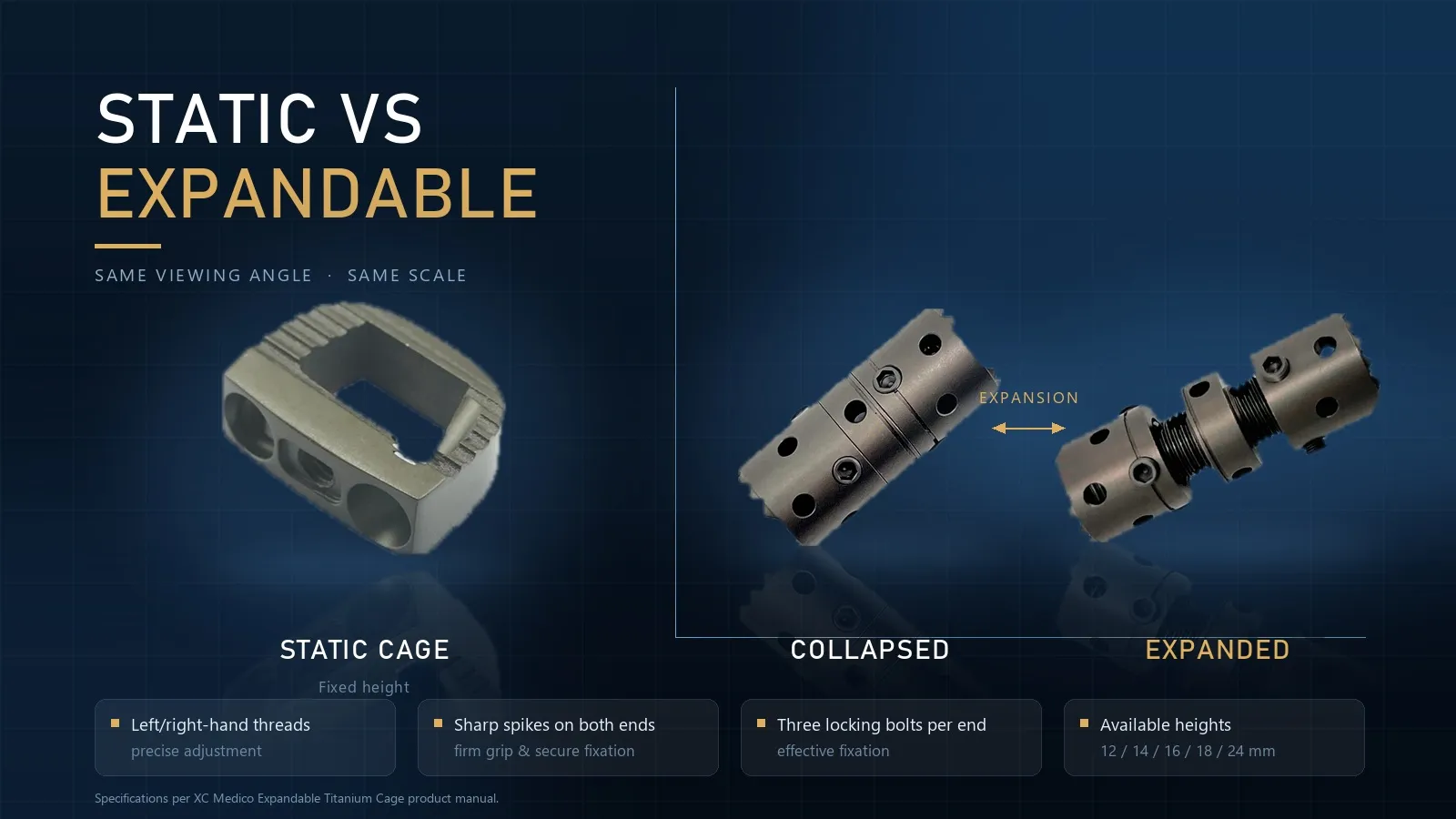
For static systems, procurement teams should examine the spread of fixed heights, footprints and angles, plus how trials map to each implant. Inventory planning follows the sizes required by the intended customer base. A compact catalog may be practical, but only if its available configurations meet those requirements.
Expandable systems add questions about insertion dimensions, final geometry, expansion controls, locking, graft access and extraction tools. Dedicated drivers may need inspection or replacement under the manufacturer's instructions. Obtain the complete workflow and set contents before estimating instrument costs or promising case support.
Compare the cost of maintaining a usable system: implants, instruments, training, replacements, inventory and replenishment. Neither fewer implant SKUs nor a higher purchase price alone establishes lower total cost. Examples of documented workflows include FORZA XP[28] and Calibrate LTX[20].
Cervical vs TLIF vs PLIF vs ALIF vs OLIF Cage Requirements
The following table is a procurement framework, not a surgical technique guide. Each approach requires its own documented configuration, even when a supplier uses related materials or family names.
| Cage category | Configuration to compare | Instrument priorities | Verification priority |
|---|---|---|---|
| Cervical | Small footprints, heights, endplate shape; integrated or separate fixation. | Cervical trials, inserter, graft tools and applicable fixation drivers. | ACDF indications, levels and supplemental fixation requirements. |
| TLIF | Straight or curved geometry, insertion profile, fixed or expandable design. | Matched inserter, trials and any articulation or expansion controls. | Access compatibility and exact cage-inserter connection. |
| PLIF | Posterior insertion geometry, size range and documented single or paired use. | Posterior preparation tools, trials and inserters. | Implant quantities and approved fixation combination. |
| ALIF | Anterior footprint, lordosis and fixation configuration. | Anterior trials, access tools and integrated-fixation instruments where applicable. | Standalone limitations and approach-specific fixation instructions. |
| OLIF / lateral | Length, width, lordosis and intended oblique or lateral trajectory. | Approach-specific access, preparation and insertion instruments. | Exact route, permitted levels and local labeling. |
Keep approach names separate from marketing abbreviations. A posterior cage with “oblique” in its description may refer to its insertion angle within a posterior procedure. It should not be assumed suitable for an oblique lateral approach merely because the terminology appears similar.
What Makes a Complete Spinal Cage Portfolio?
A complete portfolio is one that supports the distributor's intended customers with documented implants, instruments and service. It does not require stocking every available technology. Start with the procedure mix, then identify the materials, dimensions and fixation options needed for those procedures.
The implant matrix should show each family's footprint, height and angle options, including any gaps between catalog listings and routinely supplied sizes. Match every implant family to its trials and inserters. If expansion, integrated fixation or specialized graft delivery is involved, include those instruments explicitly rather than hiding them within an unspecified “complete set.”
Completeness also includes packaging configuration, labeling, lot traceability, current IFUs and replacement support. Ask whether individual damaged instruments can be reordered and whether product revisions affect older trays. A portfolio can look comprehensive online yet remain difficult to support if essential replacements have uncertain availability.
XC Medico's Spine System category provides a starting point for related implants. Buyers should turn that category view into a confirmed implant-and-instrument bill of materials for their chosen cage families.
Global Spinal Cage Brands vs OEM-Oriented Manufacturers
Branded distribution and OEM procurement involve different commercial arrangements. With a branded system, the buyer needs authorization, market availability, training and continuity of product support. Access to a well-known catalog does not itself establish an available distributor territory.
An OEM spinal cage manufacturer may discuss manufacturing to an agreed design, private labeling or defined customization. These arrangements require explicit responsibility for design ownership, technical documentation, labeling, registration and post-market support. Changing a logo is not sufficient to establish a compliant private-label program.
Company size or country of origin does not establish which model is available. Ask every prospective partner the same questions about product ownership, manufacturing scope and documentation. XC Medico describes OEM and ODM services, but the exact cage family, permitted modifications, minimum quantities and project responsibilities must be agreed individually.
How to Choose a Spinal Cage Manufacturer
Define the Required Portfolio Before Requesting Prices
Specify the destination market, procedures, materials, expected volumes and instrument needs. Separate launch requirements from optional later additions. Comparable requests help interbody cage manufacturers quote the same scope instead of offering different products under a broad “lumbar cage” description.
Match the Product to Its Legal and Regulatory Identity
Reconcile the supplier's trading name, legal manufacturer, catalog number, label and regulatory documents. ISO 13485 concerns a quality management system; it does not itself authorize a particular spinal cage implant for sale. A US 510(k) clearance concerns a specified device and indications, not an unrestricted endorsement of a company's entire catalog.
Review the Whole Implant-and-Instrument System
Request a numbered set list and a compatibility matrix. Check trials, inserters, drivers, graft tools and replacement parts against the quoted implants. For expandable designs, include locking and extraction tools. Review reusable-instrument processing instructions and identify who provides training and technical support.
Assess Manufacturing Evidence and Supply Continuity
Ask for relevant material traceability, inspection and test summaries, packaging information and sterilization evidence where applicable. Agree how design, material or process changes will be communicated. Evaluate replenishment by SKU, not only a general shipping promise, and document handling of discontinued sizes and damaged instruments.
Compare Total Support Costs
Evaluate the initial implant purchase, instrument investment, replacements, training and inventory burden together. For OEM projects, include documentation, artwork and change-management work. Buyers concentrating on posterior lumbar sourcing can use our TLIF and PLIF cage manufacturer evaluation guide as a more focused companion.
What Should Distributors Ask a Spinal Cage Supplier?
A useful supplier response connects every claim to a model, document or contractual commitment. Use these questions to compare offers from a spinal cage supplier or interbody cage supplier on a consistent basis.
| Question | Evidence to request | Why it matters |
|---|---|---|
| Who is the legal manufacturer? | Label, company identity and matching product records. | Connects the quotation to the responsible organization. |
| Which exact approaches are supported? | Current IFU and model-specific catalog. | Prevents assumptions based on similar product names. |
| What is registered in our market? | Applicable authorization and product scope. | Separates global catalog presence from local supply eligibility. |
| What is each component made from? | Material specifications and relevant traceability records. | Clarifies coatings, markers and multi-material mechanisms. |
| Are the instruments fully matched? | Instrument list, part numbers and compatibility statement. | Defines a usable system rather than an implant-only quote. |
| How is the product packaged? | Label, shelf-life and processing or sterilization information. | Clarifies the supplied condition and handling requirements. |
| How are replacements supplied? | Individual instrument pricing and replenishment terms. | Supports continuity after the initial order. |
| What OEM changes are permitted? | Agreed design, labeling and regulatory responsibilities. | Prevents undocumented customization. |
| How are complaints and changes managed? | Escalation contacts and written notification procedures. | Establishes ongoing support and traceability. |
Frequently Asked Questions
What is a spinal cage?
A spinal cage is an implant used to provide structural support and space for bone graft during spinal fusion. In this guide, the term refers to interbody devices placed between adjacent vertebral bodies, rather than vertebral body replacement implants used for a different reconstruction purpose.
What are the main types of spinal cages?
The main approach-based categories are cervical, TLIF, PLIF, ALIF and OLIF or lateral interbody cages. Each category may include different materials and static or expandable designs. These classifications overlap, so a single implant can be both a titanium cage and an expandable TLIF cage.
What is the difference between an interbody cage and a spinal cage?
Interbody cage is the more specific term for a device placed in the disc space between vertebral bodies. Spinal cage and spine cage are broader expressions often used for the same implant. Buyers should specify interbody fusion cage and the intended approach to avoid confusion with vertebral body replacement devices.
Which materials are commonly used in spinal cages?
Common materials include PEEK, titanium and titanium alloys. Some devices combine a PEEK body with a titanium coating, while others use porous titanium structures. Markers, fixation elements and expansion components may use additional materials, so the complete component specification should be checked.
What is the difference between PEEK and titanium cages?
PEEK cages have a polymer-based structure, often with radiographic markers. Titanium cages use metal structures that may be solid or porous. Imaging behavior, surface characteristics and finished-device mechanics vary by design. Material choice alone does not establish which implant will produce a better clinical outcome.
What is an expandable spinal cage?
An expandable spinal cage has a mechanism that changes specified dimensions after insertion. Depending on the model, expansion may affect height, lordosis or footprint. It requires the correct insertion and expansion instruments, and its documented range should not be extrapolated to other expandable systems.
What is the difference between TLIF, PLIF, ALIF and OLIF cages?
The names describe different lumbar access approaches: transforaminal, posterior, anterior and oblique lateral. Cage geometry, insertion connections, instruments and fixation requirements are configured accordingly. Similar dimensions or materials do not make cages interchangeable between approaches; the selected device's instructions determine its intended use.
How should distributors compare spinal cage manufacturers?
Compare named product families by procedure coverage, materials, static or expandable design, matched instruments and local documentation. Then assess supply continuity, training, replacement support and commercial authorization. For OEM projects, also establish design ownership, labeling responsibilities and change control before comparing final quotations.
What documents should buyers request from an interbody cage supplier?
Request the current catalog, model list, IFU, labels, applicable market authorizations and relevant quality-system certificates. Add implant-instrument compatibility information, material and test summaries, packaging and sterilization documentation where applicable, and traceability procedures. The required submission package depends on the destination market and commercial arrangement.
Editorial Accuracy Note
XC Medico publishes this article and is included in the comparison. The sequence is editorial and does not establish clinical superiority, market leadership or equivalent regulatory status. Manufacturer descriptions are used to identify products and construction features, not to adopt unsupported performance claims. Supplier-fit comments are editorial purchasing considerations.
This guide supports product research and procurement discussions. Device selection and use depend on qualified clinical judgment, current instructions and applicable requirements. Bench or animal findings should not be presented as proof that one cage produces superior patient outcomes.
Build a Documented Cage and Instrument Portfolio
Discuss cervical and lumbar interbody sourcing with XC Medico. Share your destination market, required approaches, material preferences, expected quantities and instrument needs. For private-label projects, include the proposed branding and customization scope.
Request a model-level catalog and quotation covering cage options, matched instruments, available documentation and agreed supply responsibilities. This gives your team a concrete basis for technical review and commercial comparison.
Sources and Update Notes
Review cutoff: September 22, 2026. Numbered source notes throughout this guide refer to the official resources collected below. Product pages and catalogs establish documented offerings; regulatory records establish the specific facts within those records. Neither independently confirms stock, distribution rights or authorization in another country.
- Company identity: Highridge replaces the legacy Zimmer Biomet spine entry; its official history records the intervening ZimVie business.
- Recent portfolio changes: DePuy Synthes' July 2026 announcement supports X-PAC TLIF/LLIF inclusion; Spineart's August 2026 FDA document supports SCALA TL inclusion.
- Category boundaries: ulrich medical's expandable vertebral body replacements are excluded from expandable interbody coverage. Its catalog separately identifies Tsunami Medical as manufacturer of Bone InGrowth cages.
- Evidence limitations: XC Medico's OLIF reference is less detailed than its reviewed cervical and other lumbar pages. Sanyou's historical FDA evidence should be reconciled with current export models.
Recheck company ownership, product availability, IFU revisions and local registrations before purchasing. Future article updates should change the review date only after the underlying sources and portfolio statements have been checked again.
- Highridge company historyhighridgemedical.com
- DePuy Synthes acquisition announcement, July 16, 2026jnj.com
- Medtronic — interbody product portfoliomedtronic.com
- Medtronic — Catalyft systemmedtronic.com
- Medtronic — company locationsmedtronic.com
- Globus Medical — product directoryglobusmedical.com
- Globus Medical — ALIF portfolioglobusmedical.com
- Globus Medical — HEDRON instructionsglobusmedical.com
- Globus Medical — headquartersglobusmedical.com
- DePuy Synthes — spine product directoryjnjmedtech.com
- DePuy Synthes — CONDUIT platformjnjmedtech.com
- Highridge Medical — cervical portfoliohighridgemedical.com
- Highridge Medical — ALIF directoryhighridgemedical.com
- Highridge Medical — 2025 expandable-system acquisitionhighridgemedical.com
- Highridge Medical — TrellOss-L MPF brochurehighridgemedical.com
- Alphatec / ATEC — IdentiTi-Catecspine.com
- Alphatec / ATEC — IdentiTi-PSatecspine.com
- Alphatec / ATEC — ALIF portfolioatecspine.com
- Alphatec / ATEC — TLIF portfolioatecspine.com
- Alphatec / ATEC — Calibrate LTXatecspine.com
- Alphatec / ATEC — AMP LTX instruments and fixationatecspine.com
- Spineart — Ti-LIFE product familiesspineart.com
- Spineart — FDA K261049accessdata.fda.gov
- Spineart — SCALA TL device recordaccessgudid.nlm.nih.gov
- Spineart — company historyspineart.com
- Orthofix — lumbar portfolioorthofix.com
- Orthofix — WaveForm Corthofix.com
- Orthofix — FORZA XPorthofix.com
- ulrich medical — cerv-Xulrichmedical.com
- ulrich medical — pezoulrichmedical.com
- ulrich medical — tezoulrichmedical.com
- ulrich medical — catalog and partner-manufacturer attributionulrichmedical.com
- Sanyou Medical — interbody portfoliosanyoumed.com
- Sanyou Medical — ALIF portfoliosanyoumed.com
- Sanyou Medical — lateral portfoliosanyoumed.com
- Sanyou Medical — FDA K163422accessdata.fda.gov
- Medtronic PEEK and coating documentationmedtronic.com
- ISO's explanation of ISO 13485iso.org
- FDA explanation of 510(k) clearancefda.gov

