


Quick answer: What does a hip prosthesis include?
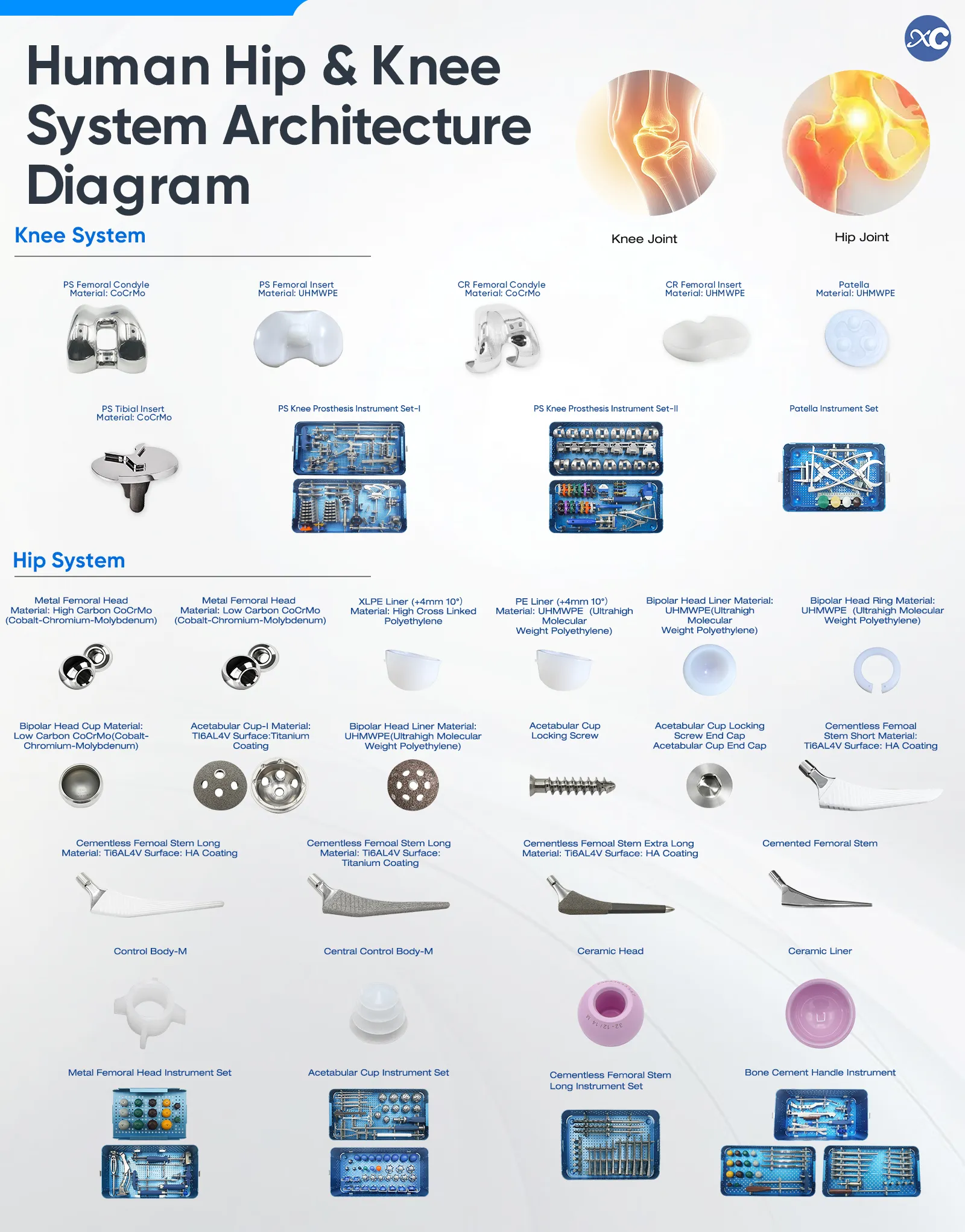
A typical total hip prosthesis has four core component groups: a femoral stem, a femoral head, an acetabular shell or cup, and a bearing liner. Acetabular screws, adapters, dual mobility parts, and instruments may add further line items depending on the design and procedure. For sourcing, compare each component’s material, size range, interface, fixation option, documentation, instruments, and replenishment terms instead of comparing only a one-line “hip system” price.
What a hip prosthesis actually consists of
In a total hip replacement system, the femoral stem sits in the femur and carries the modular femoral head. The head articulates against a liner housed in an acetabular shell or cup. Some designs use an integrated or monoblock bearing rather than a separate modular liner; fixation screws may be optional. Hemi-hip systems differ because they do not replace the acetabular bearing surface in the same way as a total hip construct.
This distinction matters in a quotation. “Cup” may mean only the metal shell, or it may be used informally for a shell-and-liner assembly. “Hip prosthesis” may refer to an implant set, a complete component family, or an implant-and-instrument package. Ask the supplier to define the quoted configuration and list every included SKU before comparing totals.
| Component | Function in the construct | Common material families | Sourcing checkpoints |
|---|---|---|---|
| Femoral stem | Anchors in the femur and provides the stem-side interface for the head | Titanium alloys or other system-specific implant metals | Fixation type, geometry, coating, size matrix, neck options, taper specification |
| Femoral head | Connects to the stem and forms one side of the bearing couple | Cobalt-chromium-molybdenum alloy or ceramic, subject to the system | Diameter, material, neck length, taper compatibility, available finishes |
| Acetabular shell or cup | Fits in the acetabulum and supports the bearing surface | Commonly a metallic shell; designs and coatings vary | Outer-diameter range, fixation method, liner lock, screw-hole options |
| Liner or bearing | Provides the opposing bearing surface for the femoral head | UHMWPE/HXLPE or other validated bearing materials | Inner diameter, thickness, locking design, sterilization, compatible shell and head |
| Optional screws and adapters | Support a specific cup configuration or modular interface | Varies by system | Whether included, thread and length options, driver, and compatibility list |
How do femoral stems differ by fixation and geometry?
A femoral stem may be designed for cemented fixation or for cementless press-fit fixation. In a cemented construct, the stem is fixed with bone cement according to the system’s surgical technique. A cementless stem is designed to achieve initial mechanical fit and support longer-term fixation through bone integration. These are different design approaches, not interchangeable labels for an otherwise identical part.
Stem geometry is part of the fixation strategy. Buyers should compare the proximal and distal shape, taper, neck-shaft angle, offset options, collar configuration, and the length and location of any porous or hydroxyapatite (HA) coating. The geometry also determines which broaches, rasps, and inserters belong in the instrument set. A supplier should be able to provide a size chart and a technical drawing for each family rather than describing the line only as “standard” or “universal.”
Titanium alloy is common in cementless stem catalogues, but the grade and material form matter. If a stem is specified as wrought Ti-6Al-4V ELI, ASTM F136 defines material requirements for that alloy form; it does not, on its own, define the finished implant’s design, validation, or regulatory status. The active ASTM page lists F136-26. ASTM F136
Ask for the stem-size matrix, left/right variants if applicable, available neck lengths and offsets, coating details, and included trials. Size numbers are brand-specific. Compare cemented and cementless versions as separate SKUs and check whether instruments are shared.
XC Medico lists a cementless total hip system for buyers evaluating that configuration. Use the current model documentation and product-specific technical file for the exact material and options under consideration.
How do acetabular cups and liners affect the bearing interface?
The acetabular component commonly includes a shell seated in the pelvis and a liner that forms the bearing surface. The shell’s outer diameter, fixation features, and liner-locking mechanism define which liners fit. A liner is not automatically compatible with every shell that has the same nominal diameter: internal geometry, locking features, and the manufacturer’s validated combinations matter.
UHMWPE and highly cross-linked polyethylene (HXLPE) are common liner material families. Some products use vitamin E stabilization or other material treatments. Those distinctions affect what documentation a buyer should request. ASTM F648-21 covers UHMWPE powder and fabricated forms for surgical implants, but its scope excludes intentionally cross-linked or additive-blended forms and does not cover the packaged, sterilized finished implant. Buyers should therefore request the material specification that actually applies to the supplied formulation and processing route, rather than treating “meets F648” as a complete description of every HXLPE or vitamin E liner. ASTM F648
Bearing wear is one reason to compare the material pair and liner design, but a material name alone does not establish the performance of a finished implant. Ask what evidence and market-specific documentation are available for the exact component, and confirm how the supplier identifies liner thickness by shell size and head diameter.
For an apples-to-apples comparison, request a shell-to-liner compatibility chart, the available cup outer diameters, liner inner diameters and thicknesses, screw options, and the model-specific locking mechanism. Also ask whether replacement liners can be ordered individually and whether the same liner family is available across primary and revision configurations. These details can affect inventory planning long after the first order.
How should buyers compare femoral head size, material, and taper?
The femoral head is the spherical component attached to the stem taper. Catalogue ranges may include diameters such as 28, 32, or 36 mm, but these are examples rather than a universal set of options. The available diameter is constrained by the cup and liner combination, wall thickness, neck length, and the product’s validated configuration. Final head selection is a clinical decision; the buyer’s task is to verify what combinations the supplier actually supports.
Head material should be specified by grade and form, not just by a broad label such as “metal.” Cobalt-chromium-molybdenum is one common family. ASTM F75 covers Co-28Cr-6Mo alloy castings and casting alloy for surgical implant applications, while explicitly distinguishing material requirements from the finished implant. The active ASTM listing is F75-23. ASTM F75
Ceramic heads are another option in some systems. A quote should state the manufacturer, material family, diameter, neck length, and exact compatible stem taper for every head variant. The head-to-stem taper is a precision interface. Do not infer cross-brand compatibility from a similar taper name or nominal measurement; request a written compatibility matrix or the applicable instructions for use for the exact SKUs. Cross-manufacturer mixing should be treated as unsupported unless the responsible legal manufacturer explicitly documents the combination and it is permitted in the target market.
Before stocking replacement heads, record the approved head–stem pairings and traceability details. Physical fit does not prove a combination is validated.
What does a dual mobility cup add to the system?
A dual mobility construct adds a second articulation. In a common arrangement, a small femoral head is captured inside a mobile polyethylene bearing, which then articulates within a metal acetabular shell. Product designs differ, so the words “dual mobility cup” can refer to a shell, a liner or bearing, or the complete construct. Ask the supplier to name each piece and map the interfaces in a diagram.
The design is intended to provide a larger effective articulation than a conventional fixed-bearing arrangement of similar cup size. Surgeons may consider dual mobility designs when instability is a concern or in selected revision situations, but indications, patient selection, and expected performance are product- and case-specific. The presence of a dual mobility option should not be presented as a guarantee against dislocation. A device-specific FDA 510(k) summary describes one dual mobility system and its component configuration; it is an example of a product record, not a universal indication for every system. FDA 510(k) summary for a dual mobility liner system
For sourcing, clarify whether the construct uses a modular metal liner, a mobile polyethylene bearing, or another arrangement. Then confirm shell dimensions, compatible bearing sizes, compatible femoral heads, material and sterilization details, and whether the mobile insert can be reordered separately. Ask whether each interface is from one validated family and what instruments are required for assembly and trialing.
Dual mobility adds additional compatibility and inventory questions. If the shell is in stock but the correct mobile bearing is not, a nominally complete system may still be unusable for the intended configuration. Compare replenishment terms by component and size, not only by the complete-set description. Keep the supplier’s current compatibility chart and instructions for use with the purchasing specification.
When do cemented and press-fit fixation options differ?
Cemented fixation and cementless press-fit fixation rely on different interfaces. A cemented stem is used with bone cement and a design intended for that method. A press-fit stem depends on its geometry and surface to achieve the intended mechanical fit and fixation. Cemented and cementless stems should be quoted as distinct configurations, even when they belong to one product family.
Dorr A, B, and C are classifications of proximal femoral morphology that may appear in clinical planning. They are not a procurement rule that automatically assigns one fixation method to every case. A 2024 retrospective comparison of two cementless stem designs found that the observed complication difference depended on stem design and Dorr subgroup, illustrating why a single A/B/C-to-fixation chart can oversimplify the evidence. Stem selection remains the responsibility of the treating clinical team and depends on the patient, anatomy, implant design, and local practice. Comparative study of cementless stem design across Dorr types
Surface options also require precise descriptions. “Porous,” “HA-coated,” and “polished” describe different design or surface attributes; the words alone do not show coating composition, coverage, thickness, manufacturing control, or the intended interface. Request the product drawing and coating specification, and ask which exact models are available in each fixation version.
A sourcing checklist should capture: the fixation method for every stem SKU; the coating or finish; the corresponding cementing or broaching instruments; whether the surgeon can use a shared tray across versions; and whether all options are included in the supplier’s regulatory documentation for the target market. This makes it easier to compare the true system configuration without turning a clinical choice into a purchasing assumption.
XC Medico’s cemented total hip systems can be reviewed alongside its cementless range. Confirm model-specific options and documentation directly before building a tender specification.
What should a complete hip instrument set include?
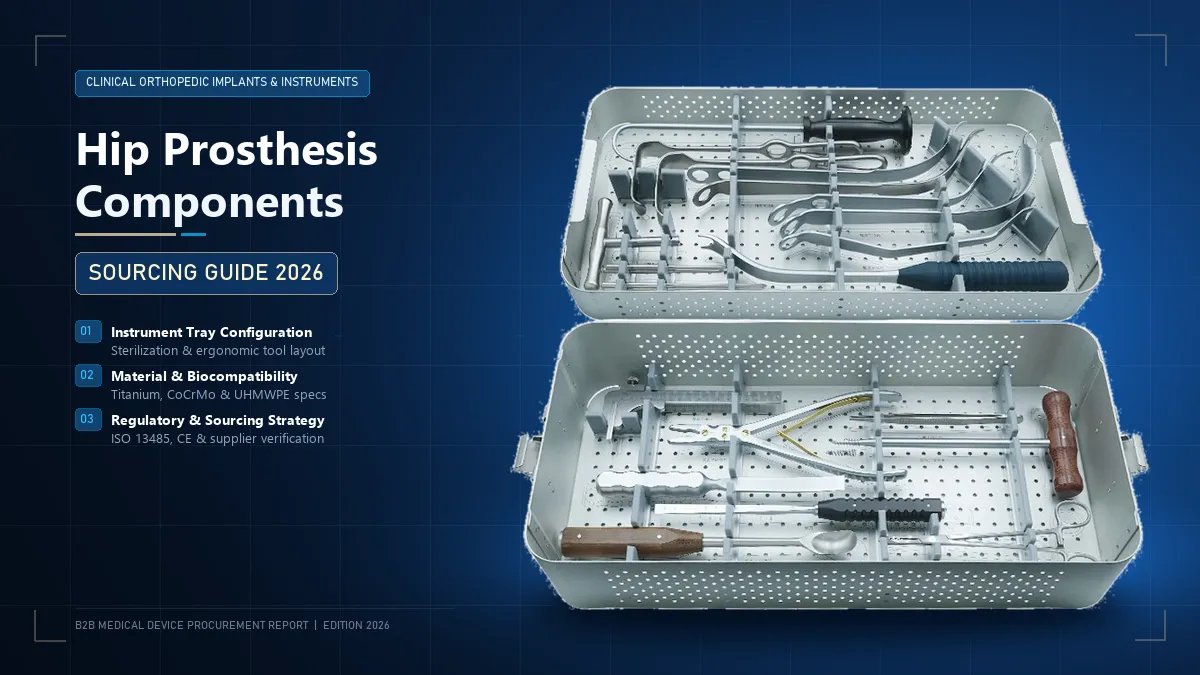
The implant quote and the instrument quote should be reviewed together. Depending on the system and surgical technique, a set may include femoral broaches or rasps, trial stems and heads, trial cups or liners, acetabular reamers, cup inserters, stem impactors, head impactors, and tools for trial reduction. A sterilization tray or container, reprocessing instructions, and replacement-part terms may also affect readiness and total cost.
The supplier should map each instrument to the implant family and size range it supports. A broach designed for one stem geometry should not be assumed to prepare for another. Likewise, trial heads, cup trials, and impactors should be checked against the final component options. Ask for the contents list, photographs or diagrams where useful, and a current surgical technique document that matches the quoted system.
| Instrument group | Typical purpose | Include in the quote? | Separate pricing or consumable? |
|---|---|---|---|
| Broaches or rasps | Prepare the femoral canal for the selected stem design | Yes / No / Loaned | Identify size range and replacements |
| Trial stem, head, cup, and liner | Check the planned configuration before final components are used | Yes / No / Loaned | Confirm whether every size is included |
| Acetabular reamers and cup inserter | Prepare the acetabular side and place the shell | Yes / No / Loaned | List handles, adapters, and wear parts |
| Stem, head, and liner impactors | Seat the implant components using the specified technique | Yes / No / Loaned | Identify system-specific tips and adapters |
| Trays, containers, and service items | Store, transport, sterilize, and maintain the instruments | Yes / No / Loaned | Clarify ownership, repair, and reprocessing terms |
Which material standards should you be able to name?
A supplier should identify the material standard, edition, form, and traceability record for the material used in each component. The standard depends on the material and manufacturing form. For example, ASTM F136 applies to wrought Ti-6Al-4V ELI alloy; ASTM F75 covers Co-28Cr-6Mo casting alloy; and ASTM F648 covers UHMWPE powder and fabricated forms within its defined scope. ISO 5832-3:2021 covers wrought Ti-6Al-4V alloy, while ISO 5834-2:2025 covers moulded UHMWPE forms. ISO 5832-3:2021 · ISO 5834-2:2025
These references describe material requirements, not a finished implant’s full design, safety, performance, or market authorization. A material certificate is not a product registration. Likewise, a certificate for a manufacturer’s facility or for one product family does not automatically cover every model, size, process, or market. The U.S. FDA states that registration of an establishment or device listing does not denote FDA approval of the establishment or its products; a 510(k) is a separate premarket submission process that demonstrates substantial equivalence for the device described in that submission. Check the actual record and scope instead of relying on a logo or certificate number. FDA establishment registration and device listing database · FDA 510(k) database
Buyers reviewing related hip and knee product families can also see XC Medico’s full joint system range; verify documentation against the exact model and configuration being quoted.
For metallic components, request a material certificate that can be traced to a heat or melt and the finished-product lot. For polyethylene or ceramic components, ask for the applicable raw-material and finished-product lot records. Confirm the supplier’s change-control process for material source, formulation, coating, sterilization, and packaging. If the buyer is registering the device locally, identify who owns the technical file, which product configurations it covers, and what documents the supplier can lawfully provide or authorize.
How do you compare two hip component quotes?
Start by aligning the scope. One quote may cover a stem, head, shell, and liner for one size, while another includes a broader size matrix, trial parts, screws, or a loan instrument tray. A lower total is not comparable until both suppliers have quoted the same components, material options, size coverage, packaging state, and support terms.
Compare four areas. First, review the component-level unit prices and the size matrix: which sizes, neck lengths, left/right variants, and cup/liner combinations are included? Second, assign the instruments: purchased, loaned, consigned, or already held by the buyer. Third, align packaging and sterilization: sterile or nonsterile supply, shelf life where applicable, packaging configuration, and the instructions needed for the destination market. Fourth, compare documentation and support: material traceability, product-family scope, regulatory documents, change notification, and replenishment lead times.
| Component | SKU and size coverage | Unit-price basis | Trial and instrument terms | Files and market scope | Replenishment terms |
|---|---|---|---|---|---|
| Femoral stem | ___ | ___ | ___ | ___ | ___ |
| Femoral head | ___ | ___ | ___ | ___ | ___ |
| Acetabular shell or cup | ___ | ___ | ___ | ___ | ___ |
| Liner or bearing | ___ | ___ | ___ | ___ | ___ |
| Optional screws or adapters | ___ | ___ | ___ | ___ | ___ |
| Trials, trays, and instruments | ___ | ___ | ___ | ___ | ___ |
Keep the unit of comparison explicit. If a quote gives one price for “a hip system,” request a component breakdown and clarify whether prices change by size or material. Record the number of quoted configurations rather than relying on a broad claim such as “full range.” If one supplier can provide a complete size matrix and another can provide only selected sizes, that affects stock planning, service coverage, and the number of line items a distributor must manage.
The same rule applies to documentation. Compare files against the quoted model numbers and target market, not against a supplier’s general certificate folder. Ask whether the files are available for review, whether they can be shared under NDA, and whether the supplier can support local registration or importer review. For a broader supplier-screening framework, see this OEM manufacturer evaluation checklist. Avoid choosing a quote on unit price alone when instruments, documentation, replenishment, or size availability are still undefined.
Twelve questions to send before the first order
- What is the complete femoral stem size matrix, and are any models right- or left-specific?
- Which femoral heads are validated for each stem taper, and can you provide the compatibility chart or applicable instructions for use?
- Which liners are validated with each acetabular shell, and what are the permitted head diameters and materials?
- Can dual mobility bearings or liners be reordered separately, and which shell and head combinations do they support?
- Are trial stems, heads, cups, and liners included in the instrument set or available through another arrangement?
- Is the instrument set purchased, loaned, or consigned, and who pays for freight, repairs, and missing pieces?
- Can the material documentation be traced to the heat or melt and finished-product lot for each quoted component?
- Does the product family offer both cemented and cementless stem versions, and which instruments are shared?
- Is each component supplied sterile or nonsterile, and what packaging, shelf-life, or local processing documentation applies?
- What is the minimum order quantity for each component SKU and size, rather than for the system as a whole?
- Which regulatory files cover the exact models and intended market, who holds them, and what access or authorization can be provided?
- What is the replenishment lead time for a missing component or instrument, and how is that timing measured?
FAQ: Hip prosthesis component sourcing
What are the components of a hip prosthesis?
A typical total hip prosthesis has four core component groups: the femoral stem, femoral head, acetabular shell or cup, and bearing liner. Screws, adapters, dual mobility parts, and instruments may be added depending on the design and procedure.
What is the difference between a cemented and a cementless femoral stem?
A cemented stem is fixed with bone cement as described in the system’s surgical technique. A cementless stem is designed for press-fit fixation and subsequent bone integration. They are separate configurations and should be compared with their matching instruments and documentation.
What is a dual mobility cup used for?
A dual mobility construct has two articulations, commonly a femoral head inside a mobile polyethylene bearing that moves within an acetabular shell. It is designed to increase effective articulation; indications and patient selection depend on the specific product and the treating clinical team.
Which materials are used in hip prosthesis components?
Materials vary by component and design. Femoral stems and shells may use titanium alloys or other implant metals; femoral heads may use cobalt-chromium-molybdenum or ceramic; and liners may use UHMWPE or HXLPE. Confirm the actual grade, material form, and applicable standard for each model.
What is the minimum order for OEM hip prosthesis components?
There is no universal minimum order. Ask for the MOQ by component SKU and size, and confirm whether first-order quantities differ for stock products, private-label packaging, custom changes, or instruments.
How do I verify a hip implant supplier before the first order?
Match certificates and material records to the exact component models, sizes, and lots in the quote. Check the applicable product and market documentation, confirm component compatibility in writing, review instrument and replenishment terms, and clarify who owns or can authorize access to regulatory files.
Next step: request a component-level comparison
If you are evaluating a hip prosthesis supplier, share the target market, planned fixation options, required component sizes, and preferred instrument arrangement with XC Medico. Ask for a component-level comparison, the compatibility information available for the exact models, and examples of applicable material documentation. This gives both sides a clear list to review before discussing quantities or a first order.
You can contact XC Medico to request the component checklist.
Contact XC MedicoThis guide is for product sourcing and procurement planning. It is not clinical advice or a recommendation for a particular implant or patient. Device selection and use should follow the responsible clinical team’s judgment, the product’s current instructions for use, and the regulations in the target market.
Sources and update notes
- ASTM International: ASTM F136-26, ASTM F75-23, and ASTM F648-21.
- International Organization for Standardization: ISO 5832-3:2021 and ISO 5834-2:2025.
- U.S. Food and Drug Administration: dual mobility 510(k) summary example, establishment registration and device listing, and the 510(k) database.
- Lee et al., comparative study of cementless stem design across Dorr types, Archives of Orthopaedic and Trauma Surgery, 2024.

