


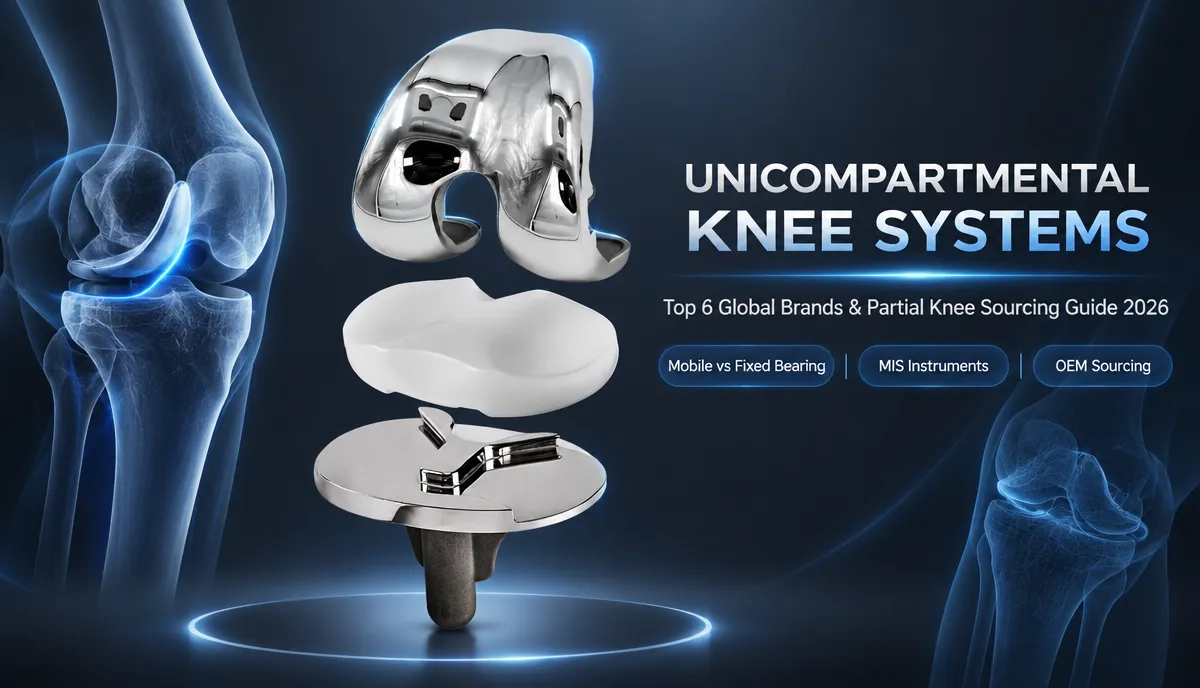
2026 BUYER'S GUIDE · JOINT REPLACEMENT · Last reviewed: November 2, 2026
Choosing a partial knee replacement supplier means choosing an entire implant and instrument system. Bearing design matters, but so do the component combinations a manufacturer authorizes, the sizes a hospital actually uses, the availability of matching trials, and the documents that permit supply in the destination market.
This guide compares six unicompartmental knee replacement system brands for orthopedic distributors, hospital procurement teams and medical-device companies evaluating manufacturing partners. It connects product evidence to practical purchasing questions: what belongs in the initial inventory, what depends on a robotic platform, and what must be confirmed before an OEM project becomes a marketable device.
Editorial and impartiality disclosure. XC Medico publishes this guide and provides orthopedic products and manufacturing services. Its sourcing section appears separately from the six-brand comparison. “Top 6” describes an editorial selection of documented platforms, not a ranking by clinical outcomes, market share, revenue or value. Brand order is editorial. No universal best implant or cheapest supplier is identified.
Research method. We reviewed manufacturer product pages, available technical catalogs, selected FDA device records, and orthopedic clinical information. The comparison distinguishes current public product descriptions from historical regulatory evidence. A clearance record confirms the scope of a particular submission; it does not establish present stock, distributor access or authorization in every country. Product-specific sources appear beside the relevant brand.
In This Guide
- Quick answer: six brands and key sourcing decisions
- Mobile-bearing versus fixed-bearing UKA
- Six unicompartmental knee replacement brands
- Brand comparison matrix
- Critical sourcing criteria and inventory planning
- XC Medico OEM/ODM project evaluation
- Frequently asked questions
- Procurement next steps
- Sources and update notes
1. Quick Answer: Key Sourcing Insights for Partial Knee Implants
Six documented partial knee replacement platforms worth comparing are Zimmer Biomet Oxford, Smith+Nephew JOURNEY II UK, Stryker Restoris MCK, Medacta GMK UNI, DePuy Synthes SIGMA HP and Waldemar LINK Sled. Oxford represents a mobile-bearing approach; the selected comparator configurations use fixed bearings. Buyers should compare the exact implant construct, fixation method, authorized compartment, polyethylene specification, compatible instrumentation and regional registration. Robotic compatibility adds equipment, software and service requirements to the purchasing decision. No bearing category guarantees better outcomes for every patient. For distributors, a complete proposal must connect implant sizes and thicknesses to matching trials, replenishment terms and traceability. XC Medico's separate OEM/ODM section explains how to evaluate a manufacturing project without assuming that general machining capability establishes an authorized UKA product.
Partial knee products occupy a specific place within complete joint replacement systems. A distributor's portfolio should distinguish partial knee implants from primary total knees and revision systems, with separate catalogs, compatibility records and clinical training requirements.
2. Mobile-Bearing vs. Fixed-Bearing UKA: What Changes for Buyers?
2.1 Where Partial Knee Replacement Fits
Unicompartmental knee arthroplasty, or UKA, replaces the affected femorotibial compartment rather than resurfacing the entire knee. Patient selection depends on the location of arthritis, ligament function, deformity and other clinical findings. AAOS identifies disease limited to one compartment as a central consideration and notes that ligament damage or substantial stiffness may make a patient unsuitable. Selection belongs to the treating orthopedic surgeon. See AAOS guidance on unicompartmental knee replacement.
Preserving unaffected structures can be valuable, but a purchasing guide should not promise universally faster recovery, superior flexion or better long-term survival than total knee replacement. Nor should it imply that a fixed-bearing implant compensates for clinically important ligament deficiency.
For inventory planning, primary total knee replacement systems form a separate product category. Similarly, constrained and hinge knee implants address different reconstructive requirements. Multicompartment disease does not automatically mean a hinge is required; implant constraint is a clinical decision, not a simple product upgrade.
2.2 Mobile-Bearing Mechanics and Purchasing Implications
In a mobile-bearing construct, the polyethylene bearing is intended to move relative to the tibial component. Oxford's documented design combines a conforming femoral surface with a mobile meniscal bearing. Its manufacturer describes ArCom direct compression molded polyethylene and dedicated Microplasty instrumentation. These are product-specific features, not specifications shared by every partial knee system. See Oxford Partial Knee product information.
The procurement implication is a strict matching task. Bearing size, thickness, side, femoral geometry and tibial compatibility belong in one controlled matrix. Request training requirements and approved trial components along with the implant quote. A bearing's mobility should never be interpreted as permission to mix components or improvise a thickness substitution.
2.3 Fixed-Bearing Mechanics and Purchasing Implications
A fixed-bearing design retains the polyethylene relative to the tibial support. Depending on the system, this can involve a modular insert locked into a metal tray, a preassembled metal-backed component or an all-polyethylene tibial component. Those constructions create different ordering and replacement requirements.
A fixed bearing does not have the intended free movement of a mobile meniscal bearing, but it does not remove every possibility of instability, implant failure or modular insert dissociation. Buyers should request construct-specific evidence rather than treating “no mobile-bearing dislocation” as “no dislocation risk.” The SIGMA HP locking mechanism and LINK's preassembled tibial construction illustrate why the actual product architecture matters.
| Comparison point | Mobile-bearing UKA | Fixed-bearing UKA | What procurement should verify |
|---|---|---|---|
| Bearing mobility | Movement is designed between bearing and tibial surface | Bearing is retained relative to the tibial support | Exact construction and approved component combinations |
| Wear performance | Depends on geometry, material and operating conditions | Depends on geometry, material, fixation and interfaces | Comparable wear-test methods and implant-specific clinical evidence |
| Dislocation and instability | Bearing dislocation is a relevant failure mode | Mobile-bearing escape is not the same mechanism; other instability or interface failures remain possible | Failure definitions, surveillance data and insert retention evidence |
| Training and learning curve | Platform-specific positioning and balancing requirements | Platform-specific positioning and balancing requirements also apply | Training availability and instrument familiarity; no universal easier category |
| Lateral compartment use | Do not infer lateral use from a medial product label | Some systems include lateral configurations | Regional IFU, side/compartment codes and matching instruments |
| Revision planning | Depends on failure mode, fixation and remaining bone | Also depends on construct, failure mode and remaining bone | Removal instruments, records and the hospital's approved backup plan |
| Inventory structure | Matched mobile bearings, sizes, thicknesses and trials | Modular inserts or complete tibial components, depending on design | A SKU-level bill of materials rather than a generic implant count |
Scroll horizontally to view all columns on smaller screens.
This matrix is an engineering and purchasing framework. It is not a recommendation to choose a bearing design for an individual patient. The design comparison should lead to more specific documentation requests, not an unsupported clinical ranking.
3. Six Unicompartmental Knee Replacement System Brands in 2026
The following selection includes identifiable partial knee products with public evidence suitable for a sourcing comparison. For the wider manufacturer landscape, see Top 10 Knee Implant Manufacturers in 2026. Corporate brand breadth does not establish that its partial knee components share the properties of its total knee portfolio.
3.1 Zimmer Biomet — Oxford Partial Knee
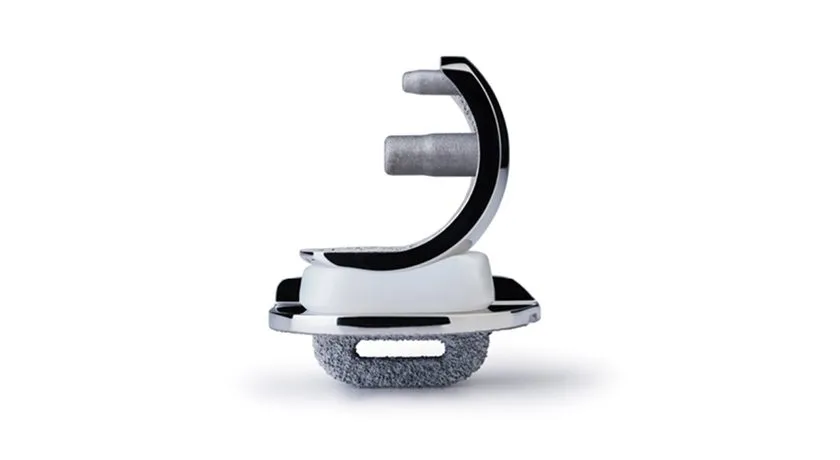
Entity and verified platform. Zimmer Biomet publishes separate Oxford cemented and cementless partial knee information. The reviewed Oxford platform is mobile-bearing; the US cementless page specifies medial-compartment use and lists important eligibility restrictions. Availability and labeling remain regional.
Product distinction. The cementless brochure describes cobalt-chromium components with titanium plasma spray and hydroxyapatite coatings. The technical guide describes CoCrMo femoral and tibial components, matching polyethylene bearings and Microplasty instruments. It is important to distinguish the base alloy from the coating and from the bearing material.
Distributor relevance. An Oxford partial knee sourcing request should name the fixation version, destination market, complete size matrix and exact instrument generation. Ask whether instrument loan, purchase, replenishment and training are separate contracts. Do not infer channel margins or hospital acceptance from published clinical history.
What buyers should verify. Obtain the regional IFU, compatible femoral/bearing combinations, trial inventory and any required cemented backup for a cementless program. Do not extend the reviewed medial indication to a lateral procedure simply because another product carries the Oxford name.
Official sources reviewed: Oxford cementless product and indications, cementless component brochure, Oxford Microplasty technical guide.
3.2 Smith+Nephew — JOURNEY II UK
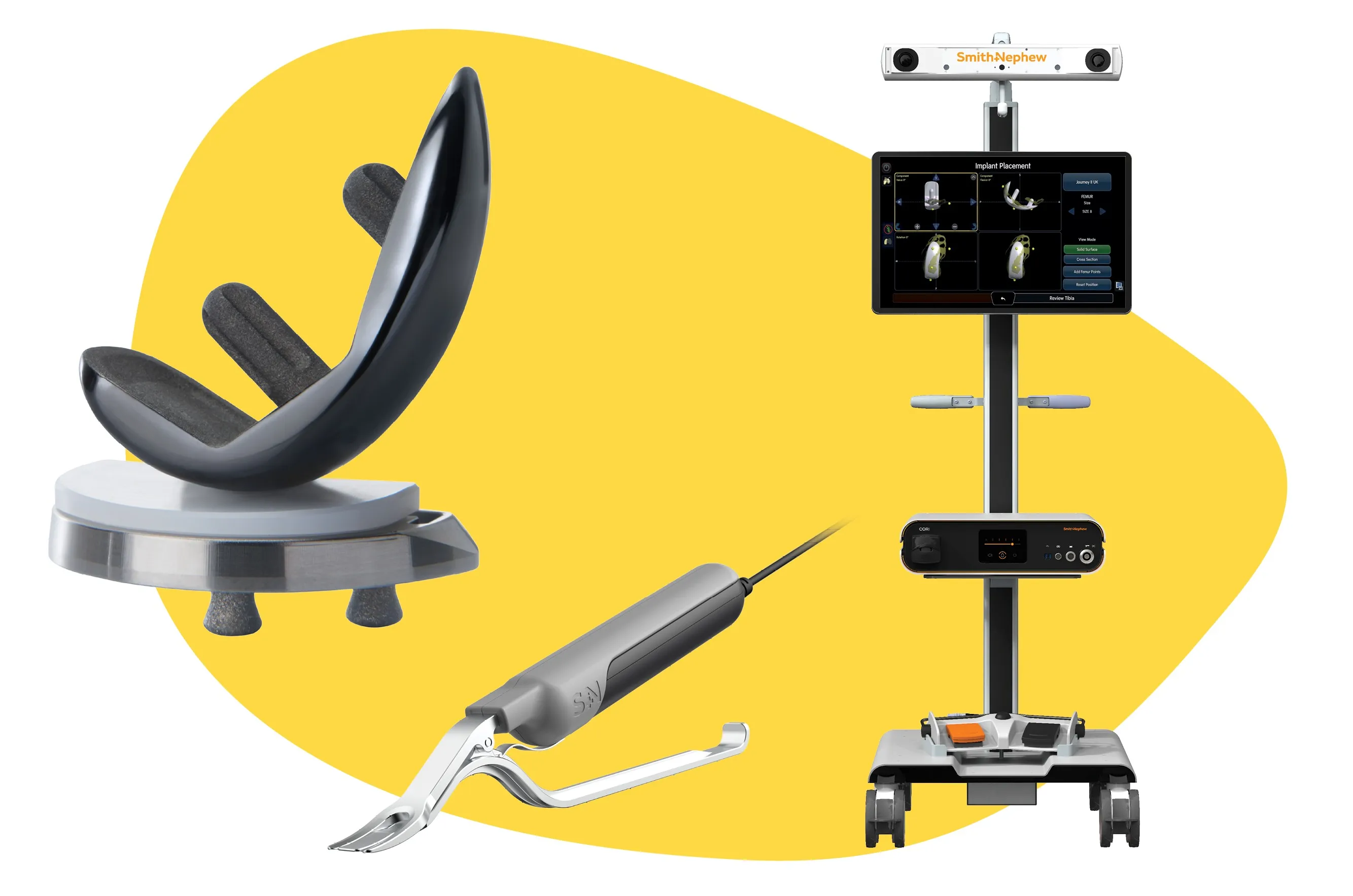
Entity and verified platform. Smith+Nephew's JOURNEY II UK is a unicompartmental platform with OXINIUM oxidized-zirconium femoral components. Public documentation describes medial and lateral options, conventional instrumentation and compatibility with the CORI surgical system. The reviewed cemented construct uses a fixed XLPE bearing.
Product distinction. OXINIUM is a specific material technology; its name does not establish that every implant component is ceramic or that allergic reactions are impossible. Evaluate the femoral component, tibial baseplate and insert separately.
Distributor relevance. Quote conventional and CORI-assisted workflows separately. A reduced tray configuration may depend on the robotic workflow rather than apply to every hospital. Request the precise tray manifest and software/implant compatibility information.
What buyers should verify. FDA record K222653 describes specified combinations of JOURNEY II UK and ENGAGE components. It distinguishes cemented JOURNEY components from cementless ENGAGE components. This is not blanket permission to regard every JOURNEY II UK construct as cementless or interchangeable. Confirm current local supply and the exact authorized combination.
Official sources reviewed: JOURNEY II UK manufacturer page, original JOURNEY II UK clearance K190085, combination-system clearance K222653. Additional construct evidence: ODEP cemented fixed-bearing record.
3.3 Stryker — Restoris MCK
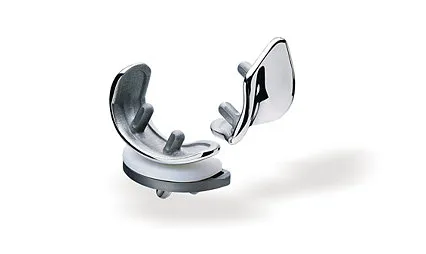
Entity and verified platform. Stryker presents Restoris MCK as a partial knee implant system paired with the Mako Partial Knee application. The manufacturer page lists medial, lateral, patellofemoral and selected bicompartmental applications. These product-family applications should not be confused with unrestricted component mixing.
Product distinction. The selected fixed-bearing Restoris MCK configuration includes X3 polyethylene. Stryker describes sequential irradiation and annealing in the material's manufacture. The supplier's process description is not a head-to-head clinical superiority result.
Distributor relevance. A Mako-associated proposal needs more than implant prices. Procurement should establish platform access, compatible software, case consumables, instrument availability, maintenance and training responsibilities. These commercial dependencies can change the cost of launching a program.
What buyers should verify. Specify the precise Restoris configuration and fixation method. FDA record K133811 concerns a separately identified Restoris Porous Partial Knee System with CoCr femoral and titanium-alloy tibial components; that historical record does not prove current regional availability of every porous option. Do not attach its specifications indiscriminately to a conventional Restoris MCK quote.
Official sources reviewed: Restoris MCK product page, Restoris porous-system FDA record K133811. Fixed-bearing X3 configuration is also described in the Australian device benefits schedule; schedule benefits are not distributor purchase prices.
3.4 Medacta — GMK UNI
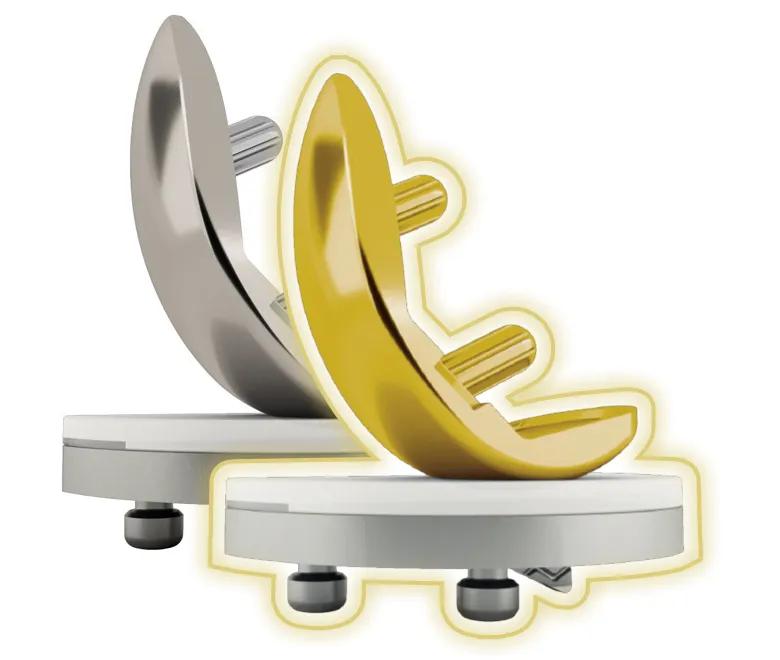
Entity and verified platform. Medacta's GMK UNI product range includes fixed metal-backed and full-polyethylene tibial options. Its published range distinguishes anatomic and symmetric femoral components, with specific material and fixation variants.
Product distinction. The product page identifies CoCrMo femoral components, selected SensiTiN-coated options and a titanium-plasma-spray/HA cementless anatomic femoral option. Fixation must be checked for the complete construct: a cementless femoral entry does not make every tibial combination cementless.
Distributor relevance. A choice between modular metal backing and a complete all-polyethylene tibial component changes the number and type of SKUs required. Compare matching trials and the inventory burden before choosing a narrower catalog.
What buyers should verify. Confirm which anatomic or symmetric components, insert thicknesses and coatings are registered locally. The manufacturer's instrumentation options include MyKnee UNI; obtain its patient-specific planning requirements and lead times separately from standard instruments. FDA K161741 documents the Fixed Plus tibial tray as a particular cemented device, not an authorization for every GMK UNI variant.
Official sources reviewed: GMK UNI product range, GMK UNI anatomic product leaflet, Fixed Plus tibial tray FDA record K161741.
3.5 DePuy Synthes — SIGMA HP Partial Knee
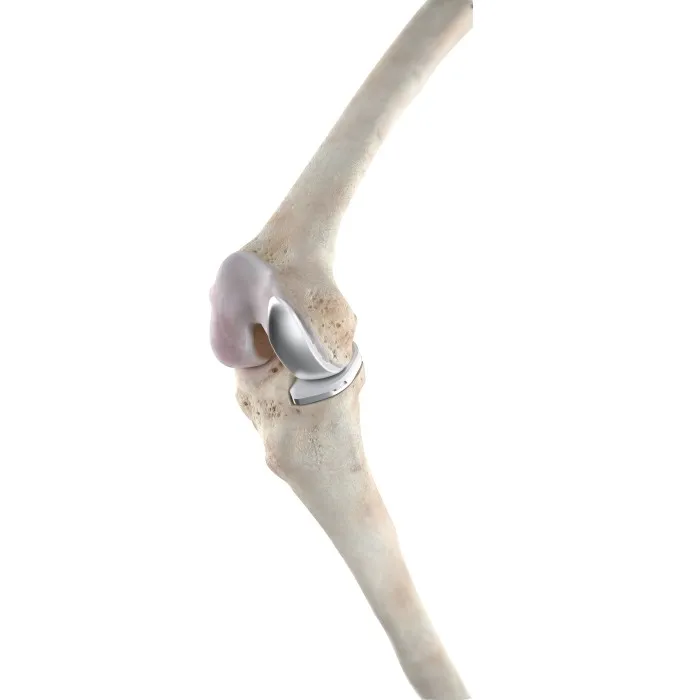
Entity and verified platform. DePuy Synthes maintains a SIGMA HP Partial Knee product page with links to technical, clinical and IFU resources. FDA K193549 identifies the SIGMA High Performance Partial Knee System as a Class II cemented device within that submission's scope.
Product distinction. Manufacturer information describes the I2 insert-locking interface and AOX antioxidant polyethylene. The fixed-bearing insert is also identified in the Australian device schedule. Material options should be tied to exact catalog numbers rather than generalized across the SIGMA family.
Distributor relevance. Buyers can structure their evaluation around the approved implant combination, instrument set and supporting evidence. Ask which bearing versions are supplied in the destination market and whether a quote includes every trial needed for the planned range.
What buyers should verify. Confirm regional indications, the current femoral alloy specification, tibial backing, polyethylene version and compatibility matrix. Request the technical guide directly if a downloadable document is unavailable. A video showing a robotic-assisted case does not establish that all systems, software versions or regional configurations are compatible.
Official sources reviewed: SIGMA HP product and documentation page, FDA clearance K193549, device schedule identifying the fixed-bearing insert.
3.6 Waldemar LINK — LINK Sled Prosthesis
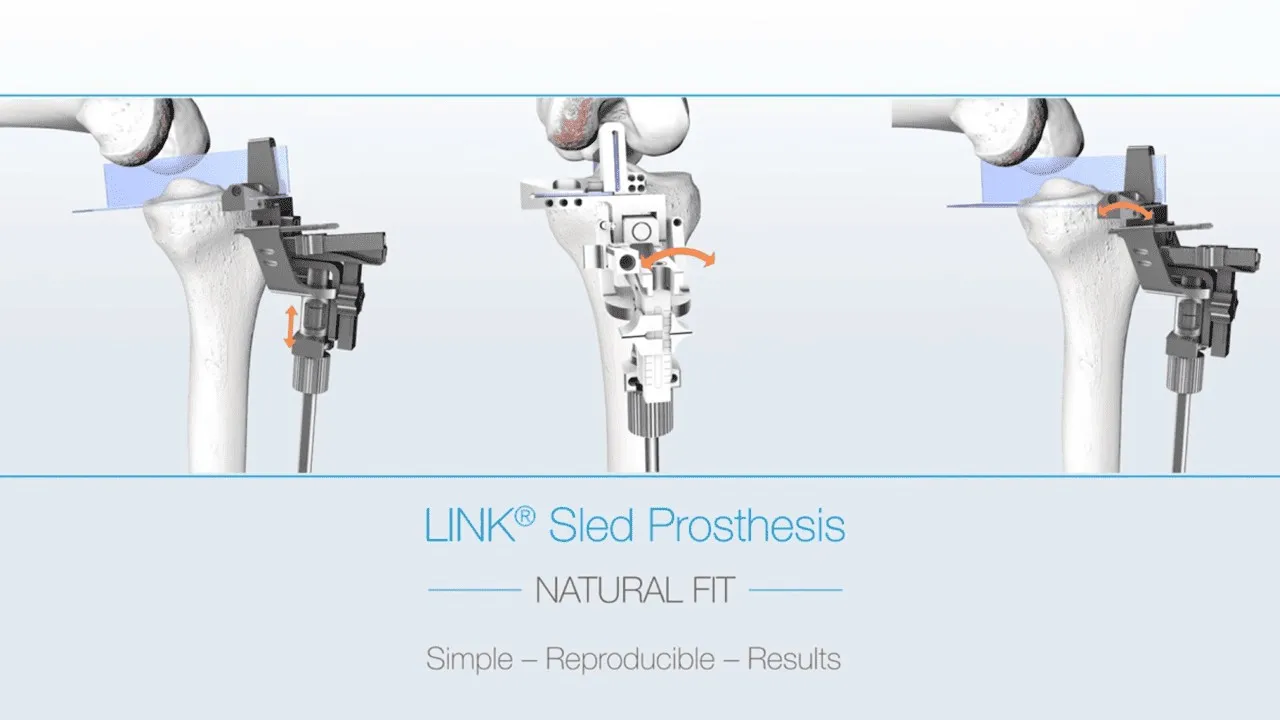
Entity and verified platform. Waldemar LINK's unicondylar Sled prosthesis is a distinct platform. LINK and Exactech are separate manufacturers and should not be combined into one brand entry. LINK's public page presents all-polyethylene and metal-backed tibial designs.
Product distinction. The reviewed US MITUS catalog lists CoCrMo femoral components, selected PorEx surface-modified versions and cemented use. Its metal-backed tibial component is supplied as a preassembled unit, which matters when comparing it with separately ordered modular inserts.
Distributor relevance. The MITUS catalog provides instrument and implant ordering information. Buyers should match the all-polyethylene or metal-backed choice to its own templates and trials, rather than assume that one generic tray serves every variant.
What buyers should verify. Check the current regional catalog, surface option, femoral dimensions and tibial footprint/height combinations. Distinguish a surface modification from the underlying alloy. Confirm availability and the exact MITUS tray configuration before using a historic catalog to create a purchase order.
Official sources reviewed: LINK Sled manufacturer page, LINK Sled/MITUS implant and instrument catalog.
4. Partial Knee Brand Comparison: Specifications and Sourcing
This comparison summarizes selected documented configurations. “Verify” identifies a genuine purchasing gap; it does not mean that the supplier lacks the feature. All fixation and material statements remain subordinate to the current regional IFU and actual SKU.
| Brand | Platform reviewed | Bearing concept | Fixation scope | Femoral material evidence | Instrument or workflow distinction | Price tier |
|---|---|---|---|---|---|---|
| Zimmer Biomet | Oxford | Mobile | Cemented and separately documented cementless versions | CoCrMo; Ti/HA coating on cementless version | Microplasty; verify generation and backup inventory | Comparable regional quote required |
| Smith+Nephew | JOURNEY II UK | Fixed | Cemented construct; separately cleared ENGAGE combinations require verification | OXINIUM oxidized zirconium | Conventional or CORI-assisted workflow | Comparable regional quote required |
| Stryker | Restoris MCK | Fixed | Confirm exact MCK construct; separate porous record is not blanket availability evidence | CoCr documented for porous-system femur; confirm selected MCK SKU | Mako Partial Knee application | Include platform and service costs |
| Medacta | GMK UNI | Fixed metal-backed or full-poly tibia | Cemented configurations; selected cementless variants are component-specific | CoCrMo; selected coating options | Standard instrumentation; MyKnee UNI option | Comparable regional quote required |
| DePuy Synthes | SIGMA HP | Fixed | Cemented system in K193549 | Obtain current femoral material declaration | Dedicated system instruments; verify any assisted workflow | Comparable regional quote required |
| Waldemar LINK | LINK Sled | Fixed all-poly or preassembled metal-backed tibia | Cemented in reviewed US catalog | CoCrMo; selected PorEx surface option | MITUS instrumentation | Comparable regional quote required |
Scroll horizontally to view all columns on smaller screens.
There is no defensible universal “premium,” “budget” or distributor-margin ranking in the public evidence reviewed. Compare quotes on the same basis: implant construct, full size coverage, instrument ownership, case support, freight, registration costs, payment terms and expiry exposure. A reimbursement amount or hospital charge is not an ex-factory implant price.
5. Critical Sourcing Criteria for Partial Knee Distributors
5.1 Evaluate Instrument Fit, Maintenance and Workflow
A compact tray is useful only if it contains the tools needed for the specified system. Request a manifest covering alignment guides, resection guides, drills, pins, sizing tools, implant trials, insertion tools and any dedicated extraction tools. Each item should have a catalog number, revision and replacement route.
Do not set an arbitrary incision length as a supplier acceptance criterion. Instead, have the hospital evaluate visibility, handling, assembly and the compatibility of the instruments with its chosen technique. For orthopedic surgical power tools, confirm the specified blade or burr, coupling, dimensions and permitted operating setup. A power-tool category page is not proof of compatibility with a named UKA system.
For reusable instruments, obtain validated cleaning and sterilization instructions, inspection criteria and service-life or replacement guidance. A loan set also needs a process for missing instruments, late returns and damaged trials. Ask how the supplier separates a planned replenishment from an urgent case-support request.
5.2 Compare Geometry and Material by Component
The femoral component, tibial support and bearing have different functions and may use different materials. The quotation should state the alloy or polymer grade, coating if present, component dimensions and applicable manufacturing specification. “Medical-grade metal” is not a useful substitute for a material declaration.
Surface finish should be specified through an approved engineering requirement and a defined measurement method. Do not turn a proposed Ra value into a verified factory capability without inspection evidence. Ask where the surface is measured, which acceptance criteria apply and how the manufacturer controls geometry after polishing.
Likewise, single-radius, multi-radius and conforming geometry are design descriptions. They do not independently establish a superior clinical outcome. Request evidence for the actual construct rather than transferring performance claims from a manufacturer's total knee line.
5.3 Polyethylene: Verify the Complete Material and Packaging Process
HXLPE is not a universal requirement for every established UKA platform. The reviewed Oxford documentation specifies ArCom direct compression molded UHMWPE, while other selected platforms describe XLPE, X3 or antioxidant-bearing options. Procurement should verify the validated material/process combination for the exact device.
Ask separately about the base resin, crosslinking treatment if used, antioxidant addition if used, thermal treatment, final sterilization method, packaging barrier and shelf-life evidence. Irradiation used for material processing and irradiation used for terminal sterilization should not be assumed to be the same step.
Ethylene oxide is a sterilizing agent, not an inert packaging gas; see the CDC explanation of low-temperature sterilization. A claim such as “gamma in nitrogen” also requires the actual validated process and packaging evidence. Neither phrase on its own establishes that oxidation or long-term wear has been eliminated.
5.4 Plan Sizes, Thicknesses and Backup Stock
There is no single standard distributor inventory that suits every partial knee system. Build the opening inventory from the hospital's planned compartment mix, surgeons' preferences, regional size availability, replenishment time and permitted component combinations.
For example, the reviewed Oxford technical guide describes five femoral sizes, seven tibial sizes and matched bearing sizes with a 3–9 mm thickness range. Medacta's published GMK UNI range lists fixed inserts in five sizes and six thickness levels: 8, 9, 10, 11, 12 and 14 mm. These figures describe different systems and must not be used as interchangeable thickness conventions or universal stock recommendations.
| Specification | What a distributor should check |
|---|---|
| Procedure and compartment | Medial or lateral authorization; do not infer one from the other |
| Side designation | Left/right and combined codes such as LM/RL, interpreted using the manufacturer's catalog |
| Femoral size and geometry | Size code, dimensions, available trials and permitted bearing pairing |
| Tibial footprint | Coverage dimensions and matching baseplate or all-poly component |
| Bearing thickness | Whether the number represents insert thickness or a defined overall construct height |
| Bearing construction | Mobile, modular fixed, preassembled metal-backed or all-polyethylene |
| Fixation | Cemented, cementless or specifically authorized mixed fixation by component |
| Material and coating | Exact grade and coating identity; avoid brand-level generalizations |
| Instrument revision | Matching templates, resection guides, trials and insertion tools |
| Sterile status | Individual SKU labeling; distinguish implants, reusable instruments and demonstration samples |
| Replenishment | Standard lead time, emergency route, minimum order and obsolete-size policy |
| Traceability | Catalog number, lot/serial identifier, UDI where applicable and expiry |
Scroll horizontally to view all columns on smaller screens.
An efficient inventory has an approved primary range and a documented route to less frequently used sizes. It does not rely on substituting an unapproved bearing because a preferred thickness is unavailable. Review actual use and expiries periodically; theoretical catalog breadth is not the same as a healthy stock profile.
5.5 Regulatory Identity and Supplier Documents
Match the name on the label, legal manufacturer, product identifier and intended use to the authorization for the destination country. A distributor agreement and a quality certificate serve different purposes from device authorization.
ISO 13485 concerns quality management; it is not a product marketing authorization. FDA establishment registration and device listing do not themselves mean approval or clearance, as the FDA explains. Use “510(k) cleared” for a device cleared through that pathway and “PMA approved” only where the device-specific record supports it. The Oxford family provides an example of why every partial knee should not automatically be described as a 510(k) device: see the FDA Oxford PMA record.
For CE-marked devices, review the declaration of conformity and applicable notified-body certificate scope against the actual product and manufacturer. Do not use a generic CE logo to cover a new private-label implant. For quality-system background, consult ISO's explanation of ISO 13485.
| Document | Purchasing question it should answer |
|---|---|
| Legal manufacturer and site details | Who is responsible for the device, and where is the relevant activity performed? |
| Quality-system certificate | Does its current scope cover the proposed products and operations? |
| Product authorization | Which exact models, uses and markets are covered? |
| Controlled catalog and compatibility matrix | Which femoral, tibial and bearing combinations are permitted? |
| Material and coating declarations | What is each component made from? |
| Design verification and mechanical evidence | Which tests support the proposed geometry and interfaces? |
| Polyethylene processing information | Which resin, treatment and bearing version are supplied? |
| Sterilization and packaging evidence | Which validated process applies to the specific SKU? |
| Shelf-life support | What supports the labeled expiry and storage conditions? |
| IFU, labels and traceability examples | Can the hospital identify and use the product within its authorized scope? |
| Reusable-instrument processing instructions | How are instruments cleaned, inspected and sterilized? |
| Complaint, change-control and recall procedure | How will the manufacturer and distributor handle changes or safety actions? |
Scroll horizontally to view all columns on smaller screens.
5.6 Ask for a Comparable Commercial Proposal
Separate the price of the implant construct from the cost of instrument sets and any digital platform. Include loan fees, training, local representative support, spare instruments, unused-stock return terms, expiry replacement, shipping and duties. Ask which costs recur per case and which are paid once.
| Question for the supplier | Useful answer or evidence |
|---|---|
| What does one complete implant construct include? | Itemized approved femoral, tibial and bearing combination |
| Which sizes are available locally today? | Current regional SKU list with stock and replenishment status |
| Is the quoted tray complete for our workflow? | Revision-controlled manifest and compatibility statement |
| What changes if robotic assistance is used? | Named platform, software, instruments, consumables and service terms |
| What happens when an uncommon size is needed? | Agreed supply route and delivery responsibility |
| How are product changes communicated? | Written notification, transition and training process |
| What is the actual cost of a supported case? | Implant cost plus allocated instrumentation, processing and support costs |
Scroll horizontally to view all columns on smaller screens.
6. Sourcing Beyond Big Brands: XC Medico OEM/ODM Project Evaluation
6.1 Start With a Defined Project Scope
XC Medico's published OEM/ODM service page describes engineering support, five-axis CNC machining, wire EDM, polishing, laser marking and packaging services. These capabilities provide a starting point for a discussion about joint implants and instruments. They do not independently establish a registered, ready-to-ship partial knee platform with a particular size range or bearing material.
For OEM/ODM joint implant manufacturing, define the requested deliverable: instrument development, trial components, machining to an approved design, packaging development, or a complete implant-system project. Each scope requires a different technical agreement, verification plan and regulatory responsibility.
The public materials reviewed do not establish the proposed UKA-specific Ra ≤0.025 μm finish, a six-size femoral range, an 8–12 mm insert range, HXLPE processing or a 10–20-set minimum order. Treat these as requirements to discuss and substantiate, rather than published XC product specifications.
6.2 Turn the Desired Portfolio Into a Feasibility Request
For a partial knee implant project, send controlled component drawings or a documented design brief, the intended market, the desired bearing architecture and the planned volume. Ask the supplier to identify existing capabilities, new development work and externally supplied processes separately.
| Project element | Information to define before quotation |
|---|---|
| Femoral component | Geometry, size range, alloy, coating and finish acceptance criteria |
| Tibial component | Footprint, fixation, backing construction and approved interface |
| Polyethylene bearing | Resin, processing, geometry, thickness convention and test requirements |
| Trial components | Required sizes, markings, dimensional control and reprocessing status |
| Instrument set | Approach-specific design requirements, coupling interfaces and verification plan |
| Packaging | Implant sterile barrier, labeling, transport testing and shelf-life plan |
| Regulatory roles | Legal manufacturer, registration applicant and technical-file ownership |
| Commercial terms | Prototype quantity, production MOQ, lead time, tooling and change-control costs |
Scroll horizontally to view all columns on smaller screens.
A branded implant photograph is not an adequate design input or evidence of compatibility. Custom instrumentation must be evaluated against the system it is intended to support, including applicable design rights and regulatory requirements. Prototype acceptance should be documented before production quantities are agreed.
6.3 Instrument Trays and Sterilization Containers
Tray design should follow the instrument manifest: clear identification, secure retention, access for cleaning and an arrangement compatible with the validated processing method. When discussing aluminum orthopedic sterilization containers, request confirmation of material, finish, dimensions and the proposed instrument load.
A reusable container for instruments is different from the sterile barrier package for an implant. A double-layer layout or anodized appearance does not establish validated sterilization performance. Confirm processing instructions for the complete loaded configuration and avoid promising compatibility with every hospital sterilizer.
6.4 Private Label, Documentation and Commercial Terms
Private labeling is more than adding a logo. The agreement must identify who controls the design, who is the legal manufacturer, which documentation can be shared and who handles product changes, complaints and field actions. Packaging artwork and laser marking must remain consistent with the approved product identity.
Ask XC Medico for a written feasibility assessment and product-specific supporting documents before describing an OEM project as a turnkey commercial system. Minimum orders, sample availability, manufacturing lead times and registration support should be confirmed in the quotation. A general service-page claim cannot substitute for a product-specific commitment.
7. Frequently Asked Questions About Partial Knee Sourcing
Why may unicompartmental knee replacement be considered instead of total knee replacement?
UKA can treat arthritis confined to an appropriate single compartment while preserving unaffected joint structures. It is not universally preferable to total knee replacement. Disease distribution, ligament function, deformity and other clinical factors determine suitability, and the treating orthopedic surgeon must assess the individual patient.
What is the difference between mobile-bearing and fixed-bearing partial knee implants?
A mobile-bearing implant allows its polyethylene bearing to move relative to the tibial component. A fixed-bearing implant retains the bearing relative to its tibial support, which may be modular, preassembled or all-polyethylene. Buyers should compare the exact construct, component compatibility and supporting evidence rather than assume one category is always better.
How many femoral and tibial sizes should a distributor stock?
There is no universal number. Opening inventory should follow the selected system's approved combinations, local case mix, surgeon requirements and replenishment times. Include matching trials and a documented route to less common sizes. Published size counts for one manufacturer should not be transferred to another system.
Is highly crosslinked polyethylene mandatory for every UKA system?
No. Established partial knee systems use different validated polyethylene materials and manufacturing processes. Check the exact resin, crosslinking or antioxidant treatment where applicable, sterilization method, packaging and shelf-life evidence. The approved product specification matters more than a generic requirement to use HXLPE.
Are robotic and conventional partial knee instruments interchangeable?
Not automatically. Compatibility depends on the implant, instrument generation, robotic platform and software configuration. Obtain written confirmation for the proposed workflow, including required consumables, conventional backup arrangements and training. A brand's participation in robotic surgery does not establish universal compatibility.
Can XC Medico develop custom UKA instruments for a specific approach?
XC Medico publicly describes custom orthopedic instrument design and manufacturing services. A UKA-specific request still requires feasibility review, controlled design inputs, compatibility verification and an agreed validation plan. Availability, regulatory responsibilities, sample quantities and lead times should be confirmed for the individual project.
Does ISO 13485 certification authorize a partial knee implant for sale?
No. ISO 13485 addresses quality management. Product market access depends on the applicable jurisdiction, exact device and authorization route. Buyers must match the legal manufacturer, model, intended use, labeling and regulatory documents; a certificate or establishment listing alone is insufficient.
8. Next Steps for Procurement
Begin with the clinical platform selected by the hospital, then translate it into a complete purchasing specification: approved implant combinations, sizes, bearing options, fixation, instrument manifest and destination-market documents. Compare commercial offers only after those elements are aligned.
For an XC Medico inquiry, provide the intended market, preferred bearing concept, implant or instrument project scope, expected case volume and sample purpose. Ask for the available catalog, engineering feasibility response and relevant product documentation. Evaluation samples and instrument trials should be distinguished from devices authorized for clinical implantation.
request a turnkey partial knee trial kit
The inquiry starts a project-specific availability and feasibility review. Kit contents, sample status, regulatory scope, minimum order and delivery terms require written confirmation before supply.
Sources and Update Notes
Review date: November 2, 2026. Manufacturer pages and linked technical documents support the platform descriptions. FDA records establish selected historical device identities and authorization scopes. The presence of an older document does not demonstrate that every described variant is currently supplied in every market.
Clinical context is grounded in AAOS information. ODEP and the Australian device schedule provide additional construct-level identification; neither is used as a worldwide sales ranking or a distributor price list. The sources reviewed do not establish comparable acquisition prices, market shares or channel margins for all six brands.
The selection emphasizes documented partial knee platforms. It does not imply that omitted manufacturers lack UKA products. Corin Uniglide and MicroPort's named unicondylar products were considered, but the current public product detail retrieved was less suitable for this comparison than the Medacta and DePuy documentation. Features of Unity or Evolution total knees were not attributed to a partial knee merely because the brand names were related.
Editorial accuracy note. This is a commercial sourcing guide, not surgical instruction, individual treatment advice or an authorization to interchange components. Product IFUs and applicable local requirements take precedence. Review this page when a manufacturer changes its catalog, component compatibility, regulatory status, instrument generation or distribution arrangements. XC-specific manufacturing requests remain subject to documented technical and regulatory review.

