


Quick Answer
A distal radius plate is an internal fixation implant used in selected distal radius fracture constructs. Buyers commonly compare volar locking plates, volar non-locking designs, dorsal plates and product-specific systems marketed under names such as DVR. These labels are not interchangeable: a DVR designation is a system or product name, while volar and dorsal describe plate position. Before comparing offers, match the intended plate family to the required fracture coverage, laterality, plate length and hole pattern, compatible screw options, instruments, labeling and local authorization. The cost trap is comparing an implant-only line item with a complete system quote: trays, instruments, replenishment, sterile presentation, documentation and compatibility can change the usable value.
In This Guide
- What the implant category covers
- Four plate families
- Volar or dorsal decision questions
- AO/OTA classification and inventory
- Instrument-set completeness
- Reading a specification sheet
- Comparing supplier quotes
- Five sourcing mistakes
- Questions to send a supplier
- Frequently asked questions
- Next step
- Sources and update notes
1. What Is a Distal Radius Plate—and When Does the Indication Change the Implant?
The distal radius is the wrist-end portion of the radius. A distal radius plate is a bone plate designed to support fixation of selected fractures or osteotomies involving this region. A plate is one component in a construct that may also include locking or non-locking screws, guide wires, drills, depth gauges and dedicated instruments. The system’s exact intended use and configuration come from its current instructions for use (IFU), product labeling and destination-market authorization.
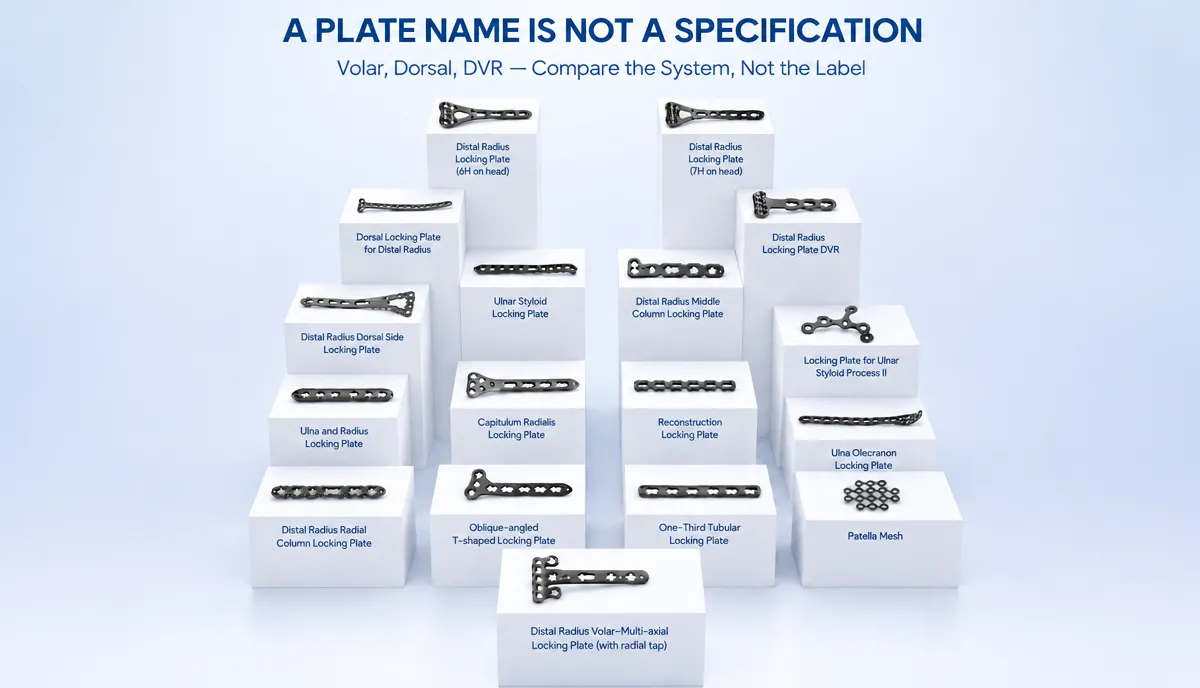
For distributors, “distal radius plate” is a broad category, not a single interchangeable SKU. A portfolio can include volar plates, dorsal plates, rim or column-specific plates, left- and right-sided designs, and different lengths or hole patterns. For example, XC Medico lists six-hole, seven-hole and DVR-style distal radius plate product pages. These are catalog examples, not a recommendation to stock a particular size or a claim that the designs are interchangeable.
Indication changes the product discussion because fracture location, fragment pattern, bone quality, associated injury and the surgeon’s planned construct affect which plate geometry and screw trajectories may be considered. The surgeon determines treatment. A sourcing guide can help ensure that the requested item, instruments and documents match the selected system; it cannot decide which fracture should be plated. The distal radius fracture fixation overview explains broader fixation options. For a related fixation method, see the guide to distal radius fracture K-wire fixation.
2. The Four Distal Radius Plate Families Buyers Commonly Compare
These categories help structure a product shortlist; they are not a universal taxonomy and they can overlap. A DVR-labeled product may itself be a volar plate. Ask the supplier to map every marketing name to the exact model, construction, compatible screws and current IFU. Public product naming can also vary by market and by catalog revision.
| Family or label | What the term usually signals | Procurement checks | Do not assume |
|---|---|---|---|
| Volar locking plate | Designed for volar placement, with locking holes as specified. Fixed- or variable-angle options depend on the system. | Contour, side, hole pattern, compatible screws, approved trajectories, guides and drivers. | That every volar plate is variable-angle or fits every fracture pattern. |
| Volar non-locking plate or construct | A volar design using non-locking screws, or a mixed plate with selected non-locking holes. | Hole type, screw model, compression feature, driver and current IFU. | That locking and non-locking screws can be exchanged in any hole. |
| Dorsal plate | Designed for dorsal placement; options can include rim, column or low-profile designs. | Subfamily, contour, side, screw trajectory, instruments and labeling. | That a dorsal plate is a reversed volar plate or that dorsal designs are interchangeable. |
| DVR-named system | A product or system name used for distal volar radius plating; not a universal technical standard. | Legal manufacturer, exact model, matching screws and instruments, local name and registration. | That every DVR-named product shares geometry, materials or regulatory status. |
The distinctions are practical. A portfolio that lists one “distal radius locking plate” may or may not include dorsal, rim, radial-column or middle-column options. XC Medico’s catalog separately identifies dorsal-side, radial-column, middle-column, dorsal locking plate and volar multi-axial locking plate pages. A buyer should confirm whether the offering is a separate plate, an accessory to a platform, or a legacy page that has been superseded.
Materials also require exact identifiers. “Titanium” alone is incomplete: request the alloy or grade, applicable standard and lot-linked material evidence. Ti-6Al-4V ELI and ASTM F136 are specific identifiers sometimes used in implant records; do not assume that every titanium plate uses them.
3. Volar or Dorsal? Which Questions Should Shape the Product Shortlist?
Distributors match the requested system to the clinician-selected construct and local labeling, then translate requirements into exact catalog items and instruments.

Question one: what anatomical region and fragment coverage are required?
Ask whether the request is for a general volar plate, a volar rim design, a dorsal plate, or a radial- or middle-column option. AO Surgery Reference describes a dorsal rim fracture pattern for which a dorsal plate may be used in the illustrated technique, but this is a fracture-specific reference, not a universal rule. The appropriate construct remains a qualified clinician’s decision. The procurement action is to ensure the exact plate family exists in the supplier’s current portfolio and that its labeling covers the proposed use.
Question two: what approach and instrument family does the clinical team use?
The modified Henry approach is an anatomical approach to palmar/volar exposure; it is not a plate specification or a universal tray name. Ask for the procedure-specific technique guide, instrument list and compatibility statement. Do not substitute instruments because trays appear similar.
Question three: what are the market-specific constraints?
Check local registration, authorized indications, sterile status, language requirements and whether the requested variants appear on the current approved catalog. A product can be described on a global website yet unavailable or differently labeled in a particular market. If a hospital asks for a “DVR plate,” have the requester identify the specific manufacturer and model or confirm that they mean a generic distal volar radius category.
4. What Does AO/OTA 23 Mean for a Distributor’s Stock List?
AO/OTA coding describes fracture location and morphology. Legacy references may use “23” for the distal radius. In the 2018 adult compendium, the distal radius is coded as 2R3, with A, B and C groups for extra-articular, partial-articular and complete-articular patterns. Check the official compendium for exact subgroups. Codes describe fractures; they do not prescribe implants or order quantities.
| Classification reference | What it describes at a high level | Stock-planning translation | Required guardrail |
|---|---|---|---|
| Legacy “23” / radius distal segment | A familiar label in older AO/OTA materials, studies and purchasing language. | Cross-reference legacy terminology to the current product and coding vocabulary used by local surgeons and registries. | Do not map the legacy code directly to one plate model. |
| 2R3A — extra-articular | Fracture in the distal radius segment that does not extend into the articular surface, with further subgroups for morphology. | Ask whether the local service needs common volar configurations, side-specific variants, and shaft lengths that match its case mix. | The category alone does not establish a specific plate length, hole count or screw trajectory. |
| 2R3B — partial articular | Articular involvement with a portion of the joint surface remaining attached to the shaft; named subgroups include different fragment locations. | Review demand for more specialized distal support, including rim or column-specific products when the clinical team requests them. | Do not infer a required plate from a single subgroup label; confirm clinician preference and product IFU. |
| 2R3C — complete articular | Complete articular fracture pattern with separation of the articular block from the shaft; subgroups describe additional morphology. | Discuss whether the local system needs a broader plate choice and a complete instrument set to support the service’s selected constructs. | Classification is not a treatment algorithm and does not replace individualized planning. |
Use classification as a vocabulary bridge, not a code-to-SKU conversion. Compare local purchasing history and clinician feedback with the registered catalog, then map side, geometry, holes, screws and tray availability. Confirm each model before ordering. Coding can organize case-mix discussions, but it is not a forecast.
5. What Should a Complete Distal Radius Instrument Set Contain?
A plate-only quote is not a complete system proposal. A distal radius instrument set should be reviewed against the manufacturer’s current catalog, technique guide and tray manifest. The exact instruments differ by system, plate family and local workflow, so the list below is a completeness check—not an operative sequence or universal mandatory tray specification.
| Set component | Buyer’s verification point | Evidence to request |
|---|---|---|
| Plate family and trial or positioning aids | Confirm which plate models and left/right variants the set supports; distinguish a trial, template or positioning aid from an implant. | Current tray manifest with item names and catalog numbers. |
| Drill guides and sleeves | Check compatibility with the plate holes and the approved screw trajectory, including whether fixed-angle and variable-angle options use different guides. | Instrument-to-implant compatibility matrix and technique guide. |
| Drills and depth measurement | Match diameter and working length to the screw family; verify the depth gauge range and how the supplier labels measurements. | Catalog numbers, dimensional specifications and inspection instructions. |
| Screwdrivers and drivers | Confirm the drive interface, driver length, handle options and whether the driver is dedicated to a particular screw generation. | Driver compatibility table and replacement-part identifiers. |
| Reduction and temporary fixation accessories | Ask which accessories are included, optional or outside the plate system; verify compatibility and intended use. | Optional-item list, IFU and any applicable separate product documentation. |
| Trays, case and sterilization accessories | Confirm tray dimensions, capacity, instrument count, closure and transport configuration; determine whether the container is validated for the stated process. | Tray layout, cleaning and sterilization instructions, and container compatibility evidence. |
| Reusable instrument service | Clarify replacement, repair, inspection and replenishment responsibilities, including how missing or damaged instruments are identified. | Written service terms, spare-part list and instrument tracking format. |
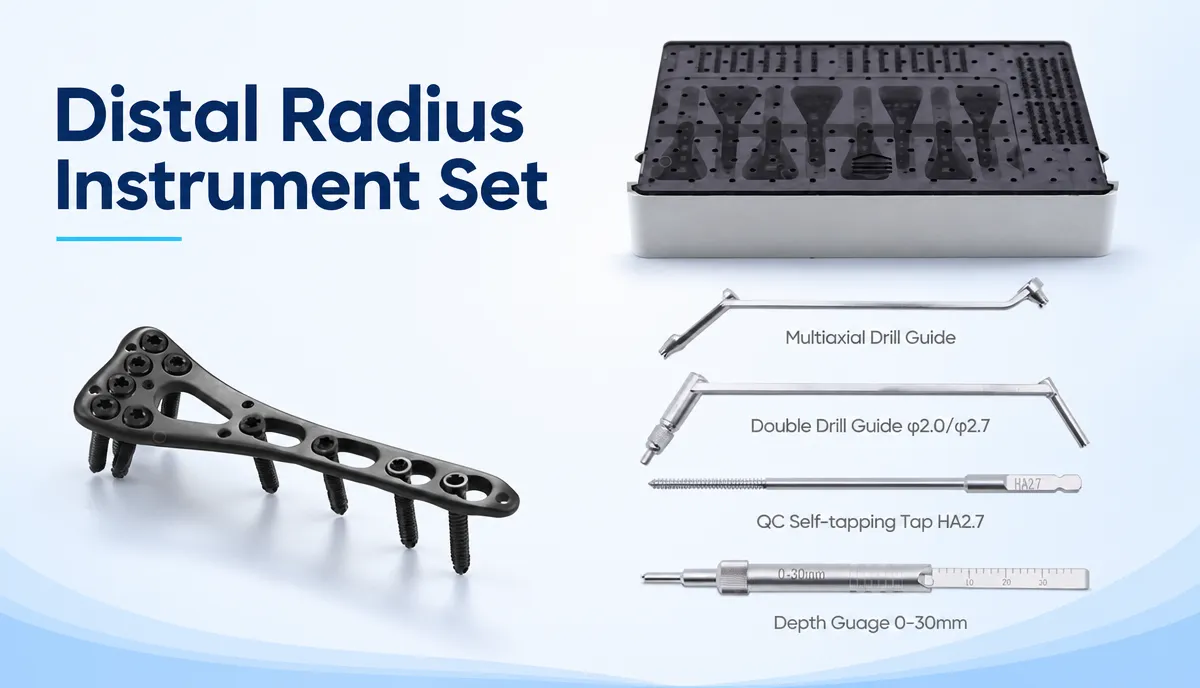
Compare the tray manifest line by line with the quote. “Complete set” may mean a full tray, a starter configuration or a set without optional tools. Confirm whether implants are separate, which instrument revision is supplied and how matching sizes are identified.
Review XC Medico’s distal radius instrument set, broader trauma instruments, and sterilization container options. Confirm tray compatibility, catalog revision and cleaning/sterilization instructions. For adjacent categories, see the radius and ulna range and trauma system portfolio.
6. How Should Buyers Read a Spec Sheet Before Requesting Samples?
Read a spec sheet as a controlled product identity document. Before requesting a sample, connect the description to the model, revision, compatible components and regulatory identity. FDA’s 2024 non-spinal plate guidance highlights device-specific information such as site, material, dimensions and screw compatibility; it does not replace the rules of the destination market.
| Specification field | What a distributor should check |
|---|---|
| Product identity | Legal manufacturer, trade name, model/SKU, catalog revision, product family and whether the listed item is current or superseded. |
| Plate geometry | Volar/dorsal or column/rim designation; left/right side; hole count and hole type; stated plate length, width and thickness; dimension units and measurement reference. |
| Material and finish | Exact alloy or grade, applicable material standard such as ASTM F136 where claimed, surface treatment or coating, and lot-linked material certificate. “Titanium” alone is not enough to compare specifications. |
| Screw interface | Compatible screw families, diameters, lengths, head/drive type, locking or non-locking function, fixed- or variable-angle description and permitted trajectory stated by the manufacturer. |
| Instrument compatibility | Drill guide, drill, depth gauge, driver, tray and any optional tool catalog numbers; revision and generation compatibility. |
| Sterile presentation | Sterile or non-sterile status, single-use or reusable designation, packaging configuration, sterilization method where supplied sterile, label and IFU alignment. |
| Regulatory identity | Destination-market registration or clearance reference; legal manufacturer and authorized representative/importer where applicable; product scope and intended use. |
| Document control | Current IFU, label, catalog, quality certificates, test summaries and revision dates; confirm that sample labels and documents match the quoted SKU. |
Define what a sample is intended to establish: dimensional review, instrument fit, packaging review or a formal market evaluation. A non-sterile sample cannot establish sterile packaging performance, and visual inspection cannot prove mechanical performance or lot consistency.
Use defined measurement terms for plate, screw and working length. For variable-angle systems, request the permitted range and supporting technical documentation. Match the sample label and model to the quote, IFU and local approval. If the identities differ, request a corrected document set before evaluation.
7. How Can You Compare Two Supplier Quotes Without Comparing Unlike Offers?
A quote comparison should separate the implant, the operating system and the supply relationship. A low line item can conceal missing instruments, unpriced accessories, documentation work or unreliable replenishment. A broader quote may include items the buyer does not need. Use the same written scope for every supplier and compare evidence rather than assumptions.
| Comparison pillar | Questions to ask | Evidence that makes the offer comparable |
|---|---|---|
| 1. Product scope and fit | Are the same plate families, sides, lengths, hole patterns, screw types and compatible instruments included? Are product names and model numbers exact? | Line-by-line SKU schedule, compatibility matrix, current catalog and IFU. Mark excluded or optional items explicitly. |
| 2. Regulatory and quality evidence | Does the offer cover products authorized for the destination market? Who is the legal manufacturer? Are certificates current and within scope? | Registration or clearance evidence, certificate scope, label/IFU copies, quality-system certificate and change-control information. |
| 3. Operational support | How are instruments supplied, tracked, repaired and replenished? What training, translation, complaint handling and technical support are included? | Tray manifest, service terms, named support process, instrument replacement policy and documented training materials. |
| 4. Total lifecycle cost and supply risk | What recurring costs, stock commitments, packaging constraints, freight terms, replacement components or stock-out exposures are outside the quote? | Written commercial assumptions, replenishment and forecast terms, warranty/return conditions, packaging details and a scenario-based total-cost worksheet. |
Request the same quote basket from each supplier: named plates, compatible screws, instruments, sterile presentation, documents, packaging and supply terms. Keep exclusions visible and clarify whether a reusable tray is sold, loaned or supplied under another arrangement.
Include inventory, registration, imports, tray processing, training and instrument downtime in total cost. For a fuller framework, see how distributors can evaluate supplier costs beyond first-order margins; for quote comparisons, read how to compare orthopedic implant OEM quotes.
Compare written replenishment and instrument-service responsibilities, using the same destination-market assumptions for labeling, import and regulatory scope. For OEM/private-label supply, define technical-document and change-control responsibilities.
8. Five Mistakes Buyers Make When Sourcing Distal Radius Plates
- Comparing by keyword instead of model. “DVR,” “volar plate” and “distal radius locking plate” can refer to different product identities. Ask for the legal manufacturer, exact SKU, current catalog revision and IFU.
- Assuming the nominal screw diameter proves compatibility. Thread form, head interface, locking mechanism, length, driver and permitted trajectory all matter. Require a manufacturer-issued compatibility list.
- Buying implants without an instrument plan. A plate may not be usable in the intended workflow without its matching guides, drills, gauges, drivers and tray. Review the manifest and service arrangement before approving the package.
- Turning fracture classification into an automatic stock order. AO/OTA categories organize description; they do not specify plate length, hole count, laterality or demand. Combine surgeon feedback, historical demand, registration and replenishment evidence.
- Accepting generic quality or regulatory language. A factory certificate, a registration reference or the word “titanium” does not prove every quoted product is covered. Confirm the certificate scope, product identity, destination market and lot-level documentation.
Maintain a version-controlled SKU matrix and require documented change notices for product, material, manufacturing-site, instrument or labeling changes. A sample can support a focused review, but it does not replace performance, sterility or authorization evidence. Keep supply terms and service responsibilities visible in the quote comparison.
9. What Should Distributors Ask a Distal Radius Plate Supplier?
Send the same questions to every shortlisted supplier and request written answers. The goal is to make the technical, regulatory and commercial scope comparable before a sample or purchase decision.
- Who is the legal manufacturer of each quoted plate, screw and instrument?
- What are the exact trade name, model/SKU and current catalog revision for each item?
- Which volar, dorsal, rim, radial-column or middle-column families are included in the current catalog?
- Which left/right options, plate lengths and hole configurations are available in the destination market?
- Which screw models, dimensions, drive types and locking interfaces are compatible with each plate?
- What material grade and standard apply to each implant, and can you provide lot-linked certificates?
- Which instruments and trays are required, optional, reusable or separately quoted?
- Can you provide the current IFU, labels, technique guide, catalog and instrument compatibility matrix?
- What registration, clearance or conformity documents cover the exact products and intended uses in our market?
- What are the sterile status, packaging configuration, sterilization instructions and shelf-life evidence for the supplied item?
- How are instrument replacement, replenishment, product changes, complaints and field actions handled?
- For an OEM/private-label project, who controls design changes, technical documentation, labeling and market-specific registration support?
Require each answer to identify the product and supporting document revision. A general brochure or facility certificate does not verify every model. Mark unsupported responses “not yet verified” and resolve them before purchase.
10. Frequently Asked Questions About Distal Radius Plates
What is a distal radius plate?
A distal radius plate is an implant designed to support fixation of selected fractures or osteotomies involving the wrist-end portion of the radius. The exact plate, screws, instruments and authorized uses depend on the product system and its current labeling. Device selection is procedure-specific, and the manufacturer’s IFU defines the stated intended use.
What are the main types of distal radius plates?
Common purchasing categories include volar locking plates, volar non-locking designs or constructs, dorsal plates, and product-specific systems marketed with names such as DVR. The categories can overlap, and the exact design must be checked against the manufacturer’s catalog and IFU. Options vary in contour, screw interface, angle control and instrumentation.
What is the difference between a volar and a dorsal distal radius plate?
“Volar” and “dorsal” describe the side of the radius for which the plate is designed. Plate geometry, fragment coverage, screw trajectories, compatible instruments and labeling vary by model. A qualified clinician selects the construct; distributors should match the requested model and system documentation. The approach and model must follow the clinical plan and applicable labeling.
What does AO/OTA 23 mean for distal radius fractures?
“23” appears in legacy AO/OTA references for the distal radius. In the 2018 adult classification, the radius is coded separately and the distal segment is commonly identified as 2R3, with A, B and C groups for extra-articular, partial-articular and complete-articular patterns. Classification describes fracture morphology; it does not determine a specific plate or stock quantity. Exact subgroups should be checked in the official compendium.
What should a complete distal radius instrument set include?
Review the manufacturer’s tray manifest for the instruments required by the selected plate and screw family, such as compatible drill guides, drills, depth gauges, drivers and trays. Confirm optional components, reusable-instrument service, cleaning and sterilization instructions, and the current compatibility matrix. Ask whether trays are sold or loaned and how replacement instruments are handled.
How should distributors compare distal radius plate manufacturers?
Compare exact product scope, model and SKU identity, material evidence, screw and instrument compatibility, destination-market authorization, sterile presentation, service support and written supply terms. Use the same product basket and assumptions for each quote, and document any evidence gaps instead of treating them as confirmed. Request records tied to the quoted model, not generic claims.
11. Build a Comparable Shortlist Before Requesting Samples
Start with the requested plate families and create a SKU matrix for sides, lengths, hole patterns, screw interfaces and instruments. Add the current IFU, material evidence, regulatory scope, sterile presentation and replenishment terms before comparing offers.
See XC Medico’s trauma implants, trauma instruments and trauma system portfolio. For custom manufacturing, review OEM/ODM services and define project responsibilities.
Need a product-level sourcing discussion?
Share the destination market, requested plate families, instrument scope and documentation requirements. XC Medico can help map the inquiry to relevant trauma products and clarify which specifications and regulatory records need to be reviewed for the proposed supply route.
Sources and Update Notes
Reviewed November 11, 2026. Sources below support the classification and procurement context; confirm current product documents for the exact model and market.
- AO Foundation: AO/OTA Fracture and Dislocation Classification Compendium—2018.
- Orthopaedic Trauma Association: OTA/AO Fracture and Dislocation Classification Compendium.
- AO Surgery Reference: Distal forearm.
- AO Surgery Reference: Dorsal plate for a partial-articular dorsal rim fracture.
- AO Surgery Reference: Palmar approach using the modified Henry approach.
- AAOS/ASSH Clinical Practice Guideline: Management of Distal Radius Fractures.
- U.S. FDA: Orthopedic Non-Spinal Bone Plates, Screws, and Washers—510(k) Submissions Guidance.
- FDA 510(k) summary K161894 — an example regulatory record that names Ti-6Al-4V under ASTM F136 for a specified trauma plate-and-screw system. This record is not evidence for another manufacturer’s product.
Editorial accuracy note: This is a procurement resource, not medical advice. Verify current labeling, authorization, clinician requirements and compatibility before ordering.

