You are here: Home » XC Ortho Insights » Industry Perspectives » How To Plan A Complete Orthopedic Trauma Product Line: Implant Sizes, Instrument Sets And Initial Inventory Based on Hospital Surgical Mix
How To Plan A Complete Orthopedic Trauma Product Line: Implant Sizes, Instrument Sets And Initial Inventory Based on Hospital Surgical Mix
Views: 0 Author: Site Editor Publish Time: 2026-11-02 Origin: Site
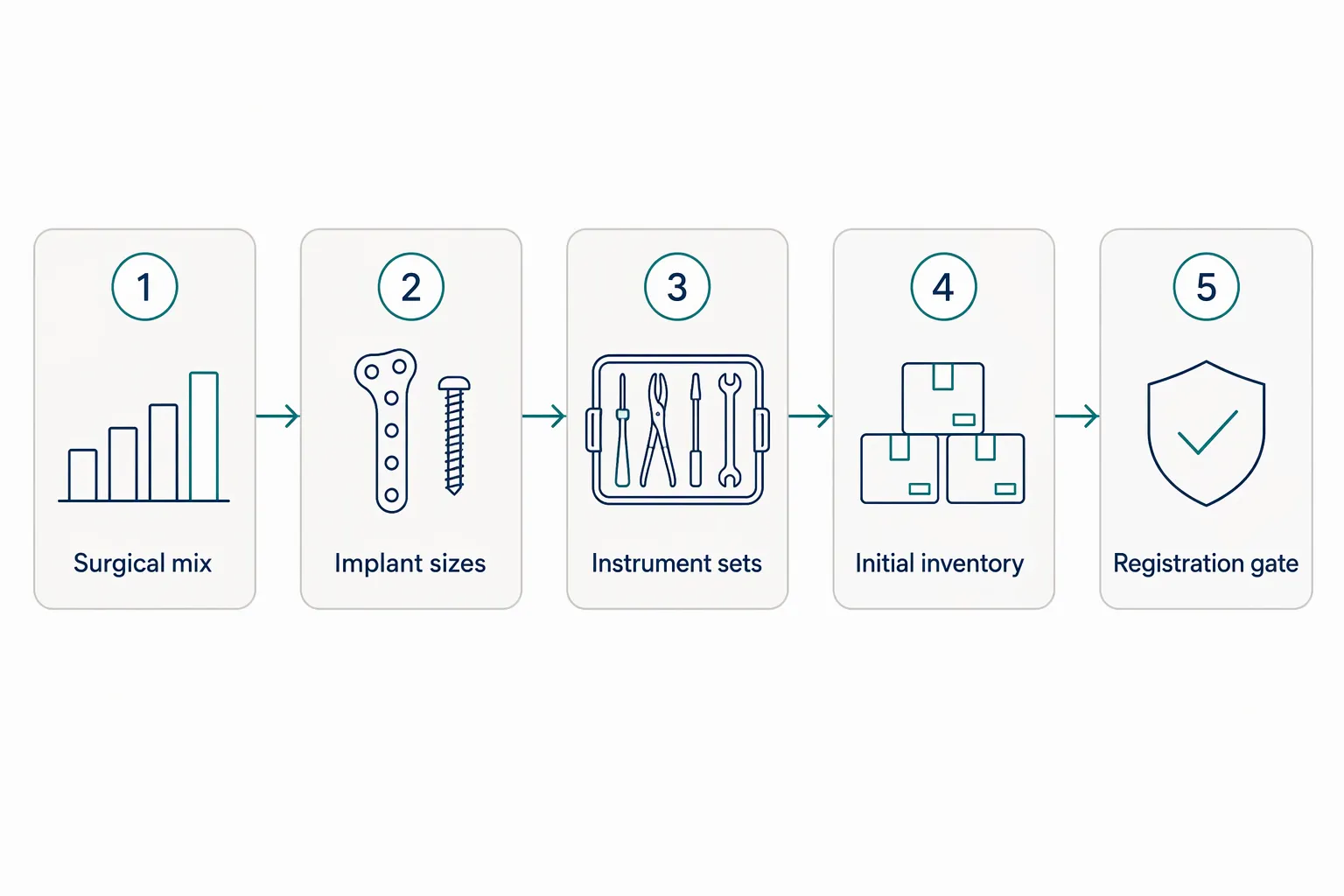
Short answer: Build a trauma product line from the hospital's surgical mix, not from a catalog, so that every bone fracture fixation procedure the hospital performs has complete implants and instruments behind it. Rank fracture procedures by annual volume, map each procedure to the implant family it actually uses (locking plates, intramedullary nails, bone screws, external fixators), plan sizes by expected usage, pair every implant family with a complete instrument set, and size the first stock order with one formula: expected demand during replenishment time + safety stock, with at least two units of every core size. Before anything ships, confirm that each SKU is covered by registration in the target country.
Key Takeaways
A trauma product line is a set of procedure solutions, not a list of SKUs. Each procedure needs implants, matching instruments, power tools and consumables, and surgical technique support.
The hospital's surgical mix decides most of the plan. Annual volume by fracture site determines which internal fixation devices and sizes are needed first.
Missing sizes are the most common reason a first order fails. A missing left/right version, length or matching screw stops a case even when "the product" is in stock.
Instrument sets are sized by concurrent cases and sterilization time, not by the number of implants purchased.
Initial inventory = demand during (lead time + review period) + safety stock. Lead time includes dispatch, international transit and customs clearance.
Registration status gates the plan. An implant only counts as available stock once it is covered by registration in the destination market.
Who This Guide Is For
Reader
What they need from this guide
Hospital procurement and purchasing officers (private hospitals, public buyers, tender and centralized procurement teams)
A defensible method to justify the first purchase list and avoid both stock-outs and dead stock
Orthopedic and trauma surgeons and department heads
Confidence that the implant sizes and instruments they rely on are in the set on the day of surgery
Orthopedic device distributors, especially small and mid-size distributors adding a trauma line
A repeatable way to build or extend a trauma portfolio for one or several hospitals without over-investing
Step 1: How Do You Analyze a Hospital's Surgical Structure?
What data should you collect first?
Collect 12 months of trauma procedure data from the hospital, or from the surgeons you serve. The minimum dataset:
Annual case volume by fracture site and procedure: for example intertrochanteric hip fixation, femoral and tibial shaft nailing, distal radius plating, clavicle plating, ankle fixation, femoral neck screw fixation and damage-control external fixation.
The fixation method each surgeon prefers for each fracture type: plate, nail, screws or external fixator.
Peak cases per day and per week, not only monthly averages.
Systems currently in use and known problems: missing sizes, worn instruments, late deliveries.
Sterilization (CSSD) turnaround time for instrument sets.
Purchasing model: direct purchase, tender or centralized procurement, or distributor consignment.
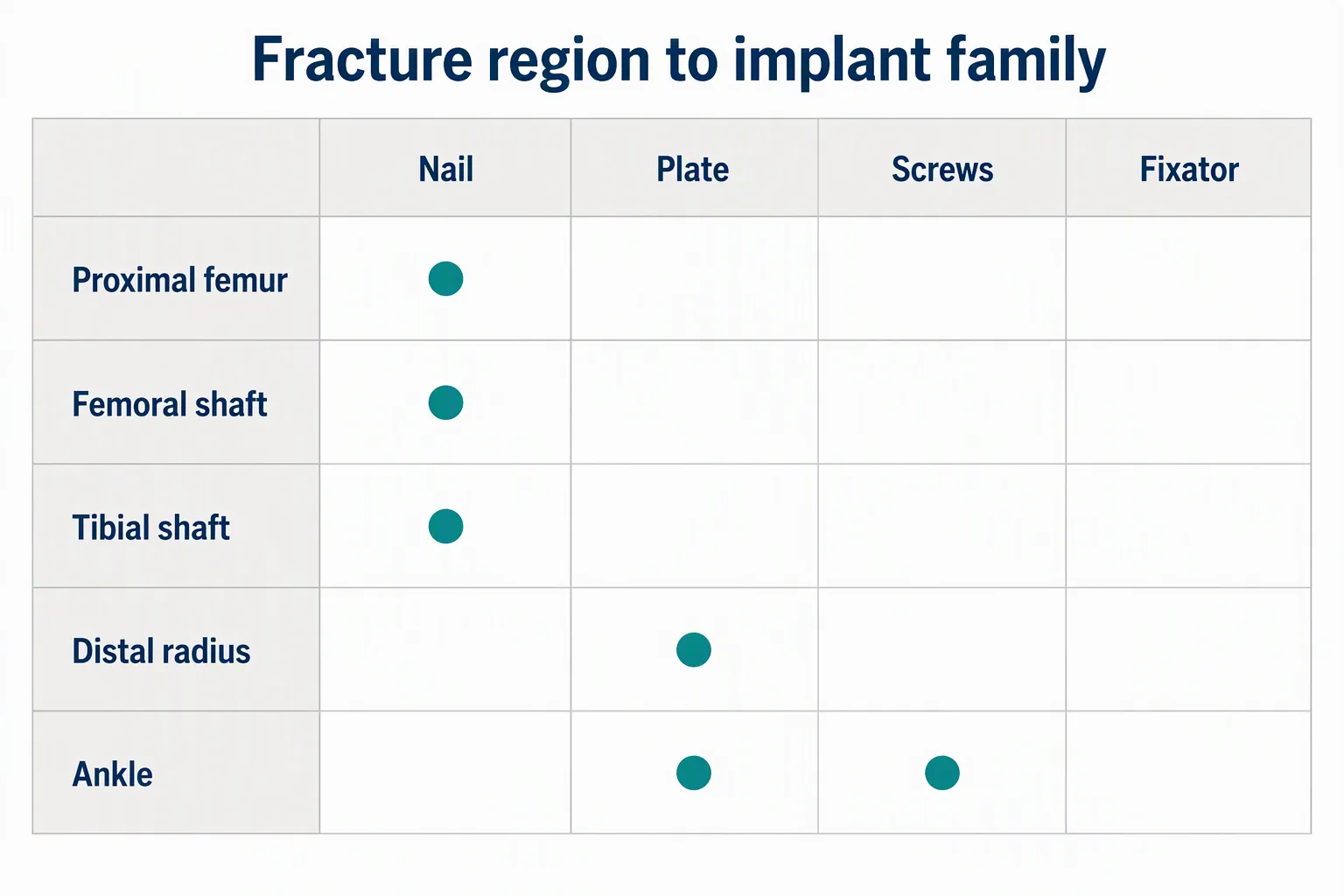
How do you turn procedure data into a product-line map?
Group procedures into implant families. The framework below supports purchasing decisions; the clinical choice always belongs to the surgeon. Clinicians can check indications against the AO Surgery Reference.
Clamps, rods and pins must match the frame configuration
Conclusion: The procedure ranking, not the product catalog, should decide which implant families enter the first order.
Why does the surgical mix matter so much?
Fracture demand is large and growing. The Global Burden of Disease 2019 analysis reported 178 million new fractures worldwide in 2019, a 33.4% increase since 1990, with the highest incidence in the oldest age groups (Lancet Healthy Longevity, 2021). That explains why hospitals with ageing populations put a lot of weight on proximal femur fixation. Still, the mix varies from hospital to hospital: a road-trauma center, an elderly-care hospital and a sports-injury clinic need different lines. National averages cannot replace the hospital's own data.
Step 2: How Do You Plan Implant Specifications and Sizes?
How many sizes do you really need?
Use a three-tier size plan for each implant family:
Tier
Definition
Stocking rule
Core sizes
Sizes that cover most of the hospital's historical cases
Always on the shelf or in the set, with backup units
Extended sizes
Used less often but clinically necessary, such as longer plates or extreme lengths
Keep at least one unit, or hold them centrally at the distributor
Special order
Rare anatomy or a surgeon's specific preference
Order on demand, with the lead time agreed in advance
Size-planning checklist by implant family
Locking plates and locking compression plates: left and right versions, hole counts and lengths, locking and non-locking screws from the same system, compatible drill guides.
Intramedullary nails (PFNA, femur nail, tibia nail): diameters × lengths, neck-shaft angle options where applicable, blades or lag screws, distal locking screws and end caps.
Bone screws (cortical, cancellous, cannulated): a diameter series that matches the plate system, the full length range for each diameter, and washers where used.
External fixators: pins and rods, clamps and connecting elements matched to the frame configuration.
Consumables tied to implants: K-wires, guide wires and drill bits.
Build the size matrix from the manufacturer's catalog together with the surgeons who will use the system. At XC Medico, supply is confirmed by procedure, registration scope and order, so the final size list is agreed during order confirmation rather than assumed from a generic catalog.
Conclusion: A case is lost because one size is missing, not saved because a hundred others are available. Plan screws and left/right variants as part of the system, never as separate purchases.
Step 3: How Do You Configure Matching Instrument Sets?
What belongs in a trauma instrument configuration?
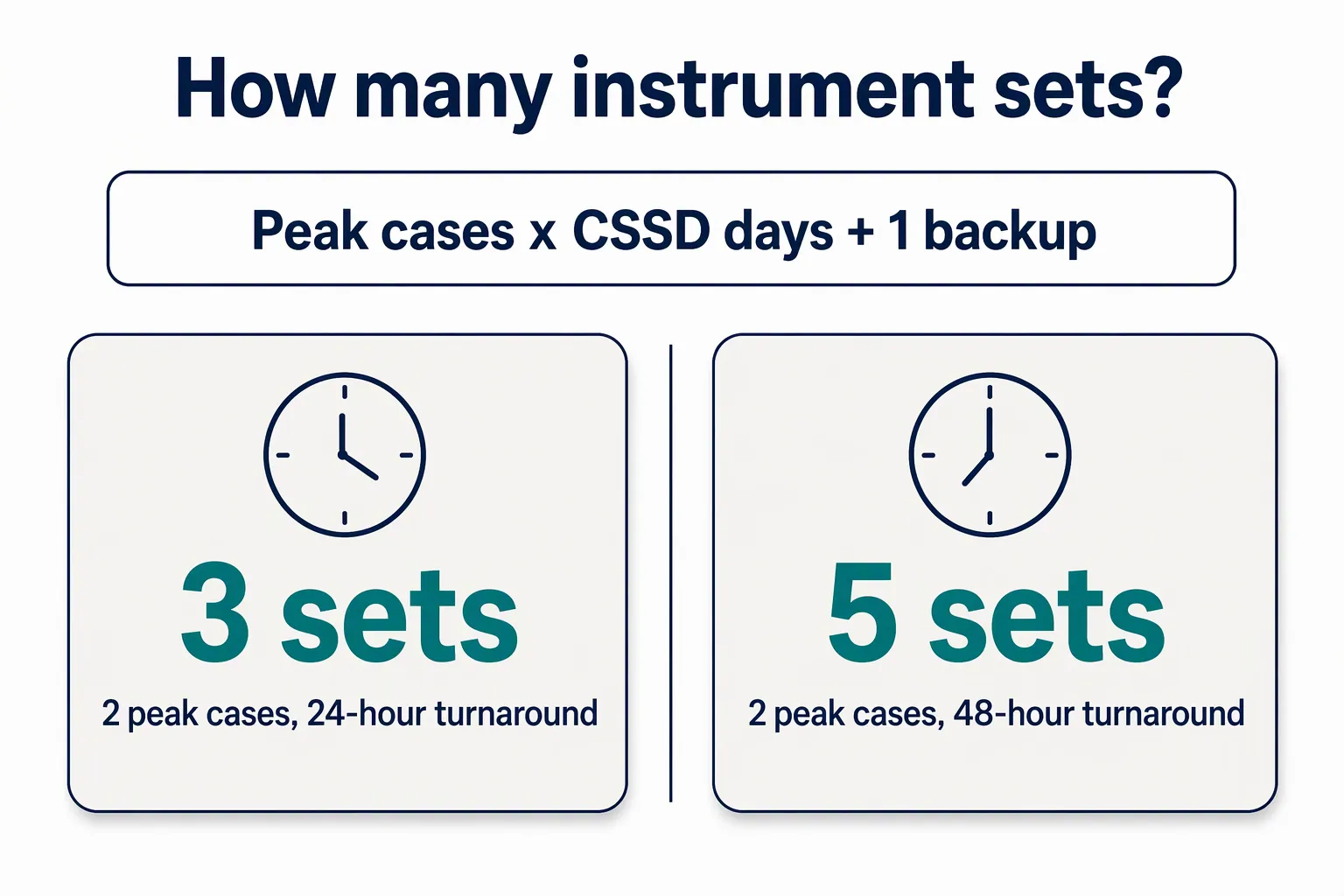
Illustrative example: a hospital performs up to 2 PFNA cases on its busiest day and CSSD returns sets within 24 hours, so ⌈2 × 1⌉ + 1 = 3 sets. If turnaround is 48 hours, ⌈2 × 2⌉ + 1 = 5 sets; otherwise the hospital has to accept a limit on how many cases it can schedule.
Conclusion: Buying one instrument set per system is the most common hidden bottleneck in a new trauma line. Size sets by concurrent cases and sterilization time.
Step 4: How Do You Calculate the First Inventory?
The per-SKU formula
Daily demand (d) = annual cases for the procedure ÷ 365 × usage share of the size × units per case
Replenishment time (L) = supplier dispatch time + international transit + customs clearance + internal receiving
Review period (R) = how often stock is checked and reordered (for example, weekly = 7 days)
Expected demand = d × (L + R)
Safety stock (SS) = z × √d × √(L + R). This Poisson approximation suits low-volume implant SKUs; z = 1.65 gives roughly a 95% service level.
Initial stock = expected demand + SS, rounded up, with a minimum of 2 units per core size (one in use, one backup)
Worked example (illustrative inputs)
Input
Value
Basis
Intertrochanteric fixation cases per year
120
Example hospital volume
Usage share of one nail size
15%
Example surgeon history
Nails per case
1
—
Dispatch time
7 days
XC Medico standard-order dispatch (in-stock items: within 3 days; subject to order confirmation)
Transit + customs
14 days
Example value; replace with the actual time for your destination country
Review period
7 days
Weekly reorder
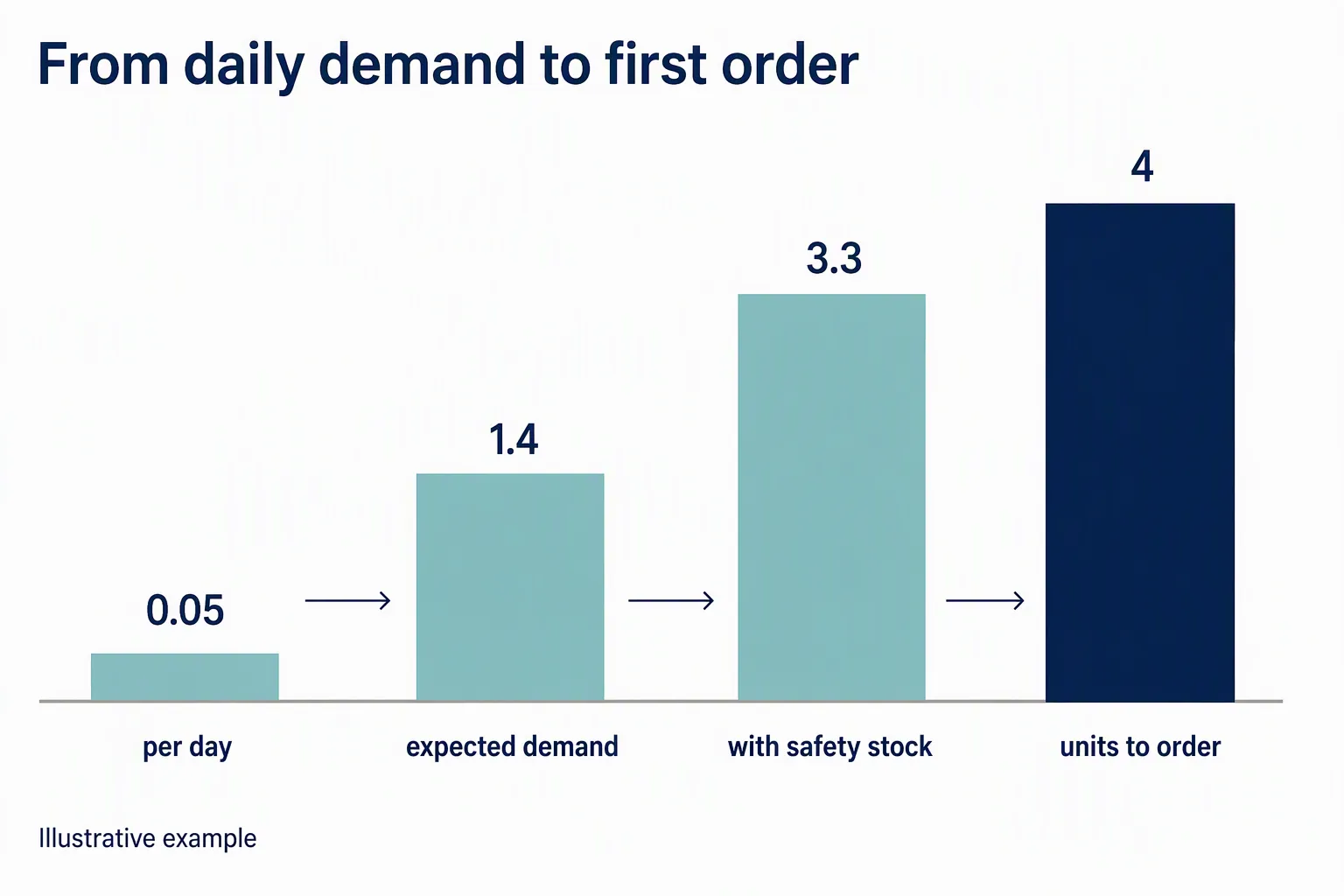
d = 120 ÷ 365 × 0.15 × 1 ≈ 0.049 per day
L + R = 7 + 14 + 7 = 28 days
Expected demand = 0.049 × 28 ≈ 1.4 units
SS = 1.65 × √0.049 × √28 ≈ 1.65 × 0.22 × 5.29 ≈ 1.9 units
Initial stock = 1.4 + 1.9 = 3.3, rounded up to 4 units of this nail size
Repeat the calculation for every size, then add the matching screws, blades and end caps per case. When an item ships from existing stock within 3 days, L shrinks and so does the stock you need to hold.
How should first-order stock be split?
Layer
What to include
Typical owner
Hospital shelf or consignment
Core sizes at the calculated stock level
Distributor or hospital
Distributor central stock
Extended sizes and a backup instrument set
Distributor
Manufacturer supply
Special-order sizes and replenishment
Manufacturer
Conclusion: Calculate initial inventory for each size from demand, replenishment time and safety stock. Never copy another hospital's list.
Step 5: What Must Be Verified in Supply Chain and Compliance?
Registration coverage: confirm that each implant SKU is covered by the medical device registration in the target country. Status differs by market and by product, and unregistered or in-registration markets need a different entry plan.
Quality system evidence: ask for the manufacturer's ISO 13485 certificate (ISO 13485:2016 is the international QMS standard for medical device organizations), plus material reports and batch test documentation. XC Medico's own process is described under quality control.
Traceability: confirm laser marking and lot traceability on implants so recalls and complaints can be handled.
Logistics terms: transport mode, customs documents, DDP availability, and payment currency requirements in the destination market (for example, Venezuela requires USD payment).
Quality-issue process: written return/exchange and warranty terms, with a defined response time. See after-sales support.
How does XC Medico support a trauma line build?
XC Medico is a China-based orthopedic implant and surgical instrument manufacturer and solutions provider serving customers worldwide. Founded in 2007, it supplies distributors, medical brands, hospitals and surgeons in more than 30 countries. Its portfolio covers trauma, spine, joint, sports medicine, CMF and medical power tools, together with external fixation and supporting surgical instruments.
Need
XC Medico capability
Trauma implant families
Plates, PFNA / femoral nails / tibial nails, cannulated screws and external fixation, with supporting instruments; supply confirmed by procedure, registration scope and order
Manufacturing and quality
Factory of about 4,300 m², 120+ machining units and a testing laboratory; production and quality control under an ISO 13485 quality management system
Traceability
Material reports, batch testing and laser marking; applicable qualification documents supplied per product and target market
Inventory and lead time
Inventory managed across 9,000+ SKUs; in-stock items ship within 3 days and standard orders within 7 days, subject to order confirmation
Commercial terms
Tiered pricing, agent pricing and OEM/ODM cooperation, including logo, color and packaging customization
Logistics
Shipping, customs clearance and DDP arranged according to the destination
Market entry
Unregistered markets: first-level agent recruitment with support for local registration and an agreed revenue-share model for later second-level agents. Registered markets: second-level agent network with agent pricing.
Clinical and after-sales support
Registration documents, technical reports, product training, case support, surgical technique videos and after-sales service; an initial handling proposal within 24 hours of a quality-issue notice; written return/exchange terms and categorized warranty
The trauma ranges are organised by anatomical region for planning: femur, tibia, foot and ankle, radius and ulna, humerus, clavicle, fibula and pelvis.
Registration status by market
Region
Registration status
Latin America
In registration: Mexico, Peru, Ecuador, Argentina. Registration planned: Colombia, Venezuela, Chile. Status to be verified: Guatemala, Nicaragua, Honduras, Bolivia, Paraguay, Dominican Republic
Southeast Asia
Registered: Indonesia. In registration: Vietnam. Status to be verified: Malaysia, Philippines, Thailand, Sri Lanka, Uzbekistan
Central Asia business region
In registration: Russia
Middle East
Status to be verified: Iraq
Industry, local and product certificates are checked against each specific product. "To be verified" does not mean unregistered. In Argentina, until registration is granted, supply follows the existing instrument range or a customized scope, and implant coverage is confirmed once registration is complete.
Step 6: How Do You Launch the Line in the Hospital?
Surgeon validation: review the size plan and instrument list with each trauma surgeon before ordering.
Training: schedule product training and a surgical technique review using the manufacturer's materials (technique videos, technical reports).
Case support: arrange on-site support for the first cases with each new system where local rules allow.
CSSD onboarding: give the sterilization team tray layouts and reprocessing instructions.
Documentation handover: registration certificates, instructions for use and lot traceability records.
Step 7: Which KPIs Should You Monitor After Launch?
KPI
Formula
Warning sign
Case fill rate
Cases with complete implants and instruments ÷ total scheduled cases
Below 98%
Size stock-outs
Number of times a required size was unavailable
The same size missing more than once
Inventory turnover
Units used ÷ average units on hand
Very low turnover on extended sizes
Dead-stock ratio
SKUs with zero use in 6 months ÷ total SKUs
Rising from one quarter to the next
Replenishment lead time
Order date to received date
Longer than the planned L
Quality complaints
Complaints per 100 cases, plus response time
Any upward trend
Step 8: How Do You Optimize the Line Over Time?
Monthly: reset stock levels using actual size usage, replacing the assumed usage shares with real data.
Quarterly: move slow sizes from the hospital shelf to distributor stock, and add sizes that caused stock-outs.
Every six months: check whether new procedures justify adding implant families.
Annually: renegotiate tiered pricing based on real volume and review registration coverage for new SKUs.
Common Mistakes to Avoid
Buying by catalog instead of by procedure: dead stock in rarely used families, gaps in high-volume ones.
Ignoring left/right and length variants: the plate is "in stock", but not in the side or length the case needs.
Buying screws separately from the plate system: incompatible screws stop the case.
Buying one instrument set per system: CSSD turnaround then caps the number of cases per day.
Treating factory dispatch time as total lead time: transit and customs often take longer than dispatch.
Skipping per-SKU registration checks: a product family can be registered while specific SKUs are not.
Never revisiting the plan: assumed size shares should be replaced with real usage within the first few months.
Master Checklist: Trauma Product Line Planning
Surgical structure
☐ 12-month case volume by fracture site and fixation method
☐ Peak same-day cases per system
☐ Surgeon preferences documented
Implants
☐ Implant families mapped to procedures
☐ Core, extended and special-order size tiers defined
☐ Left/right versions, lengths, diameters and matching screws verified
Instruments
☐ Complete instrument set for each implant system
☐ Number of sets calculated from peak cases and CSSD turnaround
☐ Power tools and consumables (K-wires, drill bits) included
Inventory
☐ Demand, L, R and safety stock calculated per SKU
☐ At least 2 units per core size
☐ Stock split across hospital, distributor and manufacturer
Supply chain and compliance
☐ Registration coverage confirmed per SKU and country
☐ ISO 13485 certificate, material reports and batch tests on file
☐ Traceability (laser marking, lot records) confirmed
☐ Logistics, DDP/customs and payment terms agreed
☐ Written warranty, return/exchange terms and response time agreed
Launch and monitoring
☐ Surgeon validation, training and first-case support scheduled
☐ Monthly KPI review in place
Frequently Asked Questions
What is the first step in building a complete trauma product line for a hospital?
Collect 12 months of trauma procedure data by fracture site and fixation method, then rank procedures by volume. That ranking decides which implant families (locking plates, intramedullary nails, bone screws or external fixators) go into the first order.
Which implant families make up a basic orthopedic trauma portfolio?
Usually anatomical locking plates and locking compression plates; intramedullary nails, including PFNA, femur nails and tibia nails; bone screws (cortical, cancellous and cannulated); and external fixators. Each family comes with its own instruments.
How do I calculate initial inventory for orthopedic implants?
For each size, initial stock = daily demand × (replenishment time + review period) + safety stock, rounded up, with at least two units per core size. Replenishment time must include dispatch, transit and customs clearance.
How many instrument sets does a hospital need per trauma system?
Multiply peak same-day cases by CSSD turnaround in days, round up, and add one backup set.
Why do new trauma lines run out of stock even after a large first order?
Usually because the order covered many implant families but not complete size runs: left/right versions, lengths or compatible screws were missing.
What should distributors check before choosing an orthopedic implants supplier?
Registration coverage for each SKU in the target country, ISO 13485 quality system evidence, material and batch test reports, implant traceability, realistic lead times including logistics, and written warranty and quality-response terms.
Can XC Medico supply a complete trauma line?
XC Medico supplies plates, PFNA / femoral and tibial nails, cannulated screws, external fixation, supporting surgical instruments and medical power tools. Supply is confirmed according to the procedure, the registration scope in the destination market and the order details.
How often should the trauma inventory plan be reviewed?
Adjust stock levels monthly using real usage, rebalance sizes quarterly, review implant families every six months, and review pricing and registration coverage annually.
Planning a trauma line for a hospital or distribution network? Share your hospital's annual case mix and target market, and the XC Medico team will map implant families, instrument sets and registration coverage for you. Contact XC Medico to start the review.
As a globally trusted Orthopedic Implants Manufacturer, XC Medico specializes in providing high quality medical solutions, including Trauma, Spine, Joint Reconstruction, and Sports Medicine implants. With over 19 years of expertise and ISO 13485 certification, we are dedicated to supplying precision engineered surgical instruments and implants to distributors, hospitals, and OEM/ODM partners worldwide.