


CONTRACT MANUFACTURING PROJECT COMPARISON · ORTHOPEDIC DEVICES · LAST REVIEWED: NOVEMBER 16, 2026
Quick answer
In medical device contract manufacturing, compare orthopedic projects through evidence, not company size or the quoted unit price alone. Verify that the legal entity and production address match across records; the ISO 13485 scope covers the relevant site and operations; regulatory files have named owners and maintenance duties; material and production lots are traceable; outsourced processes are disclosed; and instruments, packaging, sterilization work, validation, and commercial assumptions are included or clearly excluded. Use one controlled specification and the same evidence request for every candidate, then record gaps before approving samples or a first order.
1. Why do two contract manufacturing quotes describe different projects?
A quote is comparable only when both parties price the same defined project. One supplier may include a finished, labeled device, matched instruments, validated packaging, and market documents; another may price only the machined implant, leaving finishing, inspection, sterilization, validation, labeling, and regulatory work outside scope. A lower unit-price line can therefore describe a different project.
For orthopedic devices, scope can cover design transfer, material control, production, inspection, instruments, packaging, sterilization coordination, and release records. Applicability depends on the product, market, and legal role; “OEM quote” is not a standard bundle.
In a medical device OEM project or a medical device ODM project, labels alone do not determine design authority; define who controls design inputs, outputs, and changes. Assess an orthopedic implants manufacturer against the operations and records it actually undertakes.
For an orthopedic case mix, use de-identified demand and stocking history to build the configuration matrix; do not let a general catalogue substitute for the buyer’s actual product scope.
Send a controlled RFQ pack with intended use, target markets, current drawing revisions, size matrix, instruments, packaging and sterile-state expectations, regulatory assumptions, and the requested evidence. Require each supplier to mark every line included, excluded, customer-supplied, subcontracted, or pending. This guide compares project capability and evidence; it is not a brand ranking, clinical recommendation, or general implant-supplier checklist.
Include the proposed legal manufacturer and manufacturing site in the comparison record, even if those details are not yet final. Also define the sample gate, who can approve a deviation, and what evidence is required before a purchase order. These details keep the discussion focused on project readiness instead of allowing different assumptions to hide inside otherwise polished quotations.
This guide covers medical device contract manufacturing project controls.
2. Factory or trading company? Five checks that cannot be faked
No document or video is fraud-proof. Cross-check independent records so a sales description cannot substitute for project evidence. A trading company may coordinate a legitimate project; identify the legal manufacturer, production sites, and owners of quality and regulatory records.
- Match entity and address. Compare the business registration, production site, certificate, product records, quote, and sample labels. If seller and manufacturer differ, request their relationship and responsibilities in writing.
- Check manufacturer identity. Ask which entity appears as manufacturer on the applicable registration, clearance, declaration, and label. Reconcile any different names across records rather than assuming they are routine.
- Check process equipment and measurement. Request relevant equipment IDs, calibration and maintenance status, and controlled inspection examples. A universal testing machine or optical system matters only where the project’s methods require it; equipment presence alone does not validate a result.
- Map special processes. Identify whether anodizing, passivation, heat treatment, cleaning, coating, or sterilization is in-house or subcontracted. Request controls, acceptance criteria, qualification evidence, and lot records for each applicable process.
- Observe work at the site. Request a focused visit or live, time-stamped walkthrough of material receipt, production, inspection, instrument assembly, packaging, and records. Reconcile what is shown with controlled documents; a video alone is not an audit.
Log each document’s issuer, revision, site and product scope, plus unresolved questions. If an intermediary is involved, record who approves changes, releases product, investigates nonconformities, and communicates field issues. The key distinction is whether project responsibilities are visible and testable.
During a live review, ask the team to take one sample or traveler identifier and show where it is recorded at each operation. Compare that trail with the lot documents later supplied for the RFQ. The goal is not to collect more screens or certificates; it is to see whether a defined device configuration can be followed through the actual control system.
For a practical visit or remote review, use a focused what a factory visit or video audit should show agenda and request evidence tied to the proposed product rather than a general company presentation.
3. What six evidence blocks should every orthopedic contract manufacturing quote carry?
Request the same six evidence blocks from every candidate. An unclear answer is a gap, not proof of misconduct; ask for a record or owner to make each claim reviewable.
| Evidence block | What to request | Unresolved answer to probe | How to verify it |
|---|---|---|---|
| Technical file | Controlled drawings, materials, critical characteristics, inspection plan, and configuration list. | “We can work from the sample.” | Match quote and sample to the drawing revision; define change approval. |
| Regulatory file | Target market, legal manufacturer, applicable record, labeling and IFU owner, file maintenance. | “We support regulatory” with no named duty. | Map each deliverable to an entity and contract duty; verify public records where possible. |
| Quality records | Material and lot records, process traceability, inspection, calibration, nonconformance, and change control. | “Traceability” means only a shipping label. | Trace one lot from inputs through inspection, release, and shipment. |
| Instrument set | Instrument list, tray layout, compatible sizes, trial items, spares, and set ownership. | “Standard set included” without a bill of materials. | Reconcile the list to the implant matrix and identify separately priced items. |
| Packaging and sterilization | Supply state, packaging, process, responsible site, validation and release records. | “Sterile-ready” without evidence. | Match records to the device, packaging configuration, process, and target market. |
| Commercial terms | Inclusions, exclusions, tooling, samples, tests, instruments, freight, payment, and per-SKU minimums. | One unit price with open assumptions. | Use a scope matrix; compare totals only on the same basis. |
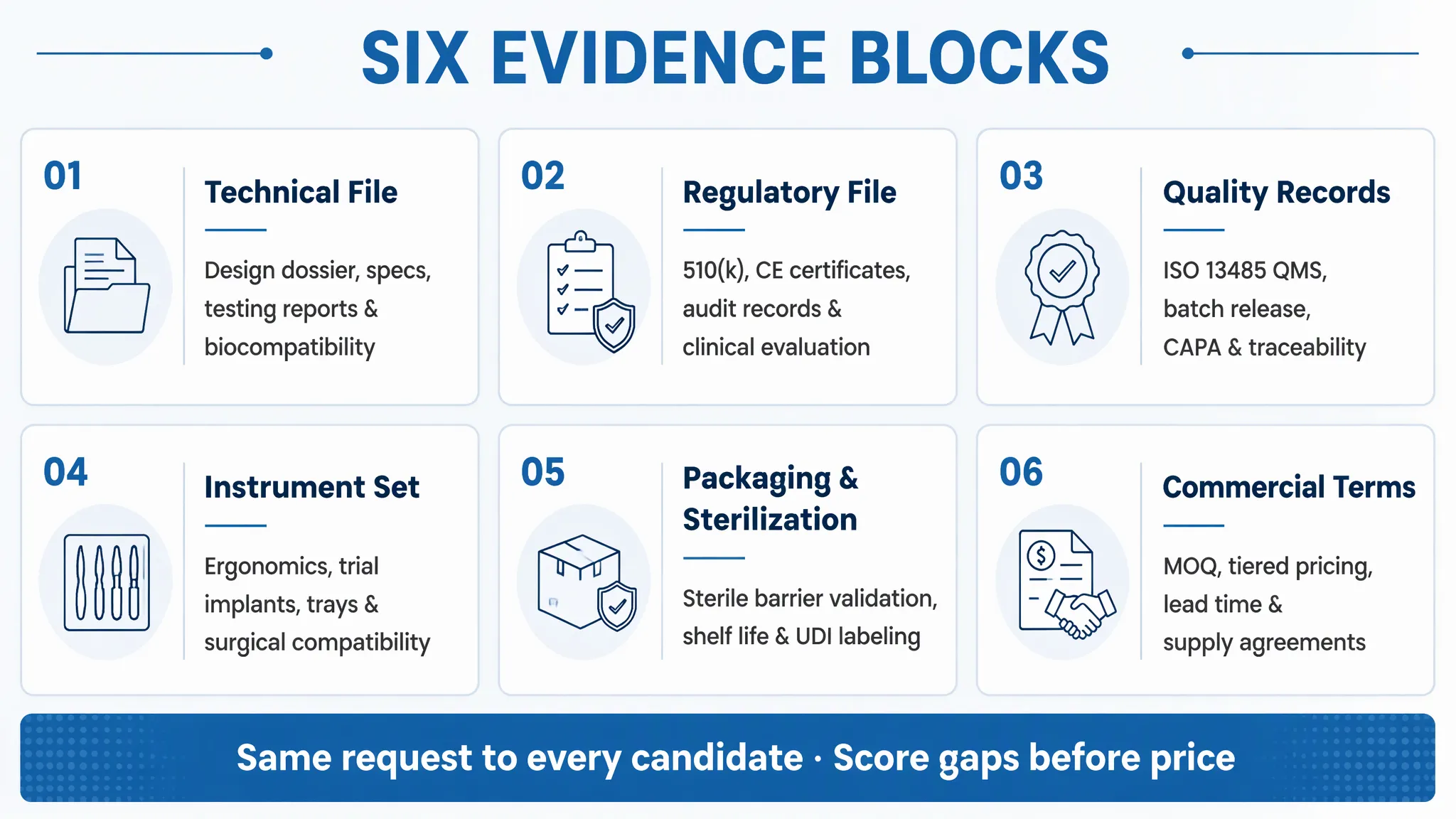
Require an answer for each row. “Not applicable” should include a reason and the owner who will reassess it if scope changes. Mark evidence verified, received but unchecked, open, excluded, or not applicable, and score it separately from price.
4. What does an ISO 13485 certificate cover—and what does it not?
An ISO 13485 certificate is evidence that a quality management system was assessed against a stated scope by a certification body. The certificate is not a device approval, market authorization, or proof that every product, factory, process, or subcontractor in a supplier’s network is covered. ISO itself explains that it does not perform certification. For buyers, the decisive task is to check the issuing certification body and the exact scope, site, and validity shown on the document.
Confirm that the certificate names the quoted legal entity and site. Its scope may cover design, manufacture, assembly, sterilization, distribution, or only selected operations; compare it with the work placed. Ask how other sites and subcontractors are controlled.
FDA’s QMSR became effective February 2, 2026, and incorporates ISO 13485:2016 by reference into parts of the U.S. quality-system framework. This does not turn a private certificate into FDA certification or device clearance. FDA does not issue certificates of conformance to ISO 13485, and regulated parties must still meet requirements applicable to their role and product. See the FDA QMSR overview and ISO’s explanation of ISO 13485 certification.
When comparing an ISO 13485 contract manufacturer, focus on the certificate scope and the site that will perform the quoted work, then verify product and process evidence separately.
Record the certificate number, entity, site, scope, issuing body, validity dates, and exclusions. Verify authenticity where possible, then request project records showing the system applies to the quoted operations.
Also ask whether the scope or site has changed since the certificate was issued and whether any relevant activity is controlled through an external provider. A supplier should be able to explain how purchasing controls, qualification, incoming acceptance, and change notification apply to outsourced steps. If the certificate covers design but the supplier only manufactures to customer drawings—or the reverse—note that distinction instead of assuming broader coverage.
5. Regulatory support: who owns the file, and who maintains it?
“Regulatory support” for an orthopedic device is not a deliverable until responsibilities are named. Map the legal manufacturer, brand owner or specification developer, registration or listing holder where applicable, authorized representative or importer, and distributor for each target market.
Ask who holds technical documentation, risk and test records, declarations, labeling masters, and registrations; who can approve changes, maintain records, and respond to authorities; and what access continues after termination. A controlled copy, access right, and ownership right are different.
EU MDR assigns obligations to manufacturers and also to importers and distributors. It sets manufacturer duties for technical documentation and the quality system, with responsibilities depending on the party’s legal role and device. Review the EU Medical Device Regulation and obtain market-specific advice before contracting.
In the United States, distinguish establishment registration and device listing from premarket status; registration or listing alone is not device approval or clearance. Identify the applicable pathway or exemption and the responsible party. Contracts can allocate tasks, but cannot erase statutory duties.
For every deliverable, record the accountable entity, operational owner, evidence, and change trigger. Define what happens to files and access if the supplier or brand relationship ends.
For private-label projects, define who handles label changes, complaints, adverse-event communication, field actions, and access to device records. Specify required contacts and information-sharing duties; review these allocations with qualified regulatory counsel for each market.
6. Orthopedic project transfer: drawings, tooling, and validation ownership
At project start, distinguish buyer-owned inputs, supplier background technology, and jointly created work. Cover drawings, CAD, specifications, process instructions, inspection programs, fixtures, molds, machining programs, gauges, methods, and project validation reports.
For tooling, document title, storage, ID, maintenance, access, and release or transfer conditions. State whether it is dedicated or shared and how production can continue if a supplier becomes unavailable. An ownership statement without custody and retrieval terms is incomplete.
Agree which operations require qualification or validation, who approves protocols, handles deviations, pays, and retains reports and raw data. Where IQ/OQ/PQ applies, define evidence and acceptance criteria for each stage; the acronym alone is not a deliverable.
Build a transfer package before design freeze: current drawings, bill of materials, process flow, supplier list, test methods, inspection templates, validated parameters, packaging records, traceability map, and open-change log. Define access and licensing rights while protecting unrelated supplier know-how.
Set change-control rules for critical specifications and define when changes trigger revalidation, regulatory review, customer notice, or new samples. This prevents the project from depending on undocumented process knowledge.
Include a transition exercise in the project plan: list the files and assets a receiving manufacturer would need, identify any format or software dependency, and confirm that a controlled copy can be produced. A workable transfer package should preserve revision history and links between design inputs, process settings, inspection methods, and the lots made under each approved baseline.
7. Orthopedic instrument sets and sterilization are part of the project
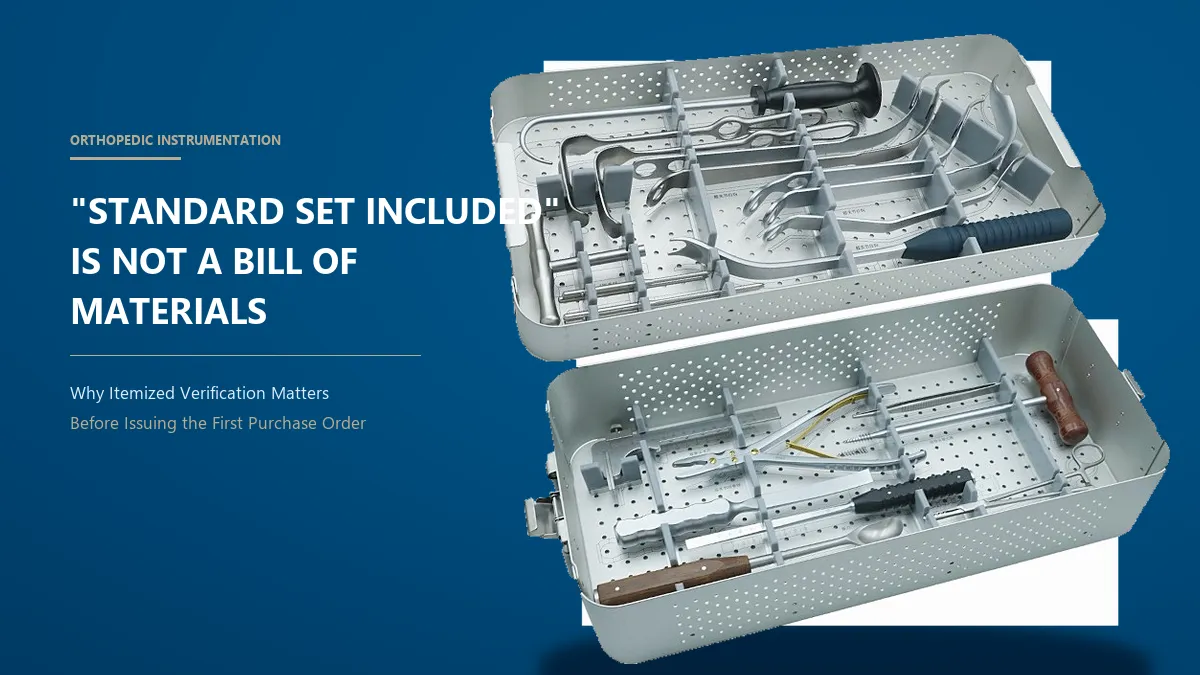
An implant quote may omit instruments needed for the proposed configuration. Define the orthopedic instrument set’s part numbers, size compatibility, trials where relevant, tray layout, spares, reusable or single-use status, reprocessing information, update owner, and whether the set is included, separately priced, customer-supplied, or excluded.
| Project element | What the quote should identify | Buyer verification |
|---|---|---|
| Instrument list | Part number, revision, size range, quantity, material or finish where relevant. | Match the list to the implant matrix and resolve unlisted tools. |
| Tray or container | Configuration, content map, ownership, spare positions, process boundary. | Confirm capacity and applicable cleaning, inspection, and reprocessing records. |
| Reusable instruments | Current cleaning, inspection, maintenance, and reprocessing instructions; wear criteria. | Match instructions to the set and market labeling requirements. |
| Sterile implants or kits | Sterile state, packaging, processing site, release evidence, labeling owner. | Match records and shelf-life support to the exact product configuration and market. |
| Samples and first order | Production-equivalent material, process, packaging, and identified deviations. | Define repeat checks if the site, process, material, or packaging changes. |
For trauma systems, review the instrument sets that ship with the implants as a separate scope item, and ask whether the exact configuration in your RFQ is covered. Do not infer a tray, screw rack, trial component, or sterile state from an implant-family name. Ask for the set bill of materials, packaging details, and compatibility statement tied to the quoted revisions.
For reusable sets, define field changes, replacement of damaged or missing instruments, and tray identification. For sterile kits, match process evidence to the exact component and packaging combination. List each supply state separately in the RFQ.
8. MOQ, per-size minimums, and first-order funding
A family-level MOQ can hide separate floors for each size, side, material, or configuration. Ask whether minimums are per SKU and what drives them: material purchasing, setup, packaging batch, sterilization load, label version, or commercial policy.
Map launch quantity, replenishment pattern, packaging unit, shelf-life constraints where applicable, and separate instrument or trial stock for each SKU. A broad matrix can create working-capital exposure even when the total MOQ looks small. Confirm how an “assortment” is divided and labeled.
Use a transparent first-order funding model rather than guessing a “typical” MOQ:
Request assumptions for included operations, quantity breaks, samples, per-size minimums, payment milestones, and dedicated material or work in process if a project pauses. Compare units, currency, quote validity, delivery basis, and taxes consistently, and confirm a schedule only after specification and approval gates are aligned.
For a medical device contract manufacturing launch, calculate each SKU separately from one-time costs.
Compare the completed scope and funding assumptions with a separate guide to comparing two quotes on total cost. This article stays focused on contract-manufacturing project readiness; the companion guide can handle broader quote and total-cost comparison.
9. A 30-day sample protocol for an orthopedic project across three suppliers
Use the same controlled inputs for each supplier. This 30-day outline is a planning template, not a promise that every device, test, or regulatory review can finish in that period. Start after the RFQ is complete; plan longer validation separately.
| Window | Buyer action | Supplier evidence or output | Decision gate |
|---|---|---|---|
| Days 1–7 Issue RFQ | Send identical drawings, matrix, markets, instrument scope, and evidence checklist to all candidates. | Scope response, legal manufacturer and site, certificate scope, process map, regulatory roles, and questions. | Compare only once project boundaries and responsible entities are clear. |
| Days 8–14 Receive samples | Log sample identity, revision, lot, packaging state, and documents. | Identified samples, agreed material and inspection records, instrument list, and sample-to-production differences. | Pause samples that cannot be tied to a revision, lot, or route. |
| Days 15–21 Bench checks | Measure agreed dimensions, inspect finish and labeling, and check instrument fit against criteria. | Test methods, traceability, process and packaging evidence, and responses to findings. | Record pass, fail, deviation, or not assessed for each characteristic. |
| Days 22–30 Resolve | Compare gaps, consolidate questions, and define approval conditions or another sample loop. | Corrected documents, action owners, revised scope, and plan for open work. | Proceed when critical gaps are closed or formally accepted by responsible parties. |
Keep review nonclinical unless the product, evaluation, and jurisdiction explicitly permit otherwise. Bench checks are not clinical evaluation, design validation, or market authorization. Reassess checks if material, site, process, instrument, or packaging changes. Score all candidates on the same evidence blocks and preserve the approved baseline and records.
Write the acceptance criteria before samples arrive, including how measurement uncertainty, borderline results, missing documents, and deviations will be handled. Keep the sample log, photographs where appropriate, measurement records, and supplier responses under revision control. If one candidate needs a second sample, give the other candidates a fair opportunity to address equivalent evidence gaps rather than changing the criteria mid-comparison.
10. Seven red flags and twelve questions for the RFQ
Seven red flags to resolve before approval
- Production address is withheld or conflicts with legal, quality, or product records.
- ISO 13485 certificate is expired, unauthenticated, or mismatched to entity, site, or scope.
- Regulatory “support” has no named manufacturer, file holder, market, deliverable, or maintenance owner.
- Traceability ends at shipment and cannot link the lot to inputs, processes, and inspection.
- Samples cannot be tied to a production-equivalent route or differences are withheld.
- A product-focused site review is refused and no corroborating records are offered.
- Full prepayment is demanded without rationale, milestones, or protection for tooling, work in process, and records.
A red flag is a prompt to investigate, not an automatic verdict. Record the evidence and resolution; leave material gaps visible rather than closing them with a general “compliant” statement.
Separate regulatory and traceability gaps from commercial preferences. Assign an owner and due date to each open point; silence is not acceptance.
Twelve questions to send with the RFQ
- Which legal entity makes the device, and where does each quoted operation occur?
- Which operations are subcontracted, and what qualification and lot records are available?
- Which certificate covers the site and scope, and how can its status be verified?
- Who is the legal manufacturer in each target market, and whose name appears on records and labels?
- Who holds and updates the regulatory and technical files, and what access survives termination?
- Which drawing revisions, materials, configurations, and acceptance criteria are quoted?
- How are material and process lots linked to inspection, release, and shipment?
- Which tests are included, with what method, equipment, criteria, and report?
- Which instruments, trays, trials, packaging, and sterilization deliverables are included?
- Which processes need validation, and who owns protocols, data, deviations, and reports?
- Who owns tooling and project files, and how are they transferred or released?
- What are per-SKU minimums, exclusions, and payment milestones?
11. Frequently asked questions
How do I compare orthopedic contract manufacturers fairly?
Give every candidate the same controlled drawings, configuration matrix, target markets, instrument scope, and evidence request. Compare named entities, site and certificate scope, regulatory responsibilities, traceability, validation, packaging, and commercial inclusions separately. Record open gaps before scoring price, and make sure one internal reviewer uses the same criteria for each response.
Is ISO 13485 enough to start a contract manufacturing project?
No. It is quality-system evidence for a stated scope, site, and certification period. Confirm that the scope covers the work, then separately verify product-specific regulatory status, technical requirements, process controls, validation evidence, traceability, and the project agreement. It is not a device clearance or market authorization.
Who owns the design and tooling after the project ends?
The contract should answer that directly. Separate buyer-owned inputs, supplier background technology, and project-created work. Define title, use rights, custody, maintenance, access to controlled records, and the process for releasing or transferring tooling and files at termination. Include any access or licensing limits in writing.
What should a contract manufacturing quote include besides the unit price?
It should define the product revision and SKU scope, included operations, tests, instruments, packaging and sterilization responsibilities, tooling, validation, regulatory deliverables, MOQ assumptions, exclusions, payment milestones, delivery basis, and quote validity. Unpriced assumptions should be listed as open items, with an owner and a decision point.
How many suppliers should I sample before the first order?
There is no universal number. Sampling more than one qualified candidate can expose differences in scope and evidence, but each sample must use the same specification and review criteria. Choose the number that your team can evaluate thoroughly and document, considering the project’s risk and available review capacity.
Can a trading company handle a contract manufacturing project?
It can coordinate a project, but the buyer should identify the legal manufacturer, production sites, subcontractors, quality responsibilities, regulatory file owner, and party responsible for release and change control. Contract and product records should align with those roles, and the buyer should know who can approve a change.
12. Next step: turn the comparison into a project brief
Define the product family, configuration matrix, target market, design inputs, instrument scope, and review records before RFQ. Separate required evidence from items agreed during development. If you are assessing a service model, review how our OEM/ODM projects are scoped, then send the same evidence request to each candidate.
Name internal engineering, quality, regulatory, and commercial reviewers. Keep a decision record for changes to samples, processes, or market assumptions.
Keep scope, owners, evidence gaps, and transfer terms in one decision record.
Discuss a contract manufacturing project
Share your device family, target market, configuration range, instruments, and key questions. The team can review the scope and initial evidence needs; confirm regulatory requirements for the specific device and market.
Sources and update notes
Regulatory context was checked against the FDA’s current QMSR overview, ISO’s ISO 13485 certification explanation, and Regulation (EU) 2017/745 on EUR-Lex. These sources support general descriptions only; they do not determine the pathway or responsibilities for a particular device. Buyers should verify the current rules, certificate scope, device records, and contractual allocation for each target market.
Last reviewed: November 16, 2026. This procurement guide is informational and does not replace legal, regulatory, quality, engineering, or clinical review of a specific device project.

