


2026 BUYER'S GUIDE · HIP REPLACEMENT · Last reviewed: November 5, 2026
An implant order for total hip replacement is more than a choice between a cemented stem and a cementless stem. The femoral component, acetabular shell or cup, bearing components and instruments must work together as an authorized system. The selected fixation method also changes which consumables, trial components, documents and training a hospital or distributor needs.
This guide compares cemented, cementless and hybrid fixation from an implant-selection and procurement perspective. For an overview of companies and portfolios, see Top 7 Hip Implant Manufacturers in 2026. It is intended for orthopedic distributors, hospital purchasing teams and medical-device companies; it does not recommend a particular implant for an individual patient. Clinical choices belong to the treating surgical team, informed by the indication, patient factors, local requirements and current instructions for use (IFU).
Editorial disclosure. XC Medico publishes this guide and offers orthopedic products and OEM/ODM services. Its products and services are discussed in a separate sourcing section. Technical descriptions use publicly available clinical and regulatory sources alongside product information. A general manufacturing capability or a company certificate does not establish that a particular implant, size, coating, component combination or regulatory authorization is available.
Research approach. We reviewed clinical guidance, registry resources, regulator information and relevant XC Medico pages. We distinguish elective primary total hip arthroplasty (THA) from fracture arthroplasty, and documented device characteristics from general procurement questions. The evidence and product documents should be rechecked for the destination market and exact product configuration.
In This Guide
- Quick answer: three fixation strategies
- Cemented vs cementless vs hybrid comparison
- How hip implants are fixed
- Cemented hip implant sourcing
- Cementless hip implant sourcing
- Bone quality and Dorr classification
- Stem designs, surfaces and coatings
- Dual mobility cup systems
- Implant and instrument compatibility checklist
- Supplier evaluation and documentation
- XC Medico products and OEM support
- Frequently asked questions
- Procurement next steps
- Sources and update notes
1. Quick Answer: What Is the Difference Between Cemented and Cementless Hip Replacement?
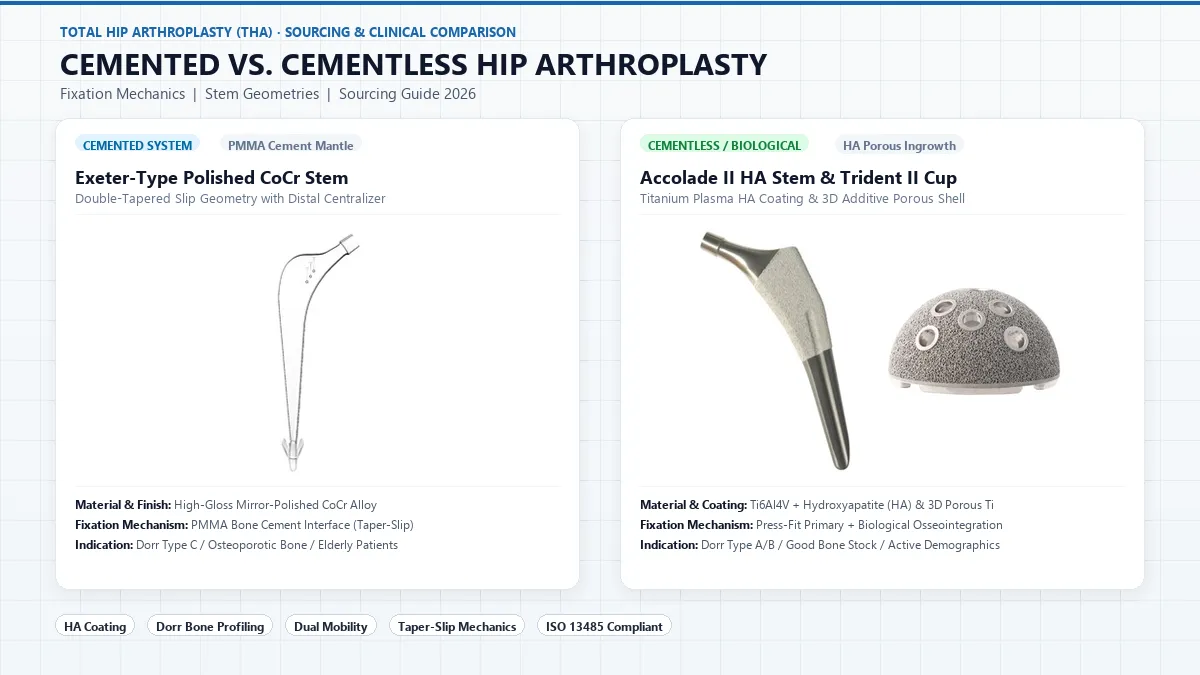
In a cemented hip replacement, bone cement is used to fix one or more implant components to prepared bone. In a cementless hip replacement, selected components are designed for initial mechanical fixation without cement, followed by potential bone ongrowth or ingrowth. A common hybrid total hip construct combines a cemented femoral stem with a cementless acetabular cup. The best configuration depends on the patient's condition, indication, anatomy, implant design and the treating surgeon's assessment; no method guarantees lifelong fixation. For distributors, the comparison should include compatible stem and cup sizes, bearing options, instruments, cement-related supplies where applicable, product registration and training. The fixation of the femoral and acetabular components should always be specified separately.
2. Cemented vs Cementless vs Hybrid Hip Replacement: Comparison Table
Total hip replacement generally involves a femoral stem and head on the thighbone side, and an acetabular cup or shell and bearing surface on the socket side. The actual components vary by system. The term “cemented” must be tied to the component being discussed, because not every total hip uses the same fixation method on both sides. The FDA describes hip implant components and general risks in its hip implant overview.
| Purchasing consideration | Cemented construct | Cementless construct | Hybrid construct |
|---|---|---|---|
| Basic definition | Bone cement fixes the specified implant component or components | The specified components are intended for fixation without cement | The two sides use different fixation methods |
| Femoral component | Cemented stem in the selected cemented configuration | Stem designed for initial fixation without cement | A common hybrid configuration uses a cemented stem |
| Acetabular component | A cemented cup may be used in a fully cemented construct | A cementless shell is designed for fixation without cement | A common hybrid configuration uses a cementless shell |
| Initial stability | Depends on the cemented construct and technique | Depends on implant geometry, bone and preparation | Femoral and acetabular sides have different fixation requirements |
| Later fixation | Depends on continued integrity of bone, cement and implant interfaces | Bone interaction with the implant surface is intended; fixation is not guaranteed | Consider each side, its evidence and risks separately |
| Purchasing implications | Include the implant-specific instrument set and required cement-related supplies | Check stem and shell size range, surface, trials and insertion instruments | Plan for cemented-stem supplies and cementless-cup instruments as applicable |
| Product verification | Confirm exact indications and compatible cement and accessories | Confirm exact fixation surface and compatible bearing components | Verify that the proposed combination is authorized for the applicable market and use |
| Recovery and revision | Depend on the patient, procedure and implant | Depend on the patient, procedure and implant | Depend on the configuration and clinical circumstances |
Scroll horizontally to view all columns on smaller screens.
The hybrid example is common, not a universal rule. Other combinations exist. A quote or purchase order should identify the fixation method for each side and should not assume that every combination of independently available components is approved. NHS patient information describes the common combination of a cemented stem with an uncemented socket in its total hip replacement guide.
3. How Are Hip Implants Fixed to Bone?
3.1 Femoral Fixation
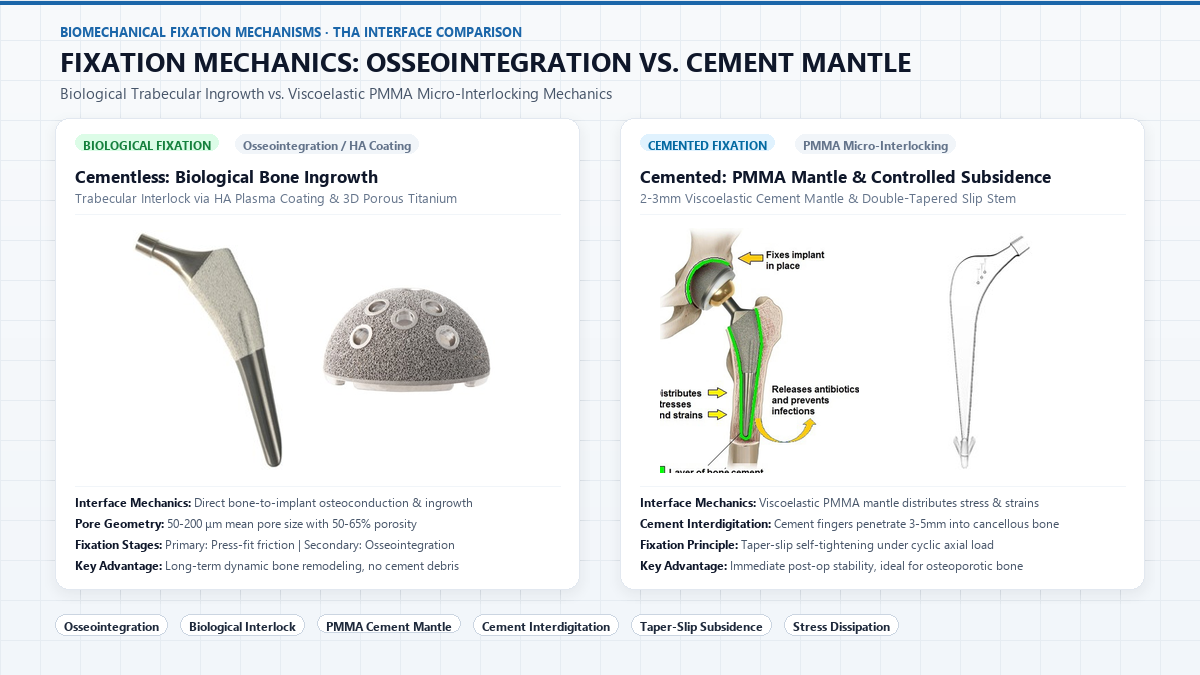
The femoral stem sits in the upper part of the femur and supports the femoral head. In a cemented system, bone cement forms an interface between the prepared bone and the implant. Specific stem designs differ: some polished tapered stems are designed to behave differently under load than other cemented stems. Do not transfer the handling instructions, expected movement or accessory requirements of one stem to another.
A cementless stem is designed to achieve initial mechanical stability without cement. Its geometry, surface, prepared bone and insertion conditions affect that stability. Some designs use porous or coated surfaces intended to support bone interaction. Initial fixation does not ensure successful long-term fixation, and neither a coating name nor a marketing description substitutes for the relevant design evidence.
3.2 Acetabular Fixation
The acetabular component is on the socket side. A cemented cup and a cementless shell have different fixation approaches and may have different bearing, trial and instrument configurations. A cementless shell may be used with a liner and, where specified for the product, supplemental fixation components. Whether accessories are necessary, optional or unavailable must be established from the specific system IFU and catalog.
Purchasing should therefore record two answers: how is the femoral component fixed, and how is the acetabular component fixed? A femoral stem's fixation method does not by itself identify the cup, bearing material or instrument tray.
3.3 Initial Stability Is Not the Same as a Lifetime Guarantee
All hip implants can encounter complications. The FDA lists risks including loosening, dislocation, fracture, infection and wear-related issues in its general hip implant information. Device design, patient factors, surgery and follow-up all matter. A specification for a coating or geometry should be considered alongside its test method, acceptable range and clinical evidence rather than treated as proof of permanent fixation.
4. Cemented Hip Implants: Components and Sourcing
4.1 What Should Be Included in a Cemented-Stem Quote?
A useful supplier quotation identifies the femoral stem design and sizes, compatible femoral heads, trials, broaches and insertion instruments. It also states which cement-related products are supplied, which are sourced separately and which are required or optional according to the device labeling. Where a particular system uses a cement restrictor, centralizer or cement preparation and delivery accessories, the quote should identify their exact references and compatibility.
The stem finish and geometry are design-specific. A polished tapered stem and a different cemented stem design should not be assumed to have the same surface finish, cement interface behavior or accessories. The relevant IFU and supplier's compatibility matrix govern the proposed configuration.
XC Medico has a cemented total hip product page. Buyers should request its current catalog, item-level details and market-specific documentation before treating a particular material, finish or accessory as included.
4.2 Risks and Clinical Context
Cemented fixation may be considered for specific patients and indications, but it is not a universal rule based solely on age. For displaced intracapsular hip fracture, the NICE hip fracture guideline recommends cemented implants in patients undergoing arthroplasty. That recommendation sits within a fracture guideline; it should not be presented as a blanket directive for every elective total hip replacement.
The surgical and anesthesia team also considers bone cement implantation syndrome (BCIS), which can involve low oxygen levels, low blood pressure and cardiac complications around cementation. Hospital protocols and the relevant clinical team govern assessment and management. See NHS England's BCIS safety case study.
For a distributor, the practical task is to supply the intended, authorized system and accurate product information. A catalog cannot replace the treating team's decision or establish that a patient will avoid a particular complication.
5. Cementless Hip Implants: Components and Sourcing
5.1 What Should Buyers Verify?
For a cementless hip stem, request the complete size chart, stem geometry, surface or coating description, required trials and the corresponding broach set. Check offset and neck options where the proposed system provides them. Confirm whether the published list refers to the actual implant, a trial or an instrument, and ask how revisions to a tray are controlled.
For a cementless acetabular shell, document shell sizes, compatible liners, bearing and head options, and any authorized supplemental fixation accessories. A shell's diameter alone does not establish compatibility with a liner or femoral head. Check the manufacturer's matrix by catalog number and destination market.
XC Medico publishes a cementless total hip product page and a cementless total hip system category. The page titles establish the product categories, not the full bill of materials for every proposed order. Verify coatings, fixation surfaces, bearing options and available sizes against current product documents.
5.2 Press-Fit and Coatings Are Not Universal Specifications
Initial fixation depends on the individual implant and the prepared bone. A proposed interference distance, minimum coating bond strength, pore size or micromotion limit cannot be used as a universal acceptance value for every stem. Buyers should ask for the actual product specification, test setup, acceptance criteria and evidence relevant to that model.
Similarly, the phrase “porous titanium and HA” describes a possible material and coating strategy, not every cementless device. Confirm the substrate, surface treatment, coating identity, location, thickness specification where applicable, and how the finished device is verified. If a performance figure is provided, request the relevant report and avoid comparing figures generated under different test methods as if they were equivalent.
6. How Do Bone Quality and Dorr Classification Affect Hip Implant Planning?
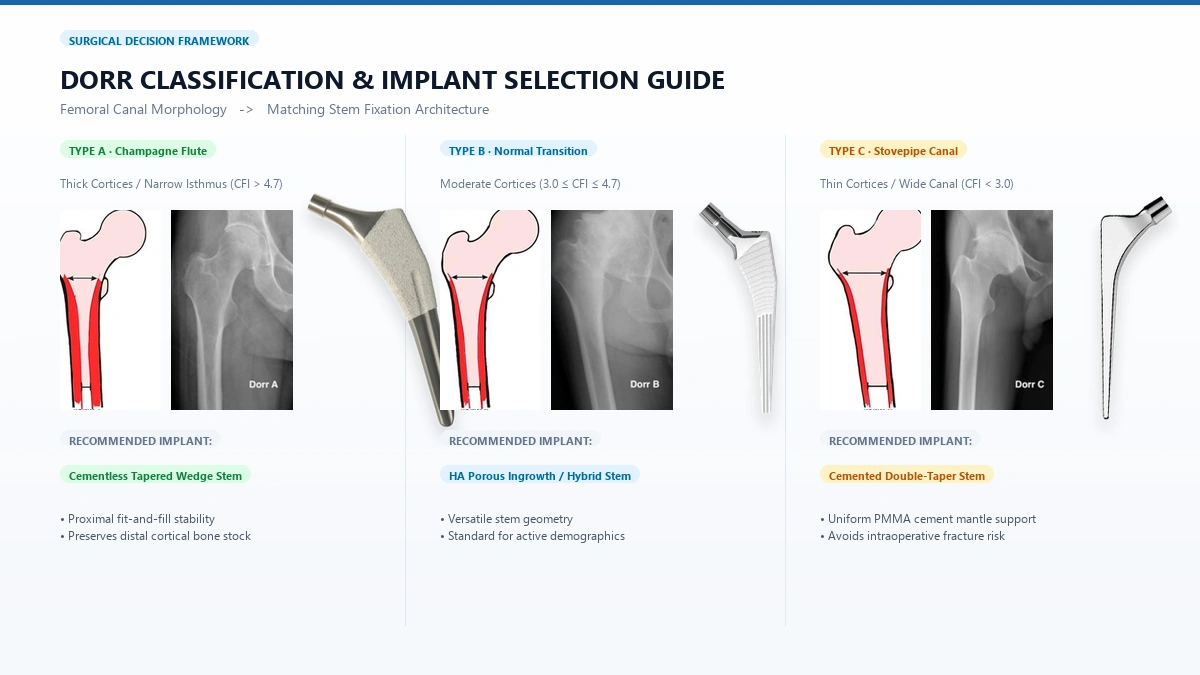
Patient bone anatomy and quality matter because the implant must obtain suitable support and fixation. Clinicians may use radiographs, bone morphology, prior surgery, fracture pattern, age and other factors as part of a broader assessment. Dorr classification describes patterns of proximal femoral morphology; it can help frame a discussion but does not prescribe a particular stem for every patient.
For procurement planning, the appropriate question is not “Which implant does every Dorr type require?” It is “Does the hospital have documented access to the sizes, designs, instruments and clinical support needed for the patient population it treats?” A surgeon's selection may also be affected by the planned procedure, local practice, availability, bone condition and the implant IFU.
Evidence must be read in context. Registry studies can identify associations for defined populations, while individual studies may use different inclusion criteria and endpoints. The American Joint Replacement Registry publications provide a starting point for evaluating fixation and revision data; their findings should not be reduced to a universal guarantee for a single patient.
Elective THA, Fracture Arthroplasty and Revision Are Different Procurement Problems
An elective primary THA order, a fracture arthroplasty order and a revision hip case may require different implants, inventory and support. Hemiarthroplasty is also distinct from a total hip construct because the acetabular side is not replaced in the same way. Do not interpret evidence about hemiarthroplasty for fracture as automatically proving outcomes for elective primary THA.
For complex replacements, suppliers may offer separate cementless revision hip systems. The presence of a revision category does not establish compatibility with a particular primary system. Obtain a project-specific catalog and component compatibility statement.
7. Femoral Stem Designs and Surface Coatings: What Should Distributors Compare?
Stem geometry influences how a particular system is intended to fit and transmit load. Common descriptive terms include tapered wedge, fit-and-fill and anatomic stems, but manufacturers do not always use these terms in exactly the same way. They are not a clinical ranking or a promise that one stem preserves the most bone, prevents thigh pain or eliminates subsidence.
| Design or surface question | Evidence to request |
|---|---|
| Stem family and fixation | Exact product name, intended fixation and current IFU |
| Geometry and range | Drawings or catalog dimensions, size range, offset and side options where applicable |
| Collar | Whether a collar is part of the model and what its intended function is |
| Base material | Material specification and traceability for the selected SKU |
| Porous surface or coating | Material, location, process, applicable specifications and quality controls |
| Surface and coating testing | Test method, acceptance limits and applicable validation or verification reports |
| Instrument interface | Matching broach, rasp, trial and insertion tools for each stem generation |
| Head connection | Explicit head/stem compatibility, taper identification and any manufacturer restrictions |
Scroll horizontally to view all columns on smaller screens.
A collar may be designed to influence seating and load transfer, but the presence of a collar alone does not establish a universal clinical benefit. Similarly, a hydroxyapatite coating is one possible surface feature; its presence, coverage and specifications should be confirmed by the supplier for the exact product. Commercial statements such as “premium surface” or “standard alloy” are insufficient substitutes for controlled documentation.
8. Where Do Dual Mobility Cups Fit in a Hip Implant Portfolio?
Dual mobility describes a bearing arrangement on the acetabular side. A typical construct has a femoral head retained within a mobile polyethylene component that articulates within an outer shell. Component configuration and permitted combinations depend on the individual system. A dual mobility design is not itself a third alternative to cemented and cementless fixation: it answers a different product-design question.
Some clinical evidence associates dual mobility constructs with lower dislocation risk in selected patient populations; this does not mean zero risk or prove an identical benefit for every implant and every patient. A published study also describes intraprosthetic dissociation as a complication requiring attention. See research on modern dual mobility intraprosthetic dissociation.
From a distributor's perspective, identify the outer shell, mobile bearing, femoral head, any additional modular component and the system's permitted fixation method. Request the current compatibility chart, authorized indications, size matrix, package configuration and instruments. A dual mobility insert cannot be assumed to fit an ordinary shell, and a femoral head from a different system cannot be substituted on appearance alone.
When the clinical project calls for dual mobility, request an itemized, system-specific proposal. Do not advertise a universal dislocation rate, jump-distance percentage or range-of-motion threshold without evidence for the specific design and relevant patient population.
9. Hip Implant Compatibility and Instrument Checklist
The purchasing unit should be a documented construct and its supporting instruments, not a collection of independently selected part names. The following checklist translates a clinical system choice into a distributor's order and document review.
| Component or requirement | What the distributor should verify |
|---|---|
| Femoral stem | Fixation, product family, dimensions, sizes, geometry, offset and material |
| Stem surface | Finish, coating or porous surface by SKU; supporting manufacturing specification |
| Femoral head | Diameter, material, neck-length option, taper and permitted stem pairing |
| Acetabular cup or shell | Fixation, diameter, surface, availability of holes or accessories where applicable |
| Liner or bearing | Material, size, shell locking interface and compatible head diameters |
| Dual mobility | Outer shell, mobile component, head and any other permitted component combination |
| Cemented-stem accessories | Cement, restrictor, centralizer and delivery supplies where the system requires or permits them |
| Stem preparation instruments | Matching broaches, rasps, handles, trials and inserters for the exact implant generation |
| Acetabular instruments | Reamers, trials and impactors that correspond to the selected cup and sizes |
| Revision support | Removal instruments and the hospital's revision plan; no assumed cross-system compatibility |
| Sterile status | Labeling for each implant, disposable accessory and reusable instrument |
| Traceability | Catalog number, lot or serial number, UDI where applicable, expiry and complaint route |
Scroll horizontally to view all columns on smaller screens.
For a new hospital account, compare the supplier's instrument manifest with the sizes and configurations on the proposed formulary. If the hospital plans both cemented and cementless stems, determine whether each needs its own broaches, trials and insertion tools. Equipment that looks similar or has a similar size label may still be incompatible.
Planning Inventory and Replenishment
No single size range or minimum number of sets is correct for every market. Build an opening inventory from the hospital's planned case mix, approved systems, surgical preferences, demand forecast and lead time. Confirm what happens when an uncommon size is needed urgently and which party carries the cost of emergency delivery.
Separate consignment stock, purchased inventory and loaned instruments in the agreement. Record instrument inspection, missing-part replacement, decontamination responsibilities and shelf-life controls for sterile implants. A low quoted stem price can be misleading if the corresponding head, cup, cement accessories, instruments and local case support are excluded.
10. How to Evaluate a Hip Implant Supplier
10.1 Product Identity and Market Access
First identify the legal manufacturer, brand, product name, model and exact implant configuration. Match the proposed SKU, intended use, material, labeling and IFU to the destination market's applicable registration or authorization. A regulatory record for one component or system does not automatically cover every product in a company's catalog.
ISO 13485 concerns medical-device quality management; it is not product marketing authorization. FDA establishment registration and device listing do not themselves mean a device is cleared or approved. The FDA explanation of registration and authorization distinguishes these concepts. Where applicable, verify the exact 510(k) clearance or other relevant pathway. For CE-marked products, check the declaration, applicable certificate and its scope against the device and legal manufacturer.
10.2 Material, Mechanical and Packaging Evidence
Ask for material declarations for the exact stem, head, shell and bearing, not a generic company-wide material list. Where available and appropriate, review summaries of mechanical, wear, coating, interface or other verification tests. Compare results only when the tested design, size, method, loading conditions and acceptance criteria are clear.
For sterile devices, request applicable information on the sterile barrier, validated sterilization process, shelf life and transport packaging. For reusable instruments, obtain cleaning, inspection and sterilization instructions. A sterilization container is not automatically a sterile implant package, and a corporate quality certificate does not replace product-level validation.
10.3 Twelve Documents to Request
| Document or confirmation | Why it matters |
|---|---|
| Legal manufacturer and production-site identification | Assigns responsibility for the device and relevant manufacturing activity |
| Current quality management certificate and scope | Helps assess the management system and covered activities |
| Product registration or clearance documentation | Links the actual device and intended use to the destination market |
| Controlled product catalog | Identifies product families, implant references and options |
| SKU and size matrix | Supports inventory and case planning |
| Implant compatibility matrix | Documents permitted stem, head, shell, liner and accessory combinations |
| Material and coating specifications | Identifies the selected component's substrate and surface |
| Relevant mechanical or performance evidence | Supports the stated design and verification requirements |
| Sterilization and packaging information | Clarifies the applicable validated sterile configuration |
| Shelf-life and storage information | Supports stock rotation and labeling checks |
| IFU, labels and instrument processing instructions | Describes authorized use, warnings and reprocessing requirements |
| Change-control and complaint procedures | Defines notification, traceability and field-action responsibilities |
Scroll horizontally to view all columns on smaller screens.
10.4 Compare the Complete Cost of Supply
Ask suppliers to separate implant prices, cement and accessories, reusable instruments, loan-set fees, training, service, shipping, duties and replacement terms. Establish which components are supplied sterile and which are processed by the hospital. Review supply continuity, minimum order, consignment returns and the treatment of expiring stock in writing.
Published list prices, reimbursement levels and statements about one country are not reliable evidence of another distributor's purchase price or margin. For a fair comparison, the product configuration and support terms must be comparable.
11. XC Medico Hip Portfolio and OEM/ODM Support
XC Medico's website lists cemented and cementless hip-related products and a broader hip and knee joint system portfolio. Buyers can begin with the published product pages and request the current catalog, size tables, instrument lists and authorization documents for the intended destination market. Product titles alone do not confirm that a particular femoral head material, dual mobility cup, coating or fixation accessory is supplied in a specific order.
For an OEM/ODM inquiry, define whether the project concerns an existing authorized product, custom instrumentation, production to customer specifications or development of a new implant system. XC Medico describes engineering and manufacturing services on its OEM/ODM service page. A project-specific feasibility review should identify the required drawings, material and finish specifications, process capabilities, verification work, legal manufacturer and documentation responsibilities.
Before describing a project as a turnkey hip system, request written confirmation of the exact scope: implant and instrument SKUs, approved component combinations, sterile status, labeling, supporting evidence and applicable market authorization. Minimum order quantities, samples, lead times, instrument loans and private-label terms should be confirmed in the commercial offer rather than inferred from a general service description.
12. Frequently Asked Questions About Hip Replacement Fixation
What is the main difference between cemented and cementless hip replacement?
Cemented fixation uses bone cement to secure the specified implant component to prepared bone. Cementless fixation uses components designed for initial mechanical fixation without cement and subsequent potential bone interaction. A total hip can also use a hybrid configuration, so the femoral and acetabular sides should be identified separately.
Is cemented or cementless hip replacement better for older patients?
There is no universal answer based on age alone. Bone quality, diagnosis, fracture status, overall health, implant design and clinical judgment all matter. Guidelines and studies apply to defined patient populations; a recommendation for fracture arthroplasty should not automatically be applied to every elective total hip replacement.
What is a hybrid total hip replacement?
A common hybrid total hip configuration combines a cemented femoral stem with a cementless acetabular component. Other fixation combinations may exist. The proposed construct, component compatibility and regional indications must be verified against the manufacturer's documentation.
Is recovery faster with cemented or cementless fixation?
Recovery and weight-bearing instructions depend on the individual patient, diagnosis, procedure, implant and treating team's plan. Fixation method alone does not guarantee a specific recovery time. Buyers should avoid making universal recovery claims when presenting a product.
Does a dual mobility cup prevent all hip dislocations?
No. Dual mobility designs can be considered in selected situations to address stability, but dislocation and other complications remain possible. The specific system's components, indications, fixation and compatibility must be checked, and a universal numerical outcome should not be promised.
Can the same broaches be used for cemented and cementless hip stems?
Not automatically. Broaches, trials and other instruments are designed for specified implant systems and generations. A distributor or hospital should use the instrument list and compatibility information supplied for the actual stem rather than assume interchangeability based on appearance or size.
What documents should a distributor request from a hip implant supplier?
Request the legal manufacturer details, relevant quality-system certificate, product registration or clearance, catalog and size list, implant compatibility matrix, material specifications, relevant performance evidence, sterilization and shelf-life information, IFU, labels, instrument processing instructions and complaint procedures. Match every document to the proposed product and destination market.
13. Next Steps for Hip Implant Procurement
Start with the hospital's intended clinical use and the selected fixation strategy for each side. Then prepare an itemized request covering stem and cup sizes, compatible heads and bearings, instrument manifests, any cement-related accessories, destination-market documentation and supply terms. For mixed or hybrid configurations, ask the supplier to confirm the complete combination in writing.
To discuss XC Medico's hip portfolio or an OEM/ODM project, provide the target country, intended use, product references, expected volumes, required instruments and the documents needed for evaluation. Requesting a catalog or sample starts a feasibility and availability review; it does not establish that a specific product is authorized for clinical use in the destination market.
Request the Hip Implant Catalog and Compatibility Information
Sources and Update Notes
Last reviewed: November 5, 2026. This article uses publicly available FDA, NHS, NICE, AAOS and peer-reviewed references linked near the relevant statements, together with XC Medico's published product and service pages. Clinical recommendations, device catalogs, labeling and regulatory status can change. A historic record or general product category is not evidence that every configuration is currently available or authorized in every market.
The article is intended as a commercial and educational overview, not surgical instruction or patient-specific treatment advice. The treating team, product IFU and applicable local regulatory requirements take precedence. XC Medico is the publisher and a potential supplier; any specific product claim, availability or OEM commitment requires verification against current documents and a written quotation.

