![What Are the Main Types of Orthopedic Implants and Their Applications]()
You might see orthopedic implants used to fix broken bones or replace joints. The main types of orthopedic implants are screws, plates, nails, prostheses, wires, and rods. Screws help keep pieces of bone together, while plates—such as buttress or compression plates—make broken bones steady. Prostheses, a type of orthopedic implant, help restore movement in joints like knees and hips. Orthopedic implants play a crucial role in treating many conditions, including fractures, osteoarthritis, and rheumatoid arthritis. These issues impact millions of people worldwide.
Key Takeaways
Orthopedic implants, such as screws and plates, help fix broken bones. They also replace joints that are damaged. These implants help people heal and move better.
Picking the right implant depends on things like age and activity level. It also depends on what kind of injury you have. This helps people heal better.
Good implants from trusted companies, like XC Medico, make things safer. They also work better and help people get better faster.
There are different implants for different jobs. Prostheses are used to replace joints. Screws are used to keep broken bones in place.
Knowing what materials are in implants, like metal alloys and polymers, is important. This helps make sure they are safe and strong for your body.
What Are Orthopedic Implants
![What Are Orthopedic Implants]()
Definition
Orthopedic implants are special devices doctors put in your body. They do this during surgery. You might need one if you break a bone. You might also need one if you have a joint problem. Doctors use strong things like metal, ceramic, or plastic to make them. These materials can handle the pressure inside your body. Orthopedic implants can take the place of a damaged bone or joint. They can also help hold broken bones together. Sometimes, they fix bones that are shaped wrong. They can also make joints more steady. These devices help your body heal and move better.
Purpose and Benefits
Orthopedic implants can help you in many ways. They help you get better after an injury. They also make your life easier. Here are some main reasons people get them:
Replace damaged parts: If your hip or knee is worn out, an implant can take its place. This helps you move again.
Support healing: If you break a bone, implants like screws or plates hold it together. This helps the bone heal straight and strong.
Correct deformities: Some implants fix bones that did not grow right.
Stabilize joints: Implants can make weak joints stronger and safer.
Note: Orthopedic implants help you get back to your normal life. They lower pain and help you move better.
Doctors pick the right implant for each person. They think about your age, how active you are, and your injury. Good implants from trusted companies work better and are safer. Modern orthopedic implants are tested carefully and meet strict rules before doctors use them.
Types of Orthopedic Implants
Orthopedic implants come in many shapes and sizes. Doctors use different implants for different injuries. Each type has its own job. Let’s see the main types and how they help you heal.
Screws
Doctors use screws in almost every orthopedic surgery. Screws hold pieces of bone together. There are different screws, like cortical, cancellous, and lag screws. Cancellous screws work best in soft bone. Cortical screws fit in hard bone. Lag screws press broken bone pieces together. This helps the bone heal straight and strong.
The length of a screw is important. If a screw is too short, it will not hold the bone well. If it is too long, it can poke out and hurt tendons or nerves. In hand surgery, the wrong screw size can cause finger stiffness or tendon injury. You need the right screw for the right job.
Tip: Always check the screw length during surgery. This helps avoid problems and helps the bone heal better.
XC Medico has many small and large fragment implants, including advanced screws. These screws are made with strong materials and careful designs. You can trust them for strong support and fewer problems. Bulk buyers get a steady supply, ISO 13485 and CE certification, and fast delivery.
Evidence Description | Findings |
Advances in Fracture Fixation | Patients using new fixation methods healed faster, especially for diaphyseal fractures. |
Impact of Implant Types | Different implant types, like intramedullary nailing, helped bones heal faster. |
Patient-Specific Factors | Things like vitamin D and diabetes changed how well people got better. |
Plates
Plates act like splints inside your body. Doctors use plates to bridge broken bones and keep them steady. There are different plates, like locking, non-locking, and polyaxial locking plates. Locking plates have special holes that hold screws at set angles. This gives extra strength, especially in weak bone. Non-locking plates use friction to hold the bone. This works well for simple breaks.
XC Medico’s Ultimate Trauma Implants and Instruments have both small and large fragment implants. The new polyaxial locking plate lets doctors change the screw angle up to ±15°. This helps doctors pick the best path for each screw. It makes surgery safer and more exact.
Some studies show two small plates at different angles can be stronger than one big plate. Stainless steel plates are very stiff. Titanium plates can bend more before breaking. After many uses, titanium plates still work well. This is good for active people.
Note: Picking the right plate can lower the risk of problems after surgery.
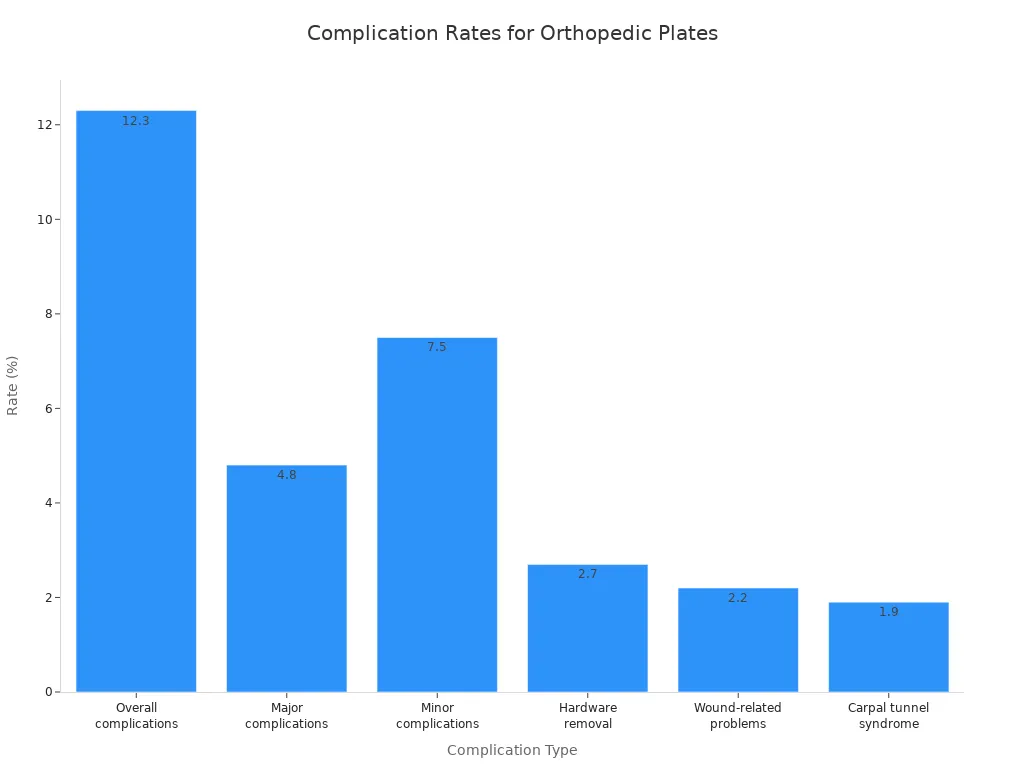
Complication Type | Rate (%) |
Overall complications | 12.3 |
Major complications | 4.8 |
Minor complications | 7.5 |
Hardware removal | 2.7 |
Wound-related problems | 2.2 |
Carpal tunnel syndrome | 1.9 |
Nails and Rods
Nails and rods go inside the bone to keep it straight. Intramedullary nails fit inside the hollow part of long bones. These bones include the femur or tibia. Some nails are simple. Others have locking screws for extra strength. Interlocking nails stop the bone from twisting or getting shorter. Doctors use these nails for both simple and hard fractures.
XC Medico’s intramedullary nails are part of their large fragment implants. These nails give strong support and let you move sooner. Some new nails can expand inside the bone. This means doctors do not need extra screws. Some nails have special coatings to fight infection and help the bone heal faster.
Feature | Intramedullary Nail | Interlocking Nail |
Fixation | Inside the medullary canal, no screws | Inside the medullary canal, with locking screws |
Rotational Stability | Limited | High (prevents rotation) |
Axial Stability | Moderate | High (prevents shortening) |
Indications | Simple fractures | Complex, comminuted, or unstable fractures |
Weight Bearing | May allow early weight-bearing | More controlled weight-bearing |
Surgical Complexity | Easier | More challenging due to locking screws |
Tip: Intramedullary nails and rods help you heal faster. They help you get back on your feet sooner.
Prostheses
![Prostheses]()
Prostheses replace joints or missing bones. You may need a hip prosthesis if your hip is badly damaged. Prostheses can also replace knees, shoulders, or fingers. Most prostheses last between 3 and 7 years. This depends on how much you use them and how well you care for them.
Type of Prosthetic | Average Lifespan |
Lower-limb Prosthetics | 3 to 5 years |
Upper-limb Prosthetics | 4 to 7 years |
Myoelectric Prosthetics | 3 to 5 years |
Most people feel happy with their new joints. About 94% of patients are satisfied with their surgery. Older patients are even more satisfied.
Lifespan is usually 3 to 5 years.
It depends on how active you are, how you care for it, and changes in your body.
Note: Prostheses help you move better and live with less pain.
Wires and Pins
Wires and pins are thin metal pieces that hold small bones in place. Doctors use them for finger fractures, children’s injuries, or to keep bones steady during surgery. Wires are easy to put in and take out. Pins are stronger and can hold bigger bones.
Aspect | Intramedullary Nails | Wires | Pins |
Main Use | Stabilization of long bone fractures | Small bone fractures, temporary fixation | Skeletal traction, large bone fixation |
Advantages | Load-sharing, strong fixation | Minimally invasive, versatile | Stronger fixation, used in traction |
Disadvantages | Risk of fat embolism, infection | Migration, less stable in large bones | Pin tract infections, soft tissue damage |
Wires and pins are very helpful for children. But doctors watch for small problems like pin-site inflammation. This happens in about 32% of cases. Most problems are mild and easy to treat.
XC Medico has a full set of trauma tools, including wires, pins, drills, and screwdrivers. You get everything you need for surgery. Bulk buyers get low order amounts, free samples, and fast shipping.
Tip: Wires and pins are simple but strong tools. They help fix small bones and help children heal.
You can see that each type of orthopedic implant has a special job. XC Medico’s Ultimate Trauma Implants and Instruments cover all these needs. You get certified quality, new designs, fast delivery, and expert help for your practice or business.
Applications of Orthopedic Implants
Orthopedic implants help you heal after injuries. They also help you move better if you have joint problems. Doctors use them in many ways. The most common uses are fixing broken bones, replacing joints, and making your spine stable.
Fracture Fixation
You need strong support when you break a bone. Doctors use special devices to hold the bone pieces together. Plates, screws, and nails keep the bone steady. This helps the bone heal the right way. You might get a plate or nail inside your bone. These tools help you walk or move sooner.
Here is a table that shows how different implants work for fixing broken bones:
Implant Type | Effectiveness | Complications | Notes |
InterTAN Nail (ITN) | Reduces non-mechanical major complications | Higher risk of intraoperative issues | Effective but risky |
Proximal Femoral Nail (PFNA) | Varying effectiveness | Moderate complications | No superior overall effectiveness |
Percutaneous Compression Plate | Reduces minor complications | Limited evidence on major outcomes | Minimal soft tissue trauma |
Gamma Nail | Reduces overall complications | Older design | Effective in certain cases |
Sliding Hip Screw (SHS) | Comparable to other implants | No significant differences | Commonly used |
Most implants are used for trauma, sports injuries, and small joint repairs. These make up about 60% of the world’s need for these devices.
Joint Replacement
If your joint is worn out or hurt, you may need a new one. Doctors use artificial joints, like a hip prosthesis, to help you move again. This is called joint replacement. Most people feel less pain and move better after getting a new joint.
Here is a table that shows what each implant is used for:
Type of Orthopedic Implant | Common Clinical Applications |
Artificial Joint Implants | Replacement in arthritis, trauma, and degenerative diseases |
Fracture Fixation Devices | Stabilization of fractures and bone healing |
Spinal Implants | Correction of spinal deformities and stabilization of spine |
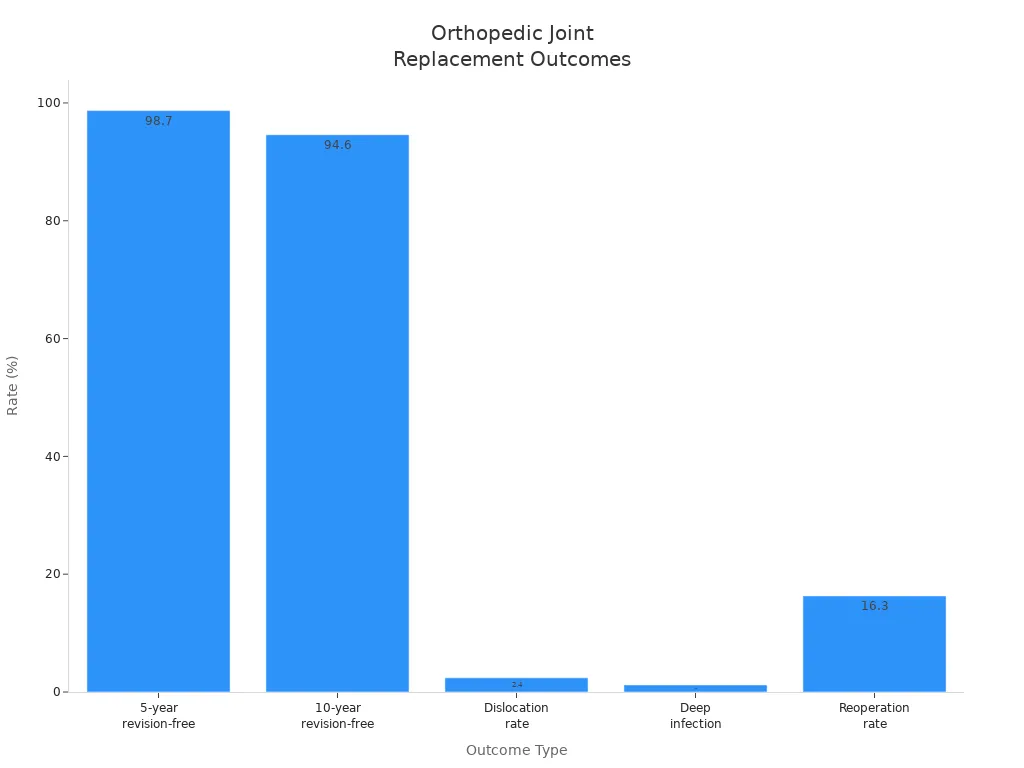
Joint replacement makes up about 38–39% of all orthopedic implants sold. Young people can keep good movement for up to 40 years after knee replacement. After 40 years, 77% of implants are still working. The five-year rate without more surgery is 98.7%. The ten-year rate is 94.6%. The main reason for another surgery is when the implant gets loose.
Spinal and Trauma Surgery
You may need spinal implants if your spine is curved or badly hurt. These devices help keep your spine straight and stable. Spinal implants are growing in use faster than other types. Doctors use rods, screws, and cages to support your back.
Some problems can happen, like infection (2%-10%), screws in the wrong place (42.8%), and broken implants (22%). Most problems do not happen often, but doctors check you carefully after surgery.
Tip: Good implants from trusted companies, like XC Medico, help lower problems and help you heal faster.
Materials in Orthopedic Implants
Orthopedic implants use different materials for different needs. The right material helps your body heal well. It also helps the implant last a long time. There are three main types of materials. These are metal alloys, ceramics, and polymers.
Metal Alloys
Most implants are made from metal alloys. These metals are very strong and last a long time. Doctors pick them because they can handle a lot of stress. They also do not rust easily. Here is a table that shows the most common metal alloys and their properties:
Alloy Type | Composition | Mechanical Properties | Biocompatibility |
CoCrMo | Cobalt, Chromium, Molybdenum, Tungsten, Carbon, Nickel | Exceptional corrosion and wear resistance, high strength, fatigue strength, Young’s modulus | Highly biocompatible, but can release toxic elements |
Titanium Alloys | Titanium with Aluminum, Vanadium, Niobium, Zirconium, Molybdenum | High strength, excellent corrosion resistance, limited fatigue and bending strength | Non-toxic, excellent biocompatibility and osseointegration |
Stainless Steel | Iron with Chromium, Nickel, Molybdenum, Manganese, Silicon, Copper, Carbon | Good mechanical properties, reasonable biocompatibility, risk of nickel ion release | Acceptable biocompatibility; improved versions have less nickel |
These metals are safe for your body. They are also strong and help you heal.
Ceramics
Ceramics make implants smooth and hard. You find ceramics in joint replacements and some prosthetic implants. Ceramics do not wear out fast. They also do not react with your body. Here are some facts about ceramics:
Alumina and zirconia are dense ceramics used in joint replacements.
Ceramics can handle heat and strong chemicals.
They give a smooth and tough surface.
Note: Ceramics can break if you put too much force on them. They are not as easy to shape as metals.
Advantages | Disadvantages |
Tolerate high temperatures | Limited design flexibility |
Resist wear from chemicals | Can break easily (brittle) |
Provide smooth, wear-resistant surfaces | Strength and toughness can be issues |
Polymers
Polymers are plastics used in many implants. You see them in joint surfaces and parts that dissolve over time. Some polymers are strong. Others are flexible.
First generation polymers are acrylic resins, polyethylene, and polymethacrylate. These are safe, cheap, and stable.
Second generation polymers, like polyglycolide and polylactide, can dissolve in your body. Doctors use them to fix bones.
Synthetic biodegradable polymers are strong and stable. They help bones heal and are used in new medicine.
Tip: The right polymer helps your implant last longer and work better for you.
Modern implants use safe and tested materials. These materials help you heal and move better.
Choosing Orthopedic lmplants
Patient and Injury Factors
There are many things to think about before picking orthopedic lmplants. Your age, health, and how active you are matter a lot. Doctors also check your bone strength and the kind of injury you have. These things help doctors pick the best implant for you.
Bone strength and age can change how your body heals. If your bones are strong, you may get better faster. You might also have fewer problems. Older people or those with weak bones may need special implants. These help them heal better. The table below shows how these things affect your treatment:
Factor | Influence on Orthopedic Implant Choice |
Bone Quality | Good bone helps the implant stay in place and heal. Weak bone can make the implant fail more often. |
Patient Age | Older people have more risks and may need different surgery. |
Fixation Device Type | Some devices work better for certain ages or bone types, like using external fixation for older people. |
You should talk to your doctor about what you do every day. Tell them what you hope to do after you heal. The right orthopedic lmplants can help you get back to normal life faster. They can also make your treatment work better.
Product Quality and Manufacturer
When you pick orthopedic lmplants, you want safe and high-quality products. Good quality helps you heal well and stay healthy. Look for implants with these important certifications:
FDA (Food and Drug Administration): This means the product is safe and works well in the US.
CE Marking: This shows the product meets European safety rules.
ISO 13485 Certification: This means the company makes medical devices with good quality control.
You should also think about the company that makes the implants. XC Medico has over 20 years of experience making orthopedic lmplants. They offer ISO and CE certified products, fast shipping, small order sizes, and free samples. These things help hospitals and buyers get what they need quickly and easily.
Advantage | Description |
Tailor-Made Supply Chain | XC Medico can make custom products and packaging just for you. |
Quality Control | They use new technology and careful checks to make sure implants are safe and strong. |
Efficient Storage | Their warehouses keep products safe and ready to ship fast. |
Technical Support | You get expert help during your treatment and recovery. |
Tip: Pick a company with a good name, proven quality, and helpful service. This makes your treatment and healing easier and more reliable.
If you focus on these things, you can choose orthopedic lmplants that help you heal and give you the best results.
You now know about the main types of orthopedic implants. These include screws, plates, nails, prostheses, wires, and rods. Each one helps you heal or move better in its own way. When picking implants, think about how long they last and if they are safe for your body. You should also think about what your body needs to get better. Good implants from a trusted company like XC Medico help you heal faster. They also give you better results. For safe and strong implants, talk to your doctor. Choose XC Medico for your orthopedic implant needs.
FAQ
What are orthopedic implants used for?
Orthopedic implants help fix broken bones. They also replace joints or support weak bones. These devices help you heal faster. They make it easier to move after injuries or surgery.
How do I know which implant is right for me?
Your doctor looks at your age and how active you are. They also check what kind of injury you have. You should ask if the product is certified. Good implants from trusted companies, like XC Medico, work better.
Are orthopedic implants safe?
Yes, they are safe. Implants are made from strong materials like titanium or stainless steel. Some are made from medical-grade polymers. XC Medico products meet ISO and CE safety rules.
How long do orthopedic implants last?
Most implants last for many years. Some joint replacements can last more than 10 years. How long your implant lasts depends on your health and how active you are.
Can I order orthopedic implants in bulk from XC Medico?
Yes, you can order many implants at once. XC Medico lets you buy with a low minimum order. They ship fast and give free samples. They have over 20 years of experience making orthopedic implants.