


Published by XC Medico · Last reviewed: September 2026
Public-source review completed September 24, 2026.
Introduction
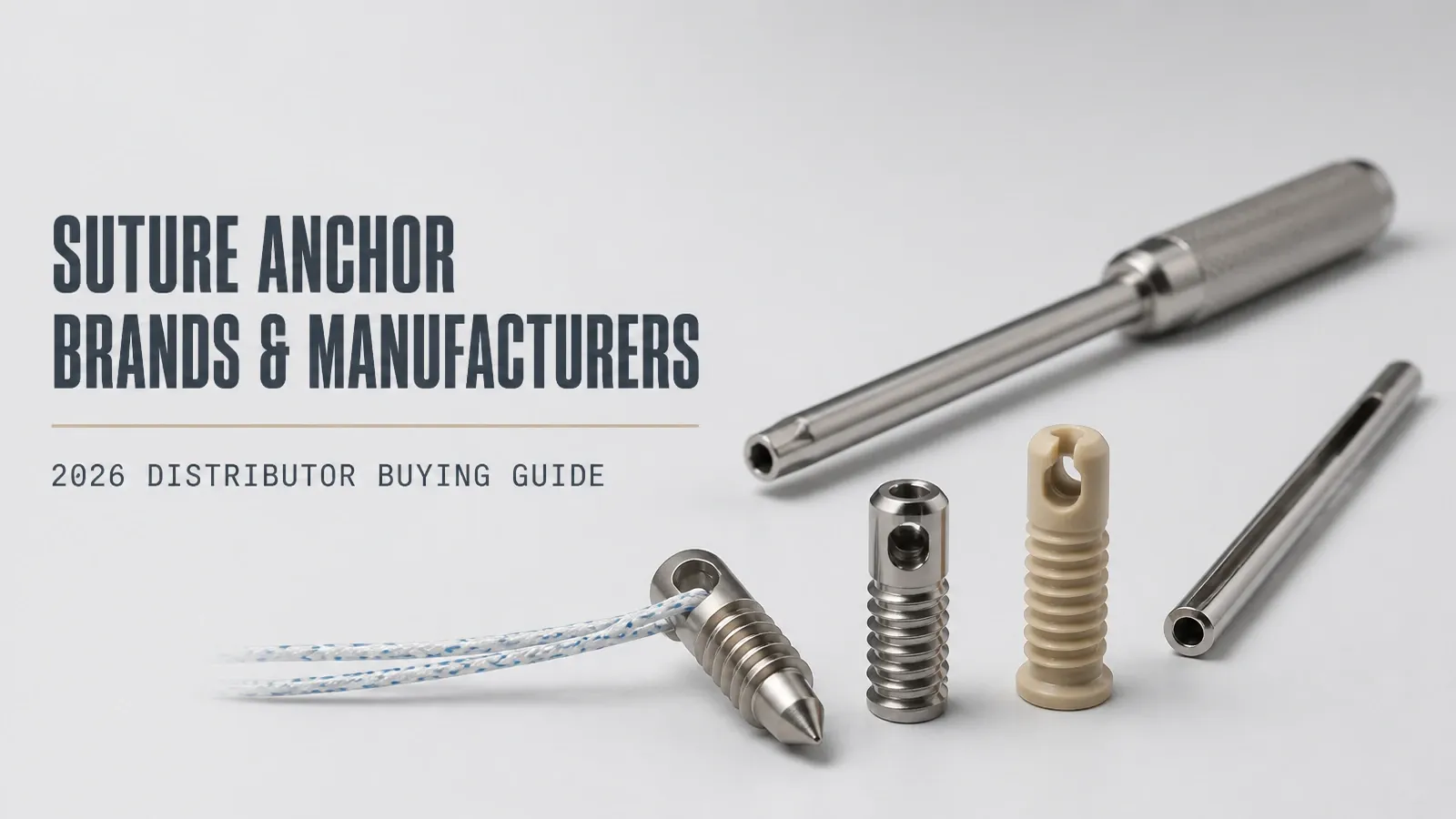
A useful comparison of suture anchor manufacturers begins with the product system behind each name. An anchor may be available in several diameters, materials, suture configurations and delivery formats, while its registration and instrument requirements vary by model and country. A familiar brand name alone does not establish whether a particular configuration belongs in your portfolio.
This Suture Anchor Hub connects brand research with practical procurement: which product families are publicly documented, how to compare anchor and suture specifications, and which evidence to request before distribution. It complements our broader sports medicine supplier guide and links to existing material and instrument resources where deeper background is useful.
The audience is distributors, sourcing teams and orthopedic businesses evaluating a suture anchor supplier. Clinical selection remains the responsibility of the treating professional using the applicable instructions for use.
Quick Answer
Which Suture Anchor Brands Should Buyers Compare?
Ten suture anchor brands and manufacturers worth comparing in 2026 are Arthrex, Smith+Nephew, DePuy Synthes/Mitek, Stryker, Zimmer Biomet, CONMED, Medacta, Sironix/Healthium Medtech, Siora Surgicals, and XC Medico. Their documented portfolios differ in solid-body and all-suture construction, knotless fixation, anchor dimensions, suture loading, and delivery instruments. Start with the exact product family and intended market rather than the company name alone. Confirm the current SKU, compatible suture or tape, matching instruments, and product-specific regulatory documentation before ordering. This guide is an editorial procurement shortlist, not a ranking of clinical outcomes or market share. XC Medico publishes the guide and is included as the tenth entry; its products receive the same verification requirements.
In This Guide
- How we researched this list
- Editorial disclosure
- Brand selection criteria
- Suture anchor brand comparison
- Ten brand and manufacturer profiles
- Portfolio structure and purchasing cost
- Anchor sizes and suture compatibility
- Single-row, double-row and suture-bridge systems
- Applications beyond the shoulder
- Pull-out strength and cyclic loading
- Regulatory identity and documentation
- Building a complete portfolio
- Evaluating a manufacturer
- 12-point supplier document checklist
- Questions distributors should ask
- Frequently asked questions
- Sources and update notes
- Editorial accuracy note
- Request product matching
How We Researched This List
We reviewed manufacturer product pages, official product literature, corporate announcements, selected FDA records, and regulatory guidance available during the September 2026 review. Product facts are connected to named families rather than inferred from general company descriptions. Each manufacturer profile includes the official sources used for its principal portfolio claims.
The comparison distinguishes three different questions: Does the product appear in official literature? What specifications are documented? Is the exact configuration authorized and available in the buyer’s market? Public evidence can answer the first two more readily than the third. We did not audit manufacturing facilities, obtain confidential technical files, or independently test products.
An older catalog or clearance can remain relevant, but its existence does not establish current stock, unchanged labeling or worldwide availability. Where a complete size matrix, compatibility statement or registration scope could not be established, the guide identifies the information buyers should request.
Editorial Disclosure
XC Medico publishes this article and sells orthopedic implants and instruments, including suture anchors. XC Medico is included as entry 10. This commercial interest should be considered when using the guide. The order reflects editorial and product-category relevance; it is not a ranking by revenue, market share, clinical performance, safety or independently measured product quality.
“Top 10” describes the scope of this shortlist, not an exhaustive market census. Product descriptions are based on public evidence, while distributor relevance and purchasing considerations are editorial assessments. Inclusion does not imply that a manufacturer endorses XC Medico or this article.
How We Selected These Suture Anchor Brands
Portfolio Breadth
We looked for identifiable suture anchor families with official supporting information. A manufacturer can be relevant with a focused portfolio; breadth alone is not a measure of clinical suitability.
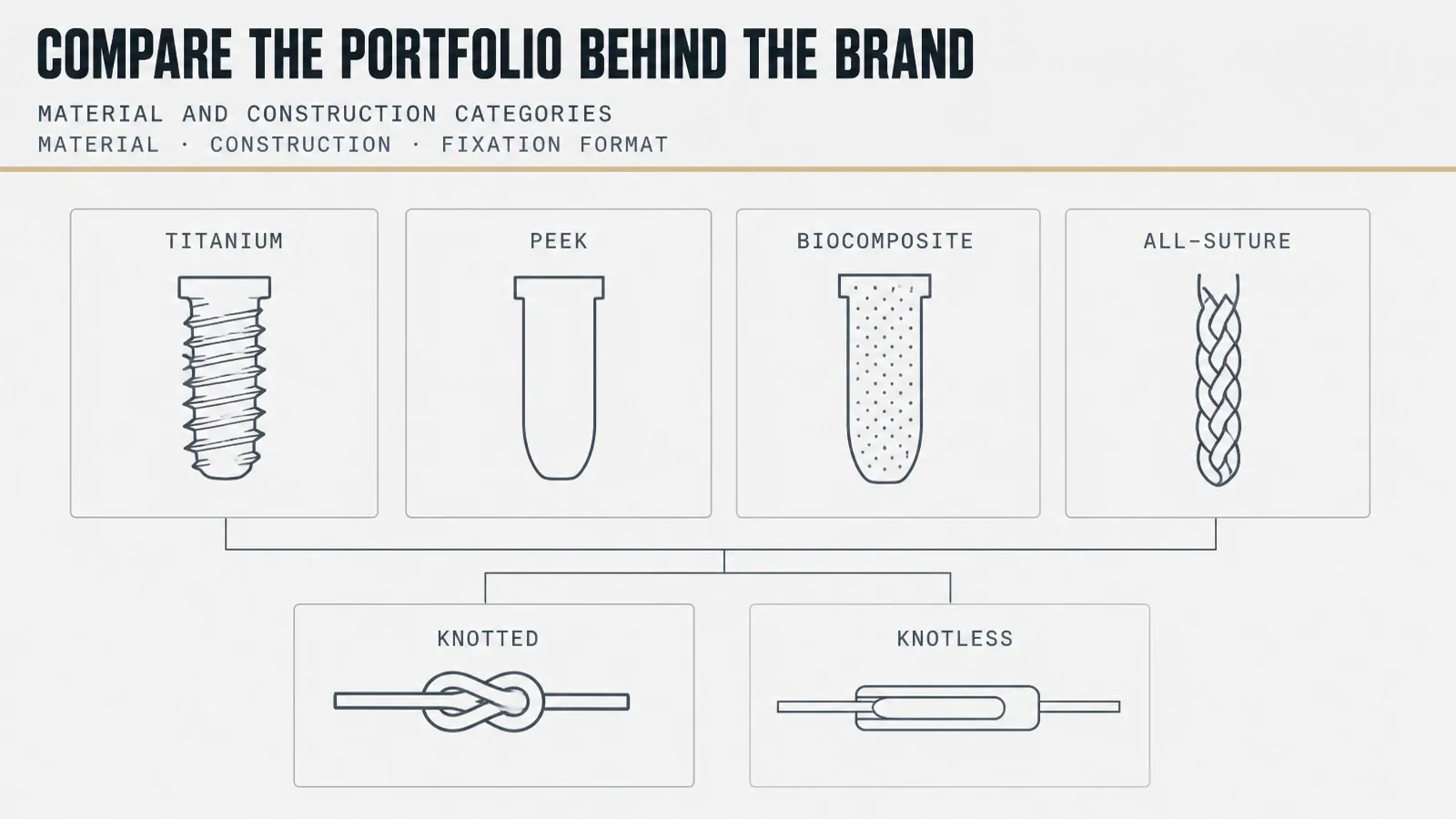
Materials and Anchor Construction
The comparison separates PEEK, titanium, biocomposite and textile anchor bodies. Mixed constructions, such as a PEEK body with a titanium tip, need their own specification.
Knotless / Knotted / All-Suture Coverage
These are overlapping attributes. All-suture describes construction; knotless describes fixation. Buyers should establish which combinations are actually offered.
Size Range and Suture Compatibility
Useful evidence includes model-specific diameter, length, loading, suture size, tape width and approved limb capacity. A broad “multiple sizes” claim is insufficient for ordering.
Instrument Compatibility
We considered whether official information identifies matching drills, guides, punches, taps and inserters. Similar-looking implants do not establish interchangeable instruments.
Regulatory and Distributor Support
Buyers need traceable product identity, market documentation and a viable supply channel. Inclusion does not confirm that a brand accepts new distributors or offers OEM production.
Suture Anchor Brand Comparison
The table summarizes documented examples, not every product sold by each company. Size entries are named-product examples, not continuous, interchangeable brand-wide ranges. Applications describe the reviewed product literature and remain subject to the local IFU.
Confirmed: the feature is explicitly documented for at least one named family. Limited: public information is incomplete or ambiguous. Verify by market: local authorization, labeling or availability must be checked. Not publicly confirmed: the reviewed sources did not establish the feature; this does not prove it is unavailable.
| Brand | Main Anchor Materials | Knotless | All-Suture | Size Range / Verified Examples | Suture or Tape Options | Main Applications | Regulatory Status |
|---|---|---|---|---|---|---|---|
| Arthrex | Biocomposite / PEEK constructions; textile FiberTak anchors | Confirmed — SwiveLock and knotless FiberTak | Confirmed — FiberTak | 2.6 FiberTak RC; 4.75 and 5.5 mm SwiveLock examples | FiberWire, FiberTape and product-specific tape configurations | Shoulder; selected foot and ankle systems | Verify by market and exact REF; no portfolio-wide authorization inferred |
| Smith+Nephew | REGENESORB material; PEEK component in HEALICOIL KNOTLESS; textile Q-FIX | Confirmed — HEALICOIL KNOTLESS and Q-FIX KNOTLESS | Confirmed — Q-FIX | Q-FIX 1.8 mm example; full family matrix requires current catalog | Suture and MINITAPE options by Q-FIX model | Shoulder instability, rotator cuff and biceps applications by model | Verify by market and exact REF |
| DePuy Synthes / Mitek | PEEK; BIOCRYL RAPIDE biocomposite; textile VERSALOOP | Confirmed — HEALIX ADVANCE Knotless | Confirmed — VERSALOOP | VERSALOOP 1.5 mm; GRYPHON X 3.0 mm; HEALIX examples 4.75 / 5.5 mm | ORTHOCORD, DYNACORD and PERMATAPE by model | Shoulder; selected ankle and other soft-tissue fixation systems | Confirmed — K130917 for HEALIX ADVANCE KNOTLESS BR; verify other models and markets |
| Stryker | PEEK / biocomposite hard-body families; textile Iconix | Confirmed — Omega and Iconix Knotless | Confirmed — Iconix | Iconix Knotless 1.4 mm; Omega 3.9 mm; AlphaVent 5.5 mm example | XBraid suture/tape configurations by model | Shoulder; selected hip, knee, foot and ankle repairs | Verify by market and exact REF |
| Zimmer Biomet | PEEK Quattro Link; textile JuggerKnot / JuggerKnotless | Confirmed — Quattro Link and JuggerKnotless | Confirmed — JuggerKnot and JuggerKnotless | JuggerKnot 1.0 mm Mini; Quattro Link 2.9 mm and 4.5 mm examples | MaxBraid and BroadBand options within specified systems | Shoulder; selected hand/wrist and foot/ankle products | Verify by market; legal manufacturer can differ from group brand |
| CONMED | Textile Y-Knot; titanium Revo families; hard-body CrossFT families | Confirmed — CrossFT Knotless / Knotless DT | Confirmed — Y-Knot | CrossFT Knotless DT: 4.0, 4.75, 5.5 and 6.5 mm listed examples | Hi-Fi suture configurations; verify tape compatibility by model | Shoulder; hip labral and selected foot/ankle systems | Verify by market and exact REF |
| Medacta | PEEK; titanium; UHMWPE all-suture construction | Confirmed — MectaLock PEEK | Confirmed — MectaLock All-Suture | MectaLock PEEK: 2.4, 2.9 and 3.4 mm in reviewed technique document | HS Fiber; standard and tape configurations in all-suture records | Shoulder and hip labral applications; other families require separate review | Confirmed — K193461 for MectaLock All-Suture; verify local model coverage |
| Sironix / Healthium Medtech | PEEK; titanium; UHMWPE STATIV all-suture construction | Confirmed — VIPLOK | Confirmed — STATIV | STATIV: 1.5, 1.8, 2.5 and 2.9 mm configurations in K223889 | Single, double or triple suture/tape configurations depending on STATIV model | Shoulder repair and other IFU-defined soft-tissue fixation | Confirmed — K223889 for STATIV; verify other products and market scope |
| Siora Surgicals | PEEK body with PEEK or titanium tip in reviewed knotless family | Confirmed — sterile knotless PEEK screw-in anchor | Limited — public “all suture” terminology needs construction clarification | Reviewed knotless PEEK family: 4.75 and 5.5 mm | Separate loaded-anchor and fibre-tape listings; compatibility needs confirmation | Shoulder arthroscopy positioning | Verify by market; product-specific authorization not established in this review |
| XC Medico | Titanium alloy; PEEK corded and knot-free product listings | Confirmed — PEEK Knot-Free product listings | Not publicly confirmed in reviewed anchor sources | Not publicly confirmed as a complete SKU matrix; request current diameter and length table | Verify loaded strands, suture size, tape and needle configuration by REF | Selected shoulder, knee, foot and ankle applications; confirm IFU | Verify by market; company-level certification claims do not establish SKU authorization |
Evidence for each row appears in the corresponding manufacturer profile. “Confirmed” describes a documented feature or the specifically named regulatory record, not independent validation of performance or unrestricted market access.
Top 10 Suture Anchor Brands and Manufacturers in 2026
The profiles follow the same sequence: company identity, documented products, procurement relevance and the evidence still needed for a purchasing decision.
01 / Arthrex
Arthrex
- Headquarters
- Naples, Florida, United States.
- Company Profile
- A medical device company with an extensive arthroscopy and soft-tissue fixation offering.
- Verified Suture Anchor Portfolio
- FiberTak soft anchors and SwiveLock anchors provide documented examples of textile and solid-body systems.
- Materials
- Reviewed literature includes biocomposite and PEEK components alongside all-suture anchor construction. Material combinations vary by REF.
- Knotless or All-Suture Coverage
- Both are confirmed. Knotless FiberTak shows that an anchor can be simultaneously knotless and all-suture.
- Size and Suture Options
- Examples include 2.6 FiberTak RC and 4.75 or 5.5 mm SwiveLock configurations. FiberWire and FiberTape options are product-specific.
- Main Applications
- Reviewed pages cover shoulder repair and selected foot and ankle systems.
- Instrument Compatibility
- Match the exact anchor to its specified preparation and delivery instruments; distinguish self-punching configurations.
- Distributor Relevance
- A useful reference for evaluating an integrated implant, suture and instrument system.
- What Buyers Should Verify
- Local channel access, current REF availability, material composition, tape loading and the complete system quotation.
02 / Smith+Nephew
Smith+Nephew
- Headquarters
- Watford, Hertfordshire, United Kingdom.
- Company Profile
- A medical technology company with a dedicated sports medicine portfolio.
- Verified Suture Anchor Portfolio
- Q-FIX All-Suture Anchor Family and HEALICOIL KNOTLESS are documented on current official product pages.
- Materials
- Q-FIX uses soft-anchor construction. HEALICOIL KNOTLESS combines REGENESORB material with an interlocking PEEK plug.
- Knotless or All-Suture Coverage
- Q-FIX includes all-suture and knotless all-suture offerings; HEALICOIL provides a separate knotless platform.
- Size and Suture Options
- The reviewed Q-FIX page identifies a 1.8 mm anchor and MINITAPE options. Obtain the current ordering matrix for additional sizes and loading combinations.
- Main Applications
- Product literature addresses shoulder labral repair, rotator cuff repair and biceps tenodesis within the relevant labeling.
- Instrument Compatibility
- Confirm the designated drill guide and preparation tools, including straight or curved access options where listed.
- Distributor Relevance
- Relevant when comparing soft-anchor coverage with a separate knotless cuff platform.
- What Buyers Should Verify
- Local release of newer configurations, material-specific documentation and the exact instruments included in each quotation.
03 / DePuy Synthes · Mitek
DePuy Synthes / Mitek
- Headquarters
- Johnson & Johnson corporate headquarters: New Brunswick, New Jersey, United States. The reviewed Mitek FDA record identifies a Raynham, Massachusetts applicant address.
- Company Profile
- The reviewed sports medicine products are presented through J&J MedTech. J&J announced an intended orthopaedics separation in October 2025; that announcement alone is not evidence of a completed separation.
- Verified Suture Anchor Portfolio
- HEALIX ADVANCE Knotless, VERSALOOP All-Suture and GRYPHON X.
- Materials
- PEEK and biocomposite options are documented for relevant hard-body families; VERSALOOP provides all-suture construction.
- Knotless or All-Suture Coverage
- Both are confirmed through separate named families.
- Size and Suture Options
- GRYPHON X is documented at 3.0 mm with ORTHOCORD, DYNACORD or 1.3 mm PERMATAPE options, including single- or dual-loaded configurations with needles.
- Main Applications
- Shoulder repair systems and selected mini-open soft-tissue procedures, including documented ankle resources.
- Instrument Compatibility
- The GRYPHON X page explicitly excludes certain legacy GRYPHON and HEALIX instruments. Similar family names must not be treated as compatibility confirmation.
- Distributor Relevance
- Useful for comparing multiple anchor constructions and needled configurations within one sports medicine offering.
- What Buyers Should Verify
- Current contracting entity, regional portfolio, instrument generation and the clearance-to-SKU mapping. K130917 applies specifically to HEALIX ADVANCE KNOTLESS BR.
04 / Stryker
Stryker
- Headquarters
- Portage, Michigan, United States.
- Company Profile
- A medical technology company whose sports medicine portfolio includes soft and hard-body anchor platforms.
- Verified Suture Anchor Portfolio
- Iconix, Iconix Knotless, Omega and AlphaVent.
- Materials
- Official literature documents all-suture Iconix, all-PEEK Omega and PEEK or biocomposite AlphaVent offerings.
- Knotless or All-Suture Coverage
- Both are confirmed; Iconix Knotless combines the two attributes.
- Size and Suture Options
- Verified examples include 1.4 mm Iconix Knotless, 3.9 mm Omega and a 5.5 mm AlphaVent PEEK configuration with XBraid tape.
- Main Applications
- Shoulder and selected hip, knee, foot and ankle soft-tissue repairs are described across the reviewed systems.
- Instrument Compatibility
- Check anchor-specific guides, obturators and preparation tools, including the distinction between self-punching and other configurations.
- Distributor Relevance
- Relevant for evaluating a multi-joint portfolio and the component requirements of combined repair systems.
- What Buyers Should Verify
- The locally available implant-suture combination, needle configuration, instrument codes and market-specific IFU.
05 / Zimmer Biomet
Zimmer Biomet
- Headquarters
- Warsaw, Indiana, United States.
- Company Profile
- An orthopedic company with anchor families spanning shoulder and selected extremity applications.
- Verified Suture Anchor Portfolio
- JuggerKnot, JuggerKnotless and Quattro Link.
- Materials
- Textile all-suture construction in the JuggerKnot families; PEEK in Quattro Link, with a titanium-tip self-punching option.
- Knotless or All-Suture Coverage
- Both are confirmed. JuggerKnotless is a knotless all-suture offering.
- Size and Suture Options
- Examples include JuggerKnot 1.0 mm Mini and Quattro Link 2.9 or 4.5 mm configurations. Quattro Link documentation describes MaxBraid suture and BroadBand tape loading; capacity must be checked for the selected model.
- Main Applications
- Shoulder repair, with separate hand/wrist and foot/ankle portfolio resources.
- Instrument Compatibility
- Confirm the designated preparation and insertion tools for the exact JuggerKnot or Quattro product.
- Distributor Relevance
- Useful when comparing small-anchor coverage and lateral-row systems.
- What Buyers Should Verify
- The legal manufacturer as well as the brand. The reviewed Quattro Link page identifies Cayenne Medical, a Zimmer Biomet company; that identity should match the supplied documentation.
06 / CONMED
CONMED
- Headquarters
- Largo, Florida, United States.
- Company Profile
- A surgical technology company with documented knot-tying and knotless anchor portfolios. Linvatec-related offerings are not counted as a separate competitor here.
- Verified Suture Anchor Portfolio
- Y-Knot, CrossFT, CrossFT Knotless / Knotless DT, and Revo families; its current catalog also identifies hip-focused anchor products.
- Materials
- Textile Y-Knot construction and titanium Revo examples are documented. Specify the exact hard-body CrossFT material rather than assuming all family variants match.
- Knotless or All-Suture Coverage
- Both are confirmed through CrossFT Knotless and Y-Knot.
- Size and Suture Options
- CrossFT Knotless DT listings include 4.0, 4.75, 5.5 and 6.5 mm examples, with selected models carrying a #2 Hi-Fi suture.
- Main Applications
- Shoulder, hip labral and selected foot and ankle systems.
- Instrument Compatibility
- The CrossFT page distinguishes sterile disposable drills from reusable non-sterile punches and taps.
- Distributor Relevance
- A useful comparison for implant-plus-instrument costing and disposable versus reusable inventory.
- What Buyers Should Verify
- Exact family generation, suture loading, preparation instruments, packaging status and regional ordering codes.
07 / Medacta
Medacta, Including the Acquired Parcus Medical Business
- Headquarters
- Castel San Pietro, Switzerland.
- Company Profile
- An orthopedic manufacturer with a sports medicine business. Medacta acquired Parcus Medical in March 2025; its March 2026 corporate presentation continues to identify that acquisition.
- Verified Suture Anchor Portfolio
- MectaLock PEEK, MectaLock TI, MectaTap TI and MectaLock All-Suture appear in official anchor literature.
- Materials
- PEEK, titanium and UHMWPE all-suture construction.
- Knotless or All-Suture Coverage
- MectaLock PEEK is documented as knotless; MectaLock All-Suture is separately documented as a knotted textile anchor.
- Size and Suture Options
- The reviewed technique lists 2.4, 2.9 and 3.4 mm MectaLock PEEK examples. All-suture records include standard and tape configurations.
- Main Applications
- Shoulder and hip labral applications are specifically addressed in the reviewed MectaLock literature.
- Instrument Compatibility
- Hip and shoulder configurations use different instrument lengths. Order the correct guide, drill and inserter combination.
- Distributor Relevance
- Relevant for distributors comparing shoulder and hip coverage while tracking an expanded sports medicine business.
- What Buyers Should Verify
- Current local catalog and legal manufacturer, especially for acquired Parcus products. Shared ownership does not establish cross-family compatibility. K193461 documents MectaLock All-Suture clearance.
08 / Sironix · Healthium Medtech
Sironix / Healthium Medtech
- Headquarters
- Bengaluru, Karnataka, India.
- Company Profile
- Sironix is Healthium Medtech’s arthroscopy offering.
- Verified Suture Anchor Portfolio
- Official Healthium resources identify CEPTRE, VIPLOK and STATIV anchor products.
- Materials
- Documented offerings include PEEK, titanium and UHMWPE all-suture construction.
- Knotless or All-Suture Coverage
- VIPLOK provides a knotless option; STATIV provides all-suture coverage.
- Size and Suture Options
- The STATIV K223889 summary lists 1.5, 1.8, 2.5 and 2.9 mm configurations. Loading varies by size and includes suture or tape options.
- Main Applications
- Shoulder repair is represented in official resources; additional applications must match the selected product’s IFU.
- Instrument Compatibility
- Specify the dedicated guide, drill and delivery configuration for each anchor size and generation.
- Distributor Relevance
- A relevant comparison for buyers examining documented hard-body and all-suture options from an Indian manufacturer.
- What Buyers Should Verify
- K223889 supports the named STATIV device, not every Sironix product. Match current REF codes, local registration and certificate scope. Request current literature where older catalog links redirect.
09 / Siora Surgicals
Siora Surgicals
- Headquarters
- New Delhi, India, based on the published corporate contact address.
- Company Profile
- An orthopedic implant supplier and manufacturer with an official shoulder arthroscopy catalog.
- Verified Suture Anchor Portfolio
- Sterile knotless PEEK screw-in anchors and separate loaded-anchor listings.
- Materials
- The reviewed knotless family specifies a PEEK body with either a PEEK or titanium tip.
- Knotless or All-Suture Coverage
- Knotless coverage is confirmed. A separate page uses “all suture” alongside “titanium”; the construction needs clarification before classification as a textile-only anchor.
- Size and Suture Options
- The knotless family lists 4.75 and 5.5 mm options. Separate fibre-tape listings do not establish compatibility with every anchor.
- Main Applications
- Shoulder arthroscopy, as positioned in the official product pages.
- Instrument Compatibility
- Request a model-specific preparation and insertion instrument list.
- Distributor Relevance
- Relevant for a catalog-based supplier comparison with direct distributor inquiry routes.
- What Buyers Should Verify
- Material terminology, exact tape compatibility, sterilization documentation and product-specific market authorization.
10 / XC Medico · Publisher Disclosure Applies
XC Medico
- Headquarters
- Changzhou, Jiangsu, China.
- Company Profile
- An orthopedic implant and instrument business serving distributor and OEM/ODM inquiries. XC Medico is the publisher of this guide.
- Verified Suture Anchor Portfolio
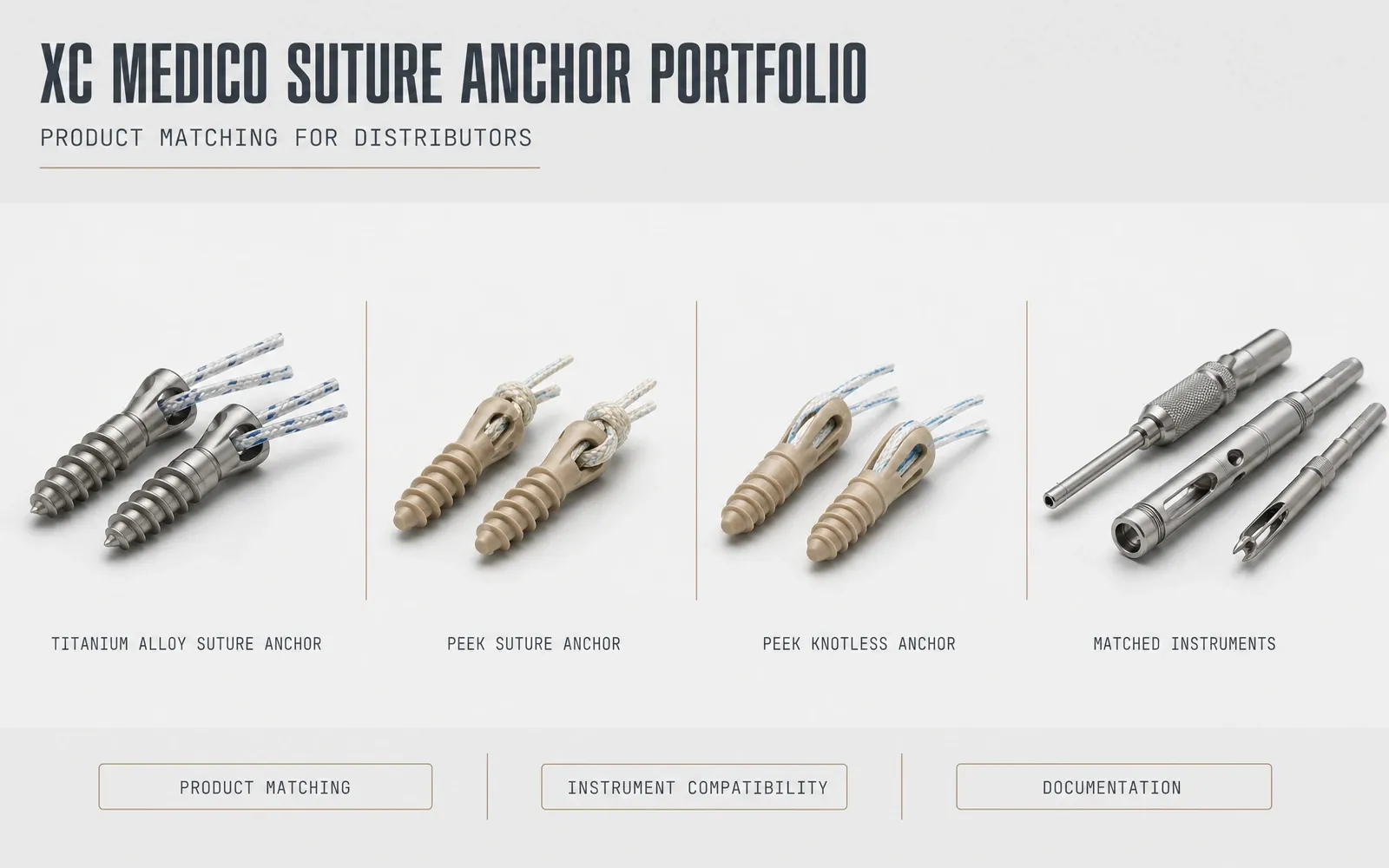
- The live anchor category lists Titanium Alloy Suture Anchor, Non-absorbable Suture Anchor, PEEK Corded Anchor and PEEK Knot-Free variants.
- Materials
- Titanium alloy and PEEK are documented. The dedicated titanium page identifies TC4 titanium alloy.
- Knotless or All-Suture Coverage
- PEEK Knot-Free listings confirm a knotless offering. All-suture anchor coverage was not established from the reviewed anchor pages.
- Size and Suture Options
- A complete diameter, length and loaded-suture matrix was not publicly established. Request a current catalog with REF codes, strand counts, suture sizes, tape compatibility and needle options.
- Main Applications
- The titanium page describes selected shoulder, knee, foot and ankle applications. Confirm the actual intended use from the supplied IFU.
- Instrument Compatibility
- Arthroscopy sets and suture-management instruments are listed separately. Obtain a written anchor-to-instrument matching list.
- Distributor Relevance
- Suitable for a product-matching inquiry covering implant specifications, associated instruments, catalog availability and proposed OEM/ODM requirements.
- What Buyers Should Verify
- The legal manufacturer, product registration, certificate scope, sterile status, shelf life and confirmed delivery terms. OEM/ODM or registration-support discussions do not guarantee authorization in a target country.
How Suture Anchor Portfolios Are Structured
Build the purchasing matrix around four independent fields: anchor construction, fixation method, dimensions and suture configuration. Combining them prevents an apparently broad catalog from hiding gaps in the configurations your customers need.
| Portfolio Dimension | Purchasing Implication |
|---|---|
| Titanium anchor | Separate the alloy, geometry, diameter, length and loaded-suture configuration. Confirm whether instruments and needles are included in the price. |
| PEEK anchor | Distinguish a fully PEEK implant from a PEEK body with a different tip or eyelet material. Keep knotted and knotless models separate. |
| Biocomposite anchor | Record the specific composition and product documentation. “Biocomposite” is not a single interchangeable material specification. |
| All-suture anchor | Record textile composition, preparation diameter, deployment format and loading. Its nominal size may describe a preparation requirement rather than a rigid screw diameter. |
| Knotted versus knotless | Create separate stock and instrument records. Confirm whether sutures are preloaded, supplied separately or passed from another component. |
| Single- versus double-loaded | Track the number of repair sutures or tapes, not just visible tails. Additional shuttle strands should not be mistaken for repair sutures. |
Compare Price Bands Through the Complete System
Do not assume that material alone predicts purchasing cost. Ask each supplier to quote the same defined configuration and separate implant cost, loaded suture or tape, disposable instruments, reusable instruments, packaging, registration support and delivery terms. No comparable public transaction-price dataset was established for this review, so the brands are not assigned unsupported “budget” or “premium” price rankings.
A practical quotation can show three commercial configurations: the implant assembly, the implant with required disposable preparation tools, and the complete supported system. Include expiry exposure and instrument replacement when comparing total purchasing cost.
For material mechanisms and clinical context, see the suture anchor materials guide and the separate PEEK and metal anchor comparison. This hub focuses on how those differences change the purchasing specification.
Suture Anchor Sizes and Suture Compatibility
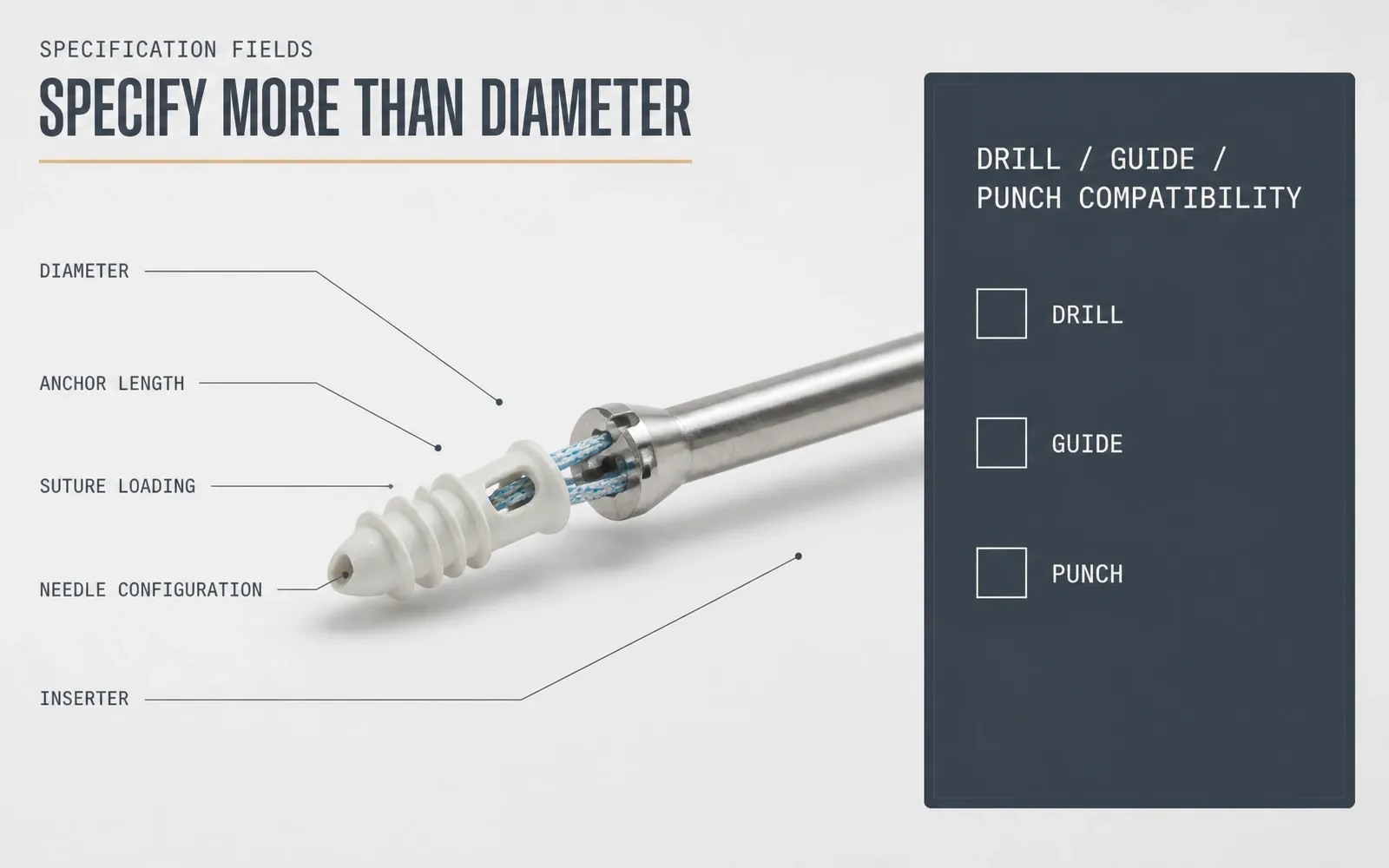
“A 5.5 mm suture anchor” is not a complete order description. Two products with the same nominal diameter may differ in length, preparation requirements, loaded sutures, delivery instruments and approved applications. For every orderable configuration, request one row linking the implant REF to all included and required components.
| Specification | What a Distributor Should Check |
|---|---|
| Product name and REF / SKU | Exact commercial name, model, catalog revision and identifier shown on the label. Avoid ordering by a generic family name alone. |
| Diameter | Nominal implant diameter, recommended preparation diameter and any difference between them. Clarify what the listed size means for an all-suture anchor. |
| Anchor length | Implant length, preparation depth and relevant driver markings. Do not infer length from another product with the same diameter. |
| Anchor construction | Body, tip, eyelet and textile materials, including mixed-material components. |
| Single-loaded / double-loaded | Number of independent repair sutures or tapes; separate repair strands from shuttles, loops and retention sutures. |
| Suture compatibility | Approved suture material, size, brand or validated specification, strand length and maximum permitted loading. |
| Tape compatibility | Tape width, construction and permitted limb count. A statement that an anchor accepts suture does not establish compatibility with every tape. |
| Needle configuration | Needled or needle-free supply, number of needles, curvature, point type and dimensions where applicable. |
| Inserter | Included or separately ordered, disposable or reusable, working length and exact compatible anchor codes. |
| Drill and drill guide | Diameter, depth stop, guide geometry and matched codes. Confirm straight or curved configurations where relevant. |
| Punch / awl / tap | Which tools are required, optional or restricted to specified conditions under the IFU; identify single-use versus reusable versions. |
| Packaging and sterile status | Implant and instrument status separately, unit quantity, sterile barrier, sterilization method and any required processing before use. |
| Shelf life and storage | Labeled expiry, storage requirements, supported shelf life and minimum remaining shelf life at delivery. |
| Traceability | Lot or serial identification, UDI where applicable, label language and mapping to shipment records. |
Use Published Sizes as Examples, Not Substitution Rules
The comparison includes examples from 1.0 mm JuggerKnot Mini to 6.5 mm CrossFT Knotless DT, but these belong to different systems and applications. They are not endpoints of a standardized, interchangeable size range. Compare products within the intended application and confirm how each manufacturer defines its nominal size.
Confirm the Entire Suture Path
Suture compatibility includes the implant, any locking mechanism, the passer, the retriever and the cutter. A wider tape may require different handling instruments even when an anchor is labeled for that tape. Use the suture passer guide for instrument background, then request written compatibility for the selected configuration. Our suture tape evidence review addresses the separate clinical discussion.
Single-Row vs Double-Row vs Suture-Bridge Systems
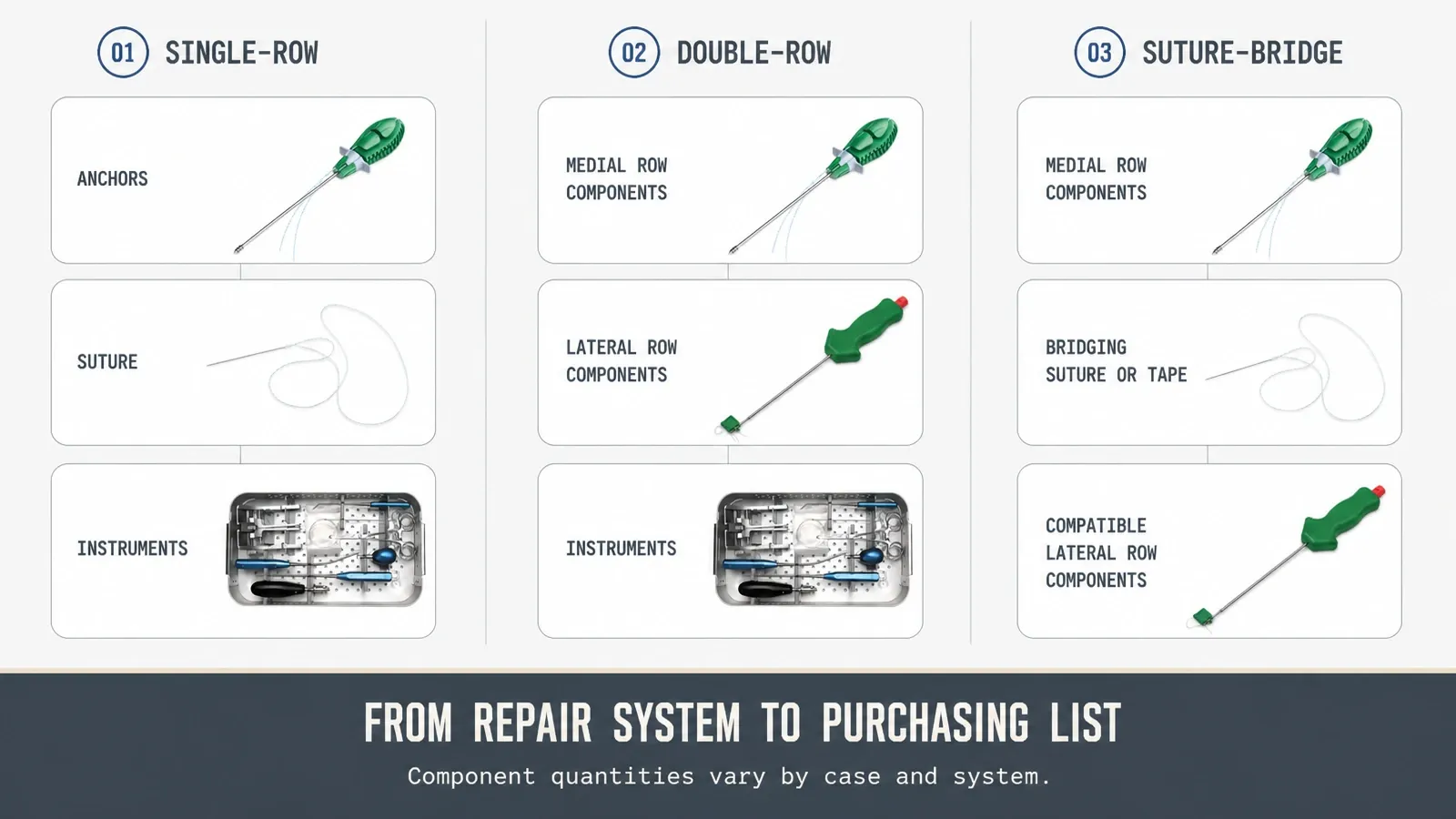
These terms influence the bill of materials, but they do not define a universal anchor count. For procurement, ask the clinical customer to specify the intended system and have the supplier map every required component to an orderable code. The following comparison describes inventory relationships, not operative technique.
| System | Procurement Relationship | Ordering Check |
|---|---|---|
| Single-row | Anchor configuration, loaded sutures or tapes, and matching preparation/insertion tools. | Confirm the requested anchor mix and case-specific quantity; “single-row” does not mean one anchor. |
| Double-row | Separate medial-row and lateral-row components may be needed, with different anchor types or loading. | List medial and lateral REF codes separately, including any dedicated instruments. |
| Suture-bridge | A double-row construct in which sutures or tapes link components across the repair; knotless lateral fixation is used in specified systems. | Verify the lateral anchor’s approved material and limb capacity against the selected medial configuration. |
The medial anchor may supply the sutures or tape used by the system, while a knotless lateral anchor secures a specified number and type of limbs. Inserters, guides and preparation tools complete the order. Do not assume that a compatible diameter establishes compatible suture loading, or that components from different manufacturers can be combined.
Keep forecast quantities distinct from clinical requirements. A distributor can plan stock using historical customer demand, but the number and type of anchors required for an individual rotator cuff repair depend on the case and the selected repair strategy.
Suture Anchor Applications Beyond the Shoulder
Anatomy should be a purchasing filter tied to the exact product IFU. A manufacturer’s presence in a joint category does not mean every anchor in its catalog is indicated for that joint.
| Application Area | Portfolio Question | Evidence and Verification |
|---|---|---|
| Shoulder | Does the portfolio cover the required rotator cuff, instability or biceps system, including instruments? | Q-FIX, FiberTak, HEALIX and other reviewed families have shoulder resources. Confirm the indication for the selected model. |
| Hip | Is the hip arthroscopy anchor supplied with the appropriate access length, guide and delivery configuration? | Medacta’s MectaLock literature specifically distinguishes hip and shoulder instrument lengths. |
| Knee | Which exact tendon or ligament fixation application is covered? | Stryker’s Omega page includes knee soft-tissue repairs. Do not substitute an anchor for a meniscal repair device or ACL/PCL fixation component based on category wording. |
| Ankle and Foot | Does the required ankle anchor or tendon-repair system include the correct suture, tape and needle configuration? | GRYPHON X ankle resources and Stryker/CONMED foot-and-ankle systems provide product-specific starting points. |
| Elbow | Does the current IFU explicitly cover the intended tendon or ligament application? | Do not infer elbow authorization from shoulder compatibility or a general “sports medicine” claim. Request the relevant IFU section before adding the SKU to an elbow offering. |
Application sources: Medacta anchor systems; Stryker Omega; GRYPHON X. These are product-literature examples, not cross-brand indication equivalence.
Pull-Out Strength and Cyclic Loading: What Buyers Should Verify
A published suture anchor pull-out strength value is meaningful only alongside its test conditions. Numbers from different manufacturers cannot be directly ranked when the substrates, anchor configurations or loading protocols differ. A maximum failure load also answers a different question from displacement during repeated loading.
Request the report behind the claim and establish whether the test evaluates anchor-to-bone fixation, the suture-locking mechanism or the complete construct. Record the following fields before discussing equivalence:
| Test Field | Required Context |
|---|---|
| Test method | Applicable standard or documented internal protocol, revision, objective and acceptance criteria. |
| Substrate / test block | Synthetic block material and density, cortical simulation or cadaveric specimen characteristics and conditioning. |
| Anchor and suture configuration | REF, diameter, length, material, repair-suture loading and preparation tools. |
| Insertion method | Preparation, insertion and deployment conditions used in the test, and consistency with the relevant instructions. |
| Loading direction | Angle relative to the anchor and substrate, fixture arrangement and whether the direction remained constant. |
| Static loading | Preload, loading rate, endpoint and definition of failure. |
| Cyclic loading protocol | Minimum and maximum load, frequency, cycle count and displacement measurement method. |
| Failure mode | Anchor pull-out, substrate failure, suture breakage, slippage, eyelet failure or another defined mechanism. |
| Sample size and variability | Number tested, individual results or dispersion, exclusions and statistical analysis where used. |
| Report availability | Report identifier, laboratory, date, tested product revision and access arrangements for supporting documentation. |
Manufacturer pages themselves often qualify bench claims. For example, Smith+Nephew identifies specific bone-block conditions for Q-FIX comparisons, while Zimmer Biomet notes that bench findings do not necessarily predict clinical outcomes. Preserve those limitations when preparing a distributor brochure.
Examples: Q-FIX evidence notes; Quattro Link bench-test qualification.
Regulatory Identity of Suture Anchors: What Distributors Should Verify
Regulatory review should follow the product from its label to the legal manufacturer and the applicable market record. The commercial brand, seller, factory operator and registration holder may be different entities. Ask the supplier to explain their relationship in writing.
Start With the Product Identity
Match the legal manufacturer, product name, model/SKU, intended use, classification and registration holder across the catalog, label, IFU and regulatory documents. Where a certificate covers a family, request evidence that the proposed configuration falls within its scope. Confirm the relevant manufacturing site and the authorized representative or importer where applicable.
FDA Clearance Is Device-Specific
A 510(k) record documents clearance for the named device and its stated scope. It is not an “FDA certified manufacturer” designation. FDA establishment registration or device listing does not, by itself, mean approval or clearance. The FDA explicitly explains this distinction in its guidance on registration and certification claims.
The specific records reviewed here include K130917 for HEALIX ADVANCE KNOTLESS BR, K193461 for MectaLock All-Suture and K223889 for STATIV. These examples should not be extended to another material, private-label version or family without verification.
CE / MDR Documentation Must Match the Product
For the relevant European market, request the EU Declaration of Conformity and applicable notified-body documentation, including certificate scope, identification and status. If a supplier relies on transitional arrangements, request the evidence supporting that route. A CE mark on a general company presentation is insufficient to establish coverage of the proposed SKU. Consult the European Commission’s Declaration of Conformity guidance and certificate information resources.
ISO 13485 Is Not Product Marketing Authorization
ISO 13485 certification concerns the quality management system within the certificate’s scope; it does not independently authorize a suture anchor for sale. Check the certified entity, sites, activities, issuing body and validity. In the United States, FDA’s Quality Management System Regulation became effective on February 2, 2026 and incorporates ISO 13485:2016 requirements by reference, with FDA-specific provisions. This does not turn an ISO certificate into device clearance. FDA QMSR information.
Complete the Sterility, Shelf-Life and Labeling Review
Request sterilization validation information appropriate to the supplied configuration, sterile-barrier and shelf-life evidence, storage conditions, current labels and the applicable IFU. Separate the sterile implant assembly from any non-sterile reusable instruments. Confirm that document revisions, product identifiers and actual shipment labels agree.
What Makes a Complete Suture Anchor Portfolio?
A complete portfolio is one that supports the needs of the distributor’s customers with documented, available configurations. It does not need to include every material or every diameter. Build it around the actual applications and systems being supplied.
- Defined application coverage: distinguish cuff, instability and other approved soft-tissue fixation needs.
- Relevant anchor configurations: identify the required knotted, knotless, solid-body or all-suture combinations.
- Useful size depth: maintain the customer-requested dimensions and agreed alternatives within the approved system.
- Matched sutures and instruments: include passers, graspers, cutters and preparation tools where required.
- Operational support: maintain current documents, replenishment terms, traceability and complaint handling.
Use a starter matrix with one row per validated configuration: application, anchor REF, material, dimensions, loading, instrument codes, market documentation, minimum order and replenishment lead time. Mark gaps explicitly instead of describing an incomplete set as a complete system.
For XC Medico inquiries, the suture grasper range and arthroscopy instrument set provide starting points for instrument discussions. Their presence in the catalog does not replace a confirmed compatibility list.
How to Evaluate a Suture Anchor Manufacturer
Apply the same evaluation to an established multinational brand, a specialist manufacturer and an OEM-oriented orthopedic sports medicine manufacturer. Resolve eligibility first, then compare commercial and service fit.
- Define the requirement. Specify market, intended applications, dimensions, material, loading and instrument needs before requesting quotations.
- Verify identity and authorization. Establish who manufactures, labels, registers and supplies the exact product.
- Review product evidence. Reconcile the catalog, IFU, mechanical documentation, sterile status and shelf life.
- Assess the complete system. Confirm every implant and instrument code and arrange any appropriate professional evaluation through authorized channels.
- Compare supply terms. Review lead time, remaining shelf life, minimum order, batch traceability, replacement terms and change notification.
- Document ongoing responsibilities. Identify complaint contacts, recall cooperation, training arrangements and responsibility for local registration maintenance.
Treat unclear answers as unresolved requirements. A supplier’s ability to provide a precise, internally consistent document package is more useful than broad claims about quality or global reach. OEM customization should also have a defined change-control and regulatory responsibility agreement.
12-Point Suture Anchor Supplier Document Checklist
Request the following package for the intended market and proposed product configuration. Some detailed reports may require confidentiality arrangements; request an appropriate reviewable summary and a clear route to any additional evidence required by the relevant authority.
| No. | Document | Minimum Review Point |
|---|---|---|
| 01 | Legal manufacturer | Legal name, address, relevant site and relationship to the seller or brand owner. |
| 02 | ISO 13485 certificate | Certified entity, site, activity scope, issuer and validity. |
| 03 | Product registration / clearance | Market, holder, device identity, scope and mapping to the proposed model. |
| 04 | Product catalog | Current revision, orderable products and regional availability. |
| 05 | SKU and size table | REF, diameter, length, loading and included accessories. |
| 06 | Material specification | Implant body, tip, eyelet and textile materials. |
| 07 | Mechanical test documentation | Protocol, tested configuration, results, failure modes and report identifier. |
| 08 | Sterilization validation information | Method, applicable configuration and supporting validation scope. |
| 09 | Shelf-life evidence | Basis for labeled expiry, packaging integrity and storage conditions. |
| 10 | IFU and labels | Current revision, indications, warnings, language and traceability identifiers. |
| 11 | Implant-instrument compatibility list | Matched drills, guides, punches, taps, inserters and processing status. |
| 12 | OEM / registration support documents | Where relevant: authorization, labeling responsibilities, technical-document access and change-control agreement. |
What Should Distributors Ask a Suture Anchor Supplier?
| Question | A Useful Supplier Answer Should Include |
|---|---|
| Who is the legal manufacturer? | The exact name and address appearing on the device label and relevant regulatory documentation. |
| Which configurations can you supply in our country? | A current market-specific REF list and the supporting registration or authorization route. |
| What suture anchor sizes are available? | A table of nominal diameter, length, preparation requirements and loading for each orderable model. |
| Can this anchor accept our chosen tape? | Written compatibility identifying the tape specification and permitted loading. Diameter alone is not an answer. |
| Is it single-loaded or double-loaded? | The number of repair sutures or tapes, with shuttles and retention strands identified separately. |
| What is included in the sterile pack? | An itemized pack list, sterile status, unit quantity and any separately supplied instruments. |
| Which instruments must be purchased? | Required and optional codes, reusability, processing instructions and replacement arrangements. |
| How was pull-out strength tested? | The full testing context, sample size, variability, failure mode and report reference. |
| What shelf life remains at delivery? | A written minimum remaining shelf-life commitment and storage requirements. |
| Can you support OEM labeling or registration? | A defined scope, responsible entities, permitted changes, document access and realistic lead time. |
| How are product changes and complaints handled? | Named contacts, notification procedures, traceability responsibilities and escalation arrangements. |
Frequently Asked Questions
What is a suture anchor?
A suture anchor is an implant used to attach soft tissue to bone through sutures or tape. Its construction, delivery system and permitted applications depend on the specific product.
For background, read what suture anchors are and how they work.
What are the main types of suture anchors?
Common purchasing categories include titanium, PEEK, biocomposite and all-suture anchors, together with knotted and knotless fixation formats. These categories overlap: an all-suture anchor can be knotted or knotless.
What is the difference between PEEK, titanium and all-suture anchors?
PEEK and titanium describe materials used in solid anchor components. All-suture describes a textile-based anchoring structure. Buyers should compare the exact construction, dimensions, sutures, instruments and labeling rather than assume that material determines suitability or performance.
What is a knotless anchor?
A knotless anchor secures the specified suture or tape through its fixation mechanism without requiring a tied knot at that anchor. The mechanism and permitted loading are product-specific; knotless does not automatically mean all-suture.
What suture anchor sizes are available?
Published examples in this guide include a 1.0 mm JuggerKnot Mini and CrossFT Knotless DT options up to 6.5 mm, across different systems. There is no universal interchangeable range. Request the exact diameter, length and preparation requirements for each SKU.
How many anchors are used in rotator cuff repair?
There is no fixed number. Anchor quantity depends on the tear, tissue and bone condition, selected repair configuration, product system and surgeon’s plan. Distributors should obtain a case-specific component request rather than treat a typical system illustration as a universal order quantity.
How should distributors compare suture anchor manufacturers?
Compare matched product configurations: intended use, material, dimensions, suture loading, instruments, market documentation and supply terms. Review mechanical evidence only with its test conditions, and resolve missing information before comparing complete-system cost.
What documents should buyers request?
Request legal-manufacturer details, ISO 13485 certification, applicable product registration or clearance, a current catalog and SKU table, material specifications, mechanical evidence, sterilization information, shelf-life evidence, IFU and labels, instrument compatibility, and relevant OEM or registration-support documents.
What is the difference between a manufacturer and a trading company?
A manufacturer has defined responsibility for the device under the applicable regulatory framework; manufacturing activities may involve contracted sites. A trading company primarily purchases and resells products. Verify the legal manufacturer, actual production arrangements and seller authorization instead of relying on the business’s marketing description.
Sources and Update Notes
Last reviewed: September 2026. The principal product sources appear directly beneath each manufacturer profile so readers can trace an entity to its named products and evidence. Regulatory references supplement those product pages; they do not certify the entire comparison.
- Product coverage: official manufacturer pages and literature for the named anchor families. Older documents were used only for the specifications they actually identify.
- Ownership: Medacta’s March 2025 acquisition announcement and March 2026 corporate presentation establish the Parcus relationship used here.
- Corporate change: J&J’s October 2025 separation announcement is treated as an announced plan, not proof that a transaction has completed.
- U.S. device records: K130917, K193461 and K223889 are examples tied to specifically named devices.
- Regulatory interpretation: FDA guidance on registration and clearance, FDA QMSR information, and European Commission conformity-document resources.
- XC Medico: current product, instrument and distributor pages were used as manufacturer-published sources. Their commercial statements were not treated as independent certification evidence.
No marketplace listing or generic “Top 10” article was used as the principal evidence for a manufacturer’s product specifications. Public product pages can change, and some legacy catalog links redirect. Obtain the current regional catalog, IFU and document package before ordering. Future revisions should recheck ownership, discontinued models, new configurations and regulatory scope.
Editorial Accuracy Note
This article is a sourcing reference, not surgical instruction, individualized treatment advice, a regulatory approval opinion or an independent product test. It does not establish clinical superiority, cross-brand interchangeability, local registration or distributor appointment availability.
Statements marked “Not publicly confirmed” identify an evidence gap in the reviewed sources. They should not be read as proof that a capability does not exist. Manufacturer terminology can also be ambiguous; request the actual material specification and IFU when a product name does not clearly describe its construction.
Product names and trademarks belong to their respective owners. Final purchasing specifications should be reconciled against current manufacturer documents and the requirements of the destination market.
XC Medico · Product Matching
Build a Documented Suture Anchor Purchasing List
Send XC Medico your target market, required application, anchor material, diameter and length, suture or tape configuration, instrument requirements and expected order quantity. Request a matched catalog proposal and the documentation applicable to the products being considered.
Include any OEM/ODM, packaging, labeling or registration-support requirements at the start. Availability, compatibility, document scope and lead time should be confirmed for the final configuration.
Helpful inquiry fields: country · application · material · diameter × length · loading · tape or suture · needles · instruments · quantity · required documents.

