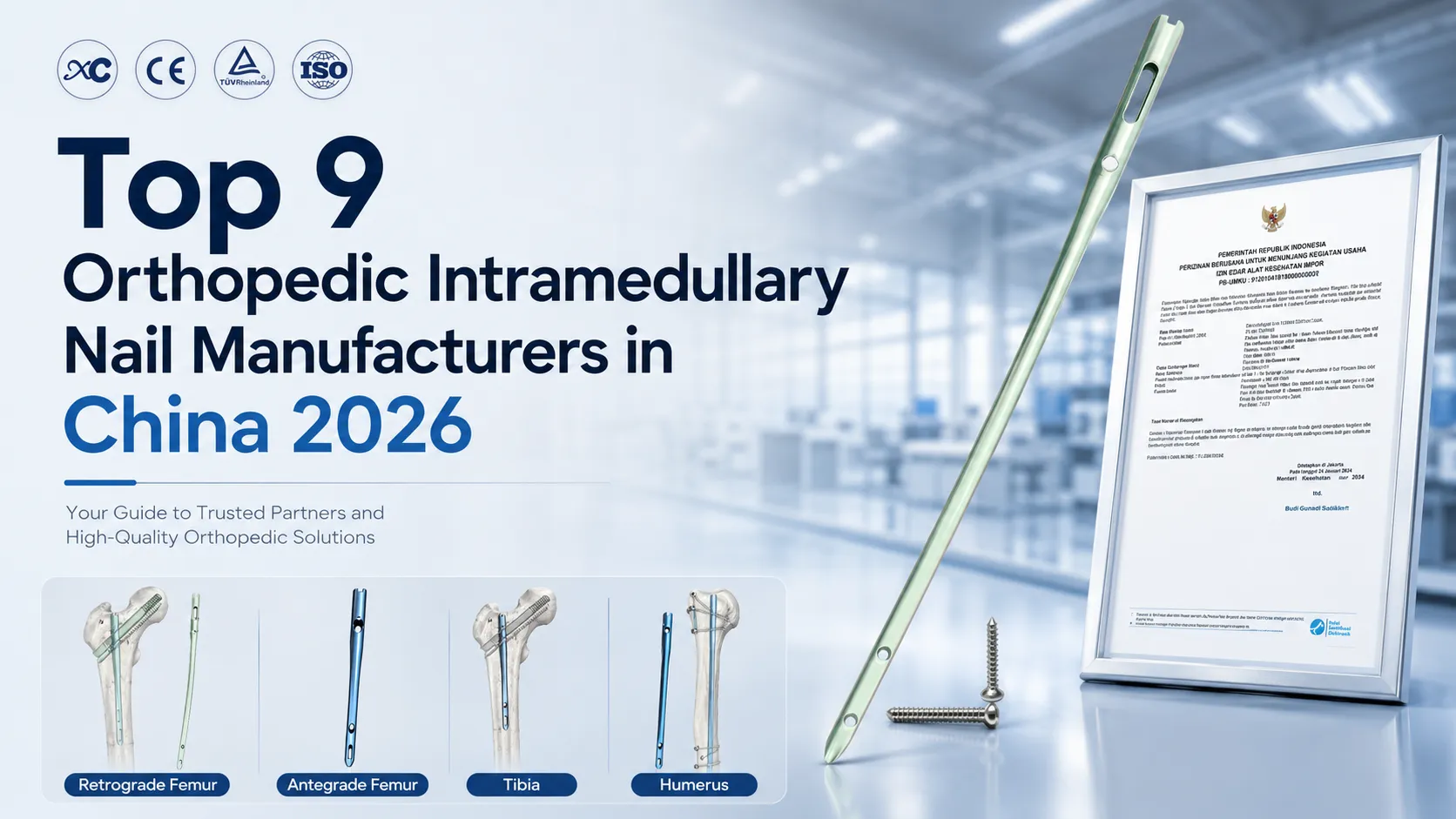
Top 9 Orthopedic Intramedullary Nail Manufacturers in China 2026
Views: 0 Author: Site Editor Publish Time: 2025-08-28 Origin: Site
China is an important manufacturing base for orthopedic trauma implants, supplying intramedullary nail systems for femoral, tibial, humeral, and proximal femoral fracture fixation. For distributors and hospital procurement teams, however, comparing manufacturers requires more than checking a catalog or unit price. A usable intramedullary nailing solution must bring the implant, locking screws, targeting devices, extraction tools, and sterilization trays together as a coordinated system.
This 2026 guide compares nine orthopedic intramedullary nail manufacturers with manufacturing operations or established orthopedic businesses in China. The ranking emphasizes product relevance, system completeness, manufacturing capability, quality management, and distributor support. It is an editorial comparison for B2B sourcing and does not constitute a clinical recommendation.
How We Selected These Intramedullary Nail Manufacturers
An intramedullary nail is not a stand-alone product. A practical system requires the nail, compatible locking components, insertion and extraction instruments, targeting guides, and clearly controlled specifications to work together. We therefore assessed each company at the system level rather than treating every orthopedic manufacturer as an intramedullary nail specialist.
Intramedullary Nail Product Portfolio
We considered whether the manufacturer offers meaningful coverage across femoral, tibial, humeral, proximal femoral, interlocking, or other trauma nailing systems. A broader line can help distributors consolidate purchasing, but portfolio breadth alone does not prove that every model is registered or available in every market.
Implant Design and Manufacturing Capability
Intramedullary nails require controlled raw materials, precision machining, consistent hole geometry, reliable thread interfaces, appropriate surface finishing, and dimensional inspection. Manufacturers with established trauma production and inspection capabilities received greater consideration.
Locking and Instrument Compatibility
The implant and instrument set must be reviewed as one system. Important factors include compatible locking screws, proximal and distal targeting, guide-wire and canal-preparation tools, insertion handles, extraction instruments, and tray organization. Procurement teams should confirm compatibility by model and reference number rather than relying on similar-looking components.
Quality Management and Documentation
We considered the visibility of quality systems, product traceability, inspection records, technical documentation, and support for market-specific registration. Certifications and registrations must always be verified for the exact legal manufacturer, product family, intended use, and destination market at the time of purchase.
Distributor and OEM Support
For international buyers, the commercial package may include catalogs, size lists, instrument configurations, samples, labeling, packaging, training materials, registration documents, and after-sales support. The ranking gives additional weight to companies that can support repeatable system-level procurement rather than one-off implant sales.
Top 9 Intramedullary Nail Manufacturers in China 2026
The order below reflects intramedullary nail relevance within the scope of this article. It is not a ranking of overall company size, clinical outcomes, or suitability for a particular patient. Buyers should conduct independent technical, regulatory, and supplier qualification before making a purchasing decision.
Weigao Orthopaedic
Weigao Orthopaedic is a large Chinese orthopedic device business with a broad portfolio spanning trauma, spine, and joint reconstruction. Its scale, domestic market presence, and established orthopedic manufacturing base make it a relevant starting point for buyers evaluating Chinese trauma implant groups.
Within an intramedullary nail sourcing project, Weigao is best evaluated as a broad orthopedic system provider. Buyers should request the current nail catalog, compatible screw matrix, dedicated instrument list, regulatory status, and local-market availability because specifications and commercial access can vary by product family and region.
Relevant strengths: broad orthopedic portfolio, established manufacturing organization, and trauma-system coverage.
Best suited for: buyers seeking a large Chinese orthopedic group with multiple implant categories.
Verify before ordering: exact nail models, instrument completeness, product registration, and distribution terms in the target market.
2. Double Medical
Double Medical is a Chinese orthopedic device manufacturer with substantial activity in trauma fixation and other orthopedic segments. Its trauma orientation makes it particularly relevant to distributors comparing intramedullary nails alongside plates, screws, and supporting surgical instruments.
The company may be attractive to buyers building a wider trauma line card rather than purchasing a single nail family. As with any large portfolio, the correct evaluation should be model-specific: nail geometry, available diameters and lengths, locking options, targeting accuracy, instrument trays, and documentation should all be reviewed together.
Relevant strengths: trauma-focused portfolio and potential for multi-category orthopedic sourcing.
Best suited for: distributors comparing complete trauma implant portfolios.
Verify before ordering: current intramedullary nail range, compatible components, lead times, and territory-specific regulatory documentation.
3. XC Medico
XC Medico is a China-based orthopedic manufacturer and supplier with a dedicated focus on trauma implants, including complete intramedullary nail systems. Its portfolio includes femoral, tibial, humeral, and proximal femoral nailing solutions, together with compatible locking components and dedicated instruments.
XC Medico also presents separate information on orthopedic quality control and inspection and OEM and ODM services. These resources can support an initial supplier review, but buyers should still request the current technical files, certificates, registration scope, material specifications, inspection reports, and model-specific compatibility list for their destination market.
Relevant strengths: dedicated intramedullary nail category, implant-and-instrument packaging, product-level information, and distributor/OEM support.
Best suited for: international distributors seeking configurable trauma systems and direct technical communication with a China-based supplier.
Verify before ordering: current size range, implant material, locking screw references, tray configuration, regulatory status, and final labeling requirements.
4. Naton Medical Group
Naton Medical Group is an established Chinese orthopedic organization with activities across trauma and other orthopedic fields. Its broader orthopedic platform and experience with implant systems make it more relevant to this list than companies focused almost entirely on joint replacement.
Procurement teams considering Naton should determine which group entity manufactures or supplies the requested nail system. This matters for contracts, technical documentation, certificates, labeling, and post-market responsibilities. Buyers should also compare the current nailing portfolio with their required anatomical coverage and instrument workflow.
Relevant strengths: established orthopedic group structure and broad implant-system experience.
Best suited for: organizations evaluating comprehensive Chinese orthopedic suppliers.
Verify before ordering: legal manufacturer, current nail portfolio, instrument configuration, and market-specific authorization.
5. Lepu Orthopaedics
Lepu Orthopaedics operates within a wider Chinese medical-device ecosystem and provides orthopedic implant solutions that include trauma-related products. Its position in this ranking reflects greater relevance to orthopedic trauma sourcing than manufacturers whose public identity is dominated by arthroplasty alone.
For an intramedullary nail project, buyers should review the latest product catalog rather than infer coverage from the group's overall medical-device scale. Confirm whether the requested femoral, tibial, humeral, or proximal femoral system is currently offered, and whether the corresponding instruments and documentation are supplied as part of the same commercial package.
Relevant strengths: orthopedic product platform and access to a broader medical-device group.
Best suited for: buyers comparing diversified Chinese healthcare manufacturers with orthopedic capabilities.
Verify before ordering: current nailing systems, model availability, regulatory documents, and after-sales instrument support.
6. Trauson (Stryker)
Trauson originated as a Chinese orthopedic company and became part of Stryker. Its historical strength in trauma and spine products gives it clear relevance when discussing the development of China's orthopedic manufacturing sector.
Trauson differs from an independent export-oriented Chinese OEM supplier because it operates within a global medical-technology group. Product access, branding, sales channels, and distributor arrangements may therefore follow Stryker's regional strategy. Buyers should confirm which products are currently available under the relevant brand in their market.
Relevant strengths: established trauma heritage and integration with a global orthopedic organization.
Best suited for: buyers working through authorized, market-specific commercial channels.
Verify before ordering: current brand ownership, local availability, authorized channel, and exact system configuration.
7. Kanghui (Medtronic)
Kanghui is a well-known name in China's orthopedic manufacturing history and became part of Medtronic after its acquisition. The business developed around orthopedic implants, including trauma-related systems, which supports its inclusion in a China-focused industry comparison.
As with Trauson, the historical company name should not be interpreted as an independent supplier with unrestricted OEM or distributor arrangements. Buyers need to verify the present legal entity, product brand, regional availability, and commercial channel before treating Kanghui as a sourcing option.
Relevant strengths: orthopedic manufacturing history and experience in trauma implants.
Best suited for: procurement teams researching established China-based orthopedic operations within a multinational group.
Verify before ordering: present product ownership, local sales channel, current nail availability, and documentation holder.
8. AK Medical
AK Medical is widely associated with joint reconstruction and orthopedic implant technology. It also participates in the broader orthopedic market, but its public positioning is less centered on intramedullary nailing than the trauma-focused companies placed above it.
Its inclusion gives buyers a view of a major Chinese orthopedic manufacturer whose strengths may be relevant to broader portfolio planning. For a nail-specific tender, procurement teams should not assume that corporate scale or joint expertise automatically translates into the required nailing portfolio. The current trauma catalog and instrument offering must be checked directly.
Relevant strengths: established orthopedic manufacturing and implant-development capabilities.
Best suited for: buyers assessing broad Chinese orthopedic companies in addition to trauma specialists.
Verify before ordering: current intramedullary nail scope, instrument availability, and destination-market registration.
9. Chunli Medical
Chunli Medical is another established Chinese orthopedic implant company, primarily recognized for joint reconstruction products. It is included as a broader orthopedic manufacturer with trauma-related relevance, but it is placed ninth because intramedullary nails are not the company's clearest public specialization.
Chunli may be worth reviewing when a distributor is evaluating several orthopedic categories from one corporate source. For an intramedullary nail tender, however, the buyer should first confirm that the required anatomical systems, locking components, dedicated instruments, and regulatory documents are currently available.
Relevant strengths: established orthopedic implant company and broader product-development experience.
Best suited for: portfolio-level supplier research where trauma is one of several categories.
Verify before ordering: nail-system relevance, complete instrument list, legal manufacturer, and registration scope.
Comparison of the Top 9 Intramedullary Nail Manufacturers
Rank
Manufacturer
Profile in This Comparison
Primary Buyer Fit
Key Point to Verify
1
Weigao Orthopaedic
Large diversified orthopedic group with trauma coverage
Multi-category orthopedic procurement
Exact nail and instrument availability by market
2
Double Medical
Trauma-oriented orthopedic manufacturer
Broad trauma portfolio sourcing
Model-specific compatibility and documentation
3
XC Medico
Dedicated nail category with implants and instruments
Distributors, OEM/ODM projects, and configurable systems
Final size list, references, registration, and tray configuration
4
Naton Medical Group
Established orthopedic group with trauma-system experience
Comprehensive orthopedic supplier evaluation
Legal manufacturer and current portfolio
5
Lepu Orthopaedics
Diversified orthopedic platform within a wider device group
Current brand, sales channel, and local availability
7
Kanghui (Medtronic)
Established Chinese orthopedic operation within a multinational group
Market-specific institutional procurement
Present ownership, documentation holder, and product access
8
AK Medical
Major orthopedic company better known for joint reconstruction
Broad orthopedic portfolio research
Actual intramedullary nail scope
9
Chunli Medical
Established orthopedic company with a joint-centered public profile
Multi-segment supplier comparison
Nail-system depth and regulatory coverage
Note: This table summarizes procurement fit, not clinical performance. Product portfolios, ownership structures, registrations, and distribution channels can change. Verify all information directly with the relevant manufacturer or authorized representative.
Popular Intramedullary Nail Types Supplied by Chinese Manufacturers
Not every supplier covers the same anatomy or fracture patterns. A distributor should first define the required nail families and then evaluate the completeness of each implant-and-instrument system. The categories below are common long-tail search and sourcing areas for femoral nail manufacturers, tibial nail manufacturers, Gamma nail manufacturers, and other orthopedic nail system suppliers.
Femoral Intramedullary Nails
Femoral nail manufacturers may offer antegrade, retrograde, reconstruction, and other interlocking femoral systems. A complete review should compare entry design, nail curvature, diameters, lengths, proximal and distal locking patterns, end caps, material options, targeting instruments, and extraction tools. Buyers should also separate femoral shaft systems from proximal femoral devices because the implant geometry and supporting instruments are not interchangeable.
Tibial nail manufacturers typically provide interlocking systems for tibial shaft fixation, while some portfolios may include specialized proximal or distal solutions. Buyers should compare bend and entry geometry, distal locking options, available lengths and diameters, locking screw compatibility, targeting accuracy, and the instruments used for reduction, canal preparation, insertion, and extraction.
Gamma nails and other cephalomedullary or proximal femoral nail systems are designed around fixation of proximal femoral fracture patterns. The commercial term “Gamma nail” may be used broadly in sourcing conversations, but buyers should distinguish brand-specific terminology from generic product categories. Important comparison points include nail length and diameter, neck-shaft angle options, cephalic fixation design, distal locking, targeting guides, and the complete instrument workflow.
Humeral nail systems address the anatomy and fixation demands of the upper limb. When comparing humeral nail manufacturers, buyers should review proximal fixation options, distal locking, left/right or universal configurations, available lengths and diameters, targeting methods, screw options, and extraction instruments. A humeral system should never be assumed to share instruments with femoral or tibial nails.
“Interlocking nail” is a functional description used across several anatomical families. Proximal and distal screws pass through the nail to control length, alignment, and rotation according to the system design. Procurement teams should verify the screw diameters, drill bits, sleeves, targeting arms, freehand locking workflow, and extraction interfaces for every nail model.
Elastic Nails
Titanium elastic nails belong to a different fixation category from rigid adult interlocking nails. They require their own indications, size range, insertion and extraction tools, and regulatory review. Distributors serving pediatric or selected trauma segments should evaluate elastic nails as a separate product family rather than treating them as a minor extension of a standard adult nailing system.
China Intramedullary Nail Manufacturers vs. Global Trauma Brands
Neither supplier group is automatically the better choice. The appropriate model depends on regulatory requirements, hospital preferences, technical support, portfolio strategy, pricing structure, and the distributor's ability to manage registration and training.
Factor
China-Based Manufacturers
Established Global Trauma Brands
Product portfolio
Ranges from focused suppliers to diversified orthopedic groups; depth varies considerably
Often built around established, standardized global systems
Customization
May offer more flexibility in instruments, trays, labeling, and packaging, subject to regulatory controls
Usually follows controlled global configurations with less local customization
OEM/ODM model
Common among export-oriented manufacturers
Generally limited or unavailable to independent distributors
Regulatory coverage
Must be checked carefully by product, legal manufacturer, and target country
May have broader registrations, but coverage still varies by product and market
Clinical familiarity
Depends on local adoption, training, and distributor support
Often benefits from wider surgeon familiarity and established training networks
Commercial channel
Can be flexible for private label or regional distribution
Often managed through tightly controlled subsidiaries or authorized distributors
Total cost
May offer a lower acquisition cost, but qualification, registration, inventory, and training costs must be included
May have higher acquisition costs with more established service infrastructure in some markets
How to Choose an Intramedullary Nail Manufacturer in China
1. Define the Required Nail Families
Start with anatomy and use case: femoral shaft, proximal femur, tibia, humerus, elastic nails, or another defined category. Specify required diameters, lengths, left/right options, locking patterns, material, and instrument sets. This prevents a broad catalog from being mistaken for a complete match.
2. Evaluate the Complete System, Not Only the Nail
Request a component matrix covering the main nail, locking screws, end caps, guide wires, reamers, insertion handles, targeting devices, drill sleeves, depth gauges, extraction tools, and trays. Confirm reference-level compatibility and ask how design changes are controlled.
3. Review Manufacturing and Inspection Controls
Assess raw-material traceability, machining controls, thread inspection, hole-position measurement, surface finishing, cleaning, packaging, and final release. Ask for relevant inspection records and test evidence for the exact product family instead of relying only on general factory claims.
4. Verify Regulatory Evidence for the Destination Market
Confirm the legal manufacturer, device classification, intended use, applicable certificates, product registrations, technical documentation, labeling, and language requirements. A certificate shown on a website may not cover every product or every country. Verification should be performed using current documents and, where appropriate, the relevant regulator or notified body database.
5. Test Instrument-to-Implant Compatibility
Before a commercial rollout, use samples or demonstration sets to check implant seating, screw engagement, targeting alignment, drill and sleeve fit, assembly, disassembly, cleaning access, tray layout, and extraction workflow. Any proposed substitute component should undergo formal compatibility review.
6. Assess Documentation and Change Control
Request drawings or controlled specifications where appropriate, current catalogs, instructions for use, surgical technique documents, inspection criteria, packaging details, shelf-life information, and revision histories. The supplier should have a clear process for notifying distributors of changes that may affect registration, inventory, or clinical use.
7. Calculate Total Landed and Lifecycle Cost
Compare more than implant price. Include instrument sets, replacement tools, sterilization trays, samples, freight, duties, registration, validation, training, safety stock, warranty terms, and the cost of managing slow-moving sizes. A lower unit price can be offset by incomplete instruments or unreliable replenishment.
8. Audit the Supplier Before Scaling
Use a staged qualification process: document review, technical meeting, sample evaluation, factory or remote audit, pilot order, incoming inspection, and performance monitoring. Define acceptance criteria and responsibilities in the quality agreement and commercial contract before expanding to a full portfolio.
Intramedullary Nail Supplier Checklist
Does the supplier cover the required anatomical nail families?
Are nail diameters, lengths, sides, angles, and locking options clearly documented?
Are compatible screws, end caps, and instruments identified by reference number?
Can the supplier provide a complete instrument and sterilization-tray list?
Are raw materials and finished implants traceable by lot or batch?
Are dimensional, mechanical, surface, cleaning, and packaging controls documented?
Do certificates and registrations cover the exact products and target market?
Are instructions for use and surgical technique materials available in required languages?
How are product changes, nonconformities, complaints, and recalls managed?
What are the minimum order, lead time, replenishment plan, warranty, and instrument replacement terms?
Can samples or demonstration sets be evaluated before a larger order?
Is distributor, private-label, or OEM/ODM support available under a written quality framework?
Frequently Asked Questions
Who are the main orthopedic intramedullary nail manufacturers in China in 2026?
Manufacturers and orthopedic groups relevant to a 2026 sourcing review include Weigao Orthopaedic, Double Medical, XC Medico, Naton Medical Group, Lepu Orthopaedics, Trauson within Stryker, Kanghui within Medtronic, AK Medical, and Chunli Medical. Their relevance, portfolio depth, ownership structure, and commercial channels differ, so the list should be used to create a qualification shortlist rather than to replace due diligence.
What products should a complete intramedullary nail system include?
A complete system normally includes the selected nail family, compatible locking screws, end caps, guide wires, canal-preparation tools, insertion and targeting instruments, drill sleeves, measuring tools, extraction instruments, and sterilization trays. The exact components depend on the model and intended procedure.
How do I compare femoral nail manufacturers?
Compare anatomical coverage, antegrade or retrograde approach, nail curvature, diameters, lengths, proximal and distal locking options, reconstruction or cephalomedullary configurations, material, targeting accuracy, extraction tools, inspection evidence, and regulatory status. Review the implant and instrument set together.
What should I ask tibial nail manufacturers?
Ask for the available nail geometry, diameters and lengths, proximal and distal locking patterns, screw matrix, targeting method, guide-wire and reaming workflow, insertion and extraction tools, tray list, test documentation, and destination-market registration. Confirm whether any proximal, distal, or retrograde system is a separate product family.
Are Gamma nails the same as proximal femoral nails?
“Gamma nail” is often used in the market when discussing cephalomedullary fixation, but it may also refer to specific branded systems. Buyers should avoid treating all proximal femoral nails as identical. Compare the actual nail geometry, cephalic fixation element, angle options, distal locking, instruments, and regulatory identity of each system.
What certifications should an intramedullary nail manufacturer have?
The required evidence depends on the destination market and product classification. Buyers commonly review the manufacturer's quality-management certification and the product's applicable registration or conformity documentation. Always verify that each document is current and covers the exact legal manufacturer, production site, product family, and intended market.
Can Chinese intramedullary nail manufacturers provide OEM or private-label products?
Some export-oriented Chinese manufacturers offer OEM, ODM, private-label, packaging, or instrument-configuration services. The scope should be defined through technical specifications, design responsibility, regulatory roles, change control, labeling approval, quality agreements, and intellectual-property review. A marketing claim of “OEM available” is not sufficient on its own.
How can a distributor reduce sourcing risk?
Use model-specific document review, supplier audits, samples, instrument compatibility checks, regulatory verification, pilot orders, incoming inspection, complaint procedures, and written quality agreements. Maintain approved component matrices so that implants and instruments from different systems are not mixed unintentionally.
Final Takeaway
The best intramedullary nail manufacturer is not necessarily the largest orthopedic company. It is the supplier whose specific implant families, locking components, instruments, quality controls, documentation, regulatory status, and service model match the buyer's market and operating requirements.
Weigao Orthopaedic and Double Medical stand out as large trauma-relevant Chinese manufacturers. XC Medico ranks third in this comparison because it presents a dedicated intramedullary nail portfolio with related instruments and distributor-facing support, without claiming that one supplier is appropriate for every market. Naton Medical Group and Lepu Orthopaedics add broader orthopedic sourcing options, while Trauson and Kanghui must be understood within their multinational ownership structures. AK Medical and Chunli Medical remain relevant orthopedic companies but have less nail-centered public positioning.
As a globally trusted Orthopedic Implants Manufacturer, XC Medico specializes in providing high quality medical solutions, including Trauma, Spine, Joint Reconstruction, and Sports Medicine implants. With over 19 years of expertise and ISO 13485 certification, we are dedicated to supplying precision engineered surgical instruments and implants to distributors, hospitals, and OEM/ODM partners worldwide.