Cancellous Screw Guide: 4.0 mm vs 6.5 mm, Full vs Partial Thread
Views: 0 Author: Site Editor Publish Time: 2026-11-25 Origin: Site
Quick answer. A cancellous screw is a bone screw intended for the softer, porous bone at the ends of long bones, and it is defined by thread design, diameter and length rather than by brand. Three variables settle most of the specification: whether the thread runs the full length or only the tip, whether the screw is 4.0 mm or 6.5 mm, and how the supplier measures length. Get those three right and the rest of the selection — drill, tap, driver, packaging — follows in a predictable order.
What a cancellous screw is — and what it is not
The difference between a cancellous screw and a cortical screw is mechanical before it is clinical. Cancellous bone is a lattice of trabeculae with a low mineral density, so a screw that has to hold there needs a coarse thread pitch, deep thread flanks and a relatively narrow core. That combination gives the thread something to bite into across a short distance and spreads the load over a small number of wide turns. A cortical screw does the opposite: a finer pitch, shallower threads and a thicker core, which suits the dense diaphyseal wall where a large number of threads can engage a thin layer of bone.
That distinction is why the two screws are not interchangeable even when they share a diameter or a drive interface. It is also why the term "cancellous screw" describes a thread geometry family, not a single product. Within the family you will find fully threaded and partially threaded versions, headed and headless designs, solid and cannulated shafts, and lengths that differ by application.
What this article does not do is recommend a screw for a particular fracture. Selection of that kind belongs to the treating surgeon and to the device's instructions for use. This guide covers specification and sourcing. It does not compare clinical outcomes between screw designs.
Full thread or partial thread: what actually changes
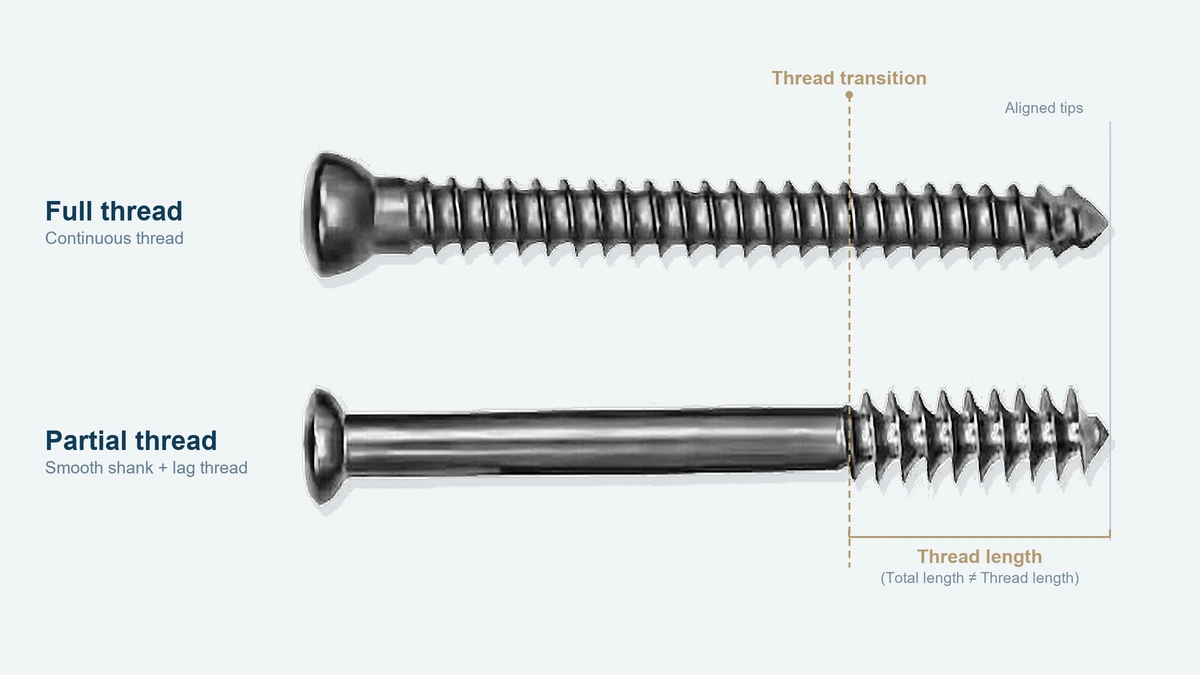
The choice between a fully threaded and a partially threaded cancellous screw is usually described as a choice about compression, and that is accurate as far as it goes. On a partially threaded screw, the unthreaded shank is narrower than the thread's outer diameter, so the screw slides through the near fragment until the thread reaches the far fragment. From that point the thread engages and further turning pulls the far fragment toward the near one. The result is a lag effect produced by the screw's own geometry rather than by a separate lag screw technique. Compression continues until the fragments meet, and the smooth shank then acts as a gliding column.
A fully threaded screw behaves differently. Because thread runs the entire length, the screw engages both fragments along its whole shaft. It does not slide, so it does not generate the same compression, but it resists pull-out over a longer distance and holds the gap it was inserted into. In thin or osteoporotic bone, and in applications where the screw has to maintain a fixed distance rather than close one, that behaviour is often what the specification is actually asking for.
Table 1 sets the two side by side in the terms a buyer needs.
Thread type
Thread position
Compression behaviour
Common application
Sourcing focus
Partial thread
Distal portion only; smooth shank proximally
Lag effect; fragments drawn together
Compressing a two-fragment gap
Thread length and shank diameter must be specified
Full thread
Entire shaft
No sliding compression; maintains set distance
Fixation where length must hold
Confirming full-length engagement suits the site
Swipe the table sideways to see every column.
A fully threaded and a partially threaded cancellous screw of the same nominal diameter. The thread transition point is what changes the compression behaviour.
The practical consequence is that thread configuration is not a cosmetic option. Partial thread is a compression decision. Full thread is a fixation decision. A quote that lists only "4.0 mm cancellous screw, 30 mm" without saying which of the two is being supplied has not described the product.
4.0 mm or 6.5 mm: which bone, which screw
Diameter in this family splits along the size of the bone fragment being held, and the two common sizes are far enough apart that they belong to different instrument sets rather than to the same tray.
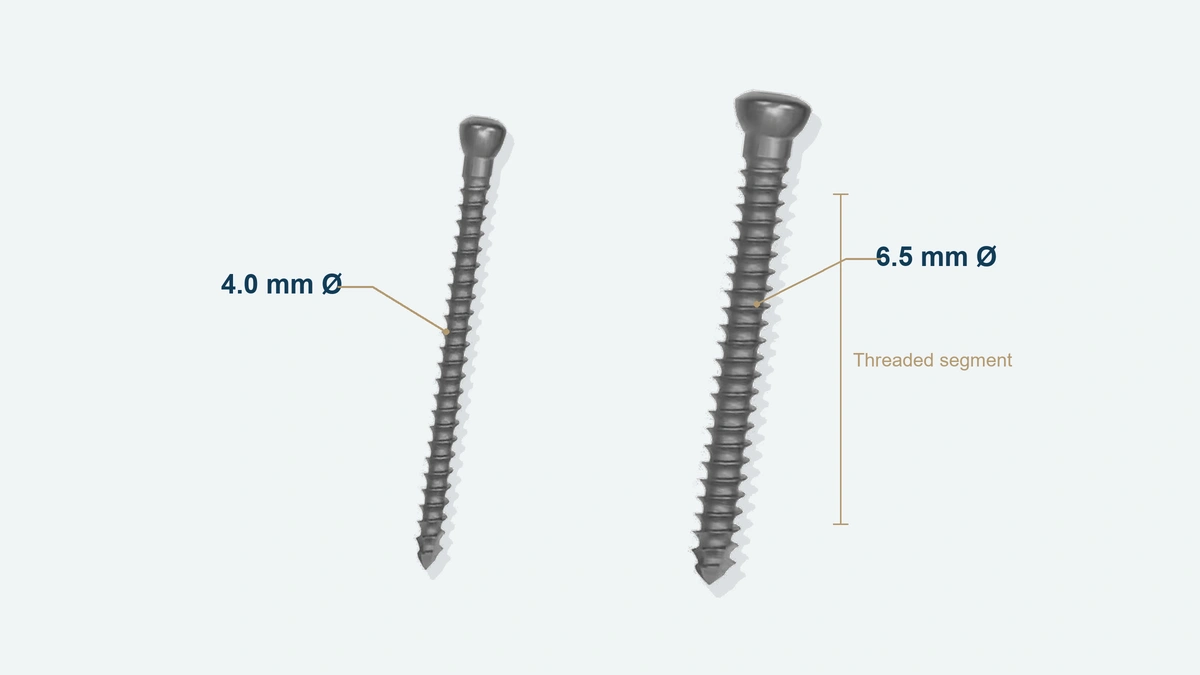
The 4.0 mm cancellous screw is the smaller of the two and is generally associated with small bone fragments and with the metaphyseal ends of smaller bones, where a 6.5 mm thread would consume too much of the available bone stock. Typical catalog lengths run from roughly 10 mm to 50 mm, with both fully threaded and partially threaded options available, and with headless variants in some ranges. Because the screw is small, the instrumentation is correspondingly fine: a matched drill bit, a matched tap, and a driver small enough not to strip the head.
The 6.5 mm cancellous screw is the larger option and is used where a longer screw has to cross a substantial cancellous volume, typically in the proximal and distal ends of the larger long bones. Lengths in common supply run from about 25 mm to 120 mm. Partial threading is frequent in this size because the long smooth shank is what allows the lag effect to work across a wide fragment; fully threaded 6.5 mm screws also exist and are specified when the screw is expected to hold a distance rather than close one.
Table 2 summarises the two sizes in the fields that matter for ordering.
Diameter
Common length range
Matching drill and tap
Typical bone region
4.0 mm
approx. 10–50 mm
System-matched drill bit and tap
Small fragments; smaller metaphyses
6.5 mm
approx. 25–120 mm
System-matched, larger drill and tap
Large cancellous volumes; long-bone ends
Swipe the table sideways to see every column.
Two points follow from the table. First, the drill and tap are not generic consumables: they belong to the screw system, and the correct pairing is the one printed on the manufacturer's instrument chart for that specific screw. Second, the size ranges overlap only at the margins, so a buyer who is asked for "cancellous screws" without a diameter is being asked an incomplete question. If the requirement is for the long, fully threaded version used in the larger size, the specification should be written against a cancellous screw range rather than against the family as a whole.
How is length measured, and why do quotes disagree
Length is the field where two suppliers most often quote the same number and mean different things. There is no single global convention, and the differences are large enough to matter at the millimetre level.
The first variable is the measuring datum. Some manufacturers measure from the underside of the head to the tip, which is the length that actually sits in bone. Others measure overall length including the head, which produces a longer figure for the same screw. Headless screws remove the ambiguity at one end but introduce another, because the drive recess or the trailing thread may or may not be counted. The second variable is whether the published figure refers to total length or to thread length; on a partially threaded screw these are two different numbers, and a catalog that lists only one of them is ambiguous by omission.
The ambiguity compounds when screws are supplied for a specific system. A 6.5 mm screw described as "45 mm" by one supplier can be dimensionally different from a "45 mm" screw in another supplier's catalog, even when both are measured head-to-tip, because the transition point between thread and shank may sit at a different position along the shaft.
The only reliable resolution is documentary. Ask for the dimension drawing, identify the datum, and confirm whether the quoted length is total or threaded. Where a screw is being matched to an existing tray or to a fixed-depth application, put the datum in the purchase specification so that a later delivery cannot be measured a different way. Two manufacturers can quote the same length and mean different things, and the drawing is what settles it.
Drill, tap and driver matching
The instrument set is where a specification that looks correct on paper fails in use. Three interfaces have to agree: the drill to the screw, the tap to the thread, and the driver to the head.
Drill sizing follows the screw's core rather than its outer diameter, which is why a drill that matches the nominal diameter of one system may be wrong for another system of the same nominal size. What matters is not the number stamped on the drill in isolation but whether that drill appears on the same instrument chart as the screw. A drill that fits the diameter may not match the pitch — and a mismatched pair either strips the purchase in soft bone or makes insertion impossible without excessive force.
Tapping raises a second decision. Non-self-tapping cancellous screws require a tap that cuts a thread form matching the screw's own thread, not merely a tap of similar diameter. Self-tapping versions cut their own path and may be specified without a separate tap, which changes both the instrument count and the insertion sequence. Neither approach is universally preferable; the point for procurement is that the choice must be made explicitly and reflected in what is shipped. If the tap is not in the quote, the screw is not in the case.
The driver interface is the third interface and the one most often left out of a written specification. Hex recesses and cruciform recesses are not interchangeable, and within hex there are different sizes. A tray of screws delivered without matching screwdrivers, or with drivers that fit a different recess, is a tray that cannot be opened in the operating room. Instrument ownership — whether the driver, drill, tap and guide come with the screws or are supplied separately — belongs in the same conversation as the screws themselves.
Cancellous vs cortical screw
The two families are often discussed as alternatives, but in practice they are used alongside each other in the same procedure, which is exactly where mismatches occur.
A cancellous screw is specified for the trabecular bone at the end of a bone, where a coarse thread with deep flanks can gather enough purchase over a short engaged length. A cortical screw is specified for the dense wall of the diaphysis, where a fine pitch allows many threads to engage a thin cortical layer without the screw standing proud or splitting the wall. When a construct crosses from metaphysis into shaft, both types may appear on the same drawing, each in the region it suits.
The risk in mixing is not conceptual but physical. A cortical screw driven into a cancellous drill hole has too little thread engagement and will not hold; a cancellous screw driven into a cortical hole may require a thread to be cut that the bone will not accept, and the coarse thread can crack a thin wall. Because the drill, tap and thread form are all system-specific, a mixed tray is only safe when the matching instruments for both families are present and identifiable.
For sourcing, this means the specification should name the family for each line item rather than relying on diameter alone. "4.0 mm screw" is ambiguous; "4.0 mm cancellous screw, partial thread" is not. Where a buyer is consolidating several product lines into one order, keeping the families visually distinct — different packaging, different labelling, different tray sections — is a reasonable control.
When does the cannulated version matter
A cannulated screw has a longitudinal channel through its core so that it can be passed over a guide wire. The channel changes the instrumentation around the screw more than it changes the screw's external geometry: a cannulated drill, a cannulated tap and a cannulated screwdriver are needed to keep the wire in place through the whole sequence.
The version matters when the trajectory itself is the problem. If the entry point and the target cannot both be seen directly, or if the screw has to follow a path that is easier to establish with a wire than with a freehand drill, a cannulated screw allows the position to be set before the screw is committed. In those cases the wire is the reference and the screw follows it.
The solid version remains the simpler product: fewer components, fewer steps, and no wire to manage. That simplicity is a legitimate reason to specify solid screws where the trajectory is straightforward. The procurement consequence is that cannulated and solid versions of the same nominal size are different line items, with different instruments and often different packaging, and should not be substituted for one another without agreement.
Materials and standards
Two material families account for most of the market, and each is normally specified by reference to an ASTM standard rather than by trade name.
Titanium alloy, usually Ti-6Al-4V ELI, is specified under ASTM F136. The "ELI" designation refers to extra-low interstitial content, and the standard covers the wrought alloy in the condition used for surgical implants. Stainless steel for implants is commonly 316L-type material specified under ASTM F138, which covers wrought 18 chromium-14 nickel-2.5 molybdenum stainless steel. Both standards describe the starting material, its chemistry and its mechanical requirements; they do not describe the finished screw.
That gap is where a common misunderstanding sits. A material certificate confirms that the metal used for a production lot conforms to a standard. It is not a product registration, and it does not demonstrate that the finished device has been cleared or approved for sale in a given market. A material certificate is not a product registration. Buyers who need both should ask for both, and should expect them to be separate documents that reference different things: one traces the melt and the lot, the other authorises the device.
Surface condition, passivation for stainless steel, and cleaning before packaging are also part of the specification, and they are usually documented on the drawing or the inspection record rather than on the material certificate.
What a screw quote must specify
A quote for cancellous screws is only usable if it can be turned into a purchase order without a second round of questions. In practice, the same few fields are the ones that go missing.
Every size needs its own minimum order quantity, stated per diameter and per length rather than as one figure for the whole family, because a long 6.5 mm screw and a short 4.0 mm screw are different production items. The thread type must be named on each line — full or partial — and, for partial thread, the thread length should be given. The length basis must be stated, with the datum identified. Packaging must be stated as sterile or non-sterile, since the two are different products with different shelf life and different handling. Lot traceability must be confirmed, including whether the lot number appears on the individual package or only on the carton. And replenishment terms should be agreed in advance, because a screw that cannot be reordered within the project timeline is a supply risk regardless of its specification.
Where the screws are being bought alongside other fixation products, it is worth checking that the quote separates them clearly. An interference screw order, for example, carries its own sizing logic and its own instrument requirements, and mixing the two families on a single ambiguous line item is a reliable way to receive the wrong product.
What six things should you check before the first order
Before the first order is placed, six checks will catch most of the failures that only become visible after delivery. None of them requires clinical judgement, and all of them can be completed before money changes hands.
Drawing. Obtain the dimension drawing for the exact item and confirm the length datum, the thread length and the head geometry against your requirement.
Material certificate. Confirm the standard cited — ASTM F136 for Ti-6Al-4V ELI, ASTM F138 for stainless steel — and check that the certificate refers to the production lot being shipped.
Drill and tap match. Confirm that the drill bit and tap quoted belong to the same system as the screw, and that their part numbers appear on the manufacturer's chart for that screw.
Instrument ownership. Establish whether drills, taps, drivers and guide wires are included, loaned or purchased separately, and who is responsible for replacement.
Lot traceability. Verify that lot marking is present at the level you need — unit package, inner box or carton — and that it links back to the inspection record.
Replenishment. Agree the reorder route and the expected lead time for the specific sizes in the order, not for the family as a whole.
One rule covers all six checks. Ask for the answer in writing, against a named part number. A supplier who can answer all six on paper is a supplier whose next delivery is likely to match the first — and where an answer is missing, the gap is visible before the order is placed rather than after the tray is opened.
Frequently asked questions
What is the difference between a cancellous and a cortical screw?
A cancellous screw has a coarse thread pitch, deep thread flanks and a narrower core, which suits soft trabecular bone. A cortical screw has a finer pitch, shallower threads and a thicker core, which suits the dense diaphyseal wall. The two are not interchangeable, because the drill and tap that match one will not match the other.
When should a partial thread be used instead of a full thread?
Partial thread is used when the screw is expected to compress two fragments: the smooth shank slides through the near fragment and the thread pulls the far one into contact. Full thread is used when the screw must hold a fixed distance rather than close a gap. The choice is a compression decision, not a cosmetic one.
How is cancellous screw length measured?
Conventions differ. Some manufacturers measure from the underside of the head to the tip; others measure overall length including the head; headless designs may or may not include the drive recess. Partially threaded screws also have a separate thread length. Always confirm the datum on the dimension drawing before ordering.
Do cancellous screws need tapping?
It depends on the design. Non-self-tapping screws require a tap that cuts a matching thread form, and the tap must belong to the same screw system. Self-tapping screws cut their own path and may not need a separate tap. The requirement should be stated explicitly on the purchase specification.
What does a cancellous screw quote need to specify?
Per-size minimum order quantity, thread type and thread length, length basis with datum, sterile or non-sterile packaging, lot traceability level, and replenishment terms. A quote that lists only diameter and length has not described the product precisely enough to order against.
Are cancellous screws available in cannulated versions?
Yes. Cannulated versions have a longitudinal channel that allows the screw to be passed over a guide wire, and they require cannulated drills, taps and drivers. They are separate line items from the solid versions and should not be substituted without agreement, because the instrumentation differs.
Sources and next step
The dimensional and standards references in this guide follow the ASTM F136 and ASTM F138 material specifications and the instrument charts published for each screw system. No torque values, thread pitch dimensions or insertion techniques are given here, because those belong to the device's own instructions for use and to the treating surgeon's judgement rather than to a purchasing document.
Where a figure is described as approximate or typical, it reflects common catalog ranges rather than a commitment for a specific product. Exact values must come from the manufacturer's drawing and specification sheet for the item being ordered.
ASTM F136 — Standard specification for wrought titanium-6aluminium-4vanadium ELI (extra low interstitial) alloy for surgical implant applications.
ASTM F138 — Standard specification for wrought 18chromium-14nickel-2.5molybdenum stainless steel bar and wire for surgical implants.
Manufacturer instrument charts and dimension drawings for each screw system referenced in this guide.
Need a cancellous screw range checked against your specification?
Send the diameter, thread configuration and length basis for the sizes you need, and XC Medico will return the drawings, material certificates and instrument lists for those items before any commercial discussion begins.
This article describes published specification and sourcing conventions for procurement purposes. It is not medical advice, does not report clinical outcomes, and does not recommend any implant for any patient; implant selection and surgical technique remain the responsibility of the treating surgeon. Standards are cited by designation only, and the current edition of each standard governs. Product names and trademarks belong to their respective owners.
As a globally trusted Orthopedic Implants Manufacturer, XC Medico specializes in providing high quality medical solutions, including Trauma, Spine, Joint Reconstruction, and Sports Medicine implants. With over 19 years of expertise and ISO 13485 certification, we are dedicated to supplying precision engineered surgical instruments and implants to distributors, hospitals, and OEM/ODM partners worldwide.